
English
Back
Open Account
Apple hits another all-time high! What’s next for the stock?
Futubull Options Sir
joined discussion · Apr 21 17:48 ·

OptionSir Breaks Down Hot Topics | Apple's 'AI Relay Race' Officially Begins! After Cook Steps Down, How Will Hardware Guru Ternus Redefine the $4 Trillion Market Cap Benchmark?

On April 20, $Apple (AAPL.US)$ the official announcement of a major personnel change was made - Tim Cook will step down as CEO on September 1, 2026, and transition to the role of Executive Chairman of the Board. The legendary 15-year tenure at the helm of Apple is coming to an end. Meanwhile, John Ternus, Senior Vice President of Hardware Engineering with 25 years at Apple, will assume the role of CEO and join the board on the same day.
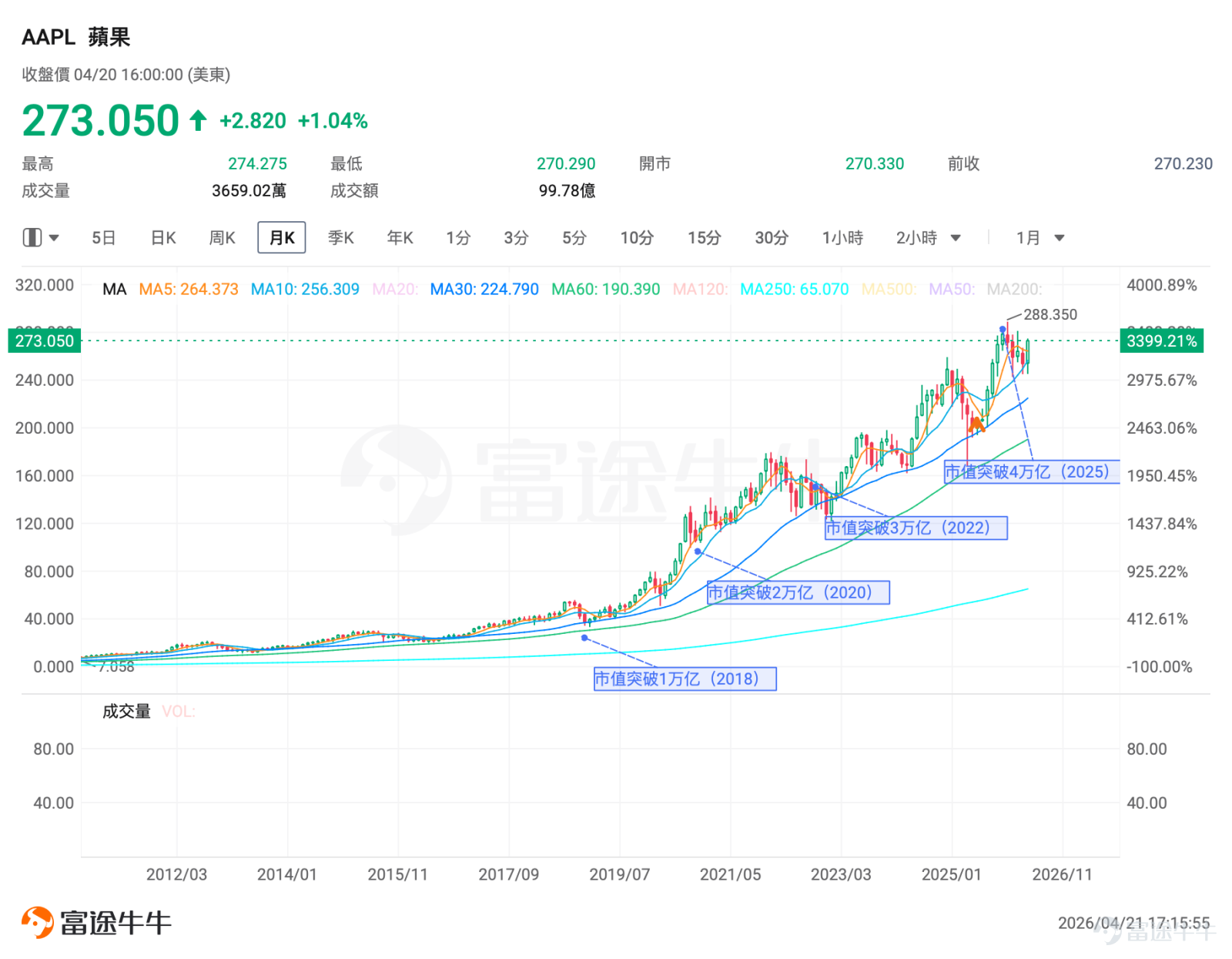
This news quickly drew market attention, with Apple's after-hours stock price falling by approximately 0.6%. The company's market cap had just surpassed the $4 trillion mark when the announcement was made.
During Cook's 15-year leadership (2011-2026), the company's market value soared from about $350 billion to over $4 trillion, growing more than elevenfold.The global expansion of the iPhone ecosystem, supply chain optimization, and privacy protection strategies all contributed to building Apple’s trillion-dollar empire during Cook's era.
On April 20, $Apple (AAPL.US)$ an official announcement of a major leadership change was made — Tim Cook will step down as CEO on September 1, 2026, and transition to the role of Executive Chairman of the Board. Cook’s legendary 15-year tenure at the helm of Apple is coming to an end. Meanwhile, John Ternus, Senior Vice President of Hardware Engineering with 25 years at Apple, will take over as CEO and join the board on the same day. This news quickly drew market attention, causing Apple's after-hours stock price to drop by approximately 0.6%. The announcement came just as the company’s market cap had surpassed the $4 trillion milestone.  Under Cook’s leadership over 15 years (2011-2026), Apple's market value soared from about $350 billion to over $4 trillion, increasing more than 11-fold.The global expansion of the iPhone ecosystem, supply chain optimization, and privacy protection strategies all helped build Apple’s trillion-dollar empire during Cook’s era. However, with the AI wave sweeping through the tech industry, Apple's relatively conservative positioning in generative AI has led to high expectations for this leadership transition. The key question for the market now is how Ternus will redefine Apple's value proposition in the AI relay race following his appointment. Hardware Engineer Ternus: A 25-Year Apple Veteran with a 'Technical Pedigree' John Ternus, aged 51, graduated in Mechanical Engineering from the University of Pennsylvania in 1995 and joined Apple’s product design team in 2001. By 2013...
However, as the AI wave sweeps through the tech industry, Apple's relatively conservative approach in generative AI has led to high expectations for the leadership transition. The core question now is how Ternus, upon taking office, will redefine Apple’s value proposition in the AI race.
John Ternus, Hardware Engineer: A 25-Year Veteran with 'Technical Pedigree'
John Ternus, aged 51, graduated in Mechanical Engineering from the University of Pennsylvania in 1995. He joined Apple’s product design team in 2001, became Vice President of Hardware Engineering in 2013, took over iPhone hardware in 2020, and was promoted to Senior Vice President in 2021, overseeing all hardware engineering for the iPhone, iPad, Mac, Apple Watch, AirPods, and even Vision Pro, directly reporting to Cook.
Unlike Cook’s expertise in operations and supply chain, Ternus is a pure “product person.”He spearheaded structural innovations, thermal optimizations, and material breakthroughs across multiple generations of the iPhone, earning recognition within the industry as the unsung hero behind Apple's hardware success.
Apple's board of directors' decision to promote from within, choosing Tennus instead of an external hire, sends two clear signals:
First isA return to technological roots. Apple was once renowned for its product-driven approach during the Jobs era, while the Cook era leaned more towards efficiency and services. Tennus’s hardware background suggests thatthe company will once again place 'ultimate product power' at the core of its strategy.
Second,Steady progress amidst stability. Tennus is known internally at Apple as 'the most low-profile executive,' with a 25-year career devoid of scandals, earning deep trust from Cook. This arrangement ensures management continuity in the 'post-Cook era.'
Tennus's three major challenges: AI lag, complex supply chains, and power friction
Despite a smooth succession, Tennus still faces three thorny tests upon assuming office.
First, there's the lag in AI strategy.This is Tennus's biggest weakness; while Google and Microsoft are making rapid advancements in large models, Apple’s Siri continues to be criticized as 'artificial unintelligence.' Although Apple’s collaboration with Google Gemini is currently in internal testing, with plans to launch a 'smarter' Siri in iOS 27,The market is concerned that Apple relies too heavily on generative AI infrastructure and cutting-edge models, making it difficult to build a differentiated competitive advantage.
Ternus must decide: should he accelerate the development of in-house large models or deepen cooperation with $Alphabet-A (GOOGL.US)$?If Apple underinvests in AI, its premium pricing power for high-end devices could be undermined.
The second challenge is supply chain complexity.Cook's highly efficient supply chain is faltering in the face of geopolitical tensions. As US-China rivalry intensifies, Apple is being forced into a 'stress test': relocating part of its Mac mini production lines back to Texas while grappling with fluctuating yields at its India plant and skyrocketing costs of AI storage chips.
Ternus, a CEO with a hardware background, must not only excel in design but also rebuild a 'de-risked' supply chain amid tariff uncertainties.
Finally, there are concerns about how to handle Trump's tariff policies and potential power frictions.
Although the Supreme Court partially overturned earlier tariffs in its February 2026 ruling, uncertainty over trade policies from the Trump administration remains.
The market is watching to see whether Ternus, a technocrat, possesses the same political acumen as Cook to lobby Washington effectively.According to Apple's announcement, Cook will continue in the role of executive chairman to "assist with specific company matters, including communication with global policymakers."Cook is responsible for external affairs such as White House visits and government-business relations, while Tenus focuses on products and operations, complementing each other's backgrounds.
However, historical cases where former CEOs remained as executive chairmen have not always ended optimistically. $Microsoft (MSFT.US)$ In the first year after Bill Gates transitioned to chief software architect, former CEO Steve Ballmer frequently faced interference and obstruction from him. The market will be watching for potential power friction risks.
Options strategy during the market repricing cycle
The short-term decline in Apple's stock price following the announcement falls under an "emotional impact," as leadership changes always bring uncertainty expectations.Given Apple's market cap of $4 trillion and the orderly arrangement of the leadership transition, the short-term impact on Apple's operational stability is limited. However, the market will closely track the new leadership’s strategic direction in AI and hardware ecosystems.
For Apple’s long-term market cap potential, the market will focus on evaluating three key points:
Whether Apple launches significant AI features in 2026, and whether the new version of Siri can deliver disruptive experiences such as "cross-application interaction and real-time search refinement."
Whether the collaboration with Google deepens, and whether "model distillation" can enhance on-device AI capabilities, enabling devices like the iPhone and Mac to possess stronger local AI functions.
Will the supply chain further localize or diversify? Will there be increased investment in AI chips, and can the next-generation M5 chip further enhance on-device AI computing power to create a differentiated advantage of 'hardware + AI'?
In response to leadership change volatility, investors with different risk appetites may consider the following options strategies:
1. Protective Put
For investors holding Apple shares but concerned about potential short-term stock price declines due to succession news, they may consider purchasing near-term in-the-money PUT options for AAPL. This strategy hedges against short-term uncertainty while retaining upside potential, making it suitable for conservative clients.
On April 20, $Apple (AAPL.US)$ an official announcement of a major leadership change was made — Tim Cook will step down as CEO on September 1, 2026, and transition to the role of Executive Chairman of the Board. Cook’s legendary 15-year tenure at the helm of Apple is coming to an end. Meanwhile, John Ternus, Senior Vice President of Hardware Engineering with 25 years at Apple, will take over as CEO and join the board on the same day. This news quickly drew market attention, causing Apple's after-hours stock price to drop by approximately 0.6%. The announcement came just as the company’s market cap had surpassed the $4 trillion milestone.  Under Cook’s leadership over 15 years (2011-2026), Apple's market value soared from about $350 billion to over $4 trillion, increasing more than 11-fold.The global expansion of the iPhone ecosystem, supply chain optimization, and privacy protection strategies all helped build Apple’s trillion-dollar empire during Cook’s era. However, with the AI wave sweeping through the tech industry, Apple's relatively conservative positioning in generative AI has led to high expectations for this leadership transition. The key question for the market now is how Ternus will redefine Apple's value proposition in the AI relay race following his appointment. Hardware Engineer Ternus: A 25-Year Apple Veteran with a 'Technical Pedigree' John Ternus, aged 51, graduated in Mechanical Engineering from the University of Pennsylvania in 1995 and joined Apple’s product design team in 2001. By 2013...
(The design images displayed on screen are for illustrative purposes only and do not constitute any investment advice or guarantees; market conditions fluctuate frequently, and the option prices shown do not represent real-world values.)
2. ATM Straddle
Investors who believe that the leadership change might increase Apple's short-term volatility could consider buying at-the-money Straddles for AAPL by simultaneously purchasing Calls and Puts. Leadership transition news tends to amplify volatility, capturing intra-day or weekly volatility expansion opportunities.However, quick entry and exit along with position sizing are required due to high time decay risks.
On April 20, $Apple (AAPL.US)$ an official announcement of a major leadership change was made — Tim Cook will step down as CEO on September 1, 2026, and transition to the role of Executive Chairman of the Board. Cook’s legendary 15-year tenure at the helm of Apple is coming to an end. Meanwhile, John Ternus, Senior Vice President of Hardware Engineering with 25 years at Apple, will take over as CEO and join the board on the same day. This news quickly drew market attention, causing Apple's after-hours stock price to drop by approximately 0.6%. The announcement came just as the company’s market cap had surpassed the $4 trillion milestone.  Under Cook’s leadership over 15 years (2011-2026), Apple's market value soared from about $350 billion to over $4 trillion, increasing more than 11-fold.The global expansion of the iPhone ecosystem, supply chain optimization, and privacy protection strategies all helped build Apple’s trillion-dollar empire during Cook’s era. However, with the AI wave sweeping through the tech industry, Apple's relatively conservative positioning in generative AI has led to high expectations for this leadership transition. The key question for the market now is how Ternus will redefine Apple's value proposition in the AI relay race following his appointment. Hardware Engineer Ternus: A 25-Year Apple Veteran with a 'Technical Pedigree' John Ternus, aged 51, graduated in Mechanical Engineering from the University of Pennsylvania in 1995 and joined Apple’s product design team in 2001. By 2013...
(The design images displayed on screen are for illustrative purposes only and do not constitute any investment advice or guarantees; market conditions fluctuate frequently, and the option prices shown do not represent real-world values.)
3. Bull Put Spread
With Apple’s market cap at 4 trillion, downside potential is limited. Investors who believe Apple’s short-term downside risk is constrained can construct a Bull Put Spread.Sell a higher strike price Put (betting that Apple's stock price will not fall below this strike price by expiration), while simultaneously buying a lower strike price Put (hedging against the risk of a significant drop, capping potential losses within a fixed range), and collect net premium.
Summary
Cook left behind a massive ship with a clear course, while Tenus must steady the helm amidst the AI storm. His hardware expertise makes him naturally adept at product development, but the AI era places greater demands on strategic vision and ecosystem integration capabilities.
Fellow investors, do you believe Apple's next value anchor lies in hardware excellence or AI intelligence? In this 'AI relay race,' can Tenus accelerate to carve out his own trajectory?
Finally, here's a small perk for fellow investors. Welcome, fellow investors, to claim your benefit.Options Beginner Pack
*This event is exclusive to invited HK users. Click to learn more.Detailed event rules>>
Market conditions are complex and volatile,Options strategyOverwhelmed by choices? Futubull helps you build a portfolio in three steps.Options strategymaking investing simple and efficient from now on!
On April 20, $Apple (AAPL.US)$ an official announcement of a major leadership change was made — Tim Cook will step down as CEO on September 1, 2026, and transition to the role of Executive Chairman of the Board. Cook’s legendary 15-year tenure at the helm of Apple is coming to an end. Meanwhile, John Ternus, Senior Vice President of Hardware Engineering with 25 years at Apple, will take over as CEO and join the board on the same day. This news quickly drew market attention, causing Apple's after-hours stock price to drop by approximately 0.6%. The announcement came just as the company’s market cap had surpassed the $4 trillion milestone.  Under Cook’s leadership over 15 years (2011-2026), Apple's market value soared from about $350 billion to over $4 trillion, increasing more than 11-fold.The global expansion of the iPhone ecosystem, supply chain optimization, and privacy protection strategies all helped build Apple’s trillion-dollar empire during Cook’s era. However, with the AI wave sweeping through the tech industry, Apple's relatively conservative positioning in generative AI has led to high expectations for this leadership transition. The key question for the market now is how Ternus will redefine Apple's value proposition in the AI relay race following his appointment. Hardware Engineer Ternus: A 25-Year Apple Veteran with a 'Technical Pedigree' John Ternus, aged 51, graduated in Mechanical Engineering from the University of Pennsylvania in 1995 and joined Apple’s product design team in 2001. By 2013...
Options Risk Warning
An option is a contract that grants the holder the right, but not the obligation, to buy or sell an asset at a fixed price on a specific date or at any time before that date. The price of an option is influenced by various factors, including the current price of the underlying asset, the strike price, time to expiration, and implied volatility. Implied volatility reflects the market’s expectations for the level of volatility in the option over a future period. It is a data point derived inversely from the Black-Scholes option pricing model and is generally regarded as an indicator of market sentiment. When investors anticipate greater volatility, they may be more willing to pay a higher price for options to hedge risks, resulting in higher implied volatility. Traders and investors use implied volatility to assess the attractiveness of option prices, identify potential mispricings, and manage risk exposure.
Disclaimer
This content does not constitute any offer, solicitation, recommendation, opinion, or guarantee of any securities, financial products, or tools. The risk of loss in trading options can be substantial. In some cases, losses may exceed the initial margin deposited. Even if you set contingent orders such as 'stop-loss' or 'limit' orders, these may not prevent losses. Market conditions may make such orders unexecutable. You may be required to deposit additional margin within a short period. If you fail to provide the required amount within the specified time, your open positions may be liquidated. However, you will still be responsible for any shortfall in your account. Therefore, before trading, you should study and understand options and carefully consider whether such trading is suitable for you based on your financial situation and investment objectives. If you trade options, you should be familiar with the procedures for exercising options and the rights and obligations upon exercise and expiration. Options trading carries extremely high risks and is not suitable for all investors. Investors should carefully readCharacteristics and Risks of Standardized Options
Editor/Doris
Risk Disclaimer: The above content only represents the author's view. It does not represent any position or investment advice of Futu. Futu makes no representation or warranty.Read more
Thumbs Up
13
Respect
1
Lol
1
329K Views
Report
Comments
Write a Comment...
15
19