
Fiber optic shortage triggers upstream supply crisis! Will fiber optic stocks keep soaring?

Not only "believe in the light," but also "understand the light"! Goldman Sachs breaks down the optical communications industry chain, and this comprehensive map is worth collecting.
"Stand in the light, don’t just stand there!” and “Believe in the light!”—these viral investment memes vividly capture the explosive rise of the optical communications sector.
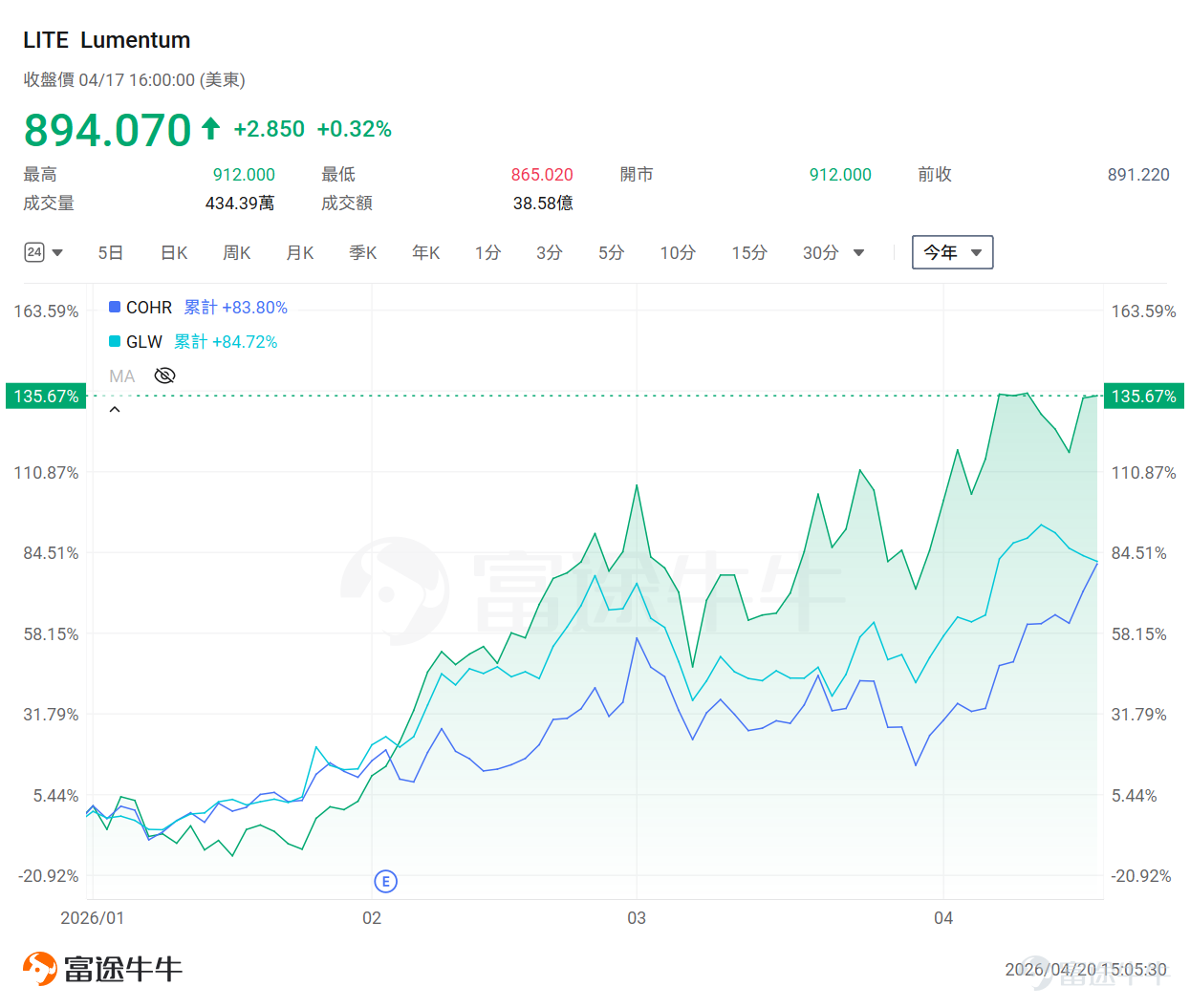
Since the beginning of this year, against the backdrop of an overall volatile market, the optical communication sector has bucked the trend and emerged as the leading core theme of the year. Capital inflows have concentrated explosively in niche areas, with OCS (optical circuit switches), CPO (co-packaged optics), and fiber optic concept stocks taking turns to surge. Several leading stocks have repeatedly hit all-time highs, showcasing a strong independent performance.

Meanwhile, AI giant $NVIDIA (NVDA.US)$ has further pushed this rally to its peak with a series of significant strategic moves this year. In just one month, NVIDIA has poured $6 billion into the optical interconnect space: On March 2, it invested $4 billion, allocating $2 billion each to $Lumentum (LITE.US)$ and $Coherent (COHR.US)$ , two major optical giants. Then, on March 31, another $2 billion was directed to $Marvell Technology (MRVL.US)$ 。This wave of heavy investment sends a very clear strategic signal: The second half of AI computing infrastructure's massive buildout is shifting its core battleground from 'GPU computing' to 'network connectivity and optical interconnects'.
Faced with this market surge, we can't help but ask: Is this merely a short-term speculative hype, or an unstoppable industry megatrend driven by the explosive growth of AI computing power? At which phase of the economic cycle is the sector currently? Is the valuation too high for new entries? Which niche track holds the most potential?
Goldman Sachs highlighted in its latest research report 'Optical Networking: The next mega trend in AI infrastructure'that optical communication networks are indeed the next big trend in AI infrastructure. This article will carefully dissect and unpack the underlying investment codes for fellow investors!
I. TAM grows from $15 billion to $154 billion; Scale-Up is the true driving force.
In its latest report, Goldman Sachs systematically outlined investment opportunities across the entire chain of the optical interconnect sector, from optical communication modules, co-packaged optics (CPO), silicon photonics (SiPh), to optical circuit switching (OCS). The report conveys a strong and clear signal:Optical communication networks are no longer merely 'supporting infrastructure' for computational expansion; instead, they are evolving into an independent super-investment theme with tremendous quantitative potential.
In the past, market consensus on the demand for optical modules was largely limited to Scale-out (horizontal expansion), which refers to external data center interconnections across racks and server rooms. However, Goldman Sachs has significantly raised the total addressable market (TAM) forecast in this report toUS$154 billion, an astonishing scale. The true core driver is actually Scale-up (vertical expansion) — high-speed optical interconnection within racks and super nodes.
The report provides specific specification comparisons: from the currently mass-produced GB300 NVL72 to the Rubin Ultra NVL576 expected to ship between 2027 and 2028, the dollar value of network interconnection per computing unit will skyrocket from US$315,000 to US$9.4 billion, marking a 29-fold increase. Behind this leap is NVIDIA’s GPU cluster size expanding from 72 to 576 chips, with interconnect levels spreading from within a rack to across racks, pushing the boundary of fiber replacing copper cables to even shorter distances.
Take the Rubin Ultra NVL576 as an example: this is a super node consisting of eight racks and 576 GPUs, requiring a second layer of high-speed optical connections between racks, all adopting CPO solutions. A single computing unit requires 324 optical engines, 162 external laser sources, 5,184 optical fibers, and MPO connectors, with material costs for the Scale-up portion alone reaching approximately US$800 million.Of the total TAM of US$154 billion, about 69% (approximately US$106 billion) belongs to Scale-up, with CPO contributing about US$91 billion under the assumption of a 29% penetration rate, accounting for roughly 59% of the total.
II. Four Drivers of Technological Evolution
To meet AI's extreme demands for bandwidth, power consumption, and miniaturization, optical communication technology is undergoing the following major evolutions:
1. Transmission speeds continue to upgrade
Data center connectivity speeds are advancing from 800G to higher specifications. By 2026, the mainstream is expected to transition to 1.6T, with further progress towards 3.2T and beyond in the following years.
2. Silicon photonics replacing traditional EML
In the optical module field, the penetration rate of silicon photonics technology is expected to surge from 6% in Q1 2024 to 46% by Q4 2028. Compared to traditional discrete optical transceivers, silicon photonics offers higher integration, smaller size, lower power consumption, and reduced costs. The cost advantage is particularly attractive. For example, in a 1.6T module, silicon photonics has a 32% Bill of Materials (BoM) advantage and a 20% price advantage over EML.

3. Co-Packaged Optics (CPO) technology to launch in 2026
CPO places optical engines as close as possible to the chip, reducing electrical paths from several centimeters to millimeter levels, significantly lowering power consumption and latency. CPO is especially suited for short-distance and high-bandwidth needs that traditional pluggable optical modules cannot meet. NVIDIA and Broadcom are leading the development of this technology, with commercialization expected to begin in 2026.
4. Optical Circuit Switch (OCS): Toward an all-optical network
OCS provides a solution that eliminates the need for optical-electrical-optical conversion, using technologies such as Micro-Electro-Mechanical Systems (MEMS) to directly provide analog optical paths from input fiber to output fiber. With OCS, data centers can upgrade to higher data transmission rates without replacing switches; the same OCS can simultaneously support different optical signal rates (e.g., 800G/1.6T/3.2T), making it an ideal choice for rapidly evolving AI clusters.
Three, which companies in the supply chain are worth watching?
Goldman Sachs has compiled a list of the optical communication industry supply chain, as follows:

I. IC Design and Manufacturing: The "Brain" of Optical Communication
The performance of optical modules largely depends on the core chips inside. This stage is responsible for handling the conversion and computational logic of optoelectronic signals.
Diversification in chip design: The supply chain covers ASIC & xPU (such as $NVIDIA (NVDA.US)$ 、 $Broadcom (AVGO.US)$ 、 $Marvell Technology (MRVL.US)$ ), PIC (Photonic Integrated Circuits) responsible for optical signal processing, and EIC (Electronic Integrated Circuits) responsible for electrical signal amplification. Among these, the design of PICs is particularly crucial as it directly determines the miniaturization and transmission efficiency of optical modules.
Support from cutting-edge foundries: These highly complex chips rely on top-tier global foundries such as $Taiwan Semiconductor (TSM.US)$ 、 $Tower Semiconductor (TSEM.US)$ to bring them to life. Advancements in advanced processes are the absolute cornerstone for improving the performance of optical communication chips and reducing power consumption.
Relevant companies are listed below:
ASIC and xPU Design: $NVIDIA (NVDA.US)$ 、 $Marvell Technology (MRVL.US)$ 、 $Broadcom (AVGO.US)$ 、 $Intel (INTC.US)$ 、 $Advanced Micro Devices (AMD.US)$ 、 $Cisco (CSCO.US)$ , MediaTek;
Photonic Integrated Circuit Design: $NVIDIA (NVDA.US)$ 、 $Marvell Technology (MRVL.US)$ 、 $Broadcom (AVGO.US)$ 、 $Lumentum (LITE.US)$ 、 $Coherent (COHR.US)$ 、 $Zhongji Innolight (300308.SZ)$ 、 $Eoptolink Technology Inc., (300502.SZ)$ 、 $Accelink Technologies (002281.SZ)$ ;
Integrated electronic circuits: $NVIDIA (NVDA.US)$ 、 $Marvell Technology (MRVL.US)$ 、$Lumentum (LITE.US)$ 、 $Coherent (COHR.US)$ 、 $MACOM Technology Solutions (MTSI.US)$ 、 $Xiamen UX IC (688807.SH)$ ;
II. Basic Materials: The 'Cornerstone' Driving Optical Properties
Unlike traditional silicon-based semiconductors, the optical communication field heavily relies on compound semiconductor materials with special optoelectronic properties.
Key substrates and epitaxy: Indium phosphide (InP) and gallium arsenide (GaAs) are the core substrates for manufacturing laser emitters and receivers. High-quality epitaxial wafers supplied by upstream vendors (such as Sumitomo Electric, VPEC, and LianYa) directly determine the light-emitting efficiency and stability of the final laser components. Additionally, high-quality copper foil is indispensable for high-speed electrical transmission.
Relevant companies are as follows:
Indium phosphide substrate: $AXT Inc (AXTI.US)$ 、 $Yunnan Lincang Xinyuan Germanium Industry (002428.SZ)$ 、 $JX Advanced Metals (5016.JP)$ 、 $Sumitomo Electric Industries (5802.JP)$ ;
Indium phosphide epi-wafer: $Sumitomo Electric Industries (5802.JP)$ , IQE, IntelliEPI, LianYa Optoelectronics, VPEC;
Gallium arsenide substrate: $AXT Inc (AXTI.US)$ 、 $Yunnan Lincang Xinyuan Germanium Industry (002428.SZ)$ 、$Sumitomo Electric Industries (5802.JP)$ ;
3. Optical Components: A Large and Precise Core Cluster
This is the most complex and diverse segment in the entire ecosystem, covering every detail from light emission, light guidance to final modular integration.
Dual progress in laser and light source technology: The current market is mainly divided into traditional EML (Electro-Absorption Modulated Laser) and emerging SiPh (Silicon Photonics) technologies. Silicon photonics, with its high level of integration and cost advantages, is rapidly gaining ground, while EML maintains a significant position in specific long-distance and mature applications. $Lumentum (LITE.US)$ 、 $Coherent (COHR.US)$ Major companies such as [missing company names] play a leading role in this field.
Passive components and optical arrays: Optical signals require splitting, filtering, and attenuation during transmission, which relies on various couplers, splitters, and wavelength division multiplexers (WDM). Meanwhile, fiber array units (FAU) are responsible for precisely aligning the optical paths on chips with external fibers, requiring extremely high sub-micron-level manufacturing processes.
Fiber optics, connectors, and final assembly: Major manufacturers like Corning and Changfei provide transmission media (fiber optics) and connect devices through various precision connectors (e.g., MPO, VSFF). Finally, $Zhongji Innolight (300308.SZ)$ 、 $Eoptolink Technology Inc., (300502.SZ)$ module assembly plants encapsulate all active and passive components into pluggable or co-packaged optical modules, delivering them to end data center customers.
Relevant companies are listed below:
Lasers/Light Sources (Silicon Photonics): $Lumentum (LITE.US)$ 、 $Coherent (COHR.US)$ 、 $Broadcom (AVGO.US)$ 、 $Applied Optoelectronics (AAOI.US)$ 、 $Yuanjie Semiconductor Technology (688498.SH)$ 、 $Jiangsu Etern (600105.SH)$ 、 $Suzhou Everbright Photonics (688048.SH)$ 、 $Henan Shijia Photons Technology (688313.SH)$ 、 $Accelink Technologies (002281.SZ)$ 、 $Sumitomo Electric Industries (5802.JP)$ 、 $Furukawa Electric (5801.JP)$ 、 $Mitsubishi Electric (6503.JP)$ , Lianya Optoelectronics;
Laser/Source (EML): $Lumentum (LITE.US)$ 、 $Coherent (COHR.US)$ 、 $Broadcom (AVGO.US)$ 、 $Yuanjie Semiconductor Technology (688498.SH)$ 、 $Jiangsu Etern (600105.SH)$ 、 $Suzhou Everbright Photonics (688048.SH)$ 、 $Henan Shijia Photons Technology (688313.SH)$ 、 $Suzhou Dongshan Precision Manufacturing (002384.SZ)$、 $Accelink Technologies (002281.SZ)$ 、 $Sumitomo Electric Industries (5802.JP)$ 、 $Furukawa Electric (5801.JP)$ 、 $Mitsubishi Electric (6503.JP)$ ;
Fiber Array Unit: $Suzhou TFC Optical Communication (300394.SZ)$ 、 $Shenzhen Zesum Technology (301486.SZ)$ 、 $Advanced Fiber Resources (300620.SZ)$ 、 $EverProX Technologies (300548.SZ)$ 、 $Focuslight Technologies Inc. (688167.SH)$ 、 $Shenzhen JPT Opto-Electronics (688025.SH)$ 、 $Sumitomo Electric Industries (5802.JP)$ , Shangquan;
Coupler/Splitter: $Lumentum (LITE.US)$ 、 $Coherent (COHR.US)$ 、 $Advanced Fiber Resources (300620.SZ)$ 、 $EverProX Technologies (300548.SZ)$ , Shangquan;
Attenuator: $Lumentum (LITE.US)$ 、$EverProX Technologies (300548.SZ)$ 、$Accelink Technologies (002281.SZ)$ , Shangquan;
Wavelength Division Multiplexer: $Lumentum (LITE.US)$ 、 $Ciena (CIEN.US)$ 、 $Advanced Fiber Resources (300620.SZ)$ 、 $EverProX Technologies (300548.SZ)$ 、$Accelink Technologies (002281.SZ)$ 、 $Suzhou TFC Optical Communication (300394.SZ)$, upper interpretation;
Optical module assembly and integration: $Lumentum (LITE.US)$ 、 $Coherent (COHR.US)$ 、 $Cisco (CSCO.US)$ 、 $Marvell Technology (MRVL.US)$ 、 $Fabrinet (FN.US)$ 、 $Nokia Oyj (NOK.US)$ 、 $CIG (06166.HK)$ 、 $Zhongji Innolight (300308.SZ)$ 、 $Eoptolink Technology Inc., (300502.SZ)$ 、$Accelink Technologies (002281.SZ)$ 、 $Hgtech (000988.SZ)$ 、$Suzhou Dongshan Precision Manufacturing (002384.SZ)$、 $Suzhou TFC Optical Communication (300394.SZ)$ ;
Optical fiber: $Corning (GLW.US)$ 、 $YOFC (06869.HK)$ 、 $Hengtong Optic-Electric (600487.SH)$ 、 $Sumitomo Electric Industries (5802.JP)$ 、 $Furukawa Electric (5801.JP)$ 、 $Fujikura (5803.JP)$, Prysmian;
VSFF Connector: $Corning (GLW.US)$ 、 $Amphenol (APH.US)$ 、 $Sumitomo Electric Industries (5802.JP)$ 、 $Fujikura (5803.JP)$, Bo Ruowei
IV. Packaging and Testing: The 'Gatekeepers' Ensuring Yield
The alignment and packaging difficulty of optical components is much higher than that of traditional electronic components; any minor deviation can lead to significant attenuation of the optical signal.
Professional packaging and testing subcontracting services (such as ASE Group, Foxconn), along with packaging equipment providing ultra-high precision alignment and dispensing welding (such as ASMPT, Robatek), have emerged. Meanwhile, to ensure stable operation of modules in high-temperature and high-frequency environments, testing equipment (such as Teradyne, Keysight) acts as the final quality and yield checkpoint before leaving the factory.
Relevant companies:
Packaging and Testing Services: $ASE Technology (ASX.US)$ 、 $Fabrinet (FN.US)$ 、 $Amkor Technology (AMKR.US)$ 、 $Jabil (JBL.US)$ 、 $JCET Group Co., Ltd. (600584.SH)$ 、 $TongFu Microelectronics (002156.SZ)$ ASE Group, Foxconn, Halma PLC;
Packaging Equipment: $Kulicke & Soffa Industries (KLIC.US)$ 、 $ASMPT (00522.HK)$ 、 $Robotechnik Intelligent Technology (300757.SZ)$ 、 $GKG Precision Machine (301338.SZ)$ 、 $Shibuya (6340.JP)$ Robatek, Chroma ATE, KOMachine;
Testing Equipment: $Teradyne (TER.US)$ 、 $Keysight Technologies (KEYS.US)$ 、 $FormFactor (FORM.US)$ 、 $Advantest (ADR) (ATEYY.US)$ 、 $Robotechnik Intelligent Technology (300757.SZ)$ 、 $Tokyo Electron (8035.JP)$ MPI Corporation, Chroma ATE, HongJin, KOMachine.
Summary
Overall, driven by substantial investments from AI giants, the long-term logic of the optical interconnect sector remains solid. However, as valuations rise, market performance will become increasingly polarized. The key to success for fellow investors navigating through cyclical fluctuations and truly 'standing in the light' lies in selecting high-quality companies with core technological moats, ensuring critical component capacity, and successfully overcoming yield bottlenecks in advanced packaging.
Risk Disclaimer: The above content only represents the author's view. It does not represent any position or investment advice of Futu. Futu makes no representation or warranty.Read more


Comments (37)
to post a comment
595
2787