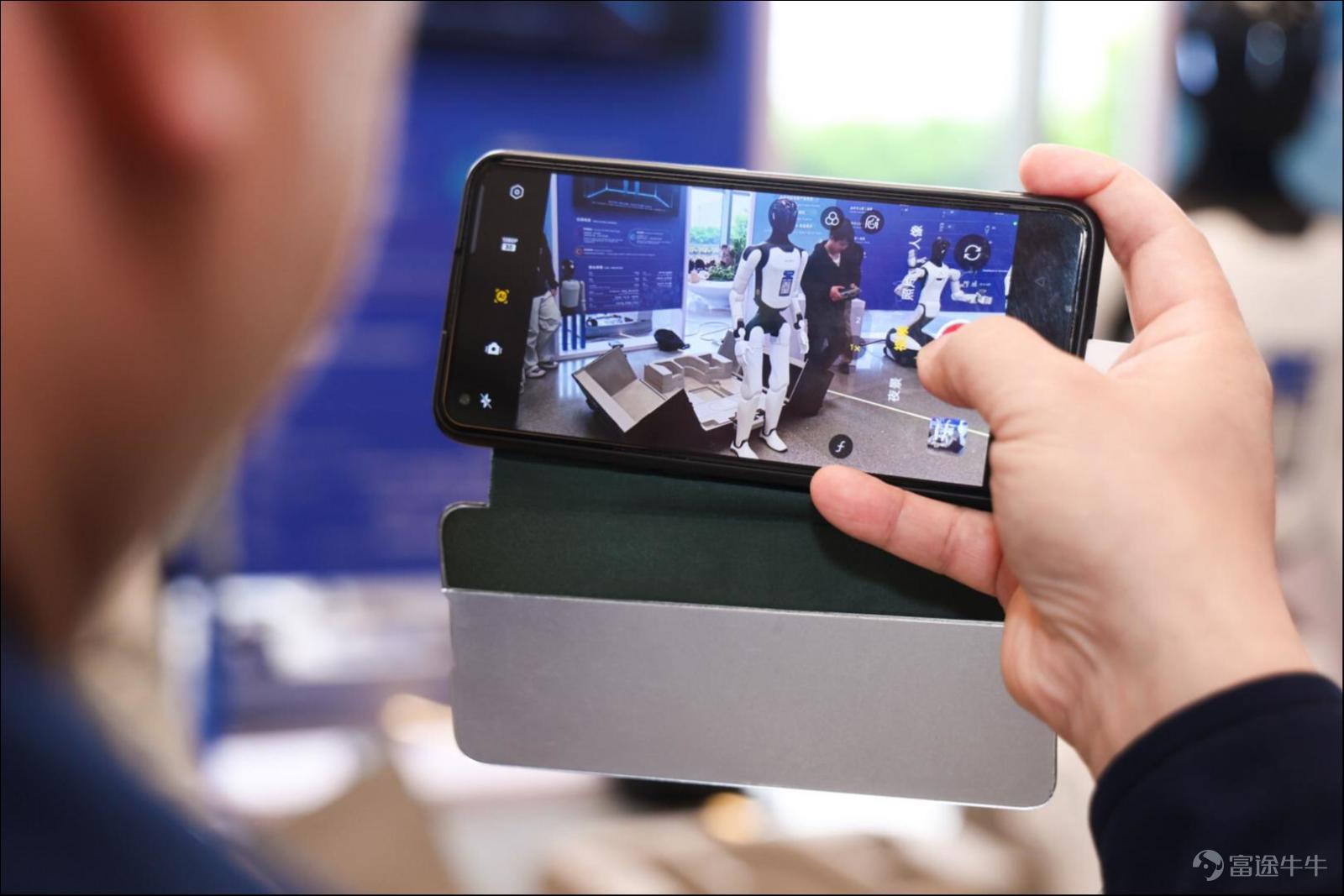

The 'deployment era inaugural year' of embodied intelligence has arrived, with internal assessments from Zhiyuan indicating that the progress bar for embodied 'GPT-3' has reached 30%.

On April 17, 2026, at the Zhangjiang Auditorium in Shanghai. More than 2,500 partners from over 30 countries and regions gathered here to witness an industry summit marking the beginning of a new era of productivity in embodied intelligence.
At the 2026 APCA (APC 2026), Deng Taihua, founder, chairman, and CEO of Zhiyuan, released the XYZ Curve and productivity framework for the embodied intelligence industry to the public for the first time. This systematically explained the evolution path of the embodied intelligence industry from the development stage to the deployment stage. Meanwhile, four new main products, six AI models, and seven productivity solutions were unveiled, and the full-stack ecological technology system, AIMA (AI Machine Architecture), was officially disclosed.

"The year 2026 is the first year of the deployment stage, marking that embodied intelligence is formally transitioning from 'able to move' to 'able to work.'" said Deng Taihua. WhenRoboticsit can work autonomously and independently create value, it becomes real productivity in the physical AI world.
"Only by achieving One Body with Three Intelligences can robots be like humans—having not only well-developed limbs but also a flexible mind; being eloquent as well as efficient workers." Deng Taihua highlighted the core product strategy of Zhiyuan at the beginning of his speech.

The so-called "One Body with Three Intelligences," the "One Body" refers to a stable, reliable, high-capacity, and low-cost physical entity, which serves as the physical carrier for embodied intelligence. The "Three Intelligences" include movement intelligence as the foundational intelligence, serving as the actuator function of the physical body; interaction intelligence as advanced intelligence, acting as the gateway for emotional value and providing service productivity; operational intelligence, another form of advanced intelligence, serves as the engine for labor value, delivering labor productivity.
In terms of technical stack planning, Zhiyuan adheres to hardware modularity and software componentization, focusing heavily on R&D for both small and large brain AI systems, utilizing three-quarters of the company's R&D workforce and more than three-quarters of its R&D budget. "We position ourselves as a foundational model company for embodied intelligence because AI needs a body, so we have developed corresponding physical entities defined by AI," emphasized Deng Taihua.
Four New Main Productswere unveiled, pointing to a clear direction: robots are no longer just props for showcasing technology but are truly becoming units of productivity entering production scenarios.
The flagship product, Expedition A3, has been launched this month and is defined as the most capable full-size humanoid robot in the industry this year. Through extreme lightweight design, the total weight has been reduced from over 70 kilograms common in the industry to 50 kilograms. Dual battery packs support hot-swapping, enabling continuous work for 8 to 10 hours without changing batteries. Lingxi X3 will hit the market by the end of this year, being the first new type of humanoid interactive service terminal combining intelligence, anthropomorphism, fun, safety, and ease of use. The Elf G2 series includes two models, G2 Air and G2 Max, targeting human-machine integrated data collection modes and industrial handling/palletizing scenarios respectively. The Coot D2 series of quadruped robots will also be released this year, covering various sizes for logistics handling, industrial inspection, security, and emergency response scenarios.

Six Major AI Modelshave significantly enhanced the three types of intelligence in the 'One Body, Three Intelligences' framework. In terms of motor intelligence, the company has released the sensorimotor fusion-based whole-body motion control foundational model BFM (trained using over 100 million frames and 700 hours of motion capture data, with parameters expanding from 1.2 million to 42 million) and the generative motion control foundational model GCFM (the first in the industry, supporting multimodal inputs such as text-to-motion and audio-matched body language). Regarding interactive intelligence, the company will release WITA Omni 1.0, the industry's first end-to-end embodied multimodal interaction large model, in the third quarter, reducing interaction latency to under 500ms. Operational intelligence is the area where Zhiyuan has made the largest investment and has the highest density of algorithmic talent; the company has already released the GO-2 model, GE-2 motion world model, open-source dataset AGIBOT WORLD 2026, and Genie Studio 2.0. In the third quarter, a new generation of embodied intelligence foundational model GO-3, integrating the WITA architecture and world model, will also be launched.
Behind this strategy lies Zhiyuan’s rapid development over the past three years. From a revenue of 300,000 yuan in 2023 to over 60 million yuan in 2024, and breaking through 1 billion yuan in revenue in 2025, Zhiyuan is not only the fastest robotics company in China to surpass 1 billion yuan in revenue but also the fastest AI company to do so. It is reported that the company’s revenue in the first quarter of this year continues to grow several times over.
Seven Productivity Solutionsrepresent the concentrated embodiment of the technical architecture — these are real products that have been normalized and deployed concurrently. These solutions can be grouped into three major directions: industrial manufacturing (including loading and unloading of 3C precision parts, industrial handling, palletizing and depalletizing, logistics sorting), commercial services (including store navigation and shopping assistance, chain catering guidance, retail service stations), and specialized operations (including security patrols, industrial and commercial cleaning).
Each solution has been validated in real production lines and scenarios at leading enterprises. At Longqi NamCheong production line, Zhiyuan robots have been deployed for more than a month. Last week during the live broadcast, they achieved 8 hours of continuous operation with zero errors, 100% success rate, meeting the requirements of the formal production line. InFulin Precision EngineeringSAIC factories, the palletizing and depalletizing scenarios have been operating routinely. Logistics sorting has been successfully implemented for half a year and overseas replication has started. Deployment cycles for security patrols have been shortened from months or weeks to days or hours. The cleaning solution shipped over 3,000 units last year, with a target of over 6,000 units this year, cumulatively achieving shipments of 10,000 units.

"After we co-create the 0-1 deployment state with our customers, we need to rely on ecosystem partners to promote the 1-N scenarios." Deng Taihua stated.
Yao Maoqing, Zhiyuan Partner, Senior Vice President, and President of the Embodied Business Division, also revealed more implementation details. According to his introduction, the Longqi project took only a little over three months from joint research and development to official deployment, faster than originally expected. The robot cycle time was initially nearly 100 seconds in the POC phase, but after algorithm optimization and software-hardware synergy, it has been reduced to 18-20 seconds, reaching or even surpassing human levels. It is reported that the workstation has completed 2,283 tasks.
"Entering a factory and filming videos to make demos is easy, but running without errors continuously for 24 hours a day, 7 days a week is extremely difficult," Yao Maoqing said. "Even harder is not becoming a bottleneck in a high-paced assembly line, which places very high demands on the maturity of the robot itself."
In terms of commercial ROI, Yao Maoqing confirmed that "the numbers add up." "Clients have officially paid for delivery, and the robots can be used for two to three years, while such workstations often require two shifts, meaning paying two people's salaries. This achieves cost reduction and efficiency improvement from an economic perspective. More importantly, the robots are very stable, with no resignations, sickness, or leave, significantly reducing management costs and personnel turnover training expenses."
Regarding the much-discussed generalization capability, Yao Maoqing revealed that moving from tablet production lines to mobile phone production lines, about 95% of development results can be directly reused, requiring only minor adjustments for specific precision operation steps. "Workflows in industrial scenarios can be broken down into atomic actions like movement, mapping, navigation, positioning, grasping, and placing. These methods are transferable, and the orchestration framework is also universal."
It is reported that at just one partner, Longqi, Zhiyuan plans to achieve a deployment scale of a hundred units by the third quarter of 2026. Additionally, scenarios similar to 3C can be horizontally expanded into fields such as semiconductor packaging and testing, and precision module assembly.
The most significant moment of the conference was when Deng Taihua, for the first time in the industry, defined the XYZ curve of embodied intelligence development and the productivity implementation framework, providing the industry with clear evolutionary coordinates and a timeline.

The X Curve (2022 to 2025) is the Development Trial Period,achieving the critical leap from prototype to mass production. In 2023, the first humanoid robot was released, completing the technical feasibility validation; by 2025, 5,000 units will be mass-produced, transforming robots from "exhibits" into "products."
The Y Curve (2026 to 2030) is the Deployment Growth Period,In March 2026, Zhiyuan Robotics reached the milestone of 10,000 units off the production line, achieving top-tier industry standards in hardware consistency and large-scale delivery capabilities. Interaction intelligence and operational intelligence were scaled up, with deployment-driven data flywheels propelling productivity to approach human levels. Zhiyuan marked 2026 as the "Deployment Era Year," leading the way into this phase.
The Z Curve (2030 and beyond) is the Deployment Popularization PeriodThe emergence of embodied intelligence has arrived – robots have comprehensively surpassed human productivity in key areas such as manufacturing, logistics, and services, with extremely superior learning efficiency and evolution speed. Swarm intelligence is beginning to emerge, unlocking market potential worth trillions.
In response, Zhiyuan unveiled the 358 Grand Plan: within three years, traversing the X-curve with the first billion in revenue already achieved; within five years, driving the implementation of the Y-curve, completing deployment of ten thousand units in the initial deployment scenarios, successfully crossing the threshold of tens of billions in revenue; within eight years, embracing the Z-curve, collaborating with global ecosystem partners to achieve large-scale promotion from 1 to N.
"By the third phase, how much revenue Zhiyuan generates no longer matters. What is important is that we are about to witness a historic moment of leapfrogging in human productivity," said Deng Taihua.
Peng Zhihui, co-founder, president, and CTO of Zhiyuan, re-examined the embodied intelligence productivity revolution from the perspective of Token economics. He stated, "The task space of embodied intelligent agents spans both the digital world and the entire physical world. A robot operating continuously in the physical world consumes Tokens every moment. Who is the largest consumer of Tokens in the AI era? Not chat applications, not code assistants, nor image and video generators – but embodied intelligent agents."

Peng Zhihui believes that the arrival of the tipping point for embodied intelligence productivity is not due to a sudden breakthrough in any single technology, but because large intelligence models, reliable embodiments, and data flywheels have matured simultaneously for the first time within the same timeframe. Large models have solved the problem of understanding the world, robotic embodiments have crossed the threshold of reliable execution, and real-world deployments have begun to form data flywheels.
"The true watershed for embodied intelligence is not just AI models entering the physical world, but products starting to integrate into real workflows. The industry is transitioning from 'selling robots' to 'delivering outcomes,'" Peng Zhihui stated.
The scaled promotion of deployment requires an exceptionally easy-to-use development platform. Zhiyuan launched the AIMA (AI Machine Architecture) full-stack ecosystem development platform, adopting a '1+3+X' architecture to provide comprehensive openness.
Among these, Lingqu OS is the open-source operating system natively adapted for embodied intelligence, providing optimal performance across the entire embodied intelligence chain. It will release version 1.0 open source in the third quarter of this year, and version 1.5 by the end of the year, maintaining a rhythm of releasing new versions every 3-6 months in the future. Lingchuang Platform is a motion content creation platform, supporting Zero-Shot/Few-Shot motion learning. Lingxin Platform is an agent customization platform, enabling diverse robot personalities. Genie Studio serves as a one-stop development platform, significantly lowering the development barrier.
Meanwhile, Zhiyuan announced the launch of the 'MetaLife' ecosystem initiative:A minimum investment of 2 billion yuan over the next five years will be allocated to support scientific research innovation, educational talent cultivation, ecosystem partner development, and developer community operations. It is reported that this year, Zhiyuan plans to allocate 100 million yuan for ecosystem development, accounting for approximately 2% of its annual revenue.。
"The ecosystem requires investment; it is not about taking but giving and making concessions," emphasized Deng Taihua. Zhiyuan's goal is to cover 1,000 research institutions within five years, cultivate 10,000 ecosystem partners, develop 100,000 open-source and application developers, and ultimately reach one million subscribers.
Regarding the logic of ecosystem division of labor, Yao Maoqing further explained: "As a highly innovative AI company with strong technological expertise and talent density, Zhiyuan focuses on solving the most challenging problems in the industry, such as core algorithms and the design and R&D of key components. For other related tasks, we maximize the integration of existing industrial chains."
According to the introduction, standard products such as sensors and wiring harnesses are handed over to supplier partners; in the data collection phase, Zhiyuan designs core methods, processes, and technologies, while human resource operations and equipment operations are outsourced to capable partners. In terms of scenario expansion, Zhiyuan handles the 0-1 process internally, while the 1-N replication of the same scenario is entrusted to downstream solution partners for integrated development and delivery.
"Experts handle specialized tasks, and we focus on the most difficult challenges," said Yao Maoqing. "An important precondition for our R&D investment is that we also consider ROI. We target clients who are highly cooperative, motivated, and mutually committed, aiming for scalable deployment after joint R&D efforts—not just randomly selecting a few scenarios and having a dozen people work for half a year, only for the entire industry to end up using three to five units."
Additionally, Zhiyuan launched the world's first Physical AI Data Network, the 'Honeycomb Data Co-Creation Initiative,' as well as the first global robot leasing network platform, 'SkyLift Rent,' utilizing the RaaS model to lower customer deployment barriers and promote large-scale commercial adoption of embodied intelligence through on-demand usage and value-based payment.
Concerning the supply chain system and external questions about 'strong binding,' Yao Maoqing clearly responded: "We do not have strong binding in our supply chain. Investment is a financial activity, and we won't relax supply chain standards or allow unreasonably priced suppliers just because someone invested in us. Every product undergoes fully market-driven sourcing based on overall product design, functional requirements, performance metrics, and cost targets. Many components and contract manufacturing follow a standardized dual-supplier system to avoid concentrating supply chain risks in a single supplier."
As a data service platform incubated by Zhiyuan, Mifeng Technology's positioning has drawn attention at the event.
Yao Maoqing explicitly stated that Mifeng would adopt a light-asset operation model, maintaining a small yet highly skilled core team. "Mifeng itself will keep a compact team, possibly around one to two hundred people, to create pilot projects. When new data collection paradigms or demands arise, they will first focus on developing 0-1 pilots here, establishing process norms and standards, then move to contract manufacturers for replication, serving as a pilot production base."
Mifeng Technology's major production capacity will be built through a franchise model, including team building, training, daily operations management empowerment, order distribution, and quality control, all of which will be designated by Mifeng. Partners are more like investing in building OEM factories, with Mifeng dispatching orders. "Mifeng itself is still relatively asset-light, operating mainly through outsourced OEM production," Yao Maoqing revealed.
In terms of data strategy layout,Mifeng Technology has set a goal to achieve 10 million hours of data production capacity by 2026. Yao Maoqing did the math: "The 10 million hour target would require around ten thousand data collection terminals. On average, whether it's humans or actual machines, working for over ten hours a day, producing three to four hours of output is quite normal. With weekends off, that’s 250 days a year. Four hours multiplied by 250 equals 1,000; ten thousand terminals equal 10 million hours."
It is reported that out of these 10 million hours of data, approximately 60%-70% will come from non-embodied collection, with 2-3 million hours coming from real machine data. "Non-embodied collection is more efficient and less costly, but real machine data is indispensable. If you really want to implement something substantial, like achieving an 8-hour, 100% success rate at Longqi Factory, this level of real machine application is unavoidable," Yao Maoqing stated.
Regarding the business model of the data industry, Yao Maoqing has a clear perspective: "Data will become, just like computing power, a very fundamental and common production resource, also becoming an investment with a certain return cycle." He disclosed that the current domestic trading price for real machine data is in the range of 500-1,000 yuan per hour, while human non-embodied data costs about half to one-third of that for real machine data.
"Over the years of artificial intelligence development, everyone has already seen clearly that those selling shovels are the first to make money. In the entire AI industry chain, onlyNVIDIAcan make profits, others are still in the investment stage. Similarly, I think data follows a similar early logic." Yao Maoqing believes the data industry will move faster than embodied solutions or specific industry-focused solutions. "From the production side of data, it still follows a paradigm closer to traditional manufacturing—operation-heavy, management-heavy, highly efficient—but with only moderate profit margins. On the demand side, many buyers are companies heavily invested in AI, such as large model firms and internet giants who spend significantly on data, so for platform-type companies with their own large production capacities, it remains a fairly sustainable business model."
As for the relationship between Mifeng Technology and Zhiyuan, Yao Maoqing emphasized the decoupling and market-oriented operation of the two. "Zhiyuan's current R&D implementation-relatedMassive datarequirements are all directly procured from Mifeng in a market-oriented manner." He revealed,The only way for Zhiyuan to obtain data from Mifeng is by placing orders in the market, "The price is not expensive, probably just over a thousand yuan per hour to purchase access to Mifeng's data. There is no way to obtain data from Mifeng for free."
In terms of data security and circulation mechanisms, Mifeng Technology has established a strict protocol system. Yao Maoqing introduced: "All user data transactions are governed by strict agreements. For users who buy ownership, Mifeng can resell the data. During this period, most users have opted for the usage rights model rather than ownership. For the very few clients who choose ownership, we conduct a rigorous asset transfer, transferring the data property rights to the user’s cloud bucket locally, destroying the data locally, and making all these clear protocol stipulations."
When asked if he was concerned about selling data to competitors, Yao Maoqing showed an open attitude: "We are not worried at all. Since we decided to incubate Mifeng as a data platform, our positioning has been very clear – to serve the entire industry and provide the fastest and highest quality supply response to all data demanders. If someone uses our data and trains powerful algorithms and functions, we would be very happy because it truly fulfills our mission of making data usable for AI and accelerating the arrival of intelligent agents."
In terms of global expansion, Zhiyuan also demonstrates ambition.
Deng Taihua revealed that 30% of Zhiyuan’s revenue this year will come from overseas, and in the near future, more than 50% of its revenue will be from overseas. To achieve this, the company is building a global supply chain system and will start constructing local manufacturing plants in regions like the United States and Europe this year.
In terms of the supply chain system, Zhiyuan proposed the concept of 'Chain A,' emphasizing three characteristics: high quality, innovation, and globalization. 'With the deployment taking place, delivering high-quality scale is a core requirement.' Deng Taihua stated that in supplier bidding, once prices reach a reasonable range, the focus shifts from being solely on low prices to comprehensive evaluations, with priority even given to quality over price.
In terms of sales channels, last year Zhiyuan shifted from direct sales to a partner-first strategy, increasing the sales share of partners from almost 0% in the first half of the year to 25% for the whole year. This year, this proportion will further increase to 60%.
Yao Maoqing revealed that this year there has been a noticeable rapid increase in demand, 'Not only in China, but actually the demand from overseas is even greater. Because overseas companies face bigger challenges in terms of human resources, and in this wave of AI development, aside from China and the US, other companies have not progressed as quickly as we have. They pay close attention to the development of China's robotics industry, and if they want to follow the development of China's robotics industry, they will definitely find Zhiyuan first, because Zhiyuan is the strongest in overall capabilities in the industry, moving the fastest, with complete technology layouts, reaching an applicable and implementable state.'
Regarding the pace of advancement in the two major scenarios of industry and commerce, Yao Maoqing stated: "Relatively speaking, progress in the industrial sector will be faster because industrial tasks have clearer certainty and standards, and ROI calculations are also well-defined. Commercial scenarios demand higher versatility and generalization from algorithms, and many commercial scenarios are open to the public, where humans and robots will have close contact, requiring higher safety standards, making it overall more complex than the industrial sector."
Facing the current investment boom in the embodied intelligence industry, Yao Maoqing maintains a clear understanding. He revealed: "Since the beginning of this year, everyone has seen the so-called 'hundred-billion club' welcoming many new members, with nearly 20 companies valued at 10 billion each, but the level of investment varies from company to company. Some are more about 'following,' letting others pave a successful path first before replicating it. Others, like us, make significant investments, as we remain committed to tackling hardcore technological challenges, chewing on the toughest bones."
In Yao Maoqing's view, the embodied intelligence industry is at a critical development juncture.
When asked how far away the 'GPT-3 moment' for embodied intelligence is, he provided a clear timeline: "From last year’s conference to early this year, I believe Zhiyuan and Mifeng were still in a linear growth phase, without a leap from 5% to 50%, probably just progressing from 5% to 10%. However, starting around Q1 this year, Mifeng began heavily focusing on capacity building. Since March, monthly data output has already increased by an order of magnitude or more, and this index continues to rise. By the end of this year, perhaps"the so-called progress bar could reach 20%-30%, likely reaching such a level."
As for how long it will take for embodied intelligence to catch up with the development stage of large models, Yao Maoqing estimates it will require 4-5 years. "I think it will take four to five years. We are currently still in a state similar to when Transformer and subsequent developments emerged in 2017 and 2018, but we haven't yet seen a complete prototype of intelligent emergence. Robots mostly execute tasks in single scenarios through imitation learning and other methods, but they have not formed autonomous capabilities like chains of thought or long-term task planning that can adapt and think in a complete environment. This has not been fully achieved yet. From 2017 and 2018 to 2022, it took four to five years."
Why are so many high-valuation companies emerging at such an early stage in the industry?
Yao Maoqing analyzed that, first, there is certainly consensus on a broad direction, recognizing that embodied intelligence is the next trillion-dollar track, whether viewed from the perspective of industrial or technological development, it is the next leap forward, which is why it has become an investment hotspot. But when it comes to individual investment cases, investment naturally involves both gains and losses, but if you accurately assess the overall market trend, ultimately you will profit.
Throughout the entire development process, some teams may experience explosive growth while others might choose the wrong technical route or business model, causing them to fade away along the way. 'I think this is all very normal. The hundred-billion club now has close to 20 members, and there will certainly be new companies joining the hundred-billion valuation group while others may fall out of it. I think this is bound to happen.'
Yao Maoqing frankly admitted that the substantial investment in full-stack development is akin to 'walking a tightrope.' 'In terms of investment, we are very determined. Since we are building robots and embodied intelligence, and aim to be the global leader, we must take the lead in doing many first-time things,' he said. According to him, Zhiyuan now has over 1,500 employees, potentially reaching more than 2,000 by the end of the year, with salary expenses alone amounting to several billion yuan. Adding in costs for hardware, equipment, data collection, model training, and computing power, the overall investment scale is enormous.
During the conversation, Yao Maoqing repeatedly expressed hopes for the industry’s collective growth. When asked if he was concerned about selling data to competitors, he displayed a rare openness: 'We are not worried at all. Since we have decided to incubate Mifeng as a data platform, our positioning is clear — to serve the entire industry and provide the fastest and highest-quality supply response to all data demanders.'
'We hope there will be someone in this industry stronger than Zhiyuan, who can deploy solutions faster across more scenarios,' Yao Maoqing stated. 'If real breakthroughs are achieved, I believe it will significantly expand opportunities for everyone. Whether you talk about Zhiyuan or others, Zhiyuan also has excellent mass production and engineering capabilities, and I believe we can benefit from the industry’s overall progress.'
This open-minded philosophy aligns with Deng Taihua's remarks at the conference. 'We do not impose exclusivity or require partners to choose us over others; everything is open to the entire industry. If another company succeeds based on Zhiyuan’s system capabilities and drives industry growth, we welcome it,' Deng Taihua noted. 'When the industry succeeds and productivity advances, we all benefit!'
Behind this all-out strategy lies Zhiyuan’s assessment of the industry window:Large models, reliable hardware, and data flywheels are maturing simultaneously within the same time frame for the first time. Whoever can close the loop first will have the opportunity to define the next-generation productivity platform.。
'Stay true to our original aspiration, and let the end guide the beginning,' Deng Taihua emphasized in closing. Zhiyuan’s mission is to create infinite productivity through intelligent machines — using scientific innovation to theoretically expand the base of 'human' entities (including both natural humans and robots), providing unlimited productivity. The vision is to become a global leader and build a universal robotics ecosystem.
From Token economics to the 'One Body, Three Intelligences' framework, from the XYZ curve to the 358 Master Plan, from the production of ten thousand units to the implementation of seven productivity solutions, the 2026 Zhiyuan Partner Conference is not just a product, strategy, and planning release — it is also a declaration of China’s embodied intelligence industry stepping onto the global competitive stage.
At this juncture defined as the 'Year of Deployment,' the embodied intelligence industry stands at a historical turning point, transitioning from development to deployment. The path Zhiyuan has taken over three years may well provide a reference framework for the entire industry.(This article was first published on the Titanium Media APP, written by DeepWrite Qin Reporting Bureau, authored by Qin Conghui.)
Risk Disclaimer: The above content only represents the author's view. It does not represent any position or investment advice of Futu. Futu makes no representation or warranty.Read more
Comments
to post a comment