
English
Back
Open Account
ME News
wrote a column · Apr 15 21:04

Yield Migration — In-depth Research on RWA × DeFi On-chain Capital Allocation

Article author, Source: CoinFound
CoinFound is a data technology company that serves institutional and professional investors in the TradFi and Crypto sectors, offering services such as RWA asset data terminals, RWA asset ratings, Web3 risk relationship graphs, AI analysis tools, and customized data. From data integration, risk identification to decision support, it helps institutions obtain critical intelligence at a lower cost and higher efficiency, transforming it into actionable insights, thereby building the global RWA foundational infrastructure.
Website:app.coinfound.org
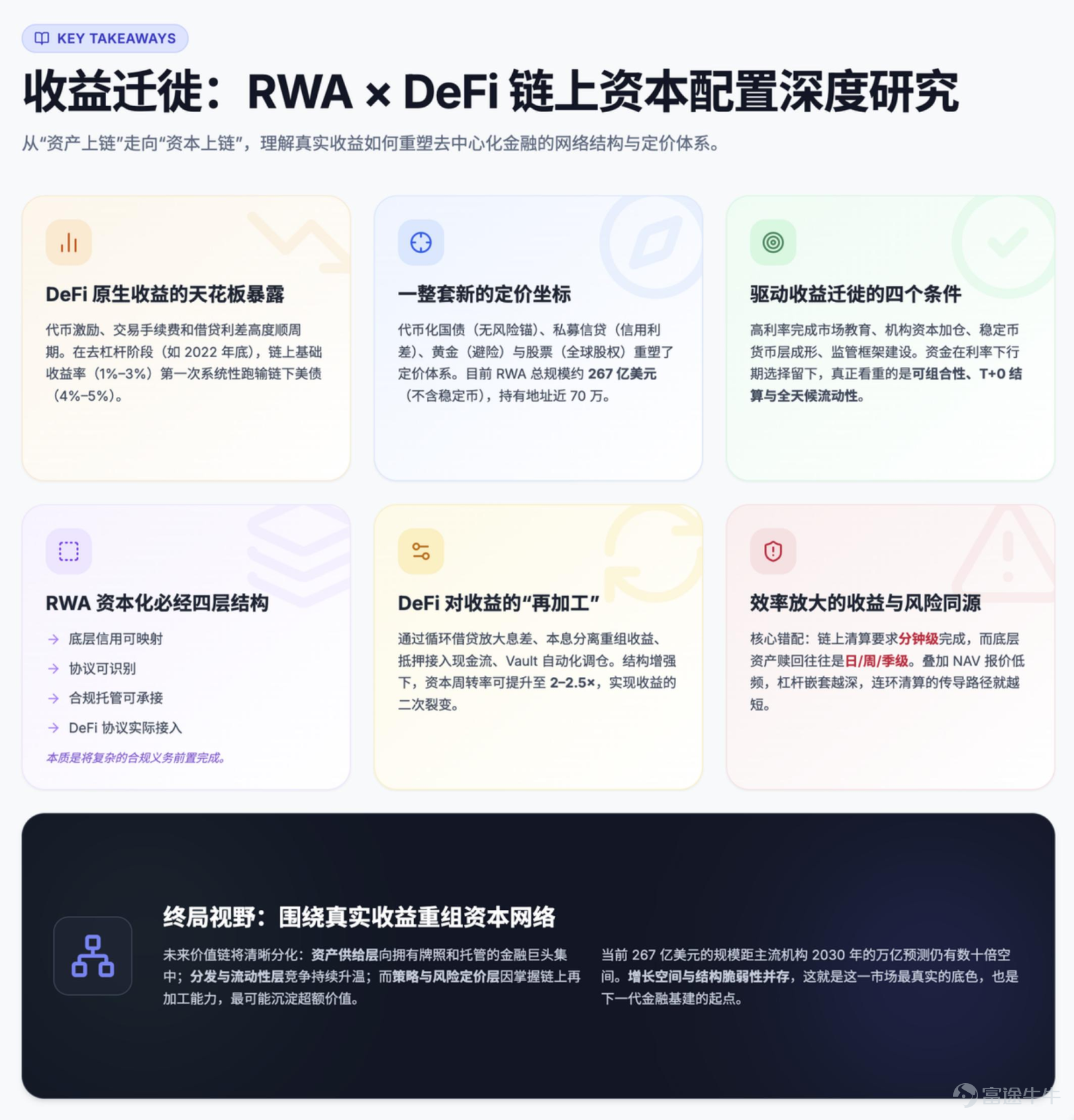
1. The ceiling of DeFi native returns has become evident: token incentives, transaction fees, and lending spreads are highly pro-cyclical. During the deleveraging phase, these three types of returns will contract simultaneously. By the end of 2022, deposit rates on Aave and Compound had fallen to 1%-3%, while US Treasury yields remained in the 4%-5% range, marking the first time on-chain funds systematically underperformed even the most basic off-chain returns.
2. RWA introduces an entirely new pricing framework: tokenized government bonds anchor external returns on-chain, private credit fills the credit spread, gold tokens introduce safe-haven pricing, and tokenized stocks connect to global equity expressions. By the end of March 2026, the total value of distributed on-chain RWAs (excluding stablecoins) reached approximately $26.7 billion, with nearly 700,000 holding addresses. The on-chain asset map has expanded from 'relative pricing between crypto assets' to a multi-dimensional pricing system.
3. Four conditions together determine this migration of returns: high interest rates have educated the market, institutional capital has shifted from testing to increasing positions, stablecoins have formed a true on-chain monetary layer, and regulation has begun shifting from enforcement-driven to framework construction. More importantly, after interest rates declined in 2025, the scale of tokenized government bonds did not shrink, indicating that capital remains not just for yield but due to composability, T+0 settlement, and round-the-clock liquidity.
4. The four-layer structure essential for RWA capitalization: After an RWA is tokenized, it must still pass through four stages—underlying credit mapping, protocol recognition, compliant custody acceptance, and actual DeFi protocol integration—before it can truly enter the on-chain capital allocation system. Whether it's Ondo-style compliance intermediaries or Sky-style protocol encapsulation, both essentially do the same thing: front-load complex compliance obligations and then hand over standardized tokens to DeFi for processing.
5. DeFi’s “reprocessing” of returns: Recycled lending amplifies interest rate spreads, principal and interest separation restructures returns, non-interest-bearing assets access cash flow through collateralization, and Vaults turn manual strategies into automated execution. On-chain structural differences often don’t lie in higher underlying interest rates but rather in the ability of the same funds to continue being collateralized, split, and reconfigured while earning the first layer of returns. In the structurally enhanced portfolio settings discussed in this article, capital turnover can increase to about 2-2.5x.
6. Efficiency-amplified returns and risks share the same origin: The core contradiction of RWA x DeFi is now clear—on-chain liquidation requires completion within minutes, while redemption of underlying assets often occurs on a daily, weekly, or even quarterly basis; some assets also carry whitelist transfer restrictions. Combined with issues like low-frequency NAV quotes and lagging governance responses, the deeper the leverage nesting, the shorter the risk transmission path.
7. RWA + DeFi represents the reorganization of capital networks around real-world returns: the asset supply layer will continue to concentrate among a few traditional financial institutions with licenses, custody capabilities, and brand credibility. Competition for distribution and liquidity entry points will intensify, while the strategy and risk pricing layers are more likely to capture excess value. By the end of March 2026, distributed on-chain RWAs will amount to approximately $267 billion, still far from mainstream institutional projections of trillions by 2030. Growth potential coexists with structural vulnerabilities, reflecting the current most realistic state of this market.
The focus of future competition is unlikely to remain on 'moving assets on-chain' for an extended period. Article author, Source: CoinFound COINFOUND CoinFound is a TradFi × Crypto data technology company catering to institutions and professional investors, providing services such as RWA asset data terminals, RWA asset ratings, Web3 risk relationship maps, AI analysis tools, and customized data. From data integration, risk identification to decision support, it helps institutions acquire critical intelligence at lower costs and higher efficiency, converting it into actionable insights, and building global RWA infrastructure. Website:app.coinfound.org X:https://x.com/CoinfoundGroup Takeaway 1. The ceiling of DeFi native yields has become evident: token incentives, transaction fees, and lending spreads are all highly pro-cyclical. During the deleveraging phase, these three types of yields will contract simultaneously. By the end of 2022, Aave and Compound's deposit rates had fallen to 1%-3%, while US Treasury yields remained in the 4%-5% range. For the first time, on-chain funds systematically underperformed even the most basic off-chain yields. 2. RWA introduces an entirely new set of pricing coordinates: tokenized treasury bonds anchor external yields on-chain, private credit...
Figure 1. Image source: CoinFound
The focus of future competition is unlikely to remain on 'moving assets on-chain' for an extended period. Article author, Source: CoinFound COINFOUND CoinFound is a TradFi × Crypto data technology company catering to institutions and professional investors, providing services such as RWA asset data terminals, RWA asset ratings, Web3 risk relationship maps, AI analysis tools, and customized data. From data integration, risk identification to decision support, it helps institutions acquire critical intelligence at lower costs and higher efficiency, converting it into actionable insights, and building global RWA infrastructure. Website:app.coinfound.org X:https://x.com/CoinfoundGroup Takeaway 1. The ceiling of DeFi native yields has become evident: token incentives, transaction fees, and lending spreads are all highly pro-cyclical. During the deleveraging phase, these three types of yields will contract simultaneously. By the end of 2022, Aave and Compound's deposit rates had fallen to 1%-3%, while US Treasury yields remained in the 4%-5% range. For the first time, on-chain funds systematically underperformed even the most basic off-chain yields. 2. RWA introduces an entirely new set of pricing coordinates: tokenized treasury bonds anchor external yields on-chain, private credit...
For a long time, the returns pursued by on-chain funds primarily came from token incentives, trading activity, and leverage expansion. Such returns appeared abundant during bullish market phases but quickly diminished when liquidity contracted and risk appetite declined. As crypto-native returns weakened overall, on-chain funds began searching for new sources of yield—not just higher annualized figures, but more stable cash flows, clearer asset backing, and return structures more easily accepted by large-scale capital.
It is against this backdrop that RWA assets started coming into the on-chain view. U.S. Treasury bonds, money market funds, private credit, gold, equities, and the stablecoin settlement layers formed around them are progressively integrating off-chain returns, credit, and price systems into the on-chain market. This is not merely about asset tokenization; at a deeper level, it reflects a migration of income sources. Cash flows that previously stayed within the traditional financial system are now entering the blockchain space, where they are being held, priced, and utilized by new groups of capital.
However, this migration of returns does not stop at simply 'moving on-chain.' Once a return enters the blockchain environment, its context immediately changes. It can be used as collateral for further financing, split into different maturities and risk preferences, embedded into automated strategies, or reorganized across different protocols, chains, and assets. While the source of these returns comes from the real world, their usage patterns are being reshaped on-chain. Therefore, the integration of RWA and DeFi is no longer just about whether tokenization works; the discussion now centers on how the on-chain market will absorb these returns and further transform them into new capital allocation structures.
This is precisely the question this article seeks to answer: how will this migration of returns alter the organization of on-chain capital? Which assets will become the new base of returns, which assets will provide price elasticity, which protocols will take on roles in distributing, amplifying, and restructuring returns, and along what pathways will risks accumulate and propagate amid efficiency improvements?
At its core, this also addresses a more specific and crucial issue: as real-world returns begin to enter the blockchain space en masse, what kind of capital allocation system will evolve within on-chain finance?
The year 2025 marks a collective turning point for on-chain funds. At the beginning of the year, crypto-native returns were still operating on inertia—interest rate spreads from lending protocols, token incentives from liquidity mining, and funding rates from perpetual contracts remained the primary sources of returns for the vast majority of on-chain capital. However, as the Federal Reserve kept the federal funds rate above 4%, the underlying demand for on-chain lending continued to shrink alongside cooling market conditions, revealing a structural mismatch: there was substantial capital on-chain seeking returns, while the supply of native on-chain returns was dwindling.
Meanwhile, short-term U.S. Treasuries off-chain were offering risk-free returns of 4%–5% annually, the global private credit market—with $3.2 trillion in outstanding volume—was providing credit spreads of 8%–12%, and gold prices surged to new all-time highs driven by geopolitical conflicts. These returns have always existed within the traditional financial system, but in the past, multiple barriers such as issuance qualifications, custody frameworks, compliance channels, and settlement pipelines separated them from on-chain funds. What happened between 2024 and 2025 essentially involved breaking down these barriers one by one: BlackRock issued BUIDL, Franklin Templeton brought mutual funds onto nine chains, Maple Finance’s institutional credit pool expanded from $300 million to $2.5 billion, and USDC surpassed USDT in trading volume for the first time in March 2026. Off-chain returns began migrating to the blockchain space on a large scale.
As of the first quarter of 2026, the total scale of on-chain RWA assets (excluding stablecoins) reached approximately $18.6 billion under a distributed framework, and exceeded $36 billion if permissioned chains were included; the total market capitalization of stablecoins surpassed $310 billion; the number of unique holding addresses for on-chain RWA tokens grew from about 100,000 at the beginning of 2025 to nearly 700,000 (Data sources: CoinFound, DefiLlama, CoinGecko, December 2025 to March 2026). These figures alone are sufficient to indicate scale, but what is more noteworthy is not the sheer volume, but rather the roles these assets play on-chain, how they interact with each other, and why they have collectively surged during the same period.
To answer these questions, the first step is to create a functional map and organize it according to how on-chain funds actually utilize these assets. The current RWA ecosystem can be divided into three layers:
• The first layer consists of yield-generating assets that provide stable cash flow: this determines the income anchor for on-chain portfolios.
• The second layer includes risk exposure assets that offer price elasticity and collateral value: these supplement pure fixed-income portfolios with volatility and capital gain opportunities.
• The third layer serves as conduits for pricing, settlement, cross-chain allocation, and fund parking: these determine whether the assets in the first two layers can truly become liquid. The relationship between the three layers is not simply parallel but resembles the internal division of labor within a capital allocation system.
On-chain portfolios require a yield anchor. Prior to 2022, this anchor was the lending rates of Aave and Compound, which fluctuated dramatically with the leverage cycles of the crypto market—exceeding 10% during bull markets and falling below 1% in bear markets, essentially an endogenous, pro-cyclical interest rate.
The emergence of tokenized treasury bonds changed this situation. When there is over $12 billion in on-chain assets backed by short-term US Treasury bonds offering annualized yields of 3%-5%, the opportunity cost of on-chain funds is, for the first time, anchored to an exogenous benchmark directly linked to the Federal Reserve’s monetary policy. Any on-chain protocol seeking to attract funds must offer yields that add sufficient risk premium above this benchmark to make sense. This seemingly minor but profoundly impactful structural change means that on-chain finance now has its own "risk-free rate" reference point for the first time. Tokenized treasury bonds form the core of this reference. As of March 2026, the total scale of tokenized US Treasury bonds exceeded $12.18 billion, with around 49 products in the market, over 13,200 holding addresses, and yields concentrated in the range of 3.0%-5.0%, fluctuating with the federal funds rate (Data source: RWA.xyz, March 2026). The operational logic is straightforward: issuers purchase short-term US Treasury bonds or money market instruments off-chain and issue corresponding tokens on-chain, with holders receiving proportional interest income from the underlying assets.
This market exhibits high concentration at the top, but the competitive landscape is undergoing subtle shifts. Hashnote (Circle system)'s USYC, leveraging deep integration with Circle and Usual Protocol, has rapidly expanded to claim the leading position with a market cap of approximately $2.61 billion, highlighting the importance of distribution channels and protocol nesting for scale growth. Close behind, BUIDL positions itself as an "on-chain money market fund" for institutional-grade allocation. Since its launch in March 2024, it has distributed over $100 million in returns to holders, with a minimum investment threshold of $5 million, deployed across seven blockchains including Ethereum, Arbitrum, and Solana. Franklin Templeton's BENJI is the first US-registered mutual fund issued on the blockchain, accessible with a very low threshold of $20 to both retail and institutional markets, covering more than nine public chains, with Stellar accounting for approximately $600 million. Ondo Finance's OUSG directly invests in BUIDL at the base level, and this nesting relationship demonstrates that DeFi composability (the ability of tokens to be embedded in other protocols for lending, collateralization, or reinvestment) is being replicated in the RWA space (Data sources: CoinFound, CoinGecko, LaikalAbs, Q1 2026; product data may vary due to differing reporting standards).
The focus of future competition is unlikely to remain on 'moving assets on-chain' for an extended period. Article author, Source: CoinFound COINFOUND CoinFound is a TradFi × Crypto data technology company catering to institutions and professional investors, providing services such as RWA asset data terminals, RWA asset ratings, Web3 risk relationship maps, AI analysis tools, and customized data. From data integration, risk identification to decision support, it helps institutions acquire critical intelligence at lower costs and higher efficiency, converting it into actionable insights, and building global RWA infrastructure. Website:app.coinfound.org X:https://x.com/CoinfoundGroup Takeaway 1. The ceiling of DeFi native yields has become evident: token incentives, transaction fees, and lending spreads are all highly pro-cyclical. During the deleveraging phase, these three types of yields will contract simultaneously. By the end of 2022, Aave and Compound's deposit rates had fallen to 1%-3%, while US Treasury yields remained in the 4%-5% range. For the first time, on-chain funds systematically underperformed even the most basic off-chain yields. 2. RWA introduces an entirely new set of pricing coordinates: tokenized treasury bonds anchor external yields on-chain, private credit...
Figure 2. (Image source: CoinFound)
Notably, the focus of competition among these products is no longer "who offers a higher yield"—as interest rate cycles trend downward, yield differences are shrinking. True differentiation is occurring along two dimensions: one is DeFi composability—whether tokens can be accepted as collateral by lending protocols like Aave and Morpho, or integrated into yield-splitting protocols such as Pendle; the other is multi-chain coverage breadth, which directly determines how much capital across ecosystems a product can access. In February 2026, BUIDL's listing on Uniswap enabled secondary trading on-chain, marking the formal entry of institutional-grade treasury tokens into the open liquidity market—prior to this, liquidity for such products was largely confined to primary subscription and redemption channels.
If tokenized treasuries provide a 'yield anchor' for on-chain portfolios, private credit offers the credit spread above that anchor. Private credit brings non-standard assets from traditional finance, such as corporate loans, trade financing, and consumer credit, onto the blockchain, where on-chain pools lend to off-chain borrowers, allowing investors to earn interest returns. As of March 2026, the total value of active loans in on-chain private credit reached $222 billion, with cumulative loans exceeding $401 billion and an average annualized yield of 10.21%. The total size of the traditional private credit market is approximately $3.2 trillion (EY, 2025), with on-chain penetration still under 1%, but growing at a yearly rate of 74%-82% (Data source: RWA.xyz, PwC, March 2026). This sector's structure is far more complex than that of treasuries. Figure leads with $155.3 billion in active loans, but it operates on the permissioned chain Provenance, offering limited composability with public-chain DeFi ecosystems—it resembles a blockchain-based traditional lending platform. Protocols truly embedded in public chains and deeply integrated with DeFi include Maple Finance and Centrifuge. Maple's TVL grew from $297 million in early 2025 to over $2.5 billion, driven primarily by its Syrup USDC pool ($1.1 billion, APY 5.17%) and Syrup USDT pool ($660 million, APY 5.12%), enabling stablecoin holders to directly capture institutional credit spreads. Centrifuge follows a different path, focusing on bringing structured credit products from traditional finance onto the blockchain. Its TVL is mainly driven by tokenized Janus Henderson AAA-rated CLO (Collateralized Loan Obligation) funds. In July 2025, Centrifuge completed its V3 migration from Polkadot to Ethereum, signaling a preference for networks with the deepest liquidity rather than sticking to its original tech stack.
The focus of future competition is unlikely to remain on 'moving assets on-chain' for an extended period. Article author, Source: CoinFound COINFOUND CoinFound is a TradFi × Crypto data technology company catering to institutions and professional investors, providing services such as RWA asset data terminals, RWA asset ratings, Web3 risk relationship maps, AI analysis tools, and customized data. From data integration, risk identification to decision support, it helps institutions acquire critical intelligence at lower costs and higher efficiency, converting it into actionable insights, and building global RWA infrastructure. Website:app.coinfound.org X:https://x.com/CoinfoundGroup Takeaway 1. The ceiling of DeFi native yields has become evident: token incentives, transaction fees, and lending spreads are all highly pro-cyclical. During the deleveraging phase, these three types of yields will contract simultaneously. By the end of 2022, Aave and Compound's deposit rates had fallen to 1%-3%, while US Treasury yields remained in the 4%-5% range. For the first time, on-chain funds systematically underperformed even the most basic off-chain yields. 2. RWA introduces an entirely new set of pricing coordinates: tokenized treasury bonds anchor external yields on-chain, private credit...
Figure 3. (Image source: CoinFound)
Source: CoinFound
However, behind the high returns of private credit lies a risk profile fundamentally different from treasuries. At the base level is borrower credit risk—on-chain credit suffered heavy losses in 2022 due to cascading defaults by institutions like Three Arrows Capital, exposing a core issue: when on-chain lending relies on crypto-native credit endorsements rather than
traditional underwriting discipline, pro-cyclicality is greatly amplified. Since 2025, newer protocols have learned from past mistakes, introducing tiered structures from traditional finance (Senior/Junior Tranche), real-time data audits, and automated collateral liquidation mechanisms. However, the liquidity discount of non-standard assets during extreme market conditions and the lag between smart contract rigid liquidation and real-world asset realization remain unsolved structural challenges. In other words, private credit provides significantly higher yields than treasuries for on-chain portfolios, but at the cost of introducing credit risk and liquidity risk—a classic trade-off between return and risk in capital allocation.
If an on-chain portfolio only holds interest-bearing assets, it gains steady cash flow but lacks price elasticity, hedging tools, and a richer pool of collateral assets. The second role of RWAs is not to continue providing yield but to integrate real-world pricing systems onto the blockchain—precious metals introduce safe-haven pricing, while tokenized stocks enable global equity price expression.
Tokenized gold is the most mature category in this layer. As of March 2026, the total market cap of on-chain gold is approximately $5.06 billion–$5.37 billion, with PAXG (issued by Paxos) and XAUT (issued by Tether) collectively accounting for about 90%–97%, forming a typical duopoly. Both share the same underlying asset logic: each token represents 1 ounce of LBMA (London Bullion Market Association)-approved deliverable gold bars, stored in Brink’s vaults in London and Swiss vaults, respectively, with holders able to redeem physical gold according to specified rules.
The focus of future competition is unlikely to remain on 'moving assets on-chain' for an extended period. Article author, Source: CoinFound COINFOUND CoinFound is a TradFi × Crypto data technology company catering to institutions and professional investors, providing services such as RWA asset data terminals, RWA asset ratings, Web3 risk relationship maps, AI analysis tools, and customized data. From data integration, risk identification to decision support, it helps institutions acquire critical intelligence at lower costs and higher efficiency, converting it into actionable insights, and building global RWA infrastructure. Website:app.coinfound.org X:https://x.com/CoinfoundGroup Takeaway 1. The ceiling of DeFi native yields has become evident: token incentives, transaction fees, and lending spreads are all highly pro-cyclical. During the deleveraging phase, these three types of yields will contract simultaneously. By the end of 2022, Aave and Compound's deposit rates had fallen to 1%-3%, while US Treasury yields remained in the 4%-5% range. For the first time, on-chain funds systematically underperformed even the most basic off-chain yields. 2. RWA introduces an entirely new set of pricing coordinates: tokenized treasury bonds anchor external yields on-chain, private credit...
Figure 4. Source: CoinGecko / CoinMarketCap
But the same underlying assets have formed different market microstructures on-chain. XAUT is more active in the Asian offshore market, forming a high-frequency trading pair with USDT.
During weekends and sudden geopolitical events, it often reacts first. In March 2026, during a weekend when a geopolitical conflict erupted, while traditional London and New York gold markets were closed, XAUT's price movement preceded PAXG's by about 15 minutes. PAXG, regulated by NYDFS, exhibits steadier and more conservative price movements and is considered a closer on-chain anchor to the traditional compliant gold market. In 2025, tokenized gold trading volume reached approximately $1.78 trillion, second only to SPDR Gold Shares (GLD), the world's largest gold ETF. This means that blockchain has given gold a previously non-existent capability: around-the-clock, uninterrupted global price discovery.
This duopoly structure is facing a potential structural shock. The World Gold Council (WGC) — the institution that led the launch of the first U.S. gold ETF in 2004 — together with Boston Consulting Group proposed the 'Gold as a Service' open platform framework in March 2026. The intent of this framework is to break down the proprietary vault systems of PAXG and XAUT through unified custody standards and interoperability protocols, allowing regional banks and new issuers to share the underlying compliant infrastructure to issue their own gold tokens. For the duopoly, this is a double-edged sword: it grows the overall pie but also directly weakens the competitive barriers they built through their proprietary vault systems.
Tokenized stocks are the fastest-growing yet most compliance-friction category within the RWA ecosystem. Throughout 2025, the market capitalization of on-chain tokenized stocks surged from just $32 million at the beginning of the year to $1.2 billion by the end, marking an annual growth rate of 2,496% — a figure unmatched by any other category in the entire RWA landscape (Data source: Token Terminal / Finance Magnates, December 2025). The core value proposition of tokenized stocks is to issue publicly traded company equities in token form on-chain, enabling holders to trade 24/7 outside traditional trading hours, achieving atomic settlement (where fund delivery and ownership transfer occur instantly within the same block), and eliminating T+1 clearing capital lock-ups.
In regulated markets, Ondo Finance’s subsidiary, Ondo Global Markets, dominates with approximately 52% market share, supporting over 250 tokenized stocks. Backed Finance (xStocks) holds about 24% and was acquired by Kraken in December 2025. Securitize accounts for roughly 20%, with AUM exceeding $4 billion, and plans to list on Nasdaq via SPAC. However, a key unresolved legal issue remains for this category: most tokenized stocks do not offer voting rights or direct equity ownership; holders possess contractual claims representing economic interests rather than traditional shareholder rights. This subjects them to far greater compliance friction in securities classification, investor protection, and cross-border offerings compared to government bonds or gold tokens.
The on-chain representation of commodities such as crude oil and agricultural products remains in its very early stages, lacking scalable products and sufficient on-chain liquidity, and does not currently constitute actionable allocation targets.
With income-generating base assets and price-elastic assets, there needs to be a pipeline system that allows them to be priced, settled, allocated, and kept continuously liquid. Stablecoins serve as this pipeline. Whether it is the subscription and redemption of tokenized treasury bonds, inflows and outflows of lending pools, or the allocation and settlement of cross-chain assets, nearly all RWA operations are mediated through stablecoins. Within the capital allocation framework, stablecoins are better understood as a 'funding intermediary layer' rather than a base asset class alongside treasuries and gold — their scale far exceeds that of narrowly defined RWAs (total stablecoin market cap surpasses $3.1 trillion, while distributed RWA assets excluding stablecoins amount to approximately $18.6 billion), and their role more closely resembles money markets and clearing systems in traditional finance.
The current stablecoin ecosystem can be divided into two layers, each addressing issues at different levels.
Fiat-backed stablecoins address the question: 'Can money flow?'
USDT and USDC together account for approximately 83% of the global stablecoin market, but the competitive landscape is undergoing a structural shift. On March 15, 2026, USDC's trading volume surpassed USDT for the first time, accounting for 64% of stablecoin trading volume (data source: CoinMarketCap). This is not a random fluctuation; behind it lies the ongoing trend of institutional capital 'migrating towards quality.' When regulated asset management institutions enter the market on a large scale, they impose strict requirements on the transparency and compliance of issuers—Circle went public on the New York Stock Exchange in June 2025 (stock ticker: CRCL), and USDC is fully backed by short-term Treasury bills managed by BlackRock, making it the natural choice for institutional funds. Tether is also actively bridging the trust gap, announcing in March 2026 the hiring of one of the Big Four accounting firms to conduct its first comprehensive audit, but its core advantage—deep liquidity in Asian offshore markets and emerging economies—will not be easily replaced in the short term.
The focus of future competition is unlikely to remain on 'moving assets on-chain' for an extended period. Article author, Source: CoinFound COINFOUND CoinFound is a TradFi × Crypto data technology company catering to institutions and professional investors, providing services such as RWA asset data terminals, RWA asset ratings, Web3 risk relationship maps, AI analysis tools, and customized data. From data integration, risk identification to decision support, it helps institutions acquire critical intelligence at lower costs and higher efficiency, converting it into actionable insights, and building global RWA infrastructure. Website:app.coinfound.org X:https://x.com/CoinfoundGroup Takeaway 1. The ceiling of DeFi native yields has become evident: token incentives, transaction fees, and lending spreads are all highly pro-cyclical. During the deleveraging phase, these three types of yields will contract simultaneously. By the end of 2022, Aave and Compound's deposit rates had fallen to 1%-3%, while US Treasury yields remained in the 4%-5% range. For the first time, on-chain funds systematically underperformed even the most basic off-chain yields. 2. RWA introduces an entirely new set of pricing coordinates: tokenized treasury bonds anchor external yields on-chain, private credit...
Figure 5. Source: CoinFound
Interest-bearing stablecoins address another issue: 'Can money generate returns while remaining liquid?' Interest-bearing stablecoins (Yield-Bearing Stablecoins) maintain their peg to the US dollar while automatically distributing returns to holders through interest generated by underlying assets. Between 2023 and 2025, this category grew 13 times from $666 million to nearly $10 billion. JPMorgan predicts that interest-bearing stablecoins could account for 50% of the stablecoin market by 2030.
They play a unique role as 'gateway assets' in the RWA ecosystem—serving both as parking stations for capital that accumulate returns during holding periods, and maintaining instant liquidity that can be used for trading, collateral, or cross-chain transfers at any time. Sky Protocol (formerly MakerDAO)'s sUSDS leads with a scale of approximately $6.22 billion. Its revenue sources are a mix of crypto over-collateralized loan interest and underlying US Treasuries. Sky Protocol reported annual revenue of $435 million and profits of $168 million in 2025, making it one of the few truly profitable protocols in DeFi. Ethena Labs’ sUSDe follows closely with a scale of approximately $3.53 billion, employing a Delta-neutral strategy (long stETH/BTC spot + short perpetual contracts + BUIDL base position). Its returns essentially stem from the funding rates in the crypto derivatives market—when the market is crowded with long positions, the funding rate is positive, allowing the strategy to generate returns; when the market shifts, returns compress or even turn negative.
However, 'having both liquidity and yield' does not mean 'without cost.' The yield enhancement mechanism of interest-bearing stablecoins inherently introduces additional protocol risks and depegging risks, as last year’s cases have already shown. Usual Protocol’s USD0 plummeted from a peak of about $1.8 billion to around $560 million, primarily due to its locked staking certificate USD0++ depegging to $0.915 in January 2025, triggering a collapse in confidence and a crash in the USUAL governance token. Mountain Protocol’s USDM, once seen as an innovative product to deliver US Treasury yields to overseas retail investors, was shut down in May 2025, with its current market value at only about $966,000. These cases teach a consistent lesson: the more layers of yield enhancement are stacked, the further the yield source moves away from 'risk-free,' and holders often underestimate this distance beforehand.
The focus of future competition is unlikely to remain on 'moving assets on-chain' for an extended period. Article author, Source: CoinFound COINFOUND CoinFound is a TradFi × Crypto data technology company catering to institutions and professional investors, providing services such as RWA asset data terminals, RWA asset ratings, Web3 risk relationship maps, AI analysis tools, and customized data. From data integration, risk identification to decision support, it helps institutions acquire critical intelligence at lower costs and higher efficiency, converting it into actionable insights, and building global RWA infrastructure. Website:app.coinfound.org X:https://x.com/CoinfoundGroup Takeaway 1. The ceiling of DeFi native yields has become evident: token incentives, transaction fees, and lending spreads are all highly pro-cyclical. During the deleveraging phase, these three types of yields will contract simultaneously. By the end of 2022, Aave and Compound's deposit rates had fallen to 1%-3%, while US Treasury yields remained in the 4%-5% range. For the first time, on-chain funds systematically underperformed even the most basic off-chain yields. 2. RWA introduces an entirely new set of pricing coordinates: tokenized treasury bonds anchor external yields on-chain, private credit...
Figure 6. Chart: CoinFound, Data sources: CoinGecko / sky.money / Exponential DeFi, March 2026.
The previous three sections answered 'role differentiation'; this section answers 'real-world weight.' The following table provides a snapshot of the scale and blockchain distribution of various RWA assets, helping readers align the previously discussed functional map with the actual market structure.
The focus of future competition is unlikely to remain on 'moving assets on-chain' for an extended period. Article author, Source: CoinFound COINFOUND CoinFound is a TradFi × Crypto data technology company catering to institutions and professional investors, providing services such as RWA asset data terminals, RWA asset ratings, Web3 risk relationship maps, AI analysis tools, and customized data. From data integration, risk identification to decision support, it helps institutions acquire critical intelligence at lower costs and higher efficiency, converting it into actionable insights, and building global RWA infrastructure. Website:app.coinfound.org X:https://x.com/CoinfoundGroup Takeaway 1. The ceiling of DeFi native yields has become evident: token incentives, transaction fees, and lending spreads are all highly pro-cyclical. During the deleveraging phase, these three types of yields will contract simultaneously. By the end of 2022, Aave and Compound's deposit rates had fallen to 1%-3%, while US Treasury yields remained in the 4%-5% range. For the first time, on-chain funds systematically underperformed even the most basic off-chain yields. 2. RWA introduces an entirely new set of pricing coordinates: tokenized treasury bonds anchor external yields on-chain, private credit...
Figure 7. Data sources: CoinFound, RWA.xyz, DeFiLlama, and CoinGecko, December 2025–March 2026. The distributed definition refers to on-chain assets that are freely transferable; the broad definition includes permissioned blockchains such as Provenance and representative assets.
This table reveals two noteworthy structural characteristics. First, according to the distributed口径, the main composition of on-chain RWAs remains Treasury-like assets. If permissioned chains and representative assets are further included, private credit-related scales would rise significantly. However, Figure's $15.5 billion active loans on Provenance, unlike composable assets in public chain DeFi, are closer to ledger digitization in permissioned networks than to freely transferable public chain capital. Second, stablecoins significantly outweigh narrow-sense RWAs in scale, indicating that stablecoins are better viewed as the financial intermediary layer supporting the entire system rather than being lumped into the same asset pool as Treasuries, credit, gold, and other assets for direct comparison.
And the distribution of these RWA assets across various public blockchains reveals another layer of competitive logic.
The focus of future competition is unlikely to remain on 'moving assets on-chain' for an extended period. Article author, Source: CoinFound COINFOUND CoinFound is a TradFi × Crypto data technology company catering to institutions and professional investors, providing services such as RWA asset data terminals, RWA asset ratings, Web3 risk relationship maps, AI analysis tools, and customized data. From data integration, risk identification to decision support, it helps institutions acquire critical intelligence at lower costs and higher efficiency, converting it into actionable insights, and building global RWA infrastructure. Website:app.coinfound.org X:https://x.com/CoinfoundGroup Takeaway 1. The ceiling of DeFi native yields has become evident: token incentives, transaction fees, and lending spreads are all highly pro-cyclical. During the deleveraging phase, these three types of yields will contract simultaneously. By the end of 2022, Aave and Compound's deposit rates had fallen to 1%-3%, while US Treasury yields remained in the 4%-5% range. For the first time, on-chain funds systematically underperformed even the most basic off-chain yields. 2. RWA introduces an entirely new set of pricing coordinates: tokenized treasury bonds anchor external yields on-chain, private credit...
Figure 8. Data sources: CoinFound, RWA.xyz, Mey Network, March 2026
Ethereum maintains an absolute dominance with approximately 55% of the share, but this is not because it has the fastest transaction speed or the lowest fees. The reason is more fundamental: when BlackRock issues assets worth billions of dollars, its tolerance for the underlying network security is close to zero. Ethereum's cryptoeconomic security verified over a decade of operation, the deepest DeFi liquidity pool, and the most extensive institutional-grade infrastructure coverage together form a network effect that other public blockchains will find difficult to replicate in the short term. Its role in the RWA space is closer to being the 'central bank ledger' – not necessarily where every transaction occurs, but definitely where final settlement and value confirmation take place.
However, latecomers are quickly carving out their niches through differentiated positioning. Solana’s RWA TVL grew from 170 million USD in 2025 to over 2 billion USD, an increase of more than 1100%, thanks to its unparalleled concurrent processing capabilities that precisely meet the needs for continuous, low-latency price discovery in tokenized stocks and commodity trading pairs. Avalanche achieved 950% growth within a year by leveraging the deployment of a 500 million USD fund from BlackRock and KYC-compliant subnets (Evergreen), pursuing a differentiation strategy focused on institutional compliance infrastructure. Multi-chain deployment has become standard; BUIDL operates on seven chains, USDY covers more than eight chains, BENJI supports more than nine chains – the competition among chains is increasingly less about technical performance and more like a comprehensive contest of ecosystems, distribution channels, and compliance infrastructure.
Returning to the core of this chapter, this panoramic map already illustrates that RWA is not a single asset class but a chain-based capital allocation system composed of income base layers, price exposures, and funding conduits. Government bonds and credit provide the yield anchor, gold and equities offer price elasticity, and stablecoins enable everything to flow and settle. The nested relationship among the three layers – OUSG investing in BUIDL, sUSDe base including BUIDL, USD0 reserves comprising USYC, BUIDL, and OUSG – demonstrates how on-chain composability is spontaneously weaving these assets into an interdependent system.
But the map is static. Why did these assets collectively make the leap from marginal experiments to scaled expansion between 2024 and 2025? What macro conditions, regulatory changes, and technological maturity aligned simultaneously to make this yield migration truly possible? This is the question the next chapter will address.
The static asset map from Chapter 1 – government bonds as yield anchors, credit overlaying credit spreads, gold and equities providing price elasticity, and stablecoins connecting all settlement conduits – cannot explain why these asset classes were not invented in 2025. US Treasury bonds have existed for over two hundred years, the stock of private credit markets exceeds 3 trillion USD, and the concept of gold tokenization appeared as early as 2018. Why is it during the 2024–2026 window that these assets collectively crossed the threshold from fragmented concept validation to being part of on-chain allocation discussions?
The answer does not lie in a single breakthrough. If it were only about sufficiently high interest rates, the explosion should have occurred in 2023; if it were only about institutional willingness, JPMorgan’s Onyx would have already gone live in 2020. This round of collective momentum in RWA essentially stems from the resonance of four types of conditions aligning at the same time: the interest rate cycle opened up a yield window and completed market education, institutional capital shifting from tentative exploration to increased positions changed the credit quality of on-chain assets, the adoption of stablecoins allowed the on-chain monetary layer to start taking shape, and regulation shifting from enforcement-driven to framework construction enabled the above changes to gain institutional support.
First, let's look at the numbers. The total scale of on-chain RWA assets (excluding stablecoins, distributed口径) grew from approximately $8.6 billion at the beginning of 2024 to around $27 billion by March 2026. If permissioned chains and representative assets are included in the statistics, the broader market size has already exceeded $36 billion. The number of unique holder addresses for on-chain RWA tokens surged from about 100,000 at the start of 2025 to nearly 694,000 by March 2026 (Data sources: CoinFound/DWF Labs, January 2024 to March 2026; Canton Network "State of RWA 2026" report).
The focus of future competition is unlikely to remain on 'moving assets on-chain' for an extended period. Article author, Source: CoinFound COINFOUND CoinFound is a TradFi × Crypto data technology company catering to institutions and professional investors, providing services such as RWA asset data terminals, RWA asset ratings, Web3 risk relationship maps, AI analysis tools, and customized data. From data integration, risk identification to decision support, it helps institutions acquire critical intelligence at lower costs and higher efficiency, converting it into actionable insights, and building global RWA infrastructure. Website:app.coinfound.org X:https://x.com/CoinfoundGroup Takeaway 1. The ceiling of DeFi native yields has become evident: token incentives, transaction fees, and lending spreads are all highly pro-cyclical. During the deleveraging phase, these three types of yields will contract simultaneously. By the end of 2022, Aave and Compound's deposit rates had fallen to 1%-3%, while US Treasury yields remained in the 4%-5% range. For the first time, on-chain funds systematically underperformed even the most basic off-chain yields. 2. RWA introduces an entirely new set of pricing coordinates: tokenized treasury bonds anchor external yields on-chain, private credit...
Figure 9. Chart: Total scale of on-chain RWA assets (from early 2023 to March 2026), comparing distributed口径 vs. broader口径 with the right axis showing changes in the number of holder addresses. Data source: CoinFound, Canton Network.
But looking solely at the aggregate figures is insufficient. This round of expansion is noteworthy not because of the staggering annualized growth rate of 80%, but because the composition of that growth has undergone a qualitative transformation.
The first signal is the source of incremental capital. Prior to 2024, the primary holders of on-chain RWAs were crypto-native DAO treasuries and DeFi protocols. For example, MakerDAO adjusted its treasury exposure from zero to $2.5 billion in tokenized treasuries in 2022, becoming one of the earliest large-scale adopters. However, after 2024, traditional financial institutions became the main contributors to growth. BlackRock launched BUIDL in March 2024, which surpassed $2.9 billion in AUM by early 2026; Franklin Templeton’s BENJI expanded to more than nine public chains; PayPal’s PYUSD grew eightfold within a year to reach $4.1 billion; Securitize began preparing for an IPO on Nasdaq. The entry of these names changed not only the scale but also the credit quality of on-chain assets—when the underlying shifted from crypto-native lending to AAA-rated US Treasuries and money market instruments, the pool of funds available for on-chain allocation discussions expanded by several orders of magnitude.
The focus of future competition is unlikely to remain on 'moving assets on-chain' for an extended period. Article author, Source: CoinFound COINFOUND CoinFound is a TradFi × Crypto data technology company catering to institutions and professional investors, providing services such as RWA asset data terminals, RWA asset ratings, Web3 risk relationship maps, AI analysis tools, and customized data. From data integration, risk identification to decision support, it helps institutions acquire critical intelligence at lower costs and higher efficiency, converting it into actionable insights, and building global RWA infrastructure. Website:app.coinfound.org X:https://x.com/CoinfoundGroup Takeaway 1. The ceiling of DeFi native yields has become evident: token incentives, transaction fees, and lending spreads are all highly pro-cyclical. During the deleveraging phase, these three types of yields will contract simultaneously. By the end of 2022, Aave and Compound's deposit rates had fallen to 1%-3%, while US Treasury yields remained in the 4%-5% range. For the first time, on-chain funds systematically underperformed even the most basic off-chain yields. 2. RWA introduces an entirely new set of pricing coordinates: tokenized treasury bonds anchor external yields on-chain, private credit...
Figure 10. Chart: Breakdown of funding sources for RWA TVL increments (2023–2025), comparing “crypto-native capital” with “traditional institutional capital” (AUM of leading products such as BlackRock and Franklin Templeton). Data sources: CoinFound, public data from various products.
The second signal is the resilience of growth during interest rate cycles. The initial surge in tokenized treasuries was indeed driven by high interest rates. The rate hike cycle between 2022 and 2024 pushed short-term US Treasury yields above 5%, while native DeFi yields shrank to 1%–2% during the bear market. This spread provided direct motivation for capital migration. However, even after the Federal Reserve entered a rate-cutting phase in 2025, the scale of on-chain treasuries did not contract despite yields falling from 5% to 3%–4%; instead, it continued to reach new highs. Tokenized treasuries grew from $3.9 billion at the start of the year to $8.6 billion by year-end, and by Q1 2026, had surpassed $10 billion.
This indicates that the high-interest-rate period completed a form of market education: on-chain funds saw for the first time the accessibility of real-world returns. And once the interest rate advantage narrowed, what kept funds invested was no longer yield alone but the additional value offered by the on-chain format—DeFi composability (using assets as collateral in platforms like Aave and Morpho for leveraged borrowing), atomic settlement (T+0 vs. traditional markets' T+1), round-the-clock liquidity, and cross-chain accessibility. This marked a paradigm shift from interest rate arbitrage to structural asset allocation.
The focus of future competition is unlikely to remain on 'moving assets on-chain' for an extended period. Article author, Source: CoinFound COINFOUND CoinFound is a TradFi × Crypto data technology company catering to institutions and professional investors, providing services such as RWA asset data terminals, RWA asset ratings, Web3 risk relationship maps, AI analysis tools, and customized data. From data integration, risk identification to decision support, it helps institutions acquire critical intelligence at lower costs and higher efficiency, converting it into actionable insights, and building global RWA infrastructure. Website:app.coinfound.org X:https://x.com/CoinfoundGroup Takeaway 1. The ceiling of DeFi native yields has become evident: token incentives, transaction fees, and lending spreads are all highly pro-cyclical. During the deleveraging phase, these three types of yields will contract simultaneously. By the end of 2022, Aave and Compound's deposit rates had fallen to 1%-3%, while US Treasury yields remained in the 4%-5% range. For the first time, on-chain funds systematically underperformed even the most basic off-chain yields. 2. RWA introduces an entirely new set of pricing coordinates: tokenized treasury bonds anchor external yields on-chain, private credit...
Figure 11. Chart: CoinFound, data source: CoinFound, Federal Reserve H.15.
The third signal is that stablecoins are starting to independently take shape as the on-chain monetary layer. This development must be viewed outside the context of RWAs themselves. By 2025, the total market cap of global stablecoins exceeded $300 billion, but the real change wasn’t in the aggregate figure—it was in the expansion of use cases. Visa disclosed in 2025 that its stablecoin settlement platform handled over $3.5 billion annually, while Stripe rolled out blockchain-based corporate financial accounts to 101 countries. Public data from Stripe in 2026 showed that the global scale of stablecoin payments reached approximately $9 trillion in 2025, growing 87% year-over-year (data sources: Visa, April/December 2025; Stripe, May 2025/March 2026). Stablecoins are evolving from being mere transactional mediums within crypto markets into tools for cross-border payments, corporate treasury management, and machine-programmable settlement layers. For RWAs, this is critical: RWAs require not only underlying assets that can be issued but also a programmable cash layer to facilitate subscriptions, redemptions, settlements, collateral scheduling, and cross-chain transfers. The wider the adoption of stablecoins, the easier it becomes for RWAs to transition from being 'assets held on-chain' to becoming 'operational units of capital on-chain.'
Taken together, these three signals point to the same conclusion: What happened between 2024 and 2025 was not merely a wave of capital inflows but a simultaneous upgrade of the foundational infrastructure for on-chain capital allocation across the yield, credit, and monetary dimensions. Capital sources shifted from crypto-native to traditional institutions, yield logic evolved from interest rate arbitrage to structural allocation, and the settlement layer transitioned from a transactional medium to programmable currency. These changes combined have enabled RWAs to attract significant capital inflows while also creating conditions to retain them.
But one condition has not yet been discussed: the system. It's one thing for funds to be willing to come in, but whether they dare to stay and can be compliantly absorbed and sustainably operated entirely depends on whether the regulatory framework can keep up with the speed of the market. If the previous analysis explains why the demand has emerged, then the next question to answer is why these demands can be institutionally supported.
The focus of future competition is unlikely to remain on 'moving assets on-chain' for an extended period. Article author, Source: CoinFound COINFOUND CoinFound is a TradFi × Crypto data technology company catering to institutions and professional investors, providing services such as RWA asset data terminals, RWA asset ratings, Web3 risk relationship maps, AI analysis tools, and customized data. From data integration, risk identification to decision support, it helps institutions acquire critical intelligence at lower costs and higher efficiency, converting it into actionable insights, and building global RWA infrastructure. Website:app.coinfound.org X:https://x.com/CoinfoundGroup Takeaway 1. The ceiling of DeFi native yields has become evident: token incentives, transaction fees, and lending spreads are all highly pro-cyclical. During the deleveraging phase, these three types of yields will contract simultaneously. By the end of 2022, Aave and Compound's deposit rates had fallen to 1%-3%, while US Treasury yields remained in the 4%-5% range. For the first time, on-chain funds systematically underperformed even the most basic off-chain yields. 2. RWA introduces an entirely new set of pricing coordinates: tokenized treasury bonds anchor external yields on-chain, private credit...
Figure 12. Figure: CoinFound, Data Sources: CoinFound and the Federal Reserve H.15
The year 2025 will be a watershed moment for global RWA regulation. Prior to this, the biggest issue with digital asset compliance was not that the rules were too strict, but rather that the rules did not exist. Are tokenized assets securities, commodities, or payment instruments? Who regulates them? Is custody responsibility on-chain or off-chain? Can retail investors participate? These questions had no clear answers in the world's major financial centers. For traditional financial institutions managing trillions of dollars, 'unclear' is more dangerous than 'very strict'—the former means they cannot justify themselves to compliance committees and external auditors.
What changed in 2025 was precisely this point. Almost simultaneously, major jurisdictions shifted from 'taking positions through case-by-case enforcement' to 'building frameworks through legislation and administrative guidance.' While the starting points and emphases of this transition varied by region, they all addressed the same core set of questions: How are assets classified? Who bears custody responsibility? Who can participate? How do cross-border flows work?
United States: Three Threads Advancing Simultaneously
The United States provides the strongest institutional thread in this round of regulatory transformation, but it’s not just one thread—it’s three threads advancing almost simultaneously.
The first is the legal classification of stablecoins. The GENIUS Act was signed into law by the President in July 2025, becoming the first federal digital asset law in the U.S. It did something that had never been clarified before: determining the regulatory jurisdiction for payment stablecoins—only licensed Payment Stablecoin Issuers (PPSIs) can issue them in the U.S., requiring 1:1 reserve backing, and explicitly stating that stablecoins are neither securities nor commodities, thus not under the jurisdiction of the SEC or CFTC. Equally important is what it excluded: The GENIUS Act prohibits paying interest or returns to stablecoin holders and clearly states that tokenized money market funds (e.g., BUIDL, BENJI) do not fall under the definition of 'payment stablecoins' and remain regulated as funds under the Investment Company Act (Data Source:Congress.govS.1582; Arnold & Porter, July 2025).
This distinction is crucial for the RWA ecosystem. It establishes a legal boundary: stablecoins are responsible for payment and settlement, while tokenized funds handle interest generation and asset allocation, with no overlap allowed. The functional layering of stablecoins as 'funding conduits' and tokenized treasury bonds as 'yield anchors,' discussed in Chapter One, now has its legal counterpart—the GENIUS Act effectively separates the monetary layer from the asset layer of on-chain finance in terms of regulatory jurisdiction.
The second thread is the asset classification framework. The Clarity Act (H.R. 3633) passed the House of Representatives on July 2025 with a 294–134 vote, categorizing digital assets into 'digital commodities' (under CFTC jurisdiction) and 'investment contract assets' (under SEC jurisdiction), while also establishing a 'mature blockchain system' standard—tokens initially issued under an investment contract may lose their security status once key managerial efforts cease. On March 17, 2026, the SEC and CFTC jointly released a landmark 68-page joint interpretation, formally establishing a five-category token classification system, designating major crypto assets as digital commodities and confirming that tokenized securities remain securities. While the Clarity Act still awaits Senate voting, the joint interpretation already provides actionable classification guidance (data source: Congress.gov H.R. 3633). SEC.gov, March 17, 2026).
The third development involves the compliance of custodial infrastructure. This thread might be the least conspicuous in detail but is critical for the practical implementation of institutional-grade RWAs. Throughout 2025, the OCC (Office of the Comptroller of the Currency) confirmed that custody of crypto assets is a permissible activity for national banks, while the FDIC eliminated the prior non-objection requirement for banks engaging in crypto activities; the three agencies jointly withdrew previous restrictive guidance. The most symbolic event occurred in December 2025 when the OCC granted national trust bank charters to BitGo, Paxos, Circle, Fidelity Digital Assets, and Ripple. In the same month, the SEC issued a no-action letter to a DTCC affiliate, allowing it to launch a three-year pilot program to tokenize securities held by DTC onto the blockchain (data source: OCC.gov, December 12, 2025; SEC.gov, December 11, 2025).
Together, these three threads offer the first relatively comprehensive response to the three most central institutional questions in the RWA ecosystem: who determines the legal identity of the settlement layer (GENIUS Act), how the boundaries of on-chain assets are defined (Clarity Act / five-category classification system), and who is qualified to act as a custodial bridge between off-chain and on-chain (OCC charter + DTCC pilot). For the specific products mentioned in Chapter One, these institutional changes have direct implications: BUIDL, registered in BVI and distributed via Securitize, requires an architecture that addresses both the exemption pathways under U.S. securities law and custodial rule requirements; BENJI, as a U.S.-registered mutual fund, saw its compliant status confirmed under the exclusion clause of the GENIUS Act; and the DTCC pilot hints at the possibility of the traditional securities clearing system itself settling on-chain in the future.
European Union: Dual-track advancement of unified access and infrastructure implementation
The EU has taken a path markedly different from that of the United States. If the U.S. regulatory logic follows a 'debate jurisdiction first, then build frameworks' approach, the EU opted for top-down design from the start. MiCA (Markets in Crypto-assets Regulation) became fully applicable on December 30, 2024, classifying crypto-assets into electronic money tokens (EMTs), asset-referenced tokens (ARTs), and other crypto-assets. RWA tokens typically fall under ART or EMT categories, requiring issuers to be authorized within the EU and maintain 100% reserves. By mid-2025, over 53 CASP (crypto-asset service provider) licenses had been issued. More importantly, MiCA introduced a cross-border passport system, allowing service providers authorized in one country to operate across the entire EU (data source: MiCA Regulation; ESMA Guidelines, 2025–2026; Skadden / Sumsub, 2025).
However, the prioritization of top-level design also implies a practical issue: while legal classifications can precede the market, infrastructure is much harder to advance. MiCA addresses the question of "who can enter," but the issue of "how to settle on-chain" remains unresolved. The actual adoption rate of the DLT Pilot Regime confirms this: as of the end of 2025, only six DLT market infrastructures have been authorized, and the ESMA evaluation report frankly admits "very little actual trading activity." The core bottleneck lies in the excessively low cap of 60 billion euros per infrastructure, overly stringent asset thresholds, and most critically, the absence of an on-chain settlement tool for central bank money. In December 2025, the European Commission released a reform proposal, raising the cap from 60 billion euros to a significant 1 trillion euros and expanding eligibility to all MiFID II financial instruments. Meanwhile, the European Central Bank is advancing a dual-track strategy: the Pontes project is set to launch a pilot in Q3 2026, connecting DLT platforms with TARGET Services to enable tokenized transactions to be settled in central bank money; the Appia project focuses on a longer-term DLT-native wholesale settlement architecture, with a blueprint expected to be released in 2028 (Data sources: ESMA Report, June 2025; Ledger Insights / DLA Piper, December 2025; ECB.europa.eu, 2025–2026).
The EU's approach reveals a core tension in RWA institutional development: while legal frameworks can be unified, settlement infrastructures need to be connected country by country, system by system. The passport regime ensures market accessibility, but the on-chain availability of central bank money determines whether the market can truly scale. This explains why, despite MiCA's global leadership in legal completeness, the scale of tokenized trading in the EU remains far smaller than its market capacity suggests.
Asia-Pacific: Different Facets from Sandbox to Real-Value Settlement
The three financial centers in the Asia-Pacific region—Hong Kong, Singapore, and Japan—are advancing RWA regulation from different angles, but their common feature is that practice precedes legislation, and pilots come before frameworks.
Hong Kong has chosen the most direct path: using government credit to back tokenization pilots. In November 2025, the Hong Kong Monetary Authority's Project Ensemble transitioned from proof-of-concept to real-value settlement (EnsembleTX went live), with seven participating banks providing tokenized deposits. In the same month, the Hong Kong Special Administrative Region government issued its third batch of tokenized green bonds, totaling approximately HKD 100 billion (about USD 13 billion) across four currencies (HKD, CNY, USD, EUR), integrating e-CNY and e-HKD tokenized central bank money for settlement for the first time, marking the largest digital bond issuance globally to date (Data source: HKMA press release, November 13, 2025). Hong Kong demonstrates a path different from the US: not starting with market classification, but focusing on government bonds, bank deposits, and real settlement scenarios, aiming to establish a complete closed loop of systems and infrastructure within a controlled range.
Singapore's focus is on wholesale settlement networks. MAS's Project Guardian has expanded to include over 40 financial institutions and more than 15 pilots across seven jurisdictions. The BLOOM (Borderless, Liquid, Open, Online, Multi-currency) initiative launched in October 2025 takes it further—building a wholesale settlement infrastructure for tokenized bank liabilities and regulated stablecoins, with DBS, Circle, Coinbase, Stripe, and over 16 other global institutions as initial members. In November of the same year, the published tokenized fund operations guidelines reiterated the principle of "technological neutrality": tokenization does not alter the economic substance of assets; tokens representing stocks, bonds, and fund interests remain under the Securities and Futures Act (Data sources: MAS official sources, 2024–2025; MAS guidelines, November 2025). Singapore's emphasis is not on retail market expansion but on establishing a scalable wholesale framework for cross-institutional, cross-currency, and cross-jurisdictional tokenized settlements.
The UK provides another reference point: testing sovereign debt on-chain through the Digital Securities Sandbox (DSS). In February 2026, HSBC Orion was selected as the platform provider for the DIGIT pilot (Digital Gilt Instrument)—the world's first G7 country project to use blockchain for issuing government debt, with the blockchain ledger serving as the sole legal record of ownership, testing atomic DvP (Delivery versus Payment) settlement using tokenized commercial bank deposits. This signifies that tokenization is no longer just private market innovation but is also entering the realm of institutional experiments in national capital market infrastructure (Data sources: GOV.UK / Bank of England, 2025–2026).
These different paths—the US's reclassification efforts, the EU's passport regime, Hong Kong's real-value settlement pilots, Singapore's wholesale network, and the UK's sovereign debt sandbox—may seem divergent, but they revolve around the same set of core issues. Comparing these approaches reveals where consensus has formed, where significant divisions still exist, and which "last-mile" gaps will become the primary constraints when RWAs scale from their current level to the next order of magnitude.
Consensus Already Formed.
At the securities recognition level, from the US SEC's "format neutrality" principle, to the EU MiCA's asset classification framework, to Hong Kong and Singapore's "same activity, same risk, same regulation" principle, major global regulatory bodies agree on one point: tokenization does not change the economic substance of an asset. A tokenized bond remains a bond, a tokenized fund share remains a fund share, and the regulatory rules applicable to the underlying assets do not disappear simply because they are on-chain. This consensus may not sound like a breakthrough, but its significance lies in eliminating a previously widespread uncertainty — whether "assets can escape existing financial regulations after being tokenized." The answer is now clear: no. For compliant issuers, this is actually good news, as certainty itself is the biggest condition for entry.
At the custody level, all regions require qualified custodians and asset segregation. By 2025, industry standards have converged to a hybrid model: off-chain custodians hold legal ownership, while blockchain tracks investor rights. Pure on-chain custody (self-custody via decentralized wallets) has yet to gain formal recognition from major regulators due to the lack of clear bankruptcy protection.
Significant divergence remains.
Divergence is mainly concentrated in two dimensions: investor access and cross-border circulation. On the access side, there are significant differences in the openness of various jurisdictions — Japan allows public STOs (Security Token Offerings) to target retail investors, while the US restricts almost all primary issuance of tokenized RWAs (Real World Assets) to accredited investors (Reg D). The EU offers a limited semi-retail pathway through ELTIF 2.0. These differences directly affect the architectural design of the products discussed in Chapter One: BUIDL's $5 million minimum threshold corresponds to an offshore route targeting large multinational institutions, while BENJI's $20 threshold corresponds to a retail-compliant path for US-registered mutual funds. Ondo USDY, through an SPV structure targeting non-US investors, avoids the legal red line of offering unregistered securities to US citizens.
The last mile remains unconnected.
The most critical gap is cross-border mutual recognition. As of Q1 2026, there is no mutual recognition framework for tokenized securities globally. The final report published by IOSCO in November 2025 established the principle of "same activity, same risk, same regulatory outcome," but this is merely a high-level consensus without accompanying enforceable mutual recognition agreements. This means that a "globally unrestricted single RWA token" is not feasible under the current regulatory environment — any cross-border issuance must simultaneously comply with parallel compliance obligations across multiple jurisdictions (prospectus/registration, AML/KYC, licensing requirements). In practice, the most feasible pathway proven so far is "issuer-friendly jurisdiction SPV + US Reg D/Reg S dual-track issuance + ERC-3643 compliant token standard + licensed qualified custodian + whitelisted investor pool." Leading products such as BUIDL and OUSG have adopted this architecture (data source: IOSCO Final Report, November 2025; GLI 2025).
The focus of future competition is unlikely to remain on 'moving assets on-chain' for an extended period. Article author, Source: CoinFound COINFOUND CoinFound is a TradFi × Crypto data technology company catering to institutions and professional investors, providing services such as RWA asset data terminals, RWA asset ratings, Web3 risk relationship maps, AI analysis tools, and customized data. From data integration, risk identification to decision support, it helps institutions acquire critical intelligence at lower costs and higher efficiency, converting it into actionable insights, and building global RWA infrastructure. Website:app.coinfound.org X:https://x.com/CoinfoundGroup Takeaway 1. The ceiling of DeFi native yields has become evident: token incentives, transaction fees, and lending spreads are all highly pro-cyclical. During the deleveraging phase, these three types of yields will contract simultaneously. By the end of 2022, Aave and Compound's deposit rates had fallen to 1%-3%, while US Treasury yields remained in the 4%-5% range. For the first time, on-chain funds systematically underperformed even the most basic off-chain yields. 2. RWA introduces an entirely new set of pricing coordinates: tokenized treasury bonds anchor external yields on-chain, private credit...
Another unresolved link is the on-chain availability of central bank money. Earlier, we mentioned the European Central Bank's Pontes project, Hong Kong's e-HKD/e-CNY pilot, and Singapore's BLOOM initiative — four major central banks are almost simultaneously advancing central bank money settlement for tokenized assets. This highlights the same bottleneck repeatedly identified by the industry: if on-chain settlement can only be completed using commercial stablecoins rather than central bank money, tokenized financial instruments will always lack a "final settlement" trust anchor in the eyes of compliant institutions. While this gap won't hinder growth at the current stage, it may well determine whether the RWA market can scale from its current hundreds of billions to McKinsey/BCG’s predicted $2–16 trillion vision by 2030.
Returning to the question posed at the beginning of this chapter: why the 2024–2026 window? We can now provide a more complete answer.
The high-interest-rate cycle has completed market education, allowing on-chain capital to see for the first time the accessibility and feasibility of real-world returns. Institutional capital has shifted from testing the waters to increasing positions, raising the credit quality of on-chain assets from crypto-native to AAA-rated. The adoption of stablecoins has enabled the on-chain monetary layer to begin taking shape independently, meaning RWAs are no longer just "assets held on-chain" but are starting to become operational capital units that can be allocated and combined. Regulatory focus has shifted from enforcement-driven to framework-building, allowing these changes to be institutionally supported for the first time — moving beyond the prosperity of gray areas into growth that is gradually absorbed and recognized by the legal system.
The simultaneous alignment of these four conditions explains why RWAs have expanded from approximately $8.6 billion to over $36 billion (broad definition) in just two years. But at this point, the question of "why the growth" has been answered. What needs to be discussed next is what happens after these assets enter the chain.
When over 12 billion USD worth of tokenized treasury bonds exist on-chain, it is not just a passively held interest-bearing asset—it begins to redefine the opportunity cost of capital on the chain. When DeFi protocols can integrate these tokenized bonds as collateral for lending, embed yield stratification, and use them to build structured products, the benchmarks for yield, pricing logic, and capital allocation methods on-chain are being reshaped. This represents a deeper shift than mere 'asset growth': the arrival of RWAs does not simply add new asset options to on-chain markets but is transforming the operational rules of on-chain finance itself.
This is the core focus of Chapter Three: what paradigm shifts will occur in DeFi's yield structure and capital allocation logic when real-world yields enter the blockchain at scale.
The focus of future competition is unlikely to remain on 'moving assets on-chain' for an extended period. Article author, Source: CoinFound COINFOUND CoinFound is a TradFi × Crypto data technology company catering to institutions and professional investors, providing services such as RWA asset data terminals, RWA asset ratings, Web3 risk relationship maps, AI analysis tools, and customized data. From data integration, risk identification to decision support, it helps institutions acquire critical intelligence at lower costs and higher efficiency, converting it into actionable insights, and building global RWA infrastructure. Website:app.coinfound.org X:https://x.com/CoinfoundGroup Takeaway 1. The ceiling of DeFi native yields has become evident: token incentives, transaction fees, and lending spreads are all highly pro-cyclical. During the deleveraging phase, these three types of yields will contract simultaneously. By the end of 2022, Aave and Compound's deposit rates had fallen to 1%-3%, while US Treasury yields remained in the 4%-5% range. For the first time, on-chain funds systematically underperformed even the most basic off-chain yields. 2. RWA introduces an entirely new set of pricing coordinates: tokenized treasury bonds anchor external yields on-chain, private credit...
Figure 13. Figure: CoinFound, Data Sources: CoinGecko / DeFiLlama
When over 12 billion USD worth of tokenized treasury bonds exist on-chain, they are not merely passively held interest-bearing instruments; they begin to redefine the opportunity cost of capital on-chain. If this assessment holds, it means that the impact of RWAs on on-chain finance goes beyond simply 'adding a few more assets'—it is changing the underlying rules of how this system operates.
This chapter will explore the full logic behind this assessment. We will start with a seemingly simple question: before the large-scale entry of RWAs, where did DeFi’s yields come from, and why did they become unsustainable at certain points? Then we will ask: what gaps has the arrival of RWAs filled, and what changes has it brought? Lastly, the most easily underestimated question: does a real-world asset automatically qualify for further processing and allocation in DeFi simply because it has been 'tokenized'?
These three questions together form the paradigm shift path from 'tokenization narrative' to 'capital allocation logic.' Understanding this path is a prerequisite for moving into Chapter Four on DeFi yield amplification mechanisms.
3.1 DeFi's Yield Dilemma: A Financial System Lacking External Anchors. To understand why RWAs can deeply integrate into on-chain finance, it is first necessary to recognize a fundamental issue DeFi faced prior to this: its yields almost entirely originated within the system itself.
The native sources of yield for DeFi protocols fall into three categories: token incentive emissions, transaction fee sharing, and lending spreads. These three share a common feature: they are highly dependent on the level of speculative activity on-chain and are essentially pro-cyclical. When the market is rising, leverage is expanding, and new users are flooding in, these three sources of yield can all rise simultaneously, creating what appears to be a prosperous positive feedback loop. However, when the cycle reverses, these sources of yield contract in tandem, often shrinking faster than they expanded.
The 2020–2021 bull market provided an extreme example of this positive feedback loop: some liquidity mining pools offered annualized returns exceeding 100%, while deposit rates on platforms like Aave and Compound stabilized in the double digits. But the other side of this sample became fully exposed in 2022. As speculative enthusiasm waned and token prices fell, the actual value of incentives plummeted, liquidity providers withdrew their funds, TVL (Total Value Locked) declined, protocol revenues shrank, and incentive space was further compressed, turning the positive feedback loop into a negative spiral. By the end of 2022, deposit rates on mainstream protocols like Aave and Compound had dropped to 1%–3%, lower than the 4%–5% yield of short-term US Treasury bonds during the same period. In other words, the returns offered by DeFi during the deleveraging cycle could not even outperform the most basic risk-free rate in traditional finance.
The essence of this dilemma does not lie in whether a particular protocol is well-designed, but rather in the fact that the entire DeFi system lacks a revenue anchor derived from external economic activities. All returns circulate internally within crypto assets: users borrow stablecoins by collateralizing ETH, which are then used to purchase more ETH or participate in liquidity mining, with mining rewards denominated in project tokens whose prices depend on market sentiment. This is a self-referential closed loop. In the absence of external cash flow, its return ceiling is determined by internal leverage multiples and speculative fervor—both of which are inherently unstable.
The collapse of UST/LUNA represents the ultimate manifestation of this dilemma. Anchor Protocol promised depositors a 'stable' interest rate of 20%, attracting over $14 billion in deposits. However, this yield was not backed by any cash flow from real economic activities—it relied entirely on inflationary subsidies from the LUNA token and the continuous inflow of new user funds. When UST depegged in May 2022, the entire ecosystem lost approximately $40 billion in market value within 72 hours. This event was not merely a market accident; it profoundly altered the risk appetite of on-chain capital. Since then, institutional investors and large sums of money have begun systematically seeking something different: on-chain assets that can be anchored to real economic activities and still provide predictable returns during bear markets.
DeFi is not short on protocol-level complexity, nor does it lack imagination in financial engineering. What it lacks is a stable, verifiable base layer of real-world income that on-chain protocols can continue to nest and call upon. This structural gap is precisely the precondition for RWA to enter the on-chain capital allocation system.
Understanding the native dilemmas of DeFi reveals that the significance of RWA goes beyond simply 'adding a few more types of on-chain assets.' Its arrival simultaneously transforms the operational foundation of on-chain finance at three levels.
For the first time, the chain has an exogenous income anchor. In traditional finance, the yield on US Treasury bonds serves as the reference benchmark for almost all asset pricing—credit spreads for corporate bonds, risk premiums for equities, and mortgage rates are all anchored to Treasuries. The fundamental reason this pricing system is robust lies in the fact that the cash flows of Treasury bonds come from actual fiscal revenues, not internal circulation within the system. When there are over $12 billion worth of tokenized Treasury bonds on-chain offering yields between 3.0% and 3.5%, DeFi has connected to this pricing chain for the first time. If the deposit rate of any lending protocol falls below this level, rational capital will shift to tokenized Treasury bonds; any liquidity mining pool's yield must offer sufficient risk premium above the Treasury rate to attract capital retention. Tokenized Treasury bonds thus effectively serve as the opportunity cost anchor for on-chain capital.
This change may seem like just the introduction of an interest rate benchmark, but its transmission effects are systemic. The Syrup USDC pool (Maple Finance, APY 9.01%) and sUSDe (Ethena Labs, APY 3.5%-3.7%) mentioned in Chapter One were able to attract billions of dollars precisely because they offered identifiable risk premiums above the Treasury benchmark. Maple’s premium comes from the credit spread of institutional loans, while Ethena’s premium arises from the funding rates in the derivatives market. Without Treasury yields serving as the 'zero point,' the returns of these protocols would merely be isolated numbers, leaving capital unable to assess whether the risks it assumes are adequately compensated. It is the presence of an exogenous anchor that shifts on-chain returns from 'incentive-driven digital races' toward 'risk-pricing-driven capital allocation.'
The focus of future competition is unlikely to remain on 'moving assets on-chain' for an extended period. Article author, Source: CoinFound COINFOUND CoinFound is a TradFi × Crypto data technology company catering to institutions and professional investors, providing services such as RWA asset data terminals, RWA asset ratings, Web3 risk relationship maps, AI analysis tools, and customized data. From data integration, risk identification to decision support, it helps institutions acquire critical intelligence at lower costs and higher efficiency, converting it into actionable insights, and building global RWA infrastructure. Website:app.coinfound.org X:https://x.com/CoinfoundGroup Takeaway 1. The ceiling of DeFi native yields has become evident: token incentives, transaction fees, and lending spreads are all highly pro-cyclical. During the deleveraging phase, these three types of yields will contract simultaneously. By the end of 2022, Aave and Compound's deposit rates had fallen to 1%-3%, while US Treasury yields remained in the 4%-5% range. For the first time, on-chain funds systematically underperformed even the most basic off-chain yields. 2. RWA introduces an entirely new set of pricing coordinates: tokenized treasury bonds anchor external yields on-chain, private credit...
Figure 14. Chart: CoinFound, Data Source: Public regulatory filings from various jurisdictions
On-chain pricing coordinates have shifted from being singular to becoming multidimensional.
Before the advent of RWA, DeFi faced a significant issue of asset homogenization. Collateral available on-chain was primarily concentrated in Ethereum and a few mainstream crypto tokens, with extremely high price correlations among these assets, leading to near-simultaneous collapses during systemic downturns, failing to provide effective diversification for portfolios. The brief depegging of stETH in June 2022 and the chain reaction triggered by the liquidation of Three Arrows Capital exemplified this homogenized risk—when the sole category of collateral simultaneously declined, a liquidation spiral became inevitable.
RWA expands the on-chain asset spectrum in two directions. On one hand, interest-bearing assets such as government bonds and credit introduce stable cash flows that are either low-correlation or even negatively correlated with the crypto market, acting as a 'ballast' in the portfolio. On the other hand, tokenized gold and tokenized stocks bring entirely different price systems onto the chain – the safe-haven attribute of gold naturally complements the risk-on characteristics of crypto assets (Chapter One data shows that the combined market capitalization of PAXG and XAUT exceeds $5 billion), while tokenized stocks allow global equity market valuation logic to be directly expressed on-chain for the first time (Ondo GM and Backed Finance’s tokenized stocks grew by over 2,400% in 2025). The entry of these assets causes DeFi's pricing logic to shift from 'relative pricing between crypto assets' to a 'multi-dimensional coordinate system composed of both on-chain and off-chain assets.'
Asset attributes have shifted from 'holding' to 'schedulable.'
The deepest impact of RWA on on-chain finance is not about the level of yield or the variety of asset types, but rather that it turns a batch of assets which could only be passively held into ones with potential to be further processed by DeFi protocols. Tokenized treasury bonds are no longer just interest-bearing instruments – on Aave they can be used as collateral to borrow stablecoins, on Pendle their yields can be split into principal tokens (PT) and yield tokens (YT), and on Morpho they can enter isolated lending markets to participate in leverage cycles. The same goes for tokenized gold: PAXG has already been accepted as collateral by multiple protocols, allowing holders to unlock liquidity without selling their gold.
This is the most critical part of the concept of 'yield migration.' The migration of yield from off-chain to on-chain is not the end of the story, but rather the beginning. Once these yields exist on-chain in token form, they enter an environment fundamentally different from traditional finance – a programmable, permissionless, 24/7 operating network of financial protocols. In this environment, yields can be split, nested, leveraged, and cross-chain scheduled, unlocking capital efficiency in ways that traditional finance's custody and clearing systems cannot. Chapter Four will delve deeper into these amplification mechanisms, but before that, we need to address a more fundamental question: After a real-world asset is 'tokenized,' does it automatically qualify to enter this system?
The answer is no. 'Tokenization' itself is merely a technical action – issuing a token on-chain that maps real-world rights. However, for a token to truly enter DeFi modules like lending, trading, and yield layering and function as capital, it needs to cross a series of thresholds. These thresholds are not linear steps but more like concentric circles nested within each other: each layer addresses trust issues in a different dimension, and only when all layers are satisfied can the asset move from 'existing on-chain' to 'usable on-chain.'
The first threshold is the credit mappability of the underlying asset.
This may sound like an obvious prerequisite, but in practice, it determines which assets can go on-chain and which cannot. The most mature asset classes currently on-chain – U.S. Treasury bonds, LBMA-approved gold bars – lead precisely because they exhibit extremely high mappability across three dimensions: high standardization (Treasury bonds have unified CUSIP numbers and publicly available market prices, gold bars adhere to the LBMA Good Delivery standard), real-time verifiability of cash flow or valuation, and clear, transferable legal ownership. In contrast, non-standard assets like real estate, art, or carbon credits face slow progress in on-chain attempts, not due to insufficient technology, but because the valuation, ownership, and cash flow of the underlying assets are difficult to map onto the chain in a standardized way.
At the legal structure level, the underlying assets are typically placed into SPVs (Special Purpose Vehicles) to achieve bankruptcy remoteness from the issuer. BUIDL’s legal entity is registered in the BVI (British Virgin Islands), USDY operates through a U.S. trust and SPV structure, and Backed Finance’s tokenized stocks are issued via a Jersey Island SPV. Delaware’s Series LLC is the most commonly used RWA SPV structure in the U.S., with approximately 60% of U.S. SPVs established in Delaware. Under the parent company, multiple isolated 'series' can be created, each holding different assets with no cross-liability (data source: GLI 2025 / Buzko Krasnov). The sole purpose of this legal framework is to ensure that token holders’ claims on the underlying assets remain valid in the event of issuer default. If this layer is not solid, all subsequent on-chain compositions and strategies will rest on an unreliable foundation.
The focus of future competition is unlikely to remain on 'moving assets on-chain' for an extended period. Article author, Source: CoinFound COINFOUND CoinFound is a TradFi × Crypto data technology company catering to institutions and professional investors, providing services such as RWA asset data terminals, RWA asset ratings, Web3 risk relationship maps, AI analysis tools, and customized data. From data integration, risk identification to decision support, it helps institutions acquire critical intelligence at lower costs and higher efficiency, converting it into actionable insights, and building global RWA infrastructure. Website:app.coinfound.org X:https://x.com/CoinfoundGroup Takeaway 1. The ceiling of DeFi native yields has become evident: token incentives, transaction fees, and lending spreads are all highly pro-cyclical. During the deleveraging phase, these three types of yields will contract simultaneously. By the end of 2022, Aave and Compound's deposit rates had fallen to 1%-3%, while US Treasury yields remained in the 4%-5% range. For the first time, on-chain funds systematically underperformed even the most basic off-chain yields. 2. RWA introduces an entirely new set of pricing coordinates: tokenized treasury bonds anchor external yields on-chain, private credit...
Figure 15. Chart: CoinFound, Data Source: CoinFound, DefiLlama
The second threshold is the standardized recognition capability of on-chain protocols.
After the legal rights of the underlying assets are established, a token that can be 'understood' by DeFi protocols needs to be issued on the chain. The core tension here lies in balancing compliance and composability. Compliance requires tokens to have built-in identity verification and transfer restrictions—who can hold, who can transfer, and in which jurisdictions they are valid—these constraints naturally conflict with the permissionless design of DeFi protocols.
Currently, the industry has formed a gradually converging technical standard for this issue. ERC-3643 (T-REX Standard) officially became an Ethereum standard in December 2023, with an integrated ONCHAINID on-chain identity system that links wallet addresses with verifiable claims such as KYC status, certification qualifications, and jurisdictions. Compliance verification is automatically executed before each transfer. Take USDY as an example; it has been deployed on over 11 public chains, with smart contracts on each chain embedding the verification logic of whitelisted investor pools (data source:RWA.xyz / Ondo Finance, 2026). In terms of DeFi composability, ERC-4626 (Tokenized Vault Standard) is becoming the universal interface for income-generating assets—it defines a unified method for depositing, withdrawing, and calculating returns for interest-bearing tokens, allowing different protocols to identify and process income-generating RWA assets using the same set of standards. The combination of these two standards—ERC-3643 addressing 'who can hold,' and ERC-4626 addressing 'how protocols can invoke'—is forming the technical foundation layer for RWA tokenization.
The third threshold is the carrying capacity of the compliance and custody systems.
The first two thresholds answer the question of whether assets can exist and be recognized on the chain, while the third answers whether larger-scale, more cautious, longer-term funds dare to come in. For traditional financial institutions managing trillions of dollars, compliance and custody are not optional but prerequisites for entry.
The current standard practice in the industry is the 'hybrid custody model': off-chain qualified custodians hold the legal ownership of the underlying assets, while the blockchain records and tracks investors’ rights. Pure on-chain custody has not yet gained mainstream regulatory approval due to the lack of clear bankruptcy protection. However, a series of institutional breakthroughs in 2025—discussed in detail in Chapter Two—are significantly lowering this threshold. In the United States, the OCC has granted national trust bank licenses to five companies including BitGo, Paxos, and Circle, and the SEC has clarified that broker-dealers can achieve 'physical possession' through appropriate private key control. In Europe, Clearstream's D7 DLT platform has gone live as a CSDR-compliant tokenization platform, and SG-FORGE has completed the full lifecycle settlement of tokenized bonds (data source:
SEC.gov / OCC.gov / Deutsche B/ SG Forge, 2025). These developments signify that the custody framework for RWAs is transitioning from 'self-attestation by crypto-native firms' to 'endorsement by prudentially regulated financial institutions,' a shift that significantly lowers the psychological barrier for institutional-grade capital.
The fourth hurdle - and the decisive one - is the actual integration of DeFi protocols.
The first three hurdles achieve the 'on-chain representation' of RWAs, while the fourth determines whether they can truly transform into 'on-chain capital.' The distinction lies in this: on-chain representation means assets exist as tokens on the blockchain, but may only serve as passively held certificates; on-chain capital implies assets can circulate within DeFi protocol networks, be lent, split, nested, and unlock financial utility beyond mere holding.
The core challenge of this hurdle is the tension between regulatory constraints and the openness of DeFi, as previously mentioned. Most RWA tokens are restricted by whitelists, preventing them from being freely transferred between arbitrary addresses like ETH or USDC. The market has evolved two pathways to resolve this contradiction.
The first is the compliant intermediary layer approach. Ondo's OUSG directly invests in BlackRock's BUIDL, creating an elegant nested structure: the underlying assets are managed under BlackRock’s compliance system (meeting institutional-grade requirements), users access through Ondo’s compliant front-end (completing investor identity verification), and the composability of DeFi is enabled via the circulation of Ondo tokens across protocols. The essence of this design is inserting a regulated intermediary layer between compliance boundaries and DeFi openness, ensuring compliance obligations are fulfilled at the intermediary layer while DeFi handles only standardized tokens.
The second is the decentralized wrapper approach. Sky Protocol (formerly MakerDAO) invests in tokenized treasury bonds through regulated trusts, channeling yields into sUSDS tokens. Any address holding sUSDS can indirectly earn treasury bond returns without undergoing the KYC process for treasury products. Compliance obligations for the underlying assets are assumed by Sky Protocol’s legal entity, while on-chain users interact with what appears to be a yield-accumulating ERC-20 token. This pathway essentially encapsulates compliance obligations at the protocol level, presenting users with 'post-compliance' standardized on-chain assets.
The commonality between these two approaches is that neither attempts to eliminate compliance obligations but instead completes them prior to on-chain circulation. The difference lies in who assumes the role of 'translation'—a specialized compliance intermediary or the protocol’s own legal framework. Regardless of the path taken, the end result is identical: the value of RWAs no longer merely exists as 'a token representing real-world rights on the chain' but becomes integrated into a financial network enabling lending, liquidity management, and yield redistribution.
Only at this stage do RWAs truly complete their transformation from 'on-chain assets' to 'on-chain capital.'
The upcoming Chapter Four will enter a new dimension: When RWA becomes on-chain capital, DeFi's amplification mechanisms—leverage cycles, yield tranching, cross-market arbitrage, and automated rebalancing—will operate on this new capital base, further processing real-world yields into more complex on-chain capital allocation structures.
The focus of future competition is unlikely to remain on 'moving assets on-chain' for an extended period. Article author, Source: CoinFound COINFOUND CoinFound is a TradFi × Crypto data technology company catering to institutions and professional investors, providing services such as RWA asset data terminals, RWA asset ratings, Web3 risk relationship maps, AI analysis tools, and customized data. From data integration, risk identification to decision support, it helps institutions acquire critical intelligence at lower costs and higher efficiency, converting it into actionable insights, and building global RWA infrastructure. Website:app.coinfound.org X:https://x.com/CoinfoundGroup Takeaway 1. The ceiling of DeFi native yields has become evident: token incentives, transaction fees, and lending spreads are all highly pro-cyclical. During the deleveraging phase, these three types of yields will contract simultaneously. By the end of 2022, Aave and Compound's deposit rates had fallen to 1%-3%, while US Treasury yields remained in the 4%-5% range. For the first time, on-chain funds systematically underperformed even the most basic off-chain yields. 2. RWA introduces an entirely new set of pricing coordinates: tokenized treasury bonds anchor external yields on-chain, private credit...
Figure 16. Figure: CoinFound
Reviewing the previous chapters, Chapter One answered which RWA assets have already arrived on-chain, Chapter Two explained why these assets are expanding at this particular time, and Chapter Three further elaborated on how real-world assets, after completing tokenization, compliance encapsulation, and protocol integration, transform from 'on-chain assets' into schedulable on-chain capital.
In this chapter, the discussion moves forward: when these assets enter the on-chain financial system, where will DeFi first focus to enhance their yield-bearing capacity, liquidity utilization, and capital turnover efficiency?
This process is not completed all at once. For assets that can already generate cash flow, the market's first attempt is to use lending and financing tools to amplify interest rate spreads. When the limits of simple leverage begin to show, the yield itself will be further split, repriced, and sold to participants with different risk preferences. For assets that originally do not generate cash flow, DeFi attempts to connect them to new sources of income through collateralization, lending, and liquidity management. Going further, interest rate and price differentials between on-chain and off-chain, protocol and protocol, and chain and chain become sources for higher-order strategies; and when these strategies no longer suit frequent manual operations, automated rebalancing and treasury systems take over the execution layer.
Therefore, this chapter does not merely introduce several mechanisms one by one but unfolds along a more specific question:
After RWA acquires capital attributes, how does DeFi progressively process them into more efficient but also more complex financial objects?
The chapter will sequentially discuss five of the most representative pathways and conclude with the institutional case study of Apollo ACRED, demonstrating how these mechanisms are continuously linked in a real-world capital chain.
After Real-World Assets (RWA) entered Decentralized Finance (DeFi), the first and most easily understood form of efficiency enhancement to emerge in the market often focused directly on leverage amplification rather than complex yield restructuring: using income-generating assets as collateral to borrow stablecoins, then using those stablecoins to buy similar assets for further collateralization. The core logic is simple—using on-chain financing to amplify the originally limited spread of the underlying asset into a more substantial portfolio return.
Looping is the standard form of this logic. It is essentially the native on-chain reproduction of repurchase agreements (Repo) and carry trades from traditional finance: investors hold an interest-bearing asset, deposit it into a lending protocol as collateral, borrow stablecoins, and then use those stablecoins to buy similar assets, repeating the process. As long as the yield of the underlying asset exceeds the borrowing cost, the strategy can amplify the net interest margin through multiple rounds of looping; conversely, once borrowing costs rise or the liquidity of the underlying asset becomes insufficient, the amplified gains from earlier rounds will quickly reverse.
Take $10,000 worth of OUSG as an example. OUSG is a tokenized short-term U.S. Treasury product launched by Ondo Finance, with its underlying assets primarily consisting of U.S. Treasuries and related low-risk cash management instruments. Ondo is one of the most active crypto-native issuers in the current RWA space, having built a complete ecosystem around tokenized U.S. Treasuries early on, covering issuance, liquidity, and lending use cases. There are already real channels on-chain that allow OUSG to be used as collateral for borrowing stablecoins, with Flux Finance being the most prominent example: this protocol, initiated by the Ondo team, allows users to borrow stablecoins such as USDC, USDT, and DAI using OUSG as collateral.
To illustrate the amplification mechanism of looping, we will use theoretical calculations here, assuming that each round can continue borrowing under the same conditions, while temporarily ignoring interest rate fluctuations, gas fees, slippage, and risk buffers.
Under this setup, the holder first uses $10,000 worth of OUSG as collateral to borrow stablecoins, then reinvests the borrowed funds into similar income-generating assets and repeats the process. Assuming a loan-to-value ratio (LTV) of 80% for illustrative purposes, $8,000 can be borrowed in the first round, $6,400 in the second round, $5,120 in the third round, and so on.
As the looping continues, the total asset exposure accumulates geometrically, with the theoretical limit approximately equal to the initial principal multiplied by 1/(1-LTV), i.e., $50,000, corresponding to about 5x total exposure.
Based on this structure, the comprehensive return on equity can be approximated as: underlying asset yield × total exposure multiplier − borrowing rate × (total exposure multiplier − 1).
It should be noted that this primarily demonstrates how looping amplifies asset exposure. For assets like OUSG, where the underlying yield and borrowing costs are relatively close, the net return enhancement from looping itself is typically not significant, with actual returns further affected by changes in market interest rates and execution frictions.
The focus of future competition is unlikely to remain on 'moving assets on-chain' for an extended period. Article author, Source: CoinFound COINFOUND CoinFound is a TradFi × Crypto data technology company catering to institutions and professional investors, providing services such as RWA asset data terminals, RWA asset ratings, Web3 risk relationship maps, AI analysis tools, and customized data. From data integration, risk identification to decision support, it helps institutions acquire critical intelligence at lower costs and higher efficiency, converting it into actionable insights, and building global RWA infrastructure. Website:app.coinfound.org X:https://x.com/CoinfoundGroup Takeaway 1. The ceiling of DeFi native yields has become evident: token incentives, transaction fees, and lending spreads are all highly pro-cyclical. During the deleveraging phase, these three types of yields will contract simultaneously. By the end of 2022, Aave and Compound's deposit rates had fallen to 1%-3%, while US Treasury yields remained in the 4%-5% range. For the first time, on-chain funds systematically underperformed even the most basic off-chain yields. 2. RWA introduces an entirely new set of pricing coordinates: tokenized treasury bonds anchor external yields on-chain, private credit...
Figure 17. Figure: CoinFound, theoretical example only
What this example truly illustrates is not just 'the ability to add leverage,' but that the on-chain financing market has enabled tokenized Treasury bonds and other real-yield assets to be continuously accumulated and reconfigured for the first time. Previously, the returns from holding Treasury tokens mainly came from underlying coupons. After entering DeFi, these assets began to simultaneously possess collateral financing value and strategic amplification potential. This is precisely why looping often becomes the first step adopted by the market after RWAs enter on-chain finance.
However, whether it is worthwhile to engage in looping does not depend on leverage itself but rather on whether there is sufficient spread between the underlying returns and the cost of on-chain financing. For tokenized treasury bonds, this margin is typically narrow. Taking a market snapshot from March 2026, OUSG's 30-day yield is about 3.44%, while mainstream DeFi stablecoin borrowing costs generally hover around 3% to 4%. In such an environment, looping strategies primarily enhance capital turnover efficiency and collateralized financing capacity rather than generating substantial excess returns solely from treasury yields.
What truly makes looping loans more attractive in the context of RWA is when the underlying assets extend beyond tokenized treasury bonds to higher-yielding private credit products. Examples include assets like Maple's syrupUSDC or Apollo ACRED, which offer base yields ranging from approximately 4.7% to 8%, while on-chain stablecoin financing costs remain roughly within the 3% to 4% range. In this scenario, looping strategies go beyond merely enhancing low-risk returns and begin forming carry structures with significant spreads. With a total exposure of five times, a rough estimate suggests that the combined APY of relevant portfolios can reach between 8% and 16%, significantly higher than in the case of tokenized treasuries. In other words, looping lending is not inherently a high-return strategy; its viability fundamentally depends on whether a positive spread between underlying returns and on-chain financing costs can be sustained long-term.
The focus of future competition is unlikely to remain on 'moving assets on-chain' for an extended period. Article author, Source: CoinFound COINFOUND CoinFound is a TradFi × Crypto data technology company catering to institutions and professional investors, providing services such as RWA asset data terminals, RWA asset ratings, Web3 risk relationship maps, AI analysis tools, and customized data. From data integration, risk identification to decision support, it helps institutions acquire critical intelligence at lower costs and higher efficiency, converting it into actionable insights, and building global RWA infrastructure. Website:app.coinfound.org X:https://x.com/CoinfoundGroup Takeaway 1. The ceiling of DeFi native yields has become evident: token incentives, transaction fees, and lending spreads are all highly pro-cyclical. During the deleveraging phase, these three types of yields will contract simultaneously. By the end of 2022, Aave and Compound's deposit rates had fallen to 1%-3%, while US Treasury yields remained in the 4%-5% range. For the first time, on-chain funds systematically underperformed even the most basic off-chain yields. 2. RWA introduces an entirely new set of pricing coordinates: tokenized treasury bonds anchor external yields on-chain, private credit...
Figure 18. Image: CoinFound, Data Source: Ondo official page, Flux Finance documentation, CoinDesk Research, Maple public materials. Data is based on publicly available information near March 2026. Actual returns will be affected by fluctuations in borrowing rates, gas costs, slippage, liquidation buffers, and position management methods.
Once looping loans were proven feasible on-chain, the market quickly moved beyond mechanically repeating leverage and began asking a more practical question: under the same underlying return conditions, whoever can lower financing costs further will create a thicker margin of safety for their strategy and better withstand interest rate fluctuations. The Smart Debt architecture of the Fluid protocol represents a notable attempt in this direction. It does not alter the basic framework of 'pledging interest-bearing assets, borrowing stablecoins, and reallocating them into yield-generating assets.' Instead, after borrowing stablecoins, it places related positions into DEX liquidity pools to earn trading fees, which are then used to offset borrowing costs. For instance, a looping strategy that originally relied on a 2 percentage point spread could see a noticeable reduction in its exposure to interest rate volatility if part of the financing costs were offset by trading fees. As of March 2026, Fluid holds 100% of on-chain sUSDai trading volume, 87% of syrupUSDC, and 68% of reUSD. This means that, under the same spread conditions, looping lending strategies executed through Fluid add an extra layer of yield buffer compared to traditional paths, reducing the risk of negative interest rate spreads.
The same logic soon extended from the lending market to broader trading infrastructure. Since 2025, BlackRock’s BUIDL has been accepted as compliant margin by platforms such as Deribit,crypto.comand Binance. The most notable change here is the upgraded role of RWA. Previously, margin was only used to cover risks and support financing, but now, in certain scenarios, the margin itself can start generating underlying returns. For example, if a trader previously needed to use pure cash or stablecoins as margin, that capital would typically sit idle during the holding period. However, if they use an asset like BUIDL, which generates returns, the margin itself can continue accruing yield while covering position risks, thus offsetting some holding costs. This does not reduce the inherent risks of leveraged trading, but it does improve the capital efficiency of the margin, indicating that RWAs are moving from lending protocols into broader on-chain trading scenarios.
In terms of scale, looping lending is no longer a niche strategy. By the end of 2025, Aave's single-protocol TVL had approached $600 billion. According to estimates from CoinDesk Indices, the trading volume generated by looping strategies is typically more than ten times the open interest, and the annual trading volume of RWA-related looping lending conservatively exceeds $1 trillion. This data does not mean all looping occurs within RWA; rather, it indicates that once yield-generating assets are accepted as collateral by lending protocols, the on-chain financing market rapidly amplifies their turnover frequency and strategy density.
But precisely because returns are amplified by leverage, risks are also proportionally magnified. For this mechanism, the real dangers lie in three types of structural risks directly corresponding to the aforementioned logic:
First, interest rate inversion: if USDC borrowing rates rise from 3% to 6% (entirely possible during periods of market volatility), the strategy flips into negative carry, and forced liquidation losses may exceed all prior gains.
Second, the unique redemption delays and liquidation mismatches of RWA: Positions collateralized by private credit tokens such as sACRED cannot be instantly sold on the open market by liquidators like ordinary ERC-20 tokens. The redemption cycle for the underlying ACRED fund is quarterly, while on-chain liquidation requires completion within minutes. This structural contradiction between redemption timelines and the immediacy of liquidation represents the most fundamental risk distinguishing RWA revolving loans from crypto-native revolving structures.
Third, oracle risks: Revolving strategies heavily rely on the continuity and accuracy of collateral valuation. Delays in NAV (Net Asset Value) quotes or distortions in price feeds during extreme market conditions may trigger unreasonable liquidations. Currently, RedStone and Chainlink are the primary oracle providers in the RWA lending market, but even the most sophisticated oracle designs can only reduce information lag to a certain extent and cannot completely eliminate the time gap in valuation transmission.
Revolving loans provide the most straightforward path to amplifying efficiency, but their limitations lie in the fact that interest rate spreads must remain consistently positive, and the underlying assets must possess sufficient on-chain liquidity to support liquidation. When the underlying assets become more complex, such as expanding from government bonds to private credit, this prerequisite becomes increasingly fragile. The next topic of discussion, yield stratification mechanisms, approaches efficiency amplification from another dimension: not through leverage, but by slicing yields themselves to amplify efficiency.
While revolving loans repeatedly utilize the collateral value of the same asset along the financing line, the market naturally shifts its focus to yield itself. For assets that can already generate stable cash flows, efficiency improvements don’t necessarily have to come from higher leverage multiples; they can also stem from a more refined approach: separating the principal and yield, which were originally tied together, to address different types of capital demands.
The principal and interest separation mechanism represented by Pendle Finance is a prime example of this concept implemented on-chain. It does not directly increase the yield of the underlying asset but instead alters how the same yield is allocated, priced, and traded on-chain. In the past, an interest-bearing asset could typically only be held in its entirety, requiring capital to simultaneously accept principal lock-up, yield volatility, and maturity constraints. After separation, capital seeking deterministic returns can hold only the principal portion, while capital willing to bear volatility and bet on future yield changes can hold only the yield portion, and liquidity providers can facilitate market-making around both. The underlying cash flow hasn’t increased, but the same cash flow can now meet more diverse demands, resulting in higher allocation density and clearer market pricing.
Pendle’s core operation involves splitting each interest-bearing asset into PT (Principal Token) and YT (Yield Token). PT represents the right to receive a fixed principal at maturity, trading at a discount to face value and gradually converging toward par as maturity approaches, allowing holders to lock in relatively predictable returns if held to maturity. YT, on the other hand, represents the claim to all floating yields of the underlying asset before maturity, with its value depending on the market's expectations of future yield changes. In other words, PT resembles a zero-coupon bond bought at a discount and redeemed at face value upon maturity, while YT isolates future yield volatility for market trading and speculation.
Take PT-USDY (Ondo tokenized U.S. Treasury bonds) as an example. Assuming the underlying annual yield of USDY is approximately 3.55%, with six months until maturity, the trading price of PT-USDY will typically be below $1. Investors purchasing at a discount and holding to maturity can redeem the underlying asset at $1 face value, thereby locking in a fixed return in advance. Correspondingly, the separated YT-USDY captures all floating yields until maturity. If the actual yield of USDY exceeds the implied market level at the time of purchase, YT holders profit; if yields decline, YT depreciates. An interest-bearing asset that could previously only be held as a whole is thus split into 'fixed-income instruments' and 'floating-income instruments.'
From a traditional finance perspective, this structure already resembles the prototype of an on-chain interest rate market. PT buyers essentially purchase a near-zero-coupon bond offering fixed returns, while YT buyers acquire exposure to elasticity corresponding to future yield changes. Liquidity providers fulfill market-making and matching functions between the two. This structure does not alter the cash flow source of the underlying asset but changes who holds the cash flow, how it is priced, and whether it can be further embedded into other strategies.
This evolution is not merely conceptual but has been validated by real-world demand. Pendle reached a historical peak TVL of $13.1 billion in 2025, with an average annual TVL of approximately $5.8 billion, total trading volume of about $47.8 billion, and protocol annual revenue of roughly $40 million. In its early stages, Pendle’s growth was primarily driven by Ethena’s sUSDe, with related pools contributing over $4.6 billion in TVL at one point. However, as synthetic dollar yields gradually declined, Pendle’s focus began shifting toward RWAs and real-yield assets. By 2026, its roadmap explicitly included regulated stablecoins and treasury products like USDG, apxUSD, and apyUSD. The most noteworthy aspect here isn’t just that a particular protocol grew, but that the market genuinely started treating 'separating yields for independent allocation and trading' as a tangible demand.
Another layer of change brought by the principal-interest separation is that interest rate expectations have been priced more directly in the on-chain market for the first time.
Take a PT-sUSDe pool maturing in May 2025 as an example, with liquidity around 123 million US dollars and a maturity date of July 31, 2025. The fixed APY corresponding to PT once fell between 1.24% and 2.49%, while the current interest rate for USDC was approximately 4% to 5%. This spread does not mean that PT has lost its significance; on the contrary, it reflects that the market has already factored in expectations of a future decline in yields. In other words, the price of PT represents not only 'discounted principal' but also an explicit vote by on-chain capital on the future path of interest rates.
In the past, such judgments were often hidden within the overall valuation of assets; now, they have been isolated, forming a price signal that can be directly observed, traded, and compared.
Following this line of thought, the objects of income splitting have started to extend from interest-bearing assets like government bonds and stablecoins to broader on-chain cash flows. Boros, launched by Pendle in August 2025, is an example that is closer to trading scenarios.
It extracts future floating funding rates for separate trading and converts these cash flows, originally embedded in trading strategies, into yield exposures that can directly express judgments, allowing floating funding rates, which were previously part of complete arbitrage positions, to gain a standalone trading entry point.
Traditional funding arbitrage typically requires traders to first establish a set of largely hedged positions across different exchanges or contracts and then use the entire principal to handle subsequent changes in funding payments. Whether the returns can be realized depends on the continuous operation of these positions over a period of time.
The focus of future competition is unlikely to remain on 'moving assets on-chain' for an extended period. Article author, Source: CoinFound COINFOUND CoinFound is a TradFi × Crypto data technology company catering to institutions and professional investors, providing services such as RWA asset data terminals, RWA asset ratings, Web3 risk relationship maps, AI analysis tools, and customized data. From data integration, risk identification to decision support, it helps institutions acquire critical intelligence at lower costs and higher efficiency, converting it into actionable insights, and building global RWA infrastructure. Website:app.coinfound.org X:https://x.com/CoinfoundGroup Takeaway 1. The ceiling of DeFi native yields has become evident: token incentives, transaction fees, and lending spreads are all highly pro-cyclical. During the deleveraging phase, these three types of yields will contract simultaneously. By the end of 2022, Aave and Compound's deposit rates had fallen to 1%-3%, while US Treasury yields remained in the 4%-5% range. For the first time, on-chain funds systematically underperformed even the most basic off-chain yields. 2. RWA introduces an entirely new set of pricing coordinates: tokenized treasury bonds anchor external yields on-chain, private credit...
Figure 19. Figure: CoinFound
Boros separates this future funding exposure from the complete position, so users do not need to configure spot and hedge legs beforehand. They simply deposit margin and can directly trade the judgment of whether the future funding will be higher or lower than the current implied market pricing.
Pendle officially defines it as a margin-based yield trading platform, supporting users to directly go long or short on funding rates and allowing traders who already hold floating funding exposures to further hedge them into fixed payments or fixed returns.
The difference in capital efficiency between the two approaches is thus very direct. Traditional funding arbitrage ties up the entire principal corresponding to the full position, whereas in Boros, what is utilized is the margin required to support that funding exposure. According to examples in Pendle's documentation, in a 2x leverage market, a trader can open a position with a notional value of 20 ETH using just 10 ETH as margin; the maintenance margin required to sustain the position is further set at 66% of the initial margin. This means that funding exposures, which traditionally required the entire principal to absorb, are here compressed into nominal exposure trades driven by margin. For users, the change is not just about shorter operational paths but a fundamental shift in how capital is utilized.
Take the WTIOILUSDC market with 24 days to expiry as an example. The current implied annualized rate is -4.90%, while the underlying funding's current annualized rate reaches -32.56%, corresponding to a short rate ROI as high as +72.11%. The BRENTOILUSDC market also exhibits similar characteristics, with a current implied annualized rate of -5.50%, underlying funding annualized at -27.17%, and corresponding short rate ROI at +69.86%.
These figures indicate that the market has begun to differentiate between the 'current actual funding level' and the 'funding expectations priced in for a future period.' The trend below further reinforces this point. Taking the timestamp of March 30, 2026, 08:00 as an example, OIL was trading around $102.55, with a funding rate of -43.20%. The underlying funding remains significantly negative, suggesting that what is being traded is a floating cash flow subject to continuous change and capable of being repriced by the market.
The focus of future competition is unlikely to remain on 'moving assets on-chain' for an extended period. Article author, Source: CoinFound COINFOUND CoinFound is a TradFi × Crypto data technology company catering to institutions and professional investors, providing services such as RWA asset data terminals, RWA asset ratings, Web3 risk relationship maps, AI analysis tools, and customized data. From data integration, risk identification to decision support, it helps institutions acquire critical intelligence at lower costs and higher efficiency, converting it into actionable insights, and building global RWA infrastructure. Website:app.coinfound.org X:https://x.com/CoinfoundGroup Takeaway 1. The ceiling of DeFi native yields has become evident: token incentives, transaction fees, and lending spreads are all highly pro-cyclical. During the deleveraging phase, these three types of yields will contract simultaneously. By the end of 2022, Aave and Compound's deposit rates had fallen to 1%-3%, while US Treasury yields remained in the 4%-5% range. For the first time, on-chain funds systematically underperformed even the most basic off-chain yields. 2. RWA introduces an entirely new set of pricing coordinates: tokenized treasury bonds anchor external yields on-chain, private credit...
Figure 20. Source: Boros
The strategy thus becomes very straightforward. Take WTIOILUSDC as an example: if a user believes that the funding rate for OIL will remain significantly negative over the next 24 days, or at least not revert as quickly as the current implied pricing suggests, they can directly enter the corresponding market to take on the short rate.
The focus of the user's trade here lies in judging whether funding will continue to stay at lower levels in the future. In this way, a portion of floating returns from the overall strategy can be isolated and become an object that can be directly bet on and repriced.
Therefore, what this section truly illustrates is how, after returns are split, capital gains higher efficiency. Principal-interest separation does not fundamentally alter the yield of the underlying asset itself but changes how the same return is utilized on-chain.
In the past, interest-bearing assets were typically held in their entirety, meaning funds had to accept principal lock-up, return volatility, and term constraints simultaneously. After splitting, principal and returns are priced separately. An asset that could only exist in a single form now gains finer allocation layers. Capital seeking deterministic returns can go to PTs, while those willing to bear volatility and bet on future return changes can opt for YTs, and market-making funds can provide liquidity around both. The underlying cash flow hasn't increased, but the same cash flow can now accommodate richer capital needs, thereby achieving higher capital efficiency. Following this logic, if returns can be further isolated from full positions and directly traded, capital efficiency will continue to rise. This is why tradable cash flows like funding rates are noteworthy: previously, they were often tied to entire arbitrage positions; now, they have started to gain independent pricing and trading entry points.
The boundaries of this efficiency improvement are also clear. Principal-interest separation can reallocate and reprice an already existing return but cannot replace the underlying cash flow itself. If the asset lacks a revenue source, then splitting loses its basis. If the underlying return is highly unstable, splitting still holds, but prices will quickly shift toward high-volatility speculation, losing the property of stable income instruments. Ultimately, this mechanism deals with 'how existing returns can be allocated and traded more precisely,' without creating returns for assets that originally lack cash flow.
Precisely because of this, when returns can already be leveraged, split, layered, and repriced, attention naturally shifts to another class of assets. On-chain markets don't just consist of bonds, credit, or interest-bearing stablecoins that inherently carry cash flows. Non-interest-bearing assets like gold and equities also possess distinct price exposure and collateral value, yet lack coupons or spreads that can be split. What follows is a discussion of how DeFi, through collateralization, lending, and liquidity management, introduces new sources of yield to these originally non-cash-flow-generating assets.
The core objects discussed in the previous two sections were assets that could consistently generate cash flow. Whether it’s revolving loans or principal-interest separation, what DeFi handles first is an already existing return, and how that return can be amplified, split, and repriced.
However, the allocation of capital on-chain will not stop here.
As lending, collateralization, and yield protocols gradually mature, the market soon began to shift its focus to another class of assets: those that do not generate cash flow but possess a clear price anchor, stable market demand, and considerable collateral value. Gold and tokenized stocks fall into this category. For these types of assets, the changes brought by DeFi are not reflected in the underlying asset suddenly starting to generate interest, but rather in the fact that the asset now possesses two forms of capital attributes simultaneously. One layer comes from the original price exposure, where holders can still retain participation rights in changes in gold or stock prices; the other layer stems from the ability to be used as on-chain collateral and obtain financing—liquidity can be unlocked without selling the asset, allowing it to plug into new yield-generating chains.
Precisely for this reason, non-interest-bearing assets entering DeFi no longer serve merely as passively held price benchmarks but are evolving into capital units that can be mobilized, financed, and re-allocated. This transformation forms the core discussion of this section.
At the current stage, tokenized gold remains the most mature example and is best suited for in-depth analysis. On one hand, products like PAXG and XAUT already have a certain level of on-chain liquidity. On the other hand, gold itself has a sufficiently clear off-chain pricing mechanism and risk-hedging characteristics, making it easier to integrate into on-chain activities such as collateralization, lending, and reinvestment. In comparison, while tokenized stocks have begun to see real on-chain use cases, they are mostly concentrated in trading, market-making, cross-chain transfers, and margin scenarios within some platforms. They remain significantly distant from forming a mature closed-loop system for lending and yield generation. Therefore, this section will first use gold as the main example to illustrate how non-interest-bearing assets gain new layers of capital functionality, then further discuss how this logic extends to assets like tokenized stocks.
The focus of future competition is unlikely to remain on 'moving assets on-chain' for an extended period. Article author, Source: CoinFound COINFOUND CoinFound is a TradFi × Crypto data technology company catering to institutions and professional investors, providing services such as RWA asset data terminals, RWA asset ratings, Web3 risk relationship maps, AI analysis tools, and customized data. From data integration, risk identification to decision support, it helps institutions acquire critical intelligence at lower costs and higher efficiency, converting it into actionable insights, and building global RWA infrastructure. Website:app.coinfound.org X:https://x.com/CoinfoundGroup Takeaway 1. The ceiling of DeFi native yields has become evident: token incentives, transaction fees, and lending spreads are all highly pro-cyclical. During the deleveraging phase, these three types of yields will contract simultaneously. By the end of 2022, Aave and Compound's deposit rates had fallen to 1%-3%, while US Treasury yields remained in the 4%-5% range. For the first time, on-chain funds systematically underperformed even the most basic off-chain yields. 2. RWA introduces an entirely new set of pricing coordinates: tokenized treasury bonds anchor external yields on-chain, private credit...
Figure 21. Image: CoinFound
4.3.1 Gold: From Safe-Haven Asset to Financiable, Re-Allocatable On-Chain Capital
In traditional contexts, the capital efficiency of gold has always been limited. Holding physical gold or gold ETFs provides exposure to gold prices but does not continuously generate cash flow like government bonds, credit products, or money market funds. The value of the asset primarily lies in price fluctuations themselves, not in income distributions during the holding period.
After tokenization, this state begins to loosen. As long as tokenized gold can be accepted as collateral by lending protocols, it gains the ability to unlock liquidity. For holders, this represents a crucial change: gold no longer needs to be sold to convert into usable funds. The value previously locked in price exposure can now, for the first time, be mobilized through collateralization.
This step alone is already significant. Only when non-interest-bearing assets acquire financing capabilities can they further enter subsequent chains such as yield grafting, leverage expression, and portfolio rebalancing. The starting point for activating returns is not that gold suddenly begins generating interest, but that gold first obtains recognition and usability within the financing market.
Strategy One: Collateralize gold, borrow stablecoins, and connect to an interest-bearing base position.This is currently the most natural and secure path. Holders first deposit PAXG or XAUT into a lending protocol, borrow a certain percentage of USDC, and then invest this portion of stablecoins into tokenized treasury bonds, interest-bearing stablecoins, or private credit products, forming a dual structure of 'gold price exposure + external cash flow'.
Taking 1 PAXG as an example, if its corresponding market value is approximately $3,300, with a loan-to-value ratio estimated at 60% to 70%, theoretically about $2,000 worth of stablecoins can be borrowed. If this USDC is invested in USDY yielding around 3.5%, or syrupUSDC with a yield of approximately 4.7% to 8%, the portfolio will begin generating new annual returns. Even after deducting borrowing costs, the additional profit margin typically remains positive.
The significance of this structure lies in how it expands the logic of holding gold from merely 'waiting for price increases' to 'generating cash flow during the holding period.' If the gold price rises, the original exposure still exists; during periods of sideways movement in gold prices, on-chain yields provide a new source of return for the asset. For on-chain funds, the emergence of this dual attribute means that gold starts transitioning from a pure safe-haven asset to a capital instrument with both financing and allocation value.
Strategy Two: Gold Recycle Lending, Amplifying Price ExposureIn more aggressive structures, holders do not settle for borrowing stablecoins to allocate to other interest-bearing assets but instead use the borrowed funds to continue purchasing gold tokens, which are then re-collateralized, creating a gold version of recycle lending. The focus of this pathway is not on generating stable cash flow but on allowing this non-interest-bearing asset to begin entering leveraged capital expression.
It differs from section 4.1 in that the former amplifies the net interest margin of an already income-generating asset; here, what is amplified is the price exposure and financing capability of the non-interest-bearing asset itself. The asset itself still does not generate interest, but it has gained higher capital flexibility through the lending market.
During periods of rising gold prices, this structure significantly enhances return performance; during rapid declines in gold prices, liquidation pressures will also amplify. Therefore, this path is closer to a directional expression tool rather than a stable income tool. It highlights that once non-interest-bearing assets enter the on-chain financing system, they also begin to be incorporated into more aggressive capital operation frameworks.
Strategy Three: Liquidity Provision, Unlocking Marginal Income ChannelsIn addition to collateralized lending and recycle structures, gold tokens can also participate in fee distribution via on-chain liquidity pools. Holders can deposit PAXG along with an equivalent amount of USDC into DEX liquidity pools, such as Curve's PAXG-USDC pool, earning trading fees by providing liquidity.
The significance of this pathway is that it demonstrates that gold tokens are no longer just static price instruments but are beginning to enter the on-chain income distribution network. Compared to the previous two structures, its revenue sources rely more directly on trading activity rather than reinvestment gains following collateralized financing.
However, the limitations of this approach are also evident. Market-making returns are unstable and entail impermanent loss risks. If gold prices rise rapidly in one direction, the AMM mechanism will automatically sell a portion of PAXG to maintain the value ratio within the pool, meaning holders lose some gold exposure during the upward movement. This indicates that while the LP strategy can open an additional fee channel for non-interest-bearing assets, it is difficult to replace the holder's pursuit of full price elasticity.
From the current market status, revenue activation for gold tokens has become somewhat representative. Since 2025, the overall scale of tokenized gold has continued to expand, with XAUT and PAXG still dominating the majority share. Meanwhile, some gold tokens have started flowing into DeFi protocols, indicating that the market is indeed attempting to incorporate gold exposure, previously only used for holding, into lending and liquidity management systems.
However, this direction is still far from mature. Mainstream lending protocols still show limited acceptance of gold tokens. Liquidity depth lags behind core collateral like stablecoins and ETH, and high supply concentration means secondary market depth on-chain remains unstable. Large positions may still face exit difficulties during extreme market conditions. Differences in oracle update frequency, on-chain prices, and offshore market response speeds can also amplify uncertainties in liquidation triggers. While gold has demonstrated that non-interest-bearing assets can be activated, it has not yet reached a highly standardized stage.
4.3.2 US Stocks: Real-world scenarios have emerged, but yield activation remains in its early stages
If gold has proven that non-interest-bearing assets can transform from simple price exposure to on-chain capital with both financing and yield-bridging capabilities, then stock tokens represent the extension of this logic to a broader range of risk assets.
In terms of asset attributes, stock tokens, like gold, primarily express price movements. The core return from holding such assets comes from changes in the underlying stock price, rather than stable coupon income. For this reason, stock tokens qualify for inclusion in the discussion framework of this section. As long as they can gain trading, collateral, or margin usage scenarios on-chain, they will begin to evolve beyond the narrow role of merely reflecting stock prices, transforming into a schedulable form of capital.
Unlike gold, the most noteworthy aspect of the US stock market at present is not what could theoretically be done, but what has actually occurred.
Strategy One: On-chain trading and liquidity provision has already been implementedThe clearest DeFi use case for stock tokens so far has emerged in on-chain trading and market-making layers. Taking Backed as an example, its tokenized Coinbase stock (bCOIN) and S&P 500 token (bCSPX) have been launched on Avalanche C-Chain and can be directly traded via DEX pools. Furthermore, these tokens have formed liquidity pools on Pharaoh Exchange, allowing users to provide liquidity around bCOIN and bCSPX, earning trading fees and Avalanche incentives.
This is highly significant because it means stock tokens are no longer just tradable mapping tools on-chain; they are beginning to enter real DeFi liquidity networks. Users can engage in market-making with stock tokens, earn transaction fees, and use cross-chain bridges to transfer related assets between Avalanche, Base, and Gnosis Chain, leveraging inter-chain liquidity and price differences to improve capital efficiency. For this section, this already constitutes a real-world yield scenario, rather than merely theoretical extrapolation.
But its boundaries are also very clear. The returns from providing liquidity mainly depend on trading activity and platform incentives, and one still has to bear the risk of impermanent loss. If the underlying stock surges in one direction, market makers may lose part of their upside exposure during the rebalancing process. In other words, this is a real source of returns, but it is closer to 'earning liquidity returns around stock tokens' and cannot yet be considered a mature mainline for activating returns.
Strategy Two: Margin and leverage expressions have emerged, but the lending loop is still immatureAnother more active real-world scenario for stock tokens currently is margin and leveraged trading within trading platforms. For example, Kraken Pro already supports margin trading for various stock and ETF tokens such as AAPLx, NVDAx, TSLAx, SPYx, and QQQx, with leverage up to three times. Users can go long or short, and eligible balances in their accounts can automatically serve as collateral, enabling cross-asset allocation and leverage expression within the same account.
This shows that stock tokens have begun to enter a higher-level financial operations framework. They are no longer just price-mapping instruments for users to buy and hold, but have started to take on the role of capital supporting leverage and margin management. This step is significant for on-chain capital allocation because it indicates that the capital attributes of stock tokens have gained initial market recognition.
However, if we raise the standard further, US stocks still lag significantly behind gold and tokenized treasury bonds. Current open and mature cases mainly focus on trading, market making, cross-chain activities, and margin scenarios within platforms. As for the layer where 'stock tokens are widely used as collateral in mainstream DeFi lending protocols to borrow stablecoins, which are then deployed into tokenized treasury bonds or interest-bearing stablecoin strategies,' there are still very few public examples, and a mature closed loop has yet to form. Although Backed explicitly mentions in its external narrative that stock tokens can further enter lending protocols and be used as collateral, this is more of a directional extension rather than an already widely implemented reality.
From this, we can clearly see that the capitalization boundary of non-interest-bearing assets continues to expand outward. Gold is already ahead, while stock tokens are at an earlier stage. Both point to the same direction: on-chain finance is beginning to attempt to incorporate more real-world assets that previously only carried price exposure into financing, liquidity, and reallocation systems.
If bringing interest-bearing assets into DeFi amplifies and restructures an existing cash flow, then bringing non-interest-bearing assets into DeFi enables assets that previously only carried price exposure to start having financing, yield grafting, and reallocation capabilities.
At this point, the range of objects processed by RWA in DeFi has expanded further. On-chain capital allocation now faces not only assets like treasuries, credit, and interest-bearing stablecoins, which naturally generate returns, but even traditionally non-interest-bearing assets like gold and stock tokens are beginning to gain new capital layers.
However, whether leveraging interest-bearing assets or activating returns on non-interest-bearing assets, the ultimate feasibility of these strategies depends on a more fundamental condition: there must be a continuous presence of arbitrage opportunities, price spreads, and functional mismatches between different markets. The cross-market arbitrage to be discussed next is precisely the concentrated manifestation of these efficiency spaces at a higher level.
The efficiency amplification mechanisms discussed earlier, whether leverage, yield segmentation, or the activation of returns from non-interest-bearing assets, ultimately all rely on the same premise: the persistent existence of exploitable yield differentials, price deviations, and functional misalignments across different markets. The reason why the various strategies discussed earlier are feasible is that what is often truly captured is not the 'high return' of any single asset but the pricing differences faced by the same pool of funds across different markets, protocols, and settlement systems.
This section will address where these differences come from.
As of March 2026, several representative interest rate and price differential windows have emerged between on-chain and off-chain environments, as well as among different protocols and chains within on-chain ecosystems. Together, they form the foundational space for RWA and DeFi arbitrage and yield enhancement.
Breaking down this data further reveals that the currently observable arbitrage and yield enhancement opportunities stem roughly from three distinct levels of misalignment.
The first type is institutional misalignment between on-chain and off-chain environments. The second type corresponds to yield misalignment driven by credit and maturity stratification. The third type is infrastructure misalignment among different protocols, chains, and liquidity environments within on-chain ecosystems. The first two types determine why many strategies remain viable over the long term, while the third type primarily influences when short-term trading windows appear and how quickly they disappear.
Among these findings, three key insights stand out.
First, the yield differential between tokenized treasuries and traditional money market funds has largely disappeared. BUIDL 7-day APY is approximately 3.43%, while Vanguard VMFXX offers about 3.60%. On a pure yield basis, tokenized treasuries even fall slightly behind. This indicates that the competitive advantage of tokenized treasuries has shifted from 'higher yields' to 'on-chain composability,' meaning they can serve as collateral in lending, recycling, and yield layering mechanisms within DeFi, which MMF shares cannot achieve. For on-chain capital, what is being purchased here is not just the coupon of short-term treasuries but a functional yield asset that enables round-the-clock settlement, embeddable strategies, and continued usability as collateral.
Second, the most significant positive interest rate differential opportunity lies in private credit. Maple institutional pools offer yields of 8%–12%, while DeFi borrowing costs range from 4%–8%. This means borrowing stablecoins on-chain to invest in private credit can generate a spread of 200–400 basis points. This is a direct application of the leveraged lending mechanism discussed in Section 4.1 within the context of private credit. However, it comes with additional costs such as credit risk, liquidity lock-up, and redemption delays. In other words, the high spreads here are not simply about 'higher returns'; they also represent the repricing of credit, maturity, and liquidity constraints on-chain.
The focus of future competition is unlikely to remain on 'moving assets on-chain' for an extended period. Article author, Source: CoinFound COINFOUND CoinFound is a TradFi × Crypto data technology company catering to institutions and professional investors, providing services such as RWA asset data terminals, RWA asset ratings, Web3 risk relationship maps, AI analysis tools, and customized data. From data integration, risk identification to decision support, it helps institutions acquire critical intelligence at lower costs and higher efficiency, converting it into actionable insights, and building global RWA infrastructure. Website:app.coinfound.org X:https://x.com/CoinfoundGroup Takeaway 1. The ceiling of DeFi native yields has become evident: token incentives, transaction fees, and lending spreads are all highly pro-cyclical. During the deleveraging phase, these three types of yields will contract simultaneously. By the end of 2022, Aave and Compound's deposit rates had fallen to 1%-3%, while US Treasury yields remained in the 4%-5% range. For the first time, on-chain funds systematically underperformed even the most basic off-chain yields. 2. RWA introduces an entirely new set of pricing coordinates: tokenized treasury bonds anchor external yields on-chain, private credit...
Figure 22. Figure: CoinFound; Data sources: FRED H.15, CoinFound, FDIC National Bank Data, Bankrate, and CoinDesk Research, March 2026.
Higher returns alone do not tell the whole story; they also reflect the repricing of credit, maturity, and liquidity constraints on-chain.
Third, the approximately 294bp gap between sDAI (DSR around 3.5%) and the FDIC national average for money market accounts (0.56%) serves as the most direct data anchor for the 'financial disintermediation' narrative. This is not a unique technical advantage of on-chain systems but rather a blockchain reflection of the 'incomplete interest rate transmission' issue within the traditional banking system. The average MMA interest rate of thousands of banks nationwide is dragged down by low-interest products from large commercial banks, creating a significant disparity with the approximately 4% yield of competitive online banking products, a space that interest-bearing stablecoins on-chain happen to fill.
In other words, these yield gaps do not stem from the same cause. The comparison between tokenized treasuries and MMFs reflects functional differences; the spread between private credit and DeFi lending costs reflects credit and term differences; and the contrast between sDAI and bank demand deposits reflects the re-expression on-chain of interest rate transmission distortions within the traditional financial system. With this understanding, the subsequent layered arbitrage types become clearer.
4.4.1 Types of Arbitrage Layering
Cross-market arbitrage in the RWA sector can be divided into three categories based on execution difficulty.
Inter-protocol arbitrage on the same chain is the most common form and is also the easiest to be smoothed out by market forces. Interest rate differences between different lending protocols on the same chain (e.g., a 30bp spread between Morpho A pool and B pool) are typically arbitraged away automatically by MEV bots within several blocks.
On-chain versus off-chain price arbitrage represents a structural opportunity. Take the 'flip' event between BUIDL and USYC as an example: In January 2026, USYC's TVL surpassed BUIDL to become the largest single tokenized treasury product (USYC
16.9vs BUIDL$1.68 billion). With identical underlying assets (short-term U.S. Treasuries), the driver of migration was tax efficiency — USYC adopts an accumulating mechanism where returns are reflected in NAV appreciation rather than dividend distributions, avoiding taxable distributions. Institutional investors' large-scale migration from BUIDL to USYC essentially completed a tax efficiency arbitrage.
Cross-chain arbitrage for similar assets theoretically exists, but the infrastructure is not yet mature. Price or yield differences for the same underlying asset across different chains do exist (BUIDL has deeper integration on Ethereum and shallower liquidity on Aptos), but the friction costs of cross-chain bridges (2%-5% fees plus multi-day delays) far exceed the arbitrage opportunities. Chainlink CCIP and LayerZero OFT standards are reducing costs, but mature cross-chain RWA arbitrage infrastructure has yet to be established, and as of 2026, arbitrage remains dominated by inter-protocol operations on the same chain and compliance-friendly cross-chain asset transfers.
4.4.2 Current Bottlenecks in Cross-Chain Arbitrage
This is also why, when evaluating a cross-market opportunity, one cannot focus solely on the interest rate differential itself but must also consider the execution friction. For RWA, these frictions are often more pronounced than for crypto-native assets because they are constrained by both on-chain and off-chain factors.
This table essentially reflects the redeemable boundary of arbitrage opportunities. Repeated KYC certifications mean that theoretically viable opportunities may not be accessible to sufficient capital simultaneously; redemption delays imply that many apparent spreads cannot be locked in through rapid liquidation; bridge friction can directly consume cross-chain spreads; and oracle lag makes minute-level or even hour-level precision arbitrage difficult to scale across RWA assets.
Therefore, what truly needs to be emphasized is not that 'high-yield arbitrage opportunities are everywhere in the market,' but rather how different types of misalignments define the theoretical upper limit of yield enhancement, and how execution friction reduces the actual redeemability of these opportunities. The spread defines the theoretical ceiling of arbitrage, but converting these spreads into sustainable returns requires a system capable of automatically executing strategies and dynamically adjusting positions. When profit windows span multiple chains, protocols, and asset types, manual execution often fails to consistently capture all opportunities. This leads us to the next topic: Vaults and automated rebalancing mechanisms.
The focus of future competition is unlikely to remain on 'moving assets on-chain' for an extended period. Article author, Source: CoinFound COINFOUND CoinFound is a TradFi × Crypto data technology company catering to institutions and professional investors, providing services such as RWA asset data terminals, RWA asset ratings, Web3 risk relationship maps, AI analysis tools, and customized data. From data integration, risk identification to decision support, it helps institutions acquire critical intelligence at lower costs and higher efficiency, converting it into actionable insights, and building global RWA infrastructure. Website:app.coinfound.org X:https://x.com/CoinfoundGroup Takeaway 1. The ceiling of DeFi native yields has become evident: token incentives, transaction fees, and lending spreads are all highly pro-cyclical. During the deleveraging phase, these three types of yields will contract simultaneously. By the end of 2022, Aave and Compound's deposit rates had fallen to 1%-3%, while US Treasury yields remained in the 4%-5% range. For the first time, on-chain funds systematically underperformed even the most basic off-chain yields. 2. RWA introduces an entirely new set of pricing coordinates: tokenized treasury bonds anchor external yields on-chain, private credit...
Figure 23. Figure: CoinFound
Every efficiency amplification mechanism discussed earlier—whether it's leveraged lending, principal and interest separation, activation of non-interest-bearing assets, or cross-market arbitrage—encounters the same bottleneck when executed manually: frequent on-chain interactions mean high gas costs, complex operational processes, and continuous manual monitoring. The emergence of DeFi Vaults aims to transition these strategies, previously reliant on manual maintenance, into an automated state where they can execute autonomously and operate sustainably.
From this perspective, the significance of Vaults lies not merely in adding another product type on-chain, but in transforming the strategic logic established in previous sections into a long-term executable system.
A Vault is essentially a standardized tool for delegating assets to a strategy contract for automatic management. It operates in two layers. The Vault contract acts as the ledger layer, managing deposits, withdrawals, and recording shares, while the Strategy contract serves as the execution layer, routing funds to different lending protocols, liquidity pools, or RWA products, and executing compounding, rebalancing, and profit aggregation.
The key infrastructure enabling this architecture to function smoothly across different protocols is the ERC-4626 standard, the Ethereum tokenized vault standard passed in 2022. The role of ERC-4626 can be understood as a universal interface within the Vault ecosystem. It establishes a unified method for deposits, share calculations, and profit reporting for all Vaults. Under this standard, a Vault’s share token, such as yvUSDC, can be directly recognized and invoked by another protocol, allowing funds to flow more seamlessly between different Vaults without rewriting interface codes for each integration.
Precisely because of this layer of standardized capability, the previously scattered paths of yield enhancement can now be orchestrated into a continuously operating strategic system.
Representative Cases
The Morpho Curated Vault is the most representative practice within the current RWA Vault framework. Morpho V2 introduces a modular vault architecture managed by Curators, where professional risk management teams such as Gauntlet, Steakhouse Financial, and Re7 Capital are responsible for selecting the underlying RWA collateral market portfolio and setting risk parameters like LTV and oracle configurations. Ordinary users can simply deposit with one click to earn professionally managed, risk-adjusted returns. As of March 2026, Morpho's Total Value Locked (TVL) stands at approximately $6.8 billion, with annualized fees reaching around $120.9 million, all of which accrue to depositors and curators. It has been deployed across 33 chains [CoinDesk Research, March 18, 2026]. This combination of 'permissionless infrastructure + professional risk management' allows institutional-grade RWA risk management to operate stably on decentralized infrastructure for the first time.
Maple Finance’s syrupUSDC Vault provides another point of reference. syrupUSDC is a permissionless stablecoin vault aimed at ordinary users, underpinned by Maple’s short-term, over-collateralized private credit portfolio. In 2025, Maple’s loan volume grew from $181 million at the beginning of the year to $1.5 billion by the end, an increase of about eightfold. Meanwhile, syrupUSDC has been integrated into multiple protocols such as Spark, Morpho, Fluid, and Pendle [The Block, "2026 DeFi Outlook," December 22, 2025]. This indicates that the value of a Vault does not lie solely in automated rebalancing but also in its ability to channel what were once relatively closed private credit returns into a broader on-chain capital network more seamlessly.
Yearn v3 adopts a multi-strategy architecture based on the ERC-4626 standard, allowing a single Vault to connect to multiple underlying strategies and dynamically allocate funds across protocols like Aave, Morpho, and Curve based on real-time yields. At the RWA level, Yearn’s USDC/DAI Vault has begun routing some funds to high-yield pools supported by RWAs, such as syrupUSDC, forming a hybrid strategy of 'traditional blue-chip DeFi + RWA benefits.' Compared to single-income sources, the significance of this multi-strategy structure lies in making yield enhancement less reliant on a specific protocol or interest rate window, while introducing greater flexibility and sustainability in portfolio adjustments.
Two items RWA-specific constraints
The feasibility of automated rebalancing rests on an implicit premise: strategy parameters must be sufficiently predictable most of the time. However, when the underlying assets are replaced with RWAs, this premise becomes immediately more complex.
The first constraint arises from redemption delay asymmetry. Underlying RWA assets, especially private credit, may have redemption cycles lasting up to 122 days, whereas users at the Vault level can often initiate redemptions at any time. This forces Vault managers to continuously balance between liquidity buffers and yield maximization—meaning they must reserve a portion of cash or highly liquid assets to meet potential redemptions rather than committing all funds to long-term positions offering the highest yields.
The second constraint stems from compliance whitelist restrictions. Vaults holding RWAs such as OUSG and ACRED, which come with KYC requirements, can only sell to whitelisted addresses during on-chain liquidation, significantly narrowing the available market depth for liquidations. Compared to crypto-native assets, which can be quickly sold in public markets, the liquidation efficiency of RWA positions is inherently lower [CoinDesk Research, March 18, 2026; Unchained Crypto, May 2025].
The presence of these two constraints serves as an important reminder: automation does not eliminate the real-world frictions associated with RWAs. Instead, it optimizes capital allocation within existing constraints, making it more efficient and stable.
Automated rebalancing advances the various efficiency amplification mechanisms discussed earlier from 'strategy feasibility' to 'sustainable execution of strategies.' With this, all five core mechanisms have been individually elaborated. The final section will demonstrate how these mechanisms can be sequentially linked together within the same capital flow through a comprehensive institutional-grade case study.
The first five sections discuss leverage enhancement, yield stratification, activation of non-interest-bearing assets, cross-market arbitrage, and automated rebalancing. Each corresponds to efficiency improvements in different dimensions, but in reality, a true institutional-grade RWA product often does not rely on just one of these mechanisms. The reason Apollo ACRED’s on-chain path is worth placing at the end of this chapter is precisely this: it is not a single-point innovation but one of the few complete cases in the current market that can continuously link multiple mechanisms.
In this sense, the value of Apollo ACRED is not just about providing a strategy path with higher returns, but rather about connecting the dots in a real capital chain—how underlying assets are packaged, how they enter the lending market, how leverage amplifies returns, how an automated system maintains operations, and how it extends toward cross-chain directions.
Case Background
Apollo Global Management is one of the largest alternative asset management companies globally, with over $1 trillion in assets under management. In January 2025, Apollo partnered with Securitize to tokenize one of its flagship funds, the Apollo Diversified Credit Fund (ADCF, underlying yield approximately 8%–9%), into ACRED tokens for qualified investors. This marks the world’s first alternative credit fund with over $1 billion in assets under management to undergo tokenization.
The Complete Path of the On-Chain Capital Journey
ACRED’s path from tokenization to DeFi yield enhancement fully traverses the four capitalization stages discussed in Chapter Three, while also linking together the various efficiency-amplifying mechanisms discussed in the first five sections of this chapter.
Step One: Tokenization encapsulation.
The underlying assets of ADCF, which consist of a basket of diversified credit portfolios, are placed into a compliant SPV. Subsequently, Securitize, acting as the transfer agent and provider of compliance infrastructure, issues ACRED tokens on-chain. Furthermore, ACRED holders can mint sACRED through Securitize—a compliantly wrapped token, or sToken. Its role is to push the asset towards higher on-chain composability while preserving investor protections and whitelist constraints as much as possible. Within the context of the entire chapter, this step aligns with the core threshold discussed in Chapter Three: how real-world assets can be embedded into DeFi protocols under compliance constraints.
Step Two: Entering the lending market.
After completing compliance encapsulation, sACRED was deposited into the Morpho lending market and curated by Gauntlet as the professional risk management team to manage the Vault and set risk parameters. It first launched on Polygon, then expanded to Ethereum and Optimism mainnets. By design, sACRED can be borrowed against USDC at a Loan-to-Value (LTV) ratio of 0.78, meaning that for every 1 dollar of sACRED, 0.78 dollars of USDC can be borrowed. At this point, ACRED has transformed from a passively held tokenized credit fund into on-chain capital that can be utilized by financing markets.
Step Three: Amplify returns through circular lending.
The borrowed USDC does not remain idle in the account but is instead used to purchase ACRED, which is then minted into sACRED and re-collateralized, forming a circular lending process. This step directly integrates the leverage amplification discussed in Section 4.1 with the automated rebalancing mentioned in Section 4.5. Gauntlet's risk system continuously monitors leverage levels and liquidation thresholds to ensure the health factor stays above a safe threshold. This is where ACRED's on-chain capital pathway begins to truly demonstrate the difference between 'institutional-grade DeFi' and standard strategies: it’s not just about creating a loop, but embedding that loop within a system of continuous monitoring and automated management.
The increase in returns from 8%-9% to a maximum of 16% can roughly be broken down into three components: First, the underlying private credit yield of ACRED itself, around 8%-9%; second, the exposure amplification brought by leverage; and third, after deducting the borrowing cost of USDC, the potential liquidity mining incentives from the Morpho ecosystem are added. This chain clearly demonstrates the logic of circular lending: When the yield of the underlying asset significantly exceeds the on-chain borrowing cost, leverage further amplifies the interest rate spread.
The year 2025 Cross-chain expansion in May
This case did not stop at single-chain lending. In May 2025, Kamino Finance announced the introduction of ACRED to Solana, marking the first deployment of the sToken standard on a non-EVM chain. This means Apollo ACRED's circular lending strategy is no longer confined to Ethereum Layer 1 and Layer 2 but has begun to extend into Solana's DeFi ecosystem. This move directly aligns with the cross-chain interoperability direction discussed in Section 4.4, transforming ACRED from a case of efficiency amplification within a single chain into a sample of a cross-chain extensible capital path.
Risk Aspect: Structural contradictions cannot be ignored
While the Apollo ACRED case showcases the current upper limit of RWA and DeFi integration, it also exposes the core structural contradiction inherent in such integration, a contradiction that will not automatically disappear even with more complex on-chain systems and more professional risk management.
The crux of the issue lies in the quarterly redemption cycle of the underlying fund ADCF of sACRED. However, in Morpho's on-chain lending market, once the health factor of the sACRED collateral position falls below the threshold, liquidation must occur immediately on-chain. Thus, a disconnect arises: After liquidators obtain sACRED, they cannot sell it on the open market like ordinary ERC-20 tokens. It can only be sold to whitelisted addresses, and underlying redemptions require at least a quarter-long wait.
The focus of future competition is unlikely to remain on 'moving assets on-chain' for an extended period. Article author, Source: CoinFound COINFOUND CoinFound is a TradFi × Crypto data technology company catering to institutions and professional investors, providing services such as RWA asset data terminals, RWA asset ratings, Web3 risk relationship maps, AI analysis tools, and customized data. From data integration, risk identification to decision support, it helps institutions acquire critical intelligence at lower costs and higher efficiency, converting it into actionable insights, and building global RWA infrastructure. Website:app.coinfound.org X:https://x.com/CoinfoundGroup Takeaway 1. The ceiling of DeFi native yields has become evident: token incentives, transaction fees, and lending spreads are all highly pro-cyclical. During the deleveraging phase, these three types of yields will contract simultaneously. By the end of 2022, Aave and Compound's deposit rates had fallen to 1%-3%, while US Treasury yields remained in the 4%-5% range. For the first time, on-chain funds systematically underperformed even the most basic off-chain yields. 2. RWA introduces an entirely new set of pricing coordinates: tokenized treasury bonds anchor external yields on-chain, private credit...
Figure 24. Chart: CoinFound, Data Source: Morpho Official Blog, 2025; Unchained Crypto, May 2025
The disconnection between the 'immediacy of on-chain liquidation' and the 'quarterly redemption of underlying assets' is precisely the fundamental risk point that distinguishes RWA circular lending from native crypto cycles. Section 4.1 already discussed this risk at an abstract level, while Apollo ACRED has exposed it very specifically.
Gauntlet's risk mitigation strategies include setting a relatively conservative LTV cap at 0.78, real-time monitoring of leverage levels, and maintaining sufficient liquidity buffers. These measures can certainly reduce the probability of risks occurring and mitigate the impact, but they address the intensity of risk exposure without eliminating the structural contradiction itself. If the entire sACRED market experiences widespread liquidation needs in a short period, such as USDC borrowing rates spiking due to extreme volatility, whether the capacity of whitelisted liquidators will be sufficient remains an issue that hasn't been fully stress-tested.
Lessons from the Case
What makes the Apollo ACRED case most valuable isn’t the higher yield figure it presents, but rather its complete demonstration of a pathway for institutional-grade RWAs moving from the real world into on-chain finance: structuring underlying assets, tokenizing encapsulation, connecting through compliant intermediaries, entering the lending market, overlaying professional risk management, implementing circular lending strategies, and further expanding towards cross-chain directions.
This pathway ties together all the mechanisms discussed in the first five sections of this chapter, providing a concrete solution to the question of how DeFi can continue amplifying efficiency after RWAs acquire capital attributes. At the same time, it also clearly exposes the current ceiling of RWA-DeFi integration: redemption delays, whitelist liquidation restrictions, and cross-chain compliance barriers remain unavoidable hard constraints during the deep embedding process.
With this, Chapter Four answers the question of how DeFi can continue to amplify efficiency on top of the RWA capital base. The first five sections enhanced RWA returns, liquidity, and capital efficiency from different dimensions on-chain, while Apollo ACRED demonstrated the full integration of these mechanisms within a single funding chain. However, efficiency amplification is never free—each mechanism introduces new dimensions of risk. The next chapter, Chapter Five, will further examine from the perspective of allocation and combination how these returns and risks actually translate into asset selection and strategy design.
Chapter Four discusses efficiency amplification mechanisms: how circular lending amplifies interest rate spreads, how principal-interest separation restructures returns, how non-interest-bearing assets connect to cash flows, how cross-market misalignments create arbitrage opportunities, and how Vaults automate these actions. But for allocators, the mechanisms themselves are merely tools—the real questions remain more specific: under predetermined capital scale, risk tolerance, liquidity requirements, and compliance constraints, how should these tools be assembled into executable portfolio structures?
Thus, Chapter Five shifts the perspective from 'how individual mechanisms work' to 'how portfolio structures work.' The focus here moves toward a set of questions closer to allocation decisions: which assets are suitable as return anchors, which assets are better suited to absorb price elasticity, which positions can provide liquidity buffers when pressure arises, and which high-yield assets might slow down the adjustment speed of the entire portfolio in extreme environments.
This chapter will unfold in three steps. Section 5.1 first consolidates the main assets discussed separately in the previous four chapters into a unified comparative framework, forming the foundational coordinates needed for portfolio modeling. Section 5.2 builds four types of typical portfolio structures on this framework, each corresponding to different allocation objectives. Section 5.3 then places these portfolios into several representative stress scenarios to test their paths of loss and sequence of fracture. The core judgment of the entire chapter thus becomes clear: the difficulty of capital allocation on-chain does not lie in selecting the single asset with the highest return, but in determining whether different assets can form a stable functional division, and whether this division remains valid under stress scenarios.
The first four chapters have already discussed tokenized treasury bonds, private credit, interest-bearing stablecoins, gold tokens, and various types of DeFi strategy products. In this section, the task is no longer to re-introduce these assets individually, but to transform them from 'single-asset analysis objects' into 'portfolio modeling variables.'
The reason is straightforward. When looking at a single asset individually, the focus is usually on its source of return, risk structure, and on-chain usage. However, once viewed through the lens of a portfolio, the questions immediately shift to another perspective: which type of asset is suitable as an income anchor, which can provide price elasticity, which can serve as a liquidity buffer, and which, despite offering higher returns, would significantly slow down the portfolio's exit efficiency in a stressed environment.
Therefore, we will consolidate key information scattered throughout the previous sections into a unified comparative framework, providing a common coordinate system for subsequent analysis of portfolio structures. Here, we will focus on comparing four dimensions: return levels, primary sources of risk, on-chain liquidity conditions, and compliance entry thresholds.
The significance of this table lies in placing all the variables truly needed for subsequent portfolio design within the same coordinate system. Return determines whether an asset can meet return targets; the primary source of risk decides whether it behaves more like an interest rate position, a credit position, or a volatility position; liquidity conditions determine whether it can serve as a buffer and rebalancing role; and compliance thresholds directly limit whether such assets can enter broader on-chain allocation structures.
Under this coordinate system, what truly matters is not the absolute level of return of a single asset, but several structural relationships that directly affect portfolio construction: the advantage of treasury-like assets has shifted from yield to composability.
The yield gap between tokenized treasury bonds and traditional money market funds had narrowed significantly by March 2026. BUIDL's yield of approximately 3.43% even showed a slight negative spread compared to Vanguard VMFXX's approximately 3.60%. This indicates that the current allocation value of tokenized treasury bonds increasingly comes less from 'higher risk-free returns available on-chain' and more from the additional functions they can perform on-chain: they can be used as collateral, participate in revolving lending, be packaged into yield-layering protocols like Pendle, and in some cases, act as margin.
For a portfolio, this type of asset serves more as an income anchor and credit anchor. It may not offer the thickest coupon, but it provides the most stable starting point for subsequent leverage, re-collateralization, and cross-protocol combinations. Therefore, treasury-like assets are typically better positioned in the portfolio's base layer rather than being relied upon as the primary source of return enhancement.
The focus of future competition is unlikely to remain on 'moving assets on-chain' for an extended period. Article author, Source: CoinFound COINFOUND CoinFound is a TradFi × Crypto data technology company catering to institutions and professional investors, providing services such as RWA asset data terminals, RWA asset ratings, Web3 risk relationship maps, AI analysis tools, and customized data. From data integration, risk identification to decision support, it helps institutions acquire critical intelligence at lower costs and higher efficiency, converting it into actionable insights, and building global RWA infrastructure. Website:app.coinfound.org X:https://x.com/CoinfoundGroup Takeaway 1. The ceiling of DeFi native yields has become evident: token incentives, transaction fees, and lending spreads are all highly pro-cyclical. During the deleveraging phase, these three types of yields will contract simultaneously. By the end of 2022, Aave and Compound's deposit rates had fallen to 1%-3%, while US Treasury yields remained in the 4%-5% range. For the first time, on-chain funds systematically underperformed even the most basic off-chain yields. 2. RWA introduces an entirely new set of pricing coordinates: tokenized treasury bonds anchor external yields on-chain, private credit...
Figure 25. Source: CoinFound
The focus of future competition is unlikely to remain on 'moving assets on-chain' for an extended period. Article author, Source: CoinFound COINFOUND CoinFound is a TradFi × Crypto data technology company catering to institutions and professional investors, providing services such as RWA asset data terminals, RWA asset ratings, Web3 risk relationship maps, AI analysis tools, and customized data. From data integration, risk identification to decision support, it helps institutions acquire critical intelligence at lower costs and higher efficiency, converting it into actionable insights, and building global RWA infrastructure. Website:app.coinfound.org X:https://x.com/CoinfoundGroup Takeaway 1. The ceiling of DeFi native yields has become evident: token incentives, transaction fees, and lending spreads are all highly pro-cyclical. During the deleveraging phase, these three types of yields will contract simultaneously. By the end of 2022, Aave and Compound's deposit rates had fallen to 1%-3%, while US Treasury yields remained in the 4%-5% range. For the first time, on-chain funds systematically underperformed even the most basic off-chain yields. 2. RWA introduces an entirely new set of pricing coordinates: tokenized treasury bonds anchor external yields on-chain, private credit...
Figure 26. Data sources: CoinFound, FRED H.15, CoinGecko, CoinDesk Research. DeFi rates represent typical ranges, not exact snapshots.
Private credit and DeFi funding costs still retain the most significant positive spread.If we shift our focus from treasury-like assets to private credit, the portfolio logic changes immediately. The yield on private credit pools is typically still higher than mainstream DeFi stablecoin funding costs, thus retaining positive carry at many points in time. This spread forms an important basis for on-chain carry trade and structured enhancement strategies, but its thickness is unstable, influenced by changes in credit spreads and fluctuations in DeFi borrowing costs. During periods of rising funding costs, this carry can narrow significantly, and some circular paths may even turn into negative returns.
However, the spread corresponding to this does not simply equate to 'higher returns.' Behind it lies a combination of credit risk premium, maturity mismatch premium, and compensation for restricted exit capabilities. For this reason, private credit can hardly serve as a liquidity buffer in a portfolio; instead, it fits better in the return-enhancing layer, supported by more liquid assets that provide a safety cushion at the portfolio level.
The allocation value of gold-like assets mainly lies in correlation management.From the perspective of a single asset, gold tokens are not particularly prominent. Holding them outright offers no coupon, and the additional yield after pledging is also limited. Compared with interest-bearing stablecoins or private credit, they seem less attractive on the surface. However, once viewed within a portfolio context, the significance of gold re-emerges. It provides something difficult to replace with other income-generating assets: price drivers not fully synchronized with the interest rate environment, and safe-haven attributes in scenarios of geopolitical conflict, inflation concerns, or fiat currency credit fluctuations.
Therefore, gold-like assets in many structures do not aim to increase the portfolio's annualized return but rather act as a low-correlation flexible component or buffer. Their contribution to the portfolio often manifests in whether they can partially hedge against losses in interest-rate and credit assets during stress scenarios, rather than contributing more yield in normal market conditions.
Liquidity differences will determine the exit order of a portfolio in stressful environments.While the previous three sets of relationships primarily decide which layer assets are placed in, liquidity differences determine who gets sold first when trouble arises, and who is forced to remain in the tail end of the portfolio. Assets like sUSDS and Aave USDC can complete deposits and withdrawals at the second level or be quickly converted in the market. Private credit assets, however, often rely on redemption windows, limited secondary markets, or whitelist transfers. Once these are placed in the same portfolio, a very typical asymmetric structure emerges.
In normal market conditions, this asymmetry is not obvious because gains can be simultaneously counted towards the portfolio. However, in stress scenarios, the most easily exited assets often take on liquidity supply responsibilities first, while the hardest-to-exit high-yield assets remain at the bottom of the portfolio, becoming the core source that truly determines net value damage and redemption pressure. For on-chain RWA portfolios, many structures may appear to have reasonable returns and sufficient diversification on paper, but problems often first surface in the exit order rather than nominal yields. The most liquid assets are sold first, and the least liquid assets can only be redeemed last. This asymmetry will be fully exposed in the stress tests in section 5.3.
From this coordinate system, we can already derive several important judgments. Treasury-type assets are more suited to serve as return anchors and functional base layers, private credit is better for enhancing returns, gold-like assets are closer to low-correlation flexible ends within the portfolio, while interest-bearing stablecoins and mainstream lending assets are better suited as liquidity buffers and rebalancing layers. Based on this division of roles, it becomes necessary in the next section to further explore: when allocation goals shift from single-asset judgment to portfolio design, how should these assets be combined to form a truly differentiated structural solution?
Faced with the asset map already laid out earlier, the focus will further narrow to how different types of funding needs should organize positions along specific pathways. Four types of portfolio structures—carry-based, barbell, hedging, and structurally enhanced—correspond to four distinct allocation objectives.
However, it should be noted that the value proposition of this section's portfolio structure analysis does not rest on the premise that 'on-chain yields are higher than traditional channels.'
In the interest rate environment of Q1 2026, the base layer returns of on-chain RWAs, whether USDY's 3.5% or sUSDS's 3.5%, are on par with traditional money market funds (e.g., Vanguard VMFXX at approximately 3.6% and Fidelity SPAXX at about 3.5%). If the evaluation criterion is solely annualized yield, on-chain portfolios do not have a significant advantage.
But yield is only one dimension of capital efficiency. Another equally or even more important dimension is:
How many times the same pool of funds can be used, i.e., the turnover rate of capital.
In traditional finance, when you invest money into a money market fund, that money is fully occupied by the task of generating interest. It cannot simultaneously be used as margin for derivatives, split into principal and income portions for separate trading, lent out for reinvestment without selling, or at least not under conditions allowing all these actions on the same day, within the same account, and without additional counterparties and legal documentation. Capital assumes only one function per cycle, resulting in a capital turnover rate of 1.
On-chain, a USDY earning a 3.5% annualized return can also be deposited into a lending protocol as collateral to borrow USDC. The borrowed USDC can then be invested in a private credit pool, deposited into another interest-bearing protocol, or split into PT and YT on Pendle for yield-layered trading. The same initial capital serves more than one function at the same time, resulting in a capital turnover rate greater than 1.
This difference represents the true structural advantage of on-chain RWA portfolios. Translating it into more intuitive language: in traditional finance, one dollar can only generate a single return; on-chain, that same dollar, while generating its first return, also unlocks the potential for second or even third redeployment. What can the second redeployment do? It could be used for revolving loans, serving as margin, hedging, or splitting revenue rights, depending on the allocator’s assessment of market conditions. The key point is that this 'second move' option itself is unique to on-chain composability—either impossible in traditional finance or achievable only with multiple intermediaries, multiple accounts, and settlement cycles lasting several days.
Therefore, this section will present the income structure in two layers when analyzing each type of portfolio:
First layer: Base income.
This is the direct cash flow generated by the initial capital, comparable to traditional channels.
Second layer: Capital redeployment capacity.
This is the additional scheduling ability unlocked by the same capital due to on-chain composability. The following sections will illustrate specific redeployment paths for each type of portfolio as examples, but it is important to note: each path is just one of many possibilities, and allocators can choose entirely different directions based on market conditions.
The sum of these two layers represents the truly comparable 'full capital output landscape' of on-chain portfolios.
The focus of future competition is unlikely to remain on 'moving assets on-chain' for an extended period. Article author, Source: CoinFound COINFOUND CoinFound is a TradFi × Crypto data technology company catering to institutions and professional investors, providing services such as RWA asset data terminals, RWA asset ratings, Web3 risk relationship maps, AI analysis tools, and customized data. From data integration, risk identification to decision support, it helps institutions acquire critical intelligence at lower costs and higher efficiency, converting it into actionable insights, and building global RWA infrastructure. Website:app.coinfound.org X:https://x.com/CoinfoundGroup Takeaway 1. The ceiling of DeFi native yields has become evident: token incentives, transaction fees, and lending spreads are all highly pro-cyclical. During the deleveraging phase, these three types of yields will contract simultaneously. By the end of 2022, Aave and Compound's deposit rates had fallen to 1%-3%, while US Treasury yields remained in the 4%-5% range. For the first time, on-chain funds systematically underperformed even the most basic off-chain yields. 2. RWA introduces an entirely new set of pricing coordinates: tokenized treasury bonds anchor external yields on-chain, private credit...
Figure 27. Source: CoinFound. Note: The above parameters are estimated benchmarks. DeFi interest rates are highly volatile, and actual execution parameters may deviate from benchmark values. This set of assumptions also serves as the parameter tuning starting point for Section 5.3's stress test. A stress test essentially pushes certain parameters to extreme levels to observe where the portfolio breaks first.
Portfolio benchmark data口径 (March 2026)
5.2.1 Carry-type portfolio: Lock in interest rate spreads while retaining options for capital redeployment.
The core logic of a carry trade portfolio is capturing interest rate differentials (Carry Trade). Allocators do not seek upside potential in asset prices; instead, their focus is on the positive spread between income and cost, aiming to lock in this interest margin as stably as possible.
A basic version of a carry trade portfolio can allocate 60% of funds to USDY or sUSDS (with an annualized return of 3.5%), 30% to Maple syrupUSDC (with an annualized return of 4.7%), and retain 10% as a USDC liquidity buffer.
The focus of future competition is unlikely to remain on 'moving assets on-chain' for an extended period. Article author, Source: CoinFound COINFOUND CoinFound is a TradFi × Crypto data technology company catering to institutions and professional investors, providing services such as RWA asset data terminals, RWA asset ratings, Web3 risk relationship maps, AI analysis tools, and customized data. From data integration, risk identification to decision support, it helps institutions acquire critical intelligence at lower costs and higher efficiency, converting it into actionable insights, and building global RWA infrastructure. Website:app.coinfound.org X:https://x.com/CoinfoundGroup Takeaway 1. The ceiling of DeFi native yields has become evident: token incentives, transaction fees, and lending spreads are all highly pro-cyclical. During the deleveraging phase, these three types of yields will contract simultaneously. By the end of 2022, Aave and Compound's deposit rates had fallen to 1%-3%, while US Treasury yields remained in the 4%-5% range. For the first time, on-chain funds systematically underperformed even the most basic off-chain yields. 2. RWA introduces an entirely new set of pricing coordinates: tokenized treasury bonds anchor external yields on-chain, private credit...
Figure 28. Chart: CoinFound, Note: At the base allocation level, the return of a carry trade portfolio is approximately 3.5%, comparable to traditional money market funds. Of this, about 100 basis points of excess return (relative to pure Treasury allocations) comes from the credit spread premium of syrupUSDC, with allocators bearing the default risk of underlying borrowers.
First layer of base allocation return
Second layer: Capital reuse potentialSixty percent of the USDY in the base allocation represents composable assets, which, while earning 3.5%, can also serve as collateral in platforms like Morpho or Aave to unlock additional deployable funds. With a 50% Loan-to-Value ratio (LTV), 60% of USDY can be used to borrow USDC equivalent to 30% of the initial capital.
For example, starting with 10,000 USDC in initial capital: 6,000 USDC of USDY can be pledged to release 3,000 USDC. The table below illustrates several typical deployment directions for this 3,000 USDC and their return performance under current interest rate conditions.
The significance of this table is not to guide allocators to choose a specific path but to highlight a structural fact:
6,000 USDC of USDY generating While earning annualized base returns of 210 USDC, additional maneuvering space of 3,000 USDC has been freed up.
This secondary deployment of 3,000 USDC is almost non-existent in traditional money market funds.
It was this table that revealed a more specific conclusion: In the interest rate environment of Q1 2026 (DeFi borrowing costs at 5%), circular lending is no longer an optimal choice for carry-trade portfolios. The first three paths all fail to generate positive incremental gains due to high borrowing costs. This does not mean capital reuse is meaningless, but rather that in the current environment, the released 3,000 USDC is better suited for non-circular uses, such as margin, options strategies, or waiting for interest rates to decline before entering the market. In other words, circular lending as a yield-enhancing strategy is highly dependent on the interest rate cycle.
The focus of future competition is unlikely to remain on 'moving assets on-chain' for an extended period. Article author, Source: CoinFound COINFOUND CoinFound is a TradFi × Crypto data technology company catering to institutions and professional investors, providing services such as RWA asset data terminals, RWA asset ratings, Web3 risk relationship maps, AI analysis tools, and customized data. From data integration, risk identification to decision support, it helps institutions acquire critical intelligence at lower costs and higher efficiency, converting it into actionable insights, and building global RWA infrastructure. Website:app.coinfound.org X:https://x.com/CoinfoundGroup Takeaway 1. The ceiling of DeFi native yields has become evident: token incentives, transaction fees, and lending spreads are all highly pro-cyclical. During the deleveraging phase, these three types of yields will contract simultaneously. By the end of 2022, Aave and Compound's deposit rates had fallen to 1%-3%, while US Treasury yields remained in the 4%-5% range. For the first time, on-chain funds systematically underperformed even the most basic off-chain yields. 2. RWA introduces an entirely new set of pricing coordinates: tokenized treasury bonds anchor external yields on-chain, private credit...
Figure 29. Source: CoinFound, Benchmark Environment Sensitivity Note: The conclusions in the above table heavily rely on the current DeFi borrowing costs (median ~5.0%). When Aave's USDC borrowing costs were approximately 2%-3% in 2024, the net incremental gain of the 'reinvest in USDY' path was positive (+0.15% to +0.45%), and the net incremental gain of the 'invest in syrupUSDC' path could exceed +0.5%. After changes in the interest rate cycle, paths without portfolio advantages may become viable, while currently advantageous paths may lose their edge due to environmental changes. This table reflects the market context of March 2026, not a permanent conclusion.
Such portfolios are more suitable for funds with extremely low tolerance for drawdowns, such as DAO treasury stable reserves, institutional on-chain cash management accounts, or transitional parking funds awaiting better allocation opportunities. Their advantages lie in predictable cash flow, short operational chains, and relatively lower compliance complexity, especially when using permissionless products like sDAI.
The barbell portfolio allocates funds at both ends of the risk spectrum: one end consists of low-volatility, high-certainty interest-bearing assets, and the other end consists of high-volatility, high-elasticity price exposure assets, with minimal intermediate positions. The key to the entire structure lies in creating tension between the two ends.
The truly critical prerequisite is that the drivers of the assets at both ends should not be highly correlated. The movement of gold and interest rate environments are not entirely synchronized; geopolitical conflicts that drive up gold prices often weigh on risk assets. This asymmetry is precisely the source of value for the barbell structure.
First layer of base returnFrom a pure coupon perspective, the certainty of return from the barbell portfolio is only 2.45%. However, coupons are not the sole source of return for the barbell structure. The 20% allocation to PAXG on the elastic side provides exposure to gold price movements. Gold rose by about 27% throughout 2024, and if the 20% allocation to PAXG achieves the same increase, its contribution to the portfolio would be 20% x 27% = 5.4%, far exceeding the total coupons from the stable side. Conversely, if gold prices fall by 10%, the portfolio would incur a loss of 20% x 10% = 2.0%. This asymmetry is the core characteristic of the barbell structure.
Layer Two: Capital Reuse SpaceIn a barbell portfolio, there are two types of assets that can be rescheduled. Taking an initial fund of 10,000 USDC as an example:
Overview of Releasable FundsThe table below only shows the scheduling direction using 1,300 USDC released from the PAXG side as an example (the logic behind the 3,500 USDC released from the stablecoin side is consistent with carry trading; see the table above).
The real question this type of portfolio addresses is how to maintain participation in non-interest-rate-driven asset price changes without significantly increasing portfolio volatility.
The focus of future competition is unlikely to remain on 'moving assets on-chain' for an extended period. Article author, Source: CoinFound COINFOUND CoinFound is a TradFi × Crypto data technology company catering to institutions and professional investors, providing services such as RWA asset data terminals, RWA asset ratings, Web3 risk relationship maps, AI analysis tools, and customized data. From data integration, risk identification to decision support, it helps institutions acquire critical intelligence at lower costs and higher efficiency, converting it into actionable insights, and building global RWA infrastructure. Website:app.coinfound.org X:https://x.com/CoinfoundGroup Takeaway 1. The ceiling of DeFi native yields has become evident: token incentives, transaction fees, and lending spreads are all highly pro-cyclical. During the deleveraging phase, these three types of yields will contract simultaneously. By the end of 2022, Aave and Compound's deposit rates had fallen to 1%-3%, while US Treasury yields remained in the 4%-5% range. For the first time, on-chain funds systematically underperformed even the most basic off-chain yields. 2. RWA introduces an entirely new set of pricing coordinates: tokenized treasury bonds anchor external yields on-chain, private credit...
Figure 30. Barbell Portfolio: Seeking both stable cash flow and unwillingness to give up price elasticity
The focus of future competition is unlikely to remain on 'moving assets on-chain' for an extended period. Article author, Source: CoinFound COINFOUND CoinFound is a TradFi × Crypto data technology company catering to institutions and professional investors, providing services such as RWA asset data terminals, RWA asset ratings, Web3 risk relationship maps, AI analysis tools, and customized data. From data integration, risk identification to decision support, it helps institutions acquire critical intelligence at lower costs and higher efficiency, converting it into actionable insights, and building global RWA infrastructure. Website:app.coinfound.org X:https://x.com/CoinfoundGroup Takeaway 1. The ceiling of DeFi native yields has become evident: token incentives, transaction fees, and lending spreads are all highly pro-cyclical. During the deleveraging phase, these three types of yields will contract simultaneously. By the end of 2022, Aave and Compound's deposit rates had fallen to 1%-3%, while US Treasury yields remained in the 4%-5% range. For the first time, on-chain funds systematically underperformed even the most basic off-chain yields. 2. RWA introduces an entirely new set of pricing coordinates: tokenized treasury bonds anchor external yields on-chain, private credit...
Figure 31. Source: CoinFound
The focus of future competition is unlikely to remain on 'moving assets on-chain' for an extended period. Article author, Source: CoinFound COINFOUND CoinFound is a TradFi × Crypto data technology company catering to institutions and professional investors, providing services such as RWA asset data terminals, RWA asset ratings, Web3 risk relationship maps, AI analysis tools, and customized data. From data integration, risk identification to decision support, it helps institutions acquire critical intelligence at lower costs and higher efficiency, converting it into actionable insights, and building global RWA infrastructure. Website:app.coinfound.org X:https://x.com/CoinfoundGroup Takeaway 1. The ceiling of DeFi native yields has become evident: token incentives, transaction fees, and lending spreads are all highly pro-cyclical. During the deleveraging phase, these three types of yields will contract simultaneously. By the end of 2022, Aave and Compound's deposit rates had fallen to 1%-3%, while US Treasury yields remained in the 4%-5% range. For the first time, on-chain funds systematically underperformed even the most basic off-chain yields. 2. RWA introduces an entirely new set of pricing coordinates: tokenized treasury bonds anchor external yields on-chain, private credit...
Figure 32. Chart: CoinFound, Note: Initial capital of 10,000 USDC retains its original base returns and full gold exposure while additionally releasing 4,800 USDC of schedulable funds. The capital turnover rate is approximately 1.5x.
The focus of future competition is unlikely to remain on 'moving assets on-chain' for an extended period. Article author, Source: CoinFound COINFOUND CoinFound is a TradFi × Crypto data technology company catering to institutions and professional investors, providing services such as RWA asset data terminals, RWA asset ratings, Web3 risk relationship maps, AI analysis tools, and customized data. From data integration, risk identification to decision support, it helps institutions acquire critical intelligence at lower costs and higher efficiency, converting it into actionable insights, and building global RWA infrastructure. Website:app.coinfound.org X:https://x.com/CoinfoundGroup Takeaway 1. The ceiling of DeFi native yields has become evident: token incentives, transaction fees, and lending spreads are all highly pro-cyclical. During the deleveraging phase, these three types of yields will contract simultaneously. By the end of 2022, Aave and Compound's deposit rates had fallen to 1%-3%, while US Treasury yields remained in the 4%-5% range. For the first time, on-chain funds systematically underperformed even the most basic off-chain yields. 2. RWA introduces an entirely new set of pricing coordinates: tokenized treasury bonds anchor external yields on-chain, private credit...
Figure 33. Source: CoinFound, Sensitivity note on baseline environment: As with carry trading, the conclusion in the table depends on DeFi borrowing costs. In a 2024 environment where borrowing costs range between 2%–3%, the net incremental value from collateral reinvestment in PAXG generates actual yield enhancement. In the current environment (borrowing costs ~5%), the value of released PAXG collateral funds is more functional, allowing liquidity access without selling gold—something either impossible or requiring separate pledged financing arrangements and multi-day settlement cycles in traditional finance. This table reflects the market context as of March 2026.
Thus, it is more suitable for allocators who hold a bidirectional uncertainty view of the macro environment.
The vulnerabilities are equally evident. If both ends of the asset spectrum come under pressure simultaneously, such as a sharp rise in interest rates coupled with a plunge in gold prices, the diversification effect that the barbell structure relies on will significantly diminish. During the Federal Reserve's aggressive rate hikes in 2022, both gold and bond prices fell at the same time, providing a real-world reference for such scenarios.
The focus of future competition is unlikely to remain on 'moving assets on-chain' for an extended period. Article author, Source: CoinFound COINFOUND CoinFound is a TradFi × Crypto data technology company catering to institutions and professional investors, providing services such as RWA asset data terminals, RWA asset ratings, Web3 risk relationship maps, AI analysis tools, and customized data. From data integration, risk identification to decision support, it helps institutions acquire critical intelligence at lower costs and higher efficiency, converting it into actionable insights, and building global RWA infrastructure. Website:app.coinfound.org X:https://x.com/CoinfoundGroup Takeaway 1. The ceiling of DeFi native yields has become evident: token incentives, transaction fees, and lending spreads are all highly pro-cyclical. During the deleveraging phase, these three types of yields will contract simultaneously. By the end of 2022, Aave and Compound's deposit rates had fallen to 1%-3%, while US Treasury yields remained in the 4%-5% range. For the first time, on-chain funds systematically underperformed even the most basic off-chain yields. 2. RWA introduces an entirely new set of pricing coordinates: tokenized treasury bonds anchor external yields on-chain, private credit...
Figure 34. Figure: CoinFound
5.2.2 Hedging Portfolio: The primary goal is not to maximize returns but to reduce volatility
The starting point of a hedging portfolio differs from the previous two types. Its priority is not expanding returns but smoothing the net value curve. The corresponding funding needs are also more specific: derivatives traders using on-chain assets as margin or on-chain funds needing to demonstrate stable returns to LPs typically focus more on minimizing losses across different environments rather than how quickly they can profit in a single phase.
Within this framework, hedging can be implemented at three levels.
The first level is return-layer hedging. Allocators can lock in fixed yields through Pendle PT, avoiding the risk of falling floating rates of the underlying asset. For instance, if an allocator is concerned that the Federal Reserve will continue cutting rates in the second half of 2026, they can convert part of their USDY position into PT-USDY, replacing the floating USDY yield with a fixed APY (assumed to be 3.5%, based on the market price at the time) until maturity. The corresponding trade-off is giving up additional gains if rates rise again, with this risk being assumed by buyers of Pendle YT.
The second level is price exposure hedging. This mainly applies to portfolios holding non-stablecoin assets, such as PAXG or tokenized stocks. The most direct approach is to establish reverse positions in on-chain derivative markets like Hyperliquid or dYdX. However, the open interest in PAXG perpetual contracts is far lower than in BTC or ETH, meaning large hedging positions could suffer slippage that may erode hedging profits.
The third level is liquidity-layer hedging. This layer is often overlooked but becomes critical in extreme conditions. The corresponding action is to always retain 15%–20% highly liquid assets (e.g., USDC, sUSDS) within the portfolio, ensuring it maintains sufficient exit positions at all times.
Level One: Base Position ReturnsA hedging portfolio does not have a fixed asset allocation template; its core lies in a risk management strategy layered on top of the base position. Taking a pure USDY base position as an example:
The focus of future competition is unlikely to remain on 'moving assets on-chain' for an extended period. Article author, Source: CoinFound COINFOUND CoinFound is a TradFi × Crypto data technology company catering to institutions and professional investors, providing services such as RWA asset data terminals, RWA asset ratings, Web3 risk relationship maps, AI analysis tools, and customized data. From data integration, risk identification to decision support, it helps institutions acquire critical intelligence at lower costs and higher efficiency, converting it into actionable insights, and building global RWA infrastructure. Website:app.coinfound.org X:https://x.com/CoinfoundGroup Takeaway 1. The ceiling of DeFi native yields has become evident: token incentives, transaction fees, and lending spreads are all highly pro-cyclical. During the deleveraging phase, these three types of yields will contract simultaneously. By the end of 2022, Aave and Compound's deposit rates had fallen to 1%-3%, while US Treasury yields remained in the 4%-5% range. For the first time, on-chain funds systematically underperformed even the most basic off-chain yields. 2. RWA introduces an entirely new set of pricing coordinates: tokenized treasury bonds anchor external yields on-chain, private credit...
Figure 35. Chart: CoinFound
Layer Two: Capital Reuse SpaceThe capital reuse story of a hedging portfolio differs subtly but importantly from the previous two categories. The freed-up capital reuse space is primarily used for hedging itself rather than pursuing additional returns.
Specifically, the mechanism of Pendle PT itself represents a form of capital reuse: allocators deposit USDY into Pendle and receive PT-USDY (locking in fixed income) and YT-USDY (floating income rights). They can sell the YT and use the proceeds to supplement liquidity buffers or for other purposes. This operation is economically similar in traditional finance to converting floating income exposure into fixed income exposure, analogous to traditional interest rate swaps. However, traditional interest rate swaps require an ISDA master agreement, counterparty credit assessments, and minimum notional amount thresholds, whereas on Pendle, it is permissionless, has no minimum threshold, and offers instant settlement.
This table illustrates where the capital reuse space in hedging portfolios lies, namely, using native on-chain tools to achieve risk management operations with much lower friction compared to high-friction traditional finance. For a trader who needs to manage margin fluctuations, an on-chain hedging portfolio might save not only costs but also time and operational complexity compared to traditional solutions.
The focus of future competition is unlikely to remain on 'moving assets on-chain' for an extended period. Article author, Source: CoinFound COINFOUND CoinFound is a TradFi × Crypto data technology company catering to institutions and professional investors, providing services such as RWA asset data terminals, RWA asset ratings, Web3 risk relationship maps, AI analysis tools, and customized data. From data integration, risk identification to decision support, it helps institutions acquire critical intelligence at lower costs and higher efficiency, converting it into actionable insights, and building global RWA infrastructure. Website:app.coinfound.org X:https://x.com/CoinfoundGroup Takeaway 1. The ceiling of DeFi native yields has become evident: token incentives, transaction fees, and lending spreads are all highly pro-cyclical. During the deleveraging phase, these three types of yields will contract simultaneously. By the end of 2022, Aave and Compound's deposit rates had fallen to 1%-3%, while US Treasury yields remained in the 4%-5% range. For the first time, on-chain funds systematically underperformed even the most basic off-chain yields. 2. RWA introduces an entirely new set of pricing coordinates: tokenized treasury bonds anchor external yields on-chain, private credit...
Figure 36. Chart: CoinFound
The focus of future competition is unlikely to remain on 'moving assets on-chain' for an extended period. Article author, Source: CoinFound COINFOUND CoinFound is a TradFi × Crypto data technology company catering to institutions and professional investors, providing services such as RWA asset data terminals, RWA asset ratings, Web3 risk relationship maps, AI analysis tools, and customized data. From data integration, risk identification to decision support, it helps institutions acquire critical intelligence at lower costs and higher efficiency, converting it into actionable insights, and building global RWA infrastructure. Website:app.coinfound.org X:https://x.com/CoinfoundGroup Takeaway 1. The ceiling of DeFi native yields has become evident: token incentives, transaction fees, and lending spreads are all highly pro-cyclical. During the deleveraging phase, these three types of yields will contract simultaneously. By the end of 2022, Aave and Compound's deposit rates had fallen to 1%-3%, while US Treasury yields remained in the 4%-5% range. For the first time, on-chain funds systematically underperformed even the most basic off-chain yields. 2. RWA introduces an entirely new set of pricing coordinates: tokenized treasury bonds anchor external yields on-chain, private credit...
Figure 37. Chart: CoinFound
5.2.3 Structured Enhanced Portfolio: How much extra return can be gained if one is willing to bear higher complexity?
A structured enhanced portfolio is the result of pushing the first three types of strategies towards higher complexity. It introduces a more complex strategy layer on top of the basic allocation, attempting to capture more sources of return. It is within this type of portfolio that the capital reuse advantages of on-chain mechanisms are more fully utilized, as well as exposing their risks more thoroughly.
The enhancement pathways for this type of portfolio focus on three lines. The first is credit下沉, shifting some positions from tokenized treasuries to private credit pools, exchanging credit risk for additional spreads at certain points in time. The second is income stratification, using Pendle to split underlying assets into PTs and YTs, leveraging YTs to place leveraged bets on floating income. The third is cross-protocol interest rate arbitrage, capturing rate differences of the same asset across different chains or protocols.
The focus of future competition is unlikely to remain on 'moving assets on-chain' for an extended period. Article author, Source: CoinFound COINFOUND CoinFound is a TradFi × Crypto data technology company catering to institutions and professional investors, providing services such as RWA asset data terminals, RWA asset ratings, Web3 risk relationship maps, AI analysis tools, and customized data. From data integration, risk identification to decision support, it helps institutions acquire critical intelligence at lower costs and higher efficiency, converting it into actionable insights, and building global RWA infrastructure. Website:app.coinfound.org X:https://x.com/CoinfoundGroup Takeaway 1. The ceiling of DeFi native yields has become evident: token incentives, transaction fees, and lending spreads are all highly pro-cyclical. During the deleveraging phase, these three types of yields will contract simultaneously. By the end of 2022, Aave and Compound's deposit rates had fallen to 1%-3%, while US Treasury yields remained in the 4%-5% range. For the first time, on-chain funds systematically underperformed even the most basic off-chain yields. 2. RWA introduces an entirely new set of pricing coordinates: tokenized treasury bonds anchor external yields on-chain, private credit...
Figure 38. Chart: CoinFound
First layer: Base position returnsThe remaining 45% of funds are allocated to higher complexity strategy layers: 25% invested in sACRED circular lending, and 20% in Pendle YT-sUSDe. sACRED is issued by Securitize, representing the exposure of the Apollo Diversified Credit fund, and can be used as collateral to borrow USDC further on Morpho.
Second layer: Capital reuse space: How one sum of money can be used three timesThe structurally enhanced portfolio is the most extreme case of capital reuse among four types of portfolios. Taking a $10,000 investment into the sACRED circular lending module as an example (corresponding to 25% allocation in the portfolio, i.e., $2,500 USDC; here, for clarity of demonstrating leverage mechanics, we use the full $10,000 as an example), this shows the flow of funds in each round of circulation:
This derivation clearly demonstrates the complete process of 'using one sum of money three times': Earning base returns in the first round, and earning net interest margins (base returns minus borrowing costs) in the second and third rounds. However, 2.1x leverage also means that any risks at the base level, such as credit defaults, NAV markdowns, or rising borrowing costs, will be amplified by the same multiple.
Impact of changes in borrowing costs on net returnsThe 20% position in Pendle YT-sUSDe also reflects capital reuse. YT essentially represents a 5-8x leveraged exposure to underlying floating returns. However, its returns are highly uncertain: When sUSDe floating returns remain stable or rise, YT may contribute 3%-7%+ to the portfolio (20% allocation x leveraged returns). When returns fall, YT may quickly drop to zero.
The comprehensive expected return of 8%-12% assumes that sACRED base returns remain at 7.5%, borrowing costs do not exceed 5%, sUSDe returns do not significantly decline, and no major credit events occur. The probability of all these conditions being met simultaneously is much lower than the prerequisites needed for carry-type or barbell-type strategies.
The focus of future competition is unlikely to remain on 'moving assets on-chain' for an extended period. Article author, Source: CoinFound COINFOUND CoinFound is a TradFi × Crypto data technology company catering to institutions and professional investors, providing services such as RWA asset data terminals, RWA asset ratings, Web3 risk relationship maps, AI analysis tools, and customized data. From data integration, risk identification to decision support, it helps institutions acquire critical intelligence at lower costs and higher efficiency, converting it into actionable insights, and building global RWA infrastructure. Website:app.coinfound.org X:https://x.com/CoinfoundGroup Takeaway 1. The ceiling of DeFi native yields has become evident: token incentives, transaction fees, and lending spreads are all highly pro-cyclical. During the deleveraging phase, these three types of yields will contract simultaneously. By the end of 2022, Aave and Compound's deposit rates had fallen to 1%-3%, while US Treasury yields remained in the 4%-5% range. For the first time, on-chain funds systematically underperformed even the most basic off-chain yields. 2. RWA introduces an entirely new set of pricing coordinates: tokenized treasury bonds anchor external yields on-chain, private credit...
Figure 39. Source: CoinFound. Note: The above table uses a practical operation approach with a 65% LTV decreasing round by round. The amount that can be borrowed in each round decreases due to LTV limits, so the actual leverage is approximately 2.1x, lower than the theoretical maximum of 3x. With $10,000 in initial capital, after three rounds of circulation, the sACRED exposure held is approximately $20,725 (actual leverage ~2.1x). After deducting all borrowing costs, the annualized net return is about $1,018, equivalent to approximately 10.2% annualized.
The focus of future competition is unlikely to remain on 'moving assets on-chain' for an extended period. Article author, Source: CoinFound COINFOUND CoinFound is a TradFi × Crypto data technology company catering to institutions and professional investors, providing services such as RWA asset data terminals, RWA asset ratings, Web3 risk relationship maps, AI analysis tools, and customized data. From data integration, risk identification to decision support, it helps institutions acquire critical intelligence at lower costs and higher efficiency, converting it into actionable insights, and building global RWA infrastructure. Website:app.coinfound.org X:https://x.com/CoinfoundGroup Takeaway 1. The ceiling of DeFi native yields has become evident: token incentives, transaction fees, and lending spreads are all highly pro-cyclical. During the deleveraging phase, these three types of yields will contract simultaneously. By the end of 2022, Aave and Compound's deposit rates had fallen to 1%-3%, while US Treasury yields remained in the 4%-5% range. For the first time, on-chain funds systematically underperformed even the most basic off-chain yields. 2. RWA introduces an entirely new set of pricing coordinates: tokenized treasury bonds anchor external yields on-chain, private credit...
Figure 40. Source: CoinFound, Benchmark Environment Sensitivity Note: The sACRED revolving lending remains effective in the current environment (borrowing cost ~5%) because the underlying ADCF return (~7.5%) maintains a positive spread of approximately 250 basis points over the borrowing cost. However, this conclusion is highly sensitive to borrowing costs. When borrowing costs rise to 7.5% (equal to the underlying return), the leverage enhancement effect disappears; beyond 7.5%, leverage shifts from an enhancer to a detractor, with each additional cycle causing further losses. This is the core observation point of the interest rate surge stress test in Section 5.3. This table reflects the market background as of March 2026.
The focus of future competition is unlikely to remain on 'moving assets on-chain' for an extended period. Article author, Source: CoinFound COINFOUND CoinFound is a TradFi × Crypto data technology company catering to institutions and professional investors, providing services such as RWA asset data terminals, RWA asset ratings, Web3 risk relationship maps, AI analysis tools, and customized data. From data integration, risk identification to decision support, it helps institutions acquire critical intelligence at lower costs and higher efficiency, converting it into actionable insights, and building global RWA infrastructure. Website:app.coinfound.org X:https://x.com/CoinfoundGroup Takeaway 1. The ceiling of DeFi native yields has become evident: token incentives, transaction fees, and lending spreads are all highly pro-cyclical. During the deleveraging phase, these three types of yields will contract simultaneously. By the end of 2022, Aave and Compound's deposit rates had fallen to 1%-3%, while US Treasury yields remained in the 4%-5% range. For the first time, on-chain funds systematically underperformed even the most basic off-chain yields. 2. RWA introduces an entirely new set of pricing coordinates: tokenized treasury bonds anchor external yields on-chain, private credit...
Figure 41
5.2.4 Four Portfolio Types: Unified Comparison
When observing the four portfolio types together, a pattern not easily visible from a yield perspective becomes clear:
The base returns of the four portfolio types are actually not very different (1.8%-3.5%). What truly sets them apart is capital turnover - i.e., how many times the same amount of money is utilized.
The carry trade type is roughly on par with traditional channels at the base layer, while the barbell type actively sacrifices some coupon income in exchange for gold price elasticity and functional reuse space. The hedging type internalizes the reuse space into a low-friction risk management tool, and the structured enhancement type pushes capital turnover to 2.0-2.5x through multi-layer leverage, increasing the output per unit of currency far above single-layer yields, at the cost of equally amplified risk.
Furthermore, choosing a portfolio type essentially means deciding two things: how many times capital is reused and where the space released by such reuse is directed. The carry trade directs reuse space towards 'earning more interest spreads' (when interest rates are favorable), the barbell type towards 'retaining more functional options', the hedging type towards 'compressing more volatility', and the structured enhancement type towards 'layering more leverage'. No direction is inherently superior; only choices that are more suitable under specific market conditions and funding constraints.
Precisely because of this, their applicable scenarios, operational thresholds, and failure modes are naturally different. The stress test in the next section examines whether these portfolios can withstand extreme shocks in their most proficient dimensions - especially when one link in the chain of capital reuse breaks, at what speed and along what path the damage will propagate throughout the entire portfolio.
The focus of future competition is unlikely to remain on 'moving assets on-chain' for an extended period. Article author, Source: CoinFound COINFOUND CoinFound is a TradFi × Crypto data technology company catering to institutions and professional investors, providing services such as RWA asset data terminals, RWA asset ratings, Web3 risk relationship maps, AI analysis tools, and customized data. From data integration, risk identification to decision support, it helps institutions acquire critical intelligence at lower costs and higher efficiency, converting it into actionable insights, and building global RWA infrastructure. Website:app.coinfound.org X:https://x.com/CoinfoundGroup Takeaway 1. The ceiling of DeFi native yields has become evident: token incentives, transaction fees, and lending spreads are all highly pro-cyclical. During the deleveraging phase, these three types of yields will contract simultaneously. By the end of 2022, Aave and Compound's deposit rates had fallen to 1%-3%, while US Treasury yields remained in the 4%-5% range. For the first time, on-chain funds systematically underperformed even the most basic off-chain yields. 2. RWA introduces an entirely new set of pricing coordinates: tokenized treasury bonds anchor external yields on-chain, private credit...
Figure 42. Chart: CoinFound, return calculations based on modeling benchmark assumptions (March 2026). 'Capital turnover' is defined as the sum of the nominal amounts of all asset exposures in the portfolio divided by the initial invested capital. For example, if 10,000 USDC of initial capital holds total asset exposure of 13,000 USDC through collateralized lending, the capital turnover rate is 1.3x. The performance of all reuse paths represents a snapshot under the current interest rate environment, and conclusions may differ significantly after changes in the interest rate cycle.
The focus of future competition is unlikely to remain on 'moving assets on-chain' for an extended period. Article author, Source: CoinFound COINFOUND CoinFound is a TradFi × Crypto data technology company catering to institutions and professional investors, providing services such as RWA asset data terminals, RWA asset ratings, Web3 risk relationship maps, AI analysis tools, and customized data. From data integration, risk identification to decision support, it helps institutions acquire critical intelligence at lower costs and higher efficiency, converting it into actionable insights, and building global RWA infrastructure. Website:app.coinfound.org X:https://x.com/CoinfoundGroup Takeaway 1. The ceiling of DeFi native yields has become evident: token incentives, transaction fees, and lending spreads are all highly pro-cyclical. During the deleveraging phase, these three types of yields will contract simultaneously. By the end of 2022, Aave and Compound's deposit rates had fallen to 1%-3%, while US Treasury yields remained in the 4%-5% range. For the first time, on-chain funds systematically underperformed even the most basic off-chain yields. 2. RWA introduces an entirely new set of pricing coordinates: tokenized treasury bonds anchor external yields on-chain, private credit...
Figure 43. Figure: CoinFound
The differences in portfolio performance in normal market conditions are often less explanatory than those in extreme environments. The true risk characteristics of a portfolio are rarely reflected solely in the profit levels most of the time, but more so in which part will begin to destabilize when stress arises. Following this line of thought, this section sets up three stress scenarios based on historical event projections to examine the respective exposure paths and primary breaking points of four types of portfolios.
Before entering specific scenarios, we first define our observation framework. This section focuses not only on book losses but also on whether liquidity can still be maintained and whether strategies can still be executed. Therefore, the following discussion will revolve around three dimensions for judgment: the first is net value impairment, which refers to the drawdown in the intrinsic value of the portfolio assets; the second is liquidity impairment, which refers to whether assets can be smoothly exited when needed; and the third is execution impairment, which refers to whether key mechanisms in the portfolio can continue to function, such as liquidation, hedging, rebalancing, and redemption.
The focus of future competition is unlikely to remain on 'moving assets on-chain' for an extended period. Article author, Source: CoinFound COINFOUND CoinFound is a TradFi × Crypto data technology company catering to institutions and professional investors, providing services such as RWA asset data terminals, RWA asset ratings, Web3 risk relationship maps, AI analysis tools, and customized data. From data integration, risk identification to decision support, it helps institutions acquire critical intelligence at lower costs and higher efficiency, converting it into actionable insights, and building global RWA infrastructure. Website:app.coinfound.org X:https://x.com/CoinfoundGroup Takeaway 1. The ceiling of DeFi native yields has become evident: token incentives, transaction fees, and lending spreads are all highly pro-cyclical. During the deleveraging phase, these three types of yields will contract simultaneously. By the end of 2022, Aave and Compound's deposit rates had fallen to 1%-3%, while US Treasury yields remained in the 4%-5% range. For the first time, on-chain funds systematically underperformed even the most basic off-chain yields. 2. RWA introduces an entirely new set of pricing coordinates: tokenized treasury bonds anchor external yields on-chain, private credit...
Figure 44. Figure: CoinFound
5.3.1 Scenario One: Stablecoin Depegging
In March 2023, after Silicon Valley Bank (SVB) collapsed, Circle confirmed that $3.3 billion of its reserves were deposited at the bank, causing USDC to briefly drop to $0.878 in the secondary market. The transmission path of this event was quite typical. First, DAI came under pressure due to its large holdings of USDC, dropping below $0.90 before stabilizing around that level. Subsequently, the DeFi lending market denominated in USDC experienced large-scale liquidations as the dollar value of collateral rapidly shrank. Later, 3pool temporarily became extremely imbalanced as the market concentrated on dumping USDC in exchange for more trusted stablecoins.
If a similar event were to recur, the shock would first hit the valuation system and liquidation chain, then spread to the portfolio's net asset value and liquidity levels.
Carry-type portfolios face the most direct pressure in this scenario. Their 60% base position (sUSDS/sDAI or USDY) and 30% yield-enhancing position (syrupUSDC) are highly correlated with the dollar stablecoin system. If USDC depegs, the underlying asset value of sUSDS/sDAI will shrink accordingly, while syrupUSDC’s underlying credit will still be denominated and issued in USDC. The lending market’s liquidation mechanism may fail due to valuation confusion. A critical point is that leveraged borrowing positions would suffer from two layers of impact simultaneously. Shrinking collateral triggers liquidation, but the stablecoins obtained from liquidation are trading at a discount, reducing market makers' willingness to take over positions and further drying up liquidity. During the 2023 USDC depegging, Aave’s liquidation mechanism largely continued to function; however, if the depegging exceeds 15% or lasts longer than 48 hours, existing historical samples are insufficient to fully verify the robustness of the liquidation system under deeper and more prolonged depegging scenarios.
The stable end of the barbell-type portfolio would experience pressure similar to that of carry-type portfolios, but the flexible end might provide some cushioning in the same scenario. Stablecoin crises are often accompanied by safe-haven demand for hard assets. During the USDC depegging in March 2023, gold prices rose by about 8% during the same period. If the 20% PAXG position in a barbell portfolio rises by 5% to 10% during a similar event, it could offset some of the losses on the stable end. However, this cushioning effect is not precise. The rise in gold may not fully cover the shrinking of the stable end, especially when the stable end is leveraged through circular borrowing, leaving the internal damage structure of the portfolio still skewed toward asymmetry.
Hedging-type portfolios perform relatively robustly in this scenario. A 15% to 20% liquidity buffer allows the portfolio to retain short-term response capabilities, while PT-locked fixed income reduces floating-rate position volatility exposure. Even if PT experiences a discount due to market panic midway, holding it to maturity typically results in limited principal loss. However, this assessment has a prerequisite: the underlying asset issuer corresponding to PT must not be directly involved in the stablecoin crisis. If issuers like Ondo also see their reserve systems impacted, the logic of PT converging at maturity will be significantly weakened.
The structured enhanced portfolio suffers the most damage in this scenario. Multi-layer protocol nesting means that each layer could become a transmission node. The sACRED leveraged lending position might trigger liquidation, while sACRED's whitelist liquidation restrictions could compress the承接capacity of liquidators. Pendle YT's value may rapidly approach zero during market panic because few are willing to pay for future floating returns amid a crisis. Cross-chain positions might also lose the opportunity to close due to bridge congestion. These risks do not simply add up but instead tend to form mutually reinforcing positive feedback loops.
5.3.2 Scenario Two: Sudden Interest Rate Surge
From March 2022 to July 2023, the Federal Reserve raised the federal funds rate from 0.25% to 5.50%, setting a record for the fastest interest rate hike in 40 years. During this process, the prices of existing fixed-income assets fell significantly, with the yield on two-year US Treasury bonds rising from 0.7% to 5.0%, resulting in an approximately 8% price drop, placing clear pressure on short-duration bond prices. Meanwhile, DeFi lending rates also fluctuated sharply as the crypto market deleveraged and demand for on-chain funds surged. In June 2022, Aave USDC borrowing rates briefly exceeded 10%.
If a similar sudden spike were to occur again under the current environment, such as Middle Eastern conflicts driving up oil prices or repeated inflation forcing the Fed to raise rates by more than 100 basis points in the second half of 2026, the key impact would focus on interest rate spreads. The core issue is not just the rise in risk-free rates but rather that the repricing of financing costs often outpaces adjustments in underlying asset yields.
The main risk for carry portfolios in this scenario is narrowing or even inverted spreads. Current treasury token yields range between 3.2% and 3.5%, while DeFi borrowing costs are roughly between 4% and 8%. If the federal funds rate rises by another 100 basis points, short-term treasury yields will rise accordingly, providing some support to the base position. However, DeFi borrowing costs may increase faster due to rising demand for on-chain leverage, creating greater headwinds on the financing side. The experience of 2022 already shows that at the start of a rate hike cycle, DeFi borrowing rates typically rise faster than the adjustment speed of underlying yields. As a result, leveraged lending strategies will face a noticeable spread compression window. Portfolios with high leverage multiples and lacking automated deleveraging mechanisms are most likely to be forced into liquidation during this phase.
The focus of future competition is unlikely to remain on 'moving assets on-chain' for an extended period. Article author, Source: CoinFound COINFOUND CoinFound is a TradFi × Crypto data technology company catering to institutions and professional investors, providing services such as RWA asset data terminals, RWA asset ratings, Web3 risk relationship maps, AI analysis tools, and customized data. From data integration, risk identification to decision support, it helps institutions acquire critical intelligence at lower costs and higher efficiency, converting it into actionable insights, and building global RWA infrastructure. Website:app.coinfound.org X:https://x.com/CoinfoundGroup Takeaway 1. The ceiling of DeFi native yields has become evident: token incentives, transaction fees, and lending spreads are all highly pro-cyclical. During the deleveraging phase, these three types of yields will contract simultaneously. By the end of 2022, Aave and Compound's deposit rates had fallen to 1%-3%, while US Treasury yields remained in the 4%-5% range. For the first time, on-chain funds systematically underperformed even the most basic off-chain yields. 2. RWA introduces an entirely new set of pricing coordinates: tokenized treasury bonds anchor external yields on-chain, private credit...
Figure 45. Figure: CoinFound
The focus of future competition is unlikely to remain on 'moving assets on-chain' for an extended period. Article author, Source: CoinFound COINFOUND CoinFound is a TradFi × Crypto data technology company catering to institutions and professional investors, providing services such as RWA asset data terminals, RWA asset ratings, Web3 risk relationship maps, AI analysis tools, and customized data. From data integration, risk identification to decision support, it helps institutions acquire critical intelligence at lower costs and higher efficiency, converting it into actionable insights, and building global RWA infrastructure. Website:app.coinfound.org X:https://x.com/CoinfoundGroup Takeaway 1. The ceiling of DeFi native yields has become evident: token incentives, transaction fees, and lending spreads are all highly pro-cyclical. During the deleveraging phase, these three types of yields will contract simultaneously. By the end of 2022, Aave and Compound's deposit rates had fallen to 1%-3%, while US Treasury yields remained in the 4%-5% range. For the first time, on-chain funds systematically underperformed even the most basic off-chain yields. 2. RWA introduces an entirely new set of pricing coordinates: tokenized treasury bonds anchor external yields on-chain, private credit...
Figure 46. Figure: CoinFound
The stable end of barbell portfolios will face interest rate pressures similar to those of carry portfolios. If the portfolio holds medium-to-long duration tokenized treasuries, the value of existing positions will decline as interest rates rise. Gold, on the flexible end, is typically pressured in environments of sharp rate increases because rising real interest rates weaken gold's attractiveness. However, if the rate hikes are driven by geopolitical conflicts and imported inflation, gold prices might remain strong due to safe-haven demand and inflation expectations. An unconventional combination like this has already occurred in March 2026, when the 10-year US Treasury yield hit an eight-month high of 4.39%, yet gold prices remained above $3,000. This shows that the relationship between interest rates and gold prices is not unidirectionally linear in extreme conditions.
Hedging portfolios perform relatively more steadily in scenarios of sudden interest rate surges. Positions like Pendle PT may experience unrealized losses on the secondary market, but as long as the strategy premise remains holding to maturity, the final return won’t be directly undermined by interim price fluctuations. For true allocators, the value of this structure lies precisely in transforming floating-rate risk into pre-maturity price volatility, making the risk profile more identifiable.
The most vulnerable aspect of structured enhanced portfolios in this scenario remains their reliance on multiple income sources tied to financing costs. Borrowing costs for sACRED leveraged lending will rise directly; refinancing pressures for borrowers in private credit pools will also increase, raising default probabilities. Pendle YT may temporarily benefit in the early stages of rate hikes due to higher floating returns, but excessive rate hikes that weigh on macro credit conditions could see increased credit risk offsetting or even exceeding the benefits of higher rates. The experience of 2022 demonstrates that in aggressive rate hike cycles, high-yield strategies often deliver lower risk-adjusted returns compared to slightly lower-yielding but structurally more stable strategies.
The table below provides a qualitative assessment, aiming to compare the relative vulnerability of four types of portfolios rather than offer precise loss predictions.
The focus of future competition is unlikely to remain on 'moving assets on-chain' for an extended period. Article author, Source: CoinFound COINFOUND CoinFound is a TradFi × Crypto data technology company catering to institutions and professional investors, providing services such as RWA asset data terminals, RWA asset ratings, Web3 risk relationship maps, AI analysis tools, and customized data. From data integration, risk identification to decision support, it helps institutions acquire critical intelligence at lower costs and higher efficiency, converting it into actionable insights, and building global RWA infrastructure. Website:app.coinfound.org X:https://x.com/CoinfoundGroup Takeaway 1. The ceiling of DeFi native yields has become evident: token incentives, transaction fees, and lending spreads are all highly pro-cyclical. During the deleveraging phase, these three types of yields will contract simultaneously. By the end of 2022, Aave and Compound's deposit rates had fallen to 1%-3%, while US Treasury yields remained in the 4%-5% range. For the first time, on-chain funds systematically underperformed even the most basic off-chain yields. 2. RWA introduces an entirely new set of pricing coordinates: tokenized treasury bonds anchor external yields on-chain, private credit...
Figure 47. Figure: CoinFound
5.3.3 Scenario Three: Credit Events in Underlying Assets
One of the most closely watched credit events in 2022 was Orthogonal Trading's default on approximately $36 million worth of loans from Maple, which highlighted the due diligence, disclosure, and recovery risks associated with on-chain institutional credit during downturns. Goldfinch also experienced multiple borrower defaults and restructuring events between 2023 and 2024, with single-event losses reaching millions of dollars. These cumulative exposures indicate that the recovery cycle and loss recognition for emerging market credit often lag significantly behind the daily pricing rhythm of on-chain assets. The key issue exposed by these events is that on-chain private credit appears stable during boom cycles but can quickly lead to principal losses and liquidity freezes once the credit cycle turns.
If a similar event were to occur again in 2026 — such as a major crypto market maker or institutional borrower becoming insolvent during a market downturn — the impact would primarily affect the interplay between underlying NAV, redemption arrangements, and collateral values.
The focus of future competition is unlikely to remain on 'moving assets on-chain' for an extended period. Article author, Source: CoinFound COINFOUND CoinFound is a TradFi × Crypto data technology company catering to institutions and professional investors, providing services such as RWA asset data terminals, RWA asset ratings, Web3 risk relationship maps, AI analysis tools, and customized data. From data integration, risk identification to decision support, it helps institutions acquire critical intelligence at lower costs and higher efficiency, converting it into actionable insights, and building global RWA infrastructure. Website:app.coinfound.org X:https://x.com/CoinfoundGroup Takeaway 1. The ceiling of DeFi native yields has become evident: token incentives, transaction fees, and lending spreads are all highly pro-cyclical. During the deleveraging phase, these three types of yields will contract simultaneously. By the end of 2022, Aave and Compound's deposit rates had fallen to 1%-3%, while US Treasury yields remained in the 4%-5% range. For the first time, on-chain funds systematically underperformed even the most basic off-chain yields. 2. RWA introduces an entirely new set of pricing coordinates: tokenized treasury bonds anchor external yields on-chain, private credit...
Figure 48. Figure: CoinFound
The 30% syrupUSDC position in carry portfolios would be directly affected. Maple has implemented structural reforms following the 2022 default, such as introducing higher over-collateralization and stricter borrower screening. However, credit risk can only be priced and diversified, not entirely eliminated. If a major borrower in the syrupUSDC pool were to default, the net asset value (NAV) of the pool would be revised downward, and holders would bear proportional losses. A more challenging issue is that credit events are often accompanied by liquidity freezes. Following default announcements, redemption requests typically surge while loan recovery takes time, reducing exit efficiency and extending redemption queues. In extreme cases, this could trigger stricter liquidity management measures, preventing holders from exiting precisely when they need liquidity the most.
If a barbell portfolio strictly limits its flexible end to gold without overloading its stable end with too many credit-like assets, its direct exposure in credit events will remain relatively low. This highlights one of the key advantages of the barbell structure: the drivers at both ends of the portfolio are not aligned, meaning credit issues at one end do not automatically spill over to the other end’s gold price. Conversely, if an allocator seeks higher returns by heavily incorporating credit-like assets into the stable end of the barbell, the protective layer of such a portfolio would be significantly weakened.
Hedging portfolios, due to their minimal credit exposure, typically experience the smallest NAV losses in this scenario. However, they may still face indirect impacts. If credit events spread further and trigger liquidity panic across the DeFi market, even portfolios not directly holding credit assets might encounter temporary liquidity contractions in the secondary markets for underlying treasury-type PTs or stable assets, leading to discounted exits.
The damage path for structured enhanced portfolios is the most complex in this scenario. The 25% sACRED revolving lending position is directly exposed to underlying private credit risks, and leverage amplifies principal losses through magnified effects. If the NAV of ADCF, the underlying fund of ACRED, is adjusted downward, the on-chain price of sACRED will also come under pressure, potentially triggering Morpho's liquidation process. However, a key recurring contradiction arises here: due to whitelist restrictions on liquidation, the number of potential counterparties in credit crises is limited, and secondary market bids may trade at significant discounts to NAV. While this discount is less noticeable during normal times, it crystallizes sharply in credit scenarios, representing hidden damage within leveraged structures.
The focus of future competition is unlikely to remain on 'moving assets on-chain' for an extended period. Article author, Source: CoinFound COINFOUND CoinFound is a TradFi × Crypto data technology company catering to institutions and professional investors, providing services such as RWA asset data terminals, RWA asset ratings, Web3 risk relationship maps, AI analysis tools, and customized data. From data integration, risk identification to decision support, it helps institutions acquire critical intelligence at lower costs and higher efficiency, converting it into actionable insights, and building global RWA infrastructure. Website:app.coinfound.org X:https://x.com/CoinfoundGroup Takeaway 1. The ceiling of DeFi native yields has become evident: token incentives, transaction fees, and lending spreads are all highly pro-cyclical. During the deleveraging phase, these three types of yields will contract simultaneously. By the end of 2022, Aave and Compound's deposit rates had fallen to 1%-3%, while US Treasury yields remained in the 4%-5% range. For the first time, on-chain funds systematically underperformed even the most basic off-chain yields. 2. RWA introduces an entirely new set of pricing coordinates: tokenized treasury bonds anchor external yields on-chain, private credit...
Figure 49. Chart: CoinFound
5.3.4 Summary of Combined Damage Across Three Scenarios
Looking at the three scenarios together reveals a very clear pattern. The higher the portfolio complexity, the more likely it is to simultaneously face pressure on net value, liquidity, and execution in extreme environments. Structured enhanced portfolios offer the highest expected returns in normal market conditions but also exhibit the greatest fragility across all three stress scenarios. Hedging-oriented portfolios typically suppress return ceilings to gain higher resilience under pressure. Carry-type and barbell-type portfolios sit between these two approaches, but their pressure paths differ: the former is more vulnerable to pricing systems and spread compression, while the latter depends on whether the risk drivers of assets at both ends can continue to diverge.
The table below provides a qualitative summary of the judgments for the first three scenarios, aiming to compare the relative vulnerabilities of the four types of portfolios rather than provide precise loss forecasts. Note: 'Low/Medium/High/Very High' are relative rankings within this chapter and do not represent a unified risk scale across asset classes.
Furthermore, the point of initial failure for each type of portfolio in extreme scenarios also varies. These differences determine the kind of funding constraints they are suited for.
This set of cross-validations ultimately points to the same conclusion. What determines a portfolio's long-term survival rate is not only its performance in normal markets but also its ability to control damage in extreme environments. For portfolios that need to operate across cycles, damage control under stress often matters more to long-term sustainability than high returns in normal markets.
Thus far, this chapter has formed a complete allocation analysis loop, from horizontal comparisons, portfolio construction, to extreme testing. It examines not only which portfolio offers higher returns but also which one has more predictable and bearable failure modes in extreme environments. Next, we will shift our perspective from the portfolio level to the market structure level, systematically analyzing the sources and transmission paths of these risks.
The focus of future competition is unlikely to remain on 'moving assets on-chain' for an extended period. Article author, Source: CoinFound COINFOUND CoinFound is a TradFi × Crypto data technology company catering to institutions and professional investors, providing services such as RWA asset data terminals, RWA asset ratings, Web3 risk relationship maps, AI analysis tools, and customized data. From data integration, risk identification to decision support, it helps institutions acquire critical intelligence at lower costs and higher efficiency, converting it into actionable insights, and building global RWA infrastructure. Website:app.coinfound.org X:https://x.com/CoinfoundGroup Takeaway 1. The ceiling of DeFi native yields has become evident: token incentives, transaction fees, and lending spreads are all highly pro-cyclical. During the deleveraging phase, these three types of yields will contract simultaneously. By the end of 2022, Aave and Compound's deposit rates had fallen to 1%-3%, while US Treasury yields remained in the 4%-5% range. For the first time, on-chain funds systematically underperformed even the most basic off-chain yields. 2. RWA introduces an entirely new set of pricing coordinates: tokenized treasury bonds anchor external yields on-chain, private credit...
Figure 50. Chart: CoinFound
The focus of future competition is unlikely to remain on 'moving assets on-chain' for an extended period. Article author, Source: CoinFound COINFOUND CoinFound is a TradFi × Crypto data technology company catering to institutions and professional investors, providing services such as RWA asset data terminals, RWA asset ratings, Web3 risk relationship maps, AI analysis tools, and customized data. From data integration, risk identification to decision support, it helps institutions acquire critical intelligence at lower costs and higher efficiency, converting it into actionable insights, and building global RWA infrastructure. Website:app.coinfound.org X:https://x.com/CoinfoundGroup Takeaway 1. The ceiling of DeFi native yields has become evident: token incentives, transaction fees, and lending spreads are all highly pro-cyclical. During the deleveraging phase, these three types of yields will contract simultaneously. By the end of 2022, Aave and Compound's deposit rates had fallen to 1%-3%, while US Treasury yields remained in the 4%-5% range. For the first time, on-chain funds systematically underperformed even the most basic off-chain yields. 2. RWA introduces an entirely new set of pricing coordinates: tokenized treasury bonds anchor external yields on-chain, private credit...
Figure 51. Chart: CoinFound
The focus of future competition is unlikely to remain on 'moving assets on-chain' for an extended period. Article author, Source: CoinFound COINFOUND CoinFound is a TradFi × Crypto data technology company catering to institutions and professional investors, providing services such as RWA asset data terminals, RWA asset ratings, Web3 risk relationship maps, AI analysis tools, and customized data. From data integration, risk identification to decision support, it helps institutions acquire critical intelligence at lower costs and higher efficiency, converting it into actionable insights, and building global RWA infrastructure. Website:app.coinfound.org X:https://x.com/CoinfoundGroup Takeaway 1. The ceiling of DeFi native yields has become evident: token incentives, transaction fees, and lending spreads are all highly pro-cyclical. During the deleveraging phase, these three types of yields will contract simultaneously. By the end of 2022, Aave and Compound's deposit rates had fallen to 1%-3%, while US Treasury yields remained in the 4%-5% range. For the first time, on-chain funds systematically underperformed even the most basic off-chain yields. 2. RWA introduces an entirely new set of pricing coordinates: tokenized treasury bonds anchor external yields on-chain, private credit...
Figure 52. Chart: CoinFound
Stress tests examine potential risks from an extreme scenario perspective at the portfolio level. However, these risks do not arise in a vacuum. Every liquidation, every depegging event, and every redemption freeze corresponds to deeper underlying risk sources. The task of this chapter is to take a step back from portfolio practices to systematically review the risk structure of RWA Œ DeFi itself.
The progression logic of this chapter can be summarized as: from off-chain to on-chain, from single points to systems. The risks faced by RWA Œ DeFi stem from the combined effects of off-chain credit and legal relationships, on-chain infrastructure, and the nested structures within DeFi. Off-chain credit events can quickly transmit to the chain through tokenization channels; defects in on-chain infrastructure may amplify localized failures into systemic crises; and the composability of DeFi, one of the most important efficiency drivers of the system, can significantly shorten the risk transmission path in leveraged nested scenarios.
RWA tokenization involves 'on-chain tokens mapping off-chain rights.' However, mapping does not imply isolation. If off-chain assets encounter problems, on-chain tokens will also be affected. This section addresses the question: which off-chain risks penetrate the tokenization encapsulation layer and directly transmit to the chain.
6.1.1 First Category: Custody and Counterparty Risk – Tokenization Cannot Eliminate Bank Runs
The USDC depegging event in March 2023 serves as a typical case for understanding this type of risk. Silicon Valley Bank (SVB) triggered a bank run due to maturity mismatches, becoming the largest single bank failure since 2008. Circle subsequently disclosed that approximately $3.3 billion, or about 8%, of its $40 billion USDC reserves were trapped in SVB. The secondary market price of USDC fell to as low as $0.87 within 60 hours.
More noteworthy is the transmission pathway. The USDC depegging directly threatened the peg of DAI through MakerDAO's PSM (Peg Stability Module), as the PSM holds billions in USDC, which is a core reserve asset of DAI. Stablecoins like FRAX and USDP, which also hold USDC in their reserves, experienced depegging as well. Research from the Federal Reserve’s FEDS Notes later confirmed that the USDC depegging triggered a chain reaction affecting DAI, USDP, and GUSD through the PSM mechanism, demonstrating how coded financial products amplify stress transmission as a systemic characteristic ^ [Federal Reserve FEDS Notes, December 2025 update] ^.
The ultimate resolution of the crisis did not come from on-chain mechanisms but rather from a joint announcement by the U.S. Treasury Department, the Federal Reserve, and the FDIC to fully guarantee SVB deposits. Had this decision been delayed by another 24 hours, or had the FDIC chosen not to protect excess deposits, Circle’s solvency would have faced a fundamental challenge. SEC filings show that as of the end of 2023, Circle’s shareholder equity was only $34 million, far below its $3.3 billion exposure to SVB.
This case offers a direct lesson for RWA Œ DeFi. Tokenized treasury products like BUIDL, OUSG, and USDY similarly rely on custodians to hold the underlying assets. Should the custodian encounter issues, the risk structure faced by on-chain token holders closely mirrors the situation USDC holders faced during the SVB incident, though differences primarily lie in regulatory levels. BlackRock-managed BUIDL is subject to the Investment Company Act, with significantly higher asset segregation compared to bank deposit accounts. However, segregation does not mean complete immunity. Extreme scenarios involving custody failures, delayed liquidations, and jurisdictional conflicts remain real-world frictions that tokenization cannot encapsulate.
6.1.2    The second category: Credit risk, smart contracts cannot repay debts on behalf of borrowers
The wave of private credit defaults on-chain in 2022 exposed another typical off-chain risk. Maple Finance accumulated approximately $54 million in bad debt between June and December 2022, involving Babel Finance's liquidity crisis ($10 million), Auros Global’s funds trapped in FTX (approximately $3 million), and Orthogonal Trading’s misreported financial status ($36 million). Active loans plummeted from a peak of $900 million to $82 million (Source: Token Terminal, December 2022). During the same period, TrueFi experienced its first default when Blockwater failed to repay $3.4 million; Goldfinch’s borrower Tugende was also revealed to have provided unauthorized internal related-party loans to affiliated subsidiaries, with about $5 million in loans likely to be a total loss.
The commonality among these default events lies in the fact that all core credit assessments occurred off-chain. The financial authenticity of borrowers, their willingness to repay, and the enforceability within their jurisdiction are not verifiable by smart contracts. While smart contracts can automatically execute predetermined rules, they cannot force repayment when borrowers become insolvent; when underlying assets consist of non-standardized debts in emerging markets, there is almost no practical path for recovery on-chain. Maple’s 'insurance fund' (Pool Cover) totaled less than $2 million, equivalent to only about 4% of the bad debt scale. In contrast, traditional banks typically maintain provision coverage ratios ranging from 100% to 300%.
Later, Maple introduced Maple 2.0, incorporating over-collateralization and stricter borrower eligibility criteria, with active loans rebounding to approximately $4 billion by 2026. This precisely demonstrates that improvements in credit risk primarily rely on traditional financial risk control measures, such as more rigorous due diligence, more substantial provisions, and higher transparency in information disclosure. Smart contracts play an execution role rather than a credit creation role.
6.1.3    The third category: Regulatory risk, where rules themselves are variables
Regulation is not just an external constraint on Real World Assets (RWA); it is itself a part of systemic risk. From Gary Gensler-led SEC’s aggressive enforcement against the crypto industry between 2021 and 2025 to Paul Atkins’ noticeable shift after taking office, regulatory political cycles have directly impacted the feasibility boundaries of the entire RWA ecosystem.
During Gensler’s tenure, the SEC pursued litigation against various crypto projects through 'enforcement by litigation.' Terraform Labs was ordered to pay over $4.5 billion in settlement, marking the largest penalty ever imposed by the SEC on a single crypto case ^[June 2024]^; Ondo Finance has been under investigation since October 2023 regarding whether its tokenized treasury product violates securities laws, with the inquiry lasting two years.SEC.govAfter Atkins took office, the situation changed significantly. At least 12 crypto cases were dismissed in 2025, and Ondo’s investigation officially closed in December 2025 without any penalties. In fiscal year 2025, new enforcement actions by the SEC dropped to 313, a year-on-year decrease of 27%, the lowest in a decade ^[Paul, Weiss Annual Enforcement Review, 2025]^.
This shift is undoubtedly beneficial for the industry, but it also reveals the essence of regulatory risk: the legality boundary of the RWA ecosystem heavily depends on political cycles and regulatory interpretations. A product structure considered compliant during Atkins’ term may still face enforcement pressure under a different interpretation by the next SEC chairman. The EU’s MiCA illustrates this point in another way. Tether faced delisting pressures on major EU exchanges for failing to obtain EMI (Electronic Money Institution) authorization; Circle, having secured compliance certification early on, gained a first-mover advantage in the European institutional market. The same asset class may encounter vastly different fates across different jurisdictions.
These three types of off-chain risks share a common feature: none of them can be prevented or eliminated by smart contracts. They can only be mitigated through off-chain means such as regulatory safeguards, due diligence, legal recourse, and diversified custody. Tokenization changes the form of circulation and efficiency of use of assets but does not alter the credit quality, custodial security, or regulatory environment of the underlying assets. Recognizing this is the first step toward understanding the risk structure of RWAs.
In addition to the off-chain risks mentioned earlier, vulnerabilities inherent in on-chain systems themselves also constitute a component of risk. The operation of DeFi relies on three pillars: oracles providing price truth, governance mechanisms setting rule parameters, and liquidation systems maintaining solvency. If any one of these pillars breaks under extreme conditions, it could amplify localized failures into systemic losses.
Oracles: The 'single point of truth' issue in on-chain finance
An oracle is the infrastructure that inputs off-chain price data into blockchain smart contracts. DeFi lending protocols rely on real-time prices from oracles to evaluate collateral value and decide whether to trigger liquidations. The problem lies in the fact that oracles can be manipulated, may malfunction, or experience delays.
The Mango Markets incident (October 2022) serves as a textbook case of oracle manipulation risk. Attacker Avraham Eisenberg opened a position with approximately $10 million worth of USDC and pushed the MNGO token price from around $0.03 to about $0.91 (a more than 30-fold increase) in an extremely illiquid spot market. He then exploited the manipulated price to borrow all available liquidity from Mango Markets’ oracle, approximately $114 million [Chainalysis, 2022 Annual Report]. The root cause of the problem was that Mango Markets used the FTX exchange as a single price source and lacked price anomaly protection for thinly traded tokens. This case became the first enforcement action by the CFTC against market manipulation in the DeFi space. Throughout 2022, DeFi suffered combined losses of approximately $403 million due to oracle manipulation attacks across 41 separate incidents.
For RWAs, oracle risks present additional complexity. Prices of crypto-native assets like ETH and BTC can be aggregated from multiple high-liquidity exchanges with updates occurring every few seconds. However, RWAs such as tokenized treasury bonds or private credit shares have different price sources: Treasury NAVs (Net Asset Values) are typically updated once daily, private credit valuations occur over longer cycles, and emerging market non-standard assets may lack continuous market quotes. When these assets are used as collateral in DeFi lending, structural mismatches arise between low-frequency price updates and high-frequency market volatility.
The focus of future competition is unlikely to remain on 'moving assets on-chain' for an extended period. Article author, Source: CoinFound COINFOUND CoinFound is a TradFi × Crypto data technology company catering to institutions and professional investors, providing services such as RWA asset data terminals, RWA asset ratings, Web3 risk relationship maps, AI analysis tools, and customized data. From data integration, risk identification to decision support, it helps institutions acquire critical intelligence at lower costs and higher efficiency, converting it into actionable insights, and building global RWA infrastructure. Website:app.coinfound.org X:https://x.com/CoinfoundGroup Takeaway 1. The ceiling of DeFi native yields has become evident: token incentives, transaction fees, and lending spreads are all highly pro-cyclical. During the deleveraging phase, these three types of yields will contract simultaneously. By the end of 2022, Aave and Compound's deposit rates had fallen to 1%-3%, while US Treasury yields remained in the 4%-5% range. For the first time, on-chain funds systematically underperformed even the most basic off-chain yields. 2. RWA introduces an entirely new set of pricing coordinates: tokenized treasury bonds anchor external yields on-chain, private credit...
Figure 53. Chart: CoinFound
The Aave wstETH incident on March 10, 2026, provides another illustration. Chaos Labs' 'Risk Oracle' system misconfigured pricing, briefly causing incorrect wstETH quotes that erroneously triggered liquidations for user positions valued at approximately $27 million [CoinDesk, March 10, 2026]. Chaos Labs CEO promised full compensation for affected users, and no bad debt occurred within the protocol itself. However, this case highlights a deeper issue: when DeFi protocols introduce specialized 'risk oracles' to manage RWA asset parameters, the source of risk shifts from decentralized networks to the configuration accuracy of single service providers. This means that while old vulnerabilities may decrease, new centralized vulnerabilities will emerge.
The YieldBlox Blend incident in February 2026 further underscores weaknesses in RWA oracles. This Stellar-based lending protocol supports USTRY (a token backed by short-term treasury bonds) as collateral. An attacker, with just one small transaction, inflated USTRY's price from around $1 to over $100 and borrowed approximately $10 million [6-B Supporting Draft]. The protocol’s oracle only read prices from a single order book without implementing price range checks or liquidity filters. When RWA tokens inherently have very limited on-chain liquidity, the cost of manipulating the oracle might be far lower than expected.
Governance Mechanisms: Rules Can Be Changed by Rulemakers
Parameters of DeFi protocols, such as interest rate curves, collateralization ratios, and liquidation thresholds, are not fixed but are determined by governance votes. This means that holders face a unique risk: even if the underlying asset remains intact, unilateral changes to the rules by the protocol's governance layer can directly undermine the asset’s value proposition.
The USD0++ incident (January 2025) is a typical case of this risk. USD0 is an RWA stablecoin backed by US short-term treasury bonds (such as USYC, BUIDL, OUSG, etc.), while USD0++ is its staked and locked version (4-year lock), theoretically guaranteed by a $1 price floor. However, Usual Protocol unilaterally altered the redemption mechanism of USD0++ through a governance vote, changing the 'guaranteed minimum redemption price of $1' to a dynamically calculated variable yield formula, with the actual redemption price falling below $1. USD0++ immediately depegged on the secondary market to approximately $0.915, while the USUAL governance token plummeted from $1.62 to $0.013 (a drop of over 99%). The total market cap of USD0 fell from a peak of approximately $1.8 billion to around $561 million ^[CoinGecko / RWA.xyz, March 2026 data]^.
The underlying treasury bonds themselves were unaffected and continued to pay interest as scheduled. However, the governance decision changed the rules for how token holders access these yields, effectively amounting to an 'on-chain default.' For RWA protocols, this underscores that even if the underlying asset carries zero risk, governance risks at the protocol layer can independently destroy token value. Timelocks and governance delay mechanisms can mitigate this risk to some extent, but the SVB/USDC incident has already shown that MakerDAO’s 48-hour governance execution delay can become a fatal flaw during real-world crises. The speed of a crisis often outpaces the responsiveness of on-chain governance.
The Curio Invest incident (March 2024) demonstrated another aspect of governance risk. An attacker exploited an access control vulnerability in the governance contract of the RWA project, unauthorizedly increasing voting power significantly and minting a large number of tokens, causing approximately $16 million in losses ^ [6-B Supporting Draft] ^. RWA projects often need to retain more administrative privileges in governance for compliance operations, redemption processing, etc.; these additional permissions also mean a greater attack surface.
Liquidation Systems: Conditions for the Breakdown of the Last Line of Defense
DeFi lending protocols maintain solvency through over-collateralization and automatic liquidation. In theory, when the value of collateral falls to a health factor below 1.0, liquidation bots automatically repay the debt and take the collateral at a discount, keeping the system perpetually over-collateralized. However, MakerDAO’s 'Black Thursday' on March 12, 2020 proved that this mechanism can completely fail under extreme conditions.
On that day, panic in global markets triggered by the COVID-19 pandemic caused ETH to drop over 50% within 24 hours, leading to severe congestion on the Ethereum network and skyrocketing gas fees. Liquidation bots were unable to submit bids on time, resulting in multiple collateralized debt positions being liquidated at 0 DAI. Liquidators acquired millions of dollars worth of ETH collateral at no cost. As a result, MakerDAO incurred approximately $5.3 million in systemic bad debt and was forced to cover it via MKR token issuance auctions ^ [MakerDAO Governance Records, March 2020] ^.
This lesson remains a critical reference for designing RWA DeFi liquidation mechanisms. When RWA assets serve as collateral in DeFi lending, liquidation faces dual constraints. First, the on-chain liquidity pathways for RWA collateral are narrower than those for crypto-native assets. Even if liquidation is triggered, there may not be enough buyers on-chain to absorb large amounts of tokenized treasuries or credit shares, leading to discounts far exceeding normal levels. Second, if RWA tokens are restricted by whitelisting—e.g., sACRED can only be transferred to compliant investors—the pool of liquidators shrinks further, making their capacity to handle extreme scenarios an unknown variable yet to undergo sufficient stress testing.
The focus of future competition is unlikely to remain on 'moving assets on-chain' for an extended period. Article author, Source: CoinFound COINFOUND CoinFound is a TradFi × Crypto data technology company catering to institutions and professional investors, providing services such as RWA asset data terminals, RWA asset ratings, Web3 risk relationship maps, AI analysis tools, and customized data. From data integration, risk identification to decision support, it helps institutions acquire critical intelligence at lower costs and higher efficiency, converting it into actionable insights, and building global RWA infrastructure. Website:app.coinfound.org X:https://x.com/CoinfoundGroup Takeaway 1. The ceiling of DeFi native yields has become evident: token incentives, transaction fees, and lending spreads are all highly pro-cyclical. During the deleveraging phase, these three types of yields will contract simultaneously. By the end of 2022, Aave and Compound's deposit rates had fallen to 1%-3%, while US Treasury yields remained in the 4%-5% range. For the first time, on-chain funds systematically underperformed even the most basic off-chain yields. 2. RWA introduces an entirely new set of pricing coordinates: tokenized treasury bonds anchor external yields on-chain, private credit...
Figure 54. Chart: CoinFound
There is a mutually reinforcing relationship among the three types of infrastructure risks. Oracle failure can trigger erroneous liquidations, as in the Aave wstETH incident; governance delays can impede crisis response, as in the 48-hour delay by MakerDAO during the USDC incident; and the malfunction of the liquidation system during network congestion can nullify the protections originally provided by oracles and governance, as seen on Black Thursday. These are not isolated risk factors but rather fracture patterns at different stress points of the same infrastructure.
Whether it is off-chain risks or infrastructure vulnerabilities, they often appear as isolated incidents in normal market conditions. However, when DeFi's composability nests multiple protocols, layers of leverage, and various assets together, a single point of failure may propagate along the leverage chain, eventually evolving into a systemic crisis. The focus of this section is not on individual risk sources themselves, but on the amplification mechanism of risks within nested structures.
Leverage multiplier effect in nested structures
The circular lending strategy discussed in Chapter Four is essentially a form of leverage stacking: deposit RWA assets, borrow stablecoins, purchase more RWA assets, and re-collateralize. Each cycle adds another layer of leverage to the same capital chain. Taking Apollo sACRED’s Morpho circular lending as an example, an LTV of 0.78 implies a theoretical maximum leverage of approximately 4.5x. In normal market conditions, this structure amplifies spreads, boosting returns from 8%-9% to as high as 16%.
However, the mathematics of leverage is symmetrical. While gains are magnified, losses are amplified simultaneously. When the price of underlying assets falls or borrowing rates rise, the health factor deteriorates in tandem, with liquidation risks increasing in proportion to the leverage multiplier. More critically, in the composable environment of DeFi, liquidation in one protocol may trigger a chain reaction in another: liquidated assets flow into the market, depressing prices, further triggering liquidations in other protocols, ultimately forming a positive feedback loop.
Mechanistic dissection of historical cases: UST/LUNA
The collapse of UST/LUNA in May 2022 serves as the ultimate case study for understanding this type of positive feedback risk. Although UST is not strictly an RWA product, the risk transmission mechanism it demonstrated is highly isomorphic to the current nesting structure of RWA in DeFi.
UST's pegging mechanism itself was an embedded leverage loop: using the market value of LUNA to back UST, and then using the expansion of UST to support LUNA demand in return. When the total market value of UST approached that of LUNA, the safety margin of this loop had already neared zero. On May 7, 2022, two large addresses withdrew 375 million UST from Anchor Protocol and sold heavily on Curve 3Pool, triggering the initial depeg. Subsequently, the transmission path rapidly entered a textbook-style positive feedback collapse: UST depegged, arbitrageurs redeemed LUNA, LUNA oversupply caused its price to plummet, further weakening the implied backing of UST, leading to more UST redemptions and continued LUNA oversupply. Within 72 hours, approximately 40 billion USD in market value evaporated (Source: SEC lawsuit, 2024).
However, the impact of this collapse extends far beyond the Terra ecosystem itself. Cross-chain bridges spread panic from the Terra network to Ethereum's DeFi ecosystem. Deposits in Anchor Protocol dropped from 14 billion USD to 3.6 billion USD. More seriously, a second shockwave followed: institutions such as Three Arrows Capital (3AC), Celsius, and Voyager successively fell into liquidity crises and eventually went bankrupt due to holding large amounts of LUNA/UST or providing credit underwriting for them; these bankruptcies further triggered loan defaults on Maple Finance and TrueFi. The entire chain reaction started with the collapse of on-chain leverage, passed through the bankruptcy of off-chain institutions, and was transmitted back to on-chain credit pools, forming a complete path of risk diffusion.
The death spiral of UST/LUNA may seem like a unique issue of algorithmic stablecoins, but its three-tier transmission mechanism can be directly mapped onto the nested structure of current RWA and DeFi:
The first is the self-referential loop of collateral. UST was backed by LUNA, and the value of LUNA depended on the prosperity of the UST ecosystem, forming a closed-loop self-referential structure. Some RWA yield strategies currently exhibit similar characteristics: if the value of the underlying assets in a circular lending strategy depends on the continuous operation of a DeFi protocol—for instance, where the returns of certain interest-bearing tokens come from DeFi lending spreads—then during systemic deleveraging scenarios, the depletion of underlying yields and forced liquidation of leverage could form a positive feedback loop.
The second is the breakdown of liquidity hubs. When UST collapsed, the imbalance in Curve’s 3Pool made the de-pegging clearly visible and rapidly amplified panic transmission. In the RWA and DeFi ecosystem, lending markets such as Morpho and Aave play similar roles as liquidity hubs. If a major RWA collateral, such as sACRED, has highly concentrated positions in the lending market, a large-scale liquidation could cause the on-chain price of that asset to instantly deviate from its NAV and trigger cascading liquidations of other positions holding the same asset.
The third is the mismatch between redemption delays and the immediacy of liquidation. UST’s minting-burning mechanism lacked sufficient processing capacity under high pressure, leading to redemption queues. The sACRED discussed in Chapter Four faces a similar structural contradiction: the underlying fund ADCF has a quarterly redemption cycle, while on-chain liquidation requires completion within minutes. If the entire sACRED market experiences a surge in liquidation demands in a short period, whether the clearing capacity of whitelisted liquidators will be sufficient remains an untested unknown under stress conditions.
Systemic data of leverage transmission
Looking at the historical scale of on-chain liquidations, this transmission risk continues. In February 2026, Aave disclosed that its cumulative historical liquidation scale had reached approximately 4.6 billion USD. Entering 2026, liquidation pressures are still occurring: during the market pullback in February, a loan collateralized by about 2.3% of the total AAVE supply entered continuous liquidation; on March 10, Aave triggered a liquidation of approximately 27 million USD due to a technical misalignment in the wstETH risk oracle. Although no bad debts were formed in the protocol itself, many user positions were still forcibly deleveraged within a short time.
These figures might still be manageable given the current scale of RWA and DeFi. However, as the scale of tokenized assets entering DeFi lending markets continues to expand, the potential impact of leverage transmission will also grow simultaneously. Meanwhile, the liquidation of RWA assets is more complex than that of crypto-native assets: price updates are slower, on-chain liquidity is shallower, and some tokens are subject to transfer restrictions. These characteristics collectively determine that once a positive feedback liquidation spiral begins, it will be harder for the market to stabilize.
The focus of future competition is unlikely to remain on 'moving assets on-chain' for an extended period. Article author, Source: CoinFound COINFOUND CoinFound is a TradFi × Crypto data technology company catering to institutions and professional investors, providing services such as RWA asset data terminals, RWA asset ratings, Web3 risk relationship maps, AI analysis tools, and customized data. From data integration, risk identification to decision support, it helps institutions acquire critical intelligence at lower costs and higher efficiency, converting it into actionable insights, and building global RWA infrastructure. Website:app.coinfound.org X:https://x.com/CoinfoundGroup Takeaway 1. The ceiling of DeFi native yields has become evident: token incentives, transaction fees, and lending spreads are all highly pro-cyclical. During the deleveraging phase, these three types of yields will contract simultaneously. By the end of 2022, Aave and Compound's deposit rates had fallen to 1%-3%, while US Treasury yields remained in the 4%-5% range. For the first time, on-chain funds systematically underperformed even the most basic off-chain yields. 2. RWA introduces an entirely new set of pricing coordinates: tokenized treasury bonds anchor external yields on-chain, private credit...
Figure 55. Figure: CoinFound
The integration of RWA and DeFi brings a more specific issue to the forefront. After real-world yields enter the blockchain, the market gains a new asset base as well as higher liquidity management efficiency, but key aspects such as credit identification, custody arrangements, legal rights confirmation, investor access, and cross-border distribution will not automatically disappear with tokenization. The larger the scale, the more these real-world constraints will shift from being background conditions to decisive variables.
This means that the evolution of RWA and DeFi will not remain at the level of 'asset on-chain.' As the number of products increases, participants expand, and capital volume rises, the market will form clearer divisions across different functional areas. Who will bring assets capable of handling large funds onto the chain? Who will connect users, liquidity, and trading networks? Who will handle risk pricing, portfolio management, and yield restructuring? These questions will collectively determine the contours of a new financial infrastructure.
From this perspective, the future RWA market is highly likely to gradually differentiate into three core layers of capability: the upstream asset supply layer, the intermediate distribution and liquidity layer, and the strategy and risk pricing layer closer to the allocation end. The first two layers determine whether assets can be continuously created and effectively flow, while the last layer determines whether these assets can truly be absorbed into the on-chain capital allocation system and generate sustainable value capture.
The starting point of the RWA market has always been the assets themselves. No matter how active on-chain trading is or how complex strategies become, the objects available for continuous allocation still need to be created first. By 'creation,' it doesn’t simply mean mapping a real-world asset into a token, but completing an entire set of heavier institutional work: underlying asset selection, SPV or fund structure setup, custody and audit arrangements, investor access rules, subscription and redemption processes, cross-jurisdictional compliance, and ongoing communication with regulators. There are not many entities capable of completing this entire process, which is the fundamental reason why the asset supply layer naturally tends to concentrate.
The most noticeable change over the past two years is that traditional financial institutions have begun systematically entering this layer. After BlackRock launched BUIDL in 2024, it quickly connected the brand of the world’s largest asset manager, its fund structures, and on-chain clearing systems. By March 2026, BUIDL's assets under management had reached approximately $20 billion to $29 billion, deployed across seven public blockchains, cumulatively distributing over $100 million in dividends to holders, and further entered Uniswap in February 2026, beginning to exhibit secondary liquidity in open markets. Franklin Templeton's BENJI fund reached about $10 billion in size during the same period, covering more than eight blockchains; JPMorgan launched MONY by the end of 2025; and Invesco took over Superstate’s USTB fund in March 2026. Capital, licenses, legal structures, and brand credibility are pushing this layer toward an increasingly clear reality: when large-scale funds begin seriously allocating on-chain products, the issuance frameworks provided by traditional asset managers and large financial institutions remain the easiest to trust.
This concentration does not stem from scale advantages alone but also from the ability to organize credit. The reason assets like tokenized government bonds, money market funds, and private credit shares can be accepted by institutions lies not in the on-chain tokens themselves but in whether there are sufficiently robust legal structures and asset protection mechanisms behind them. The appeal of BUIDL is not just 'US Treasuries on-chain' but includes BlackRock's brand, Securitize’s issuance and transfer arrangements, and a product format that institutional compliance departments can understand and accept. The significance of BENJI is not merely bringing money market funds to the blockchain but extending traditional fund shares into multi-chain distribution scenarios within a registered fund framework. While the on-chain shell enhances circulation efficiency, what ultimately determines whether large funds are willing to enter is still the off-chain institutional support system.
Precisely because the supply layer is built on this kind of capability, the ability to create assets cannot be evenly dispersed among countless participants. Government bond products may seem highly standardized, but when it comes to the issuance layer, issues such as custodian selection, applicable fund laws, share registration, transfer restrictions, tax treatment, and investor eligibility requirements come into play. Private credit products are even more complex, dealing not only with the creditworthiness of underlying borrowers but also handling valuation frequency, bad debt disposal, yield distribution, and redemption schedules. The on-chain world can reduce distribution friction but does not eliminate these institutional costs. On the contrary, as asset scales grow and regulatory attention increases, these costs will further raise the entry barrier for the supply layer.
This is why the more the RWA market develops, the more the supply layer is likely to concentrate among a few large institutions. The ETF industry provides a good reference. On the surface, ETFs are highly standardized financial products, theoretically issuable by any licensed institution. However, the actual outcome shows that long-term value is highly concentrated in a few leading institutions that simultaneously possess brand, distribution capabilities, and customer trust. Tokenized funds, tokenized government bonds, and broader on-chain securities are highly likely to evolve along a similar path. Product forms will converge, management fees will gradually decrease, and true scarcity will shift from 'whether one can issue' to 'who can consistently, efficiently, and safely issue and handle large-scale funds.'
However, the concentration of the supply layer towards traditional finance does not mean that crypto-native protocols lose their position in this layer. More accurately, the role of crypto-native protocols in the supply layer is shifting from 'creating underlying credit themselves' to 'reshaping the way assets enter the chain.' Ondo Finance is the most typical example. It did not create a new sovereign credit asset out of thin air but re-packaged BlackRock's BUIDL, short-term US Treasuries, and bank deposits into products better suited for on-chain use, enabling assets like OUSG and USDY to be accessed and allocated by a wider range of on-chain capital. By March 2026, Franklin Templeton further partnered with Ondo to offer five of its ETFs to non-US investors through Ondo Global Markets for round-the-clock trading. This move is highly representative. Traditional financial institutions still provide the underlying assets and legal frameworks, while crypto-native protocols take on the responsibilities of product repackaging, user reach, and on-chain compatibility modifications. The future of the supply layer will not converge into a monopolized world dominated by a single entity but rather resemble a new division of labor: traditional finance controls the source of credit and compliant issuance capabilities, while crypto-native protocols enhance asset usability, accessibility, and on-chain adaptability.
From this perspective, the most competitive suppliers in the future will likely possess three common characteristics. First, they must be able to provide a clear legal and custody structure that is accepted by mainstream institutions. Second, they need to handle access, subscription/redemption, and compliance boundaries across multiple jurisdictions. Third, they should allow on-chain assets to approach the liquidity and composability of open markets while maintaining institutional constraints. Those who meet these three conditions more closely will have a better chance of becoming the long-term leaders in the supply layer.
Therefore, as the RWA market continues to expand, there will be more underlying assets and participants will become increasingly diverse. However, entities capable of stably providing high-credit, large-capital-capacity, and institutionally absorbable on-chain assets will remain concentrated among a few large institutions with licenses, strong brands, custody systems, and legal structuring capabilities, along with their cooperative networks. The centralization of the supply layer will become the first cornerstone in forming the new financial infrastructure hierarchy.
The creation of an asset does not equate to the formation of a market. What truly determines whether an RWA asset can succeed in the market includes how it reaches users, on which network it circulates, and in what form transactions, clearing, and cross-chain transfers are completed. For this reason, distribution and liquidity entry points will not merely be ancillary steps after asset issuance; instead, they will gradually solidify into key intermediate layers across the entire value chain. Whoever continuously controls these entry points will have a greater chance of determining how capital enters, stays, moves, and reallocates.
Competition around this layer occurs simultaneously across three dimensions: competition among public chain ecosystems, distribution networks, and infrastructure layers.
In the public chain dimension, Ethereum remains the main battlefield for RWAs. Ethereum accounts for approximately 51%–66% of global on-chain RWA TVL, with core protocols and products like BUIDL, MONY, Aave Horizon, and Morpho primarily based on Ethereum. Its advantages stem from security, the maturity of its developer community, and the depth of DeFi composability. However, Ethereum's dominance does not mean this layer has lost variability.
Between 2025 and 2026, Solana’s RWA TVL surged from approximately $170 million to over $1.1 billion, hitting a record high, with holders increasing from 51,000 to 135,000. JPMorgan also completed the issuance of the first batch of U.S. on-chain commercial papers on Solana, settled in USDC. Avalanche, supported by its KYC-compliant subnet Evergreen and BlackRock’s $500 million fund deployment, achieved about 950% growth in 2025, with TVL rising to approximately $1.3 billion. BNB Chain, leveraging Binance’s base of 3.4 million daily active users, carved out a differentiated path of 'retail-first, institutional-following.'
These changes indicate that the underlying logic of public chain competition is not just about technical performance comparisons. Institutions choose Ethereum mainly for its security, developer ecosystem, and capacity to support complex strategies. They select Solana for its low latency and adaptability to high-frequency trading scenarios. They opt for Avalanche subnets because they can operate customized validator sets within regulatory boundaries.
The focus of future competition is unlikely to remain on 'moving assets on-chain' for an extended period. Article author, Source: CoinFound COINFOUND CoinFound is a TradFi × Crypto data technology company catering to institutions and professional investors, providing services such as RWA asset data terminals, RWA asset ratings, Web3 risk relationship maps, AI analysis tools, and customized data. From data integration, risk identification to decision support, it helps institutions acquire critical intelligence at lower costs and higher efficiency, converting it into actionable insights, and building global RWA infrastructure. Website:app.coinfound.org X:https://x.com/CoinfoundGroup Takeaway 1. The ceiling of DeFi native yields has become evident: token incentives, transaction fees, and lending spreads are all highly pro-cyclical. During the deleveraging phase, these three types of yields will contract simultaneously. By the end of 2022, Aave and Compound's deposit rates had fallen to 1%-3%, while US Treasury yields remained in the 4%-5% range. For the first time, on-chain funds systematically underperformed even the most basic off-chain yields. 2. RWA introduces an entirely new set of pricing coordinates: tokenized treasury bonds anchor external yields on-chain, private credit...
Figure 56. Figure: CoinFound
Different public chains are forming divisions based on asset classes and use cases: Ethereum supports institutional-grade clearing and complex DeFi strategies, Solana serves high-frequency trading and retail distribution, Stellar focuses on cross-border payments and money market funds, and Avalanche dives into structured credit. This also means that what truly controls capital flows may not be any single chain itself but rather those intermediate layers capable of aggregating cross-chain liquidity.
The competition in distribution networks is equally fierce.
Ondo Global Markets has gradually become the de facto hub for on-chain securities distribution. Through a digital wallet, non-US users can access Franklin Templeton's ETFs, BlackRock's treasury funds, and Ondo's own tokenized stocks. MetaMask has opened direct access to Ondo assets for non-US users; Binance has restarted tokenized stock trading via Ondo infrastructure.Blockchain.comhas launched over 200 tokenized US stocks and ETFs for users in the European Economic Area. The value of distribution networks hinges on network effects. The more asset categories that are integrated, the broader the user base covered, and the higher the switching costs for individual users. Ondo is building barriers along this logic, even announcing plans to launch a dedicated L1 public chain for institutional-grade RWAs, called Ondo Chain, attempting to extend further into the infrastructure layer from the distribution layer.
However, the most likely variable to reshape this space comes from the formal entry of traditional exchanges. In January 2026, ICE/NYSE announced the development of a tokenized securities trading platform, with core functionalities including 24/7 trading, instant settlement, stablecoin settlement, and fractionalized orders. On March 24 of the same year, NYSE signed a memorandum of understanding with Securitize, designating the latter as the first 'digital transfer agent' responsible for minting on-chain native securities. These tokens will retain full shareholder rights, including voting rights and dividends, and will be legally equivalent to traditional stocks. Around the same time, Nasdaq also received SEC approval for the tokenized trading of certain securities and partnered with Talos to launch a tokenized collateral management system.
This shift carries strong structural implications. Once tokenized securities evolve from their current offshore derivative form to regulated native securities, crypto-native distribution platforms like Ondo Global Markets will face competition not only among crypto protocols but also against the world’s largest stock exchanges for distribution and traffic entry points. However, such competition may ultimately lead to more complex cooperative relationships. Securitize already serves both BlackRock’s BUIDL and NYSE’s tokenization platform, illustrating how players in the infrastructure layer are becoming bridges connecting traditional exchanges with the crypto-native ecosystem.
It is precisely at the infrastructure layer where the barriers of key intermediaries are most visible. Securitize has completed its acquisition of Pacific Stock Transfer, managing approximately 1.2 million investor accounts and 3,000 clients. It holds triple qualifications as an SEC-registered transfer agent, broker-dealer, and alternative trading system, serving both BlackRock’s BUIDL and NYSE’s tokenization platform, with an anticipated IPO on Nasdaq soon. Meanwhile, Chainlink has established another pivotal position from the data and interoperability layer. Its SmartData provides real-time NAV feeds for Aave Horizon, while CCIP supports atomic cross-chain settlements between Kinexys and Ondo. At this layer, once standards, interfaces, and network effects take hold, the cost for latecomers to catch up will be extremely high, making competition more likely to shift from the product layer to the infrastructure layer.
Thus, the competition over distribution and liquidity entry points will not weaken as asset supply stabilizes; instead, it will intensify as more assets move on-chain. Asset creation determines 'what can go on-chain,' while distribution and liquidity entry points decide 'whether these assets can truly form a market.' Participants controlling traffic entry points, cross-chain aggregation, and infrastructure standards will wield stronger pricing power than public chains offering mere settlement services or issuers solely creating assets. This judgment aligns closely with the evolutionary path of the ETF industry. Within the ETF ecosystem, the entities with the most stable long-term profits are often not fund managers whose management fees are continuously compressed, nor exchanges providing mere order matching, but rather platforms that simultaneously control branding, distribution, and customer relationships. The intermediary layer of RWA-DeFi will likely evolve in a similar direction.
The focus of future competition is unlikely to remain on 'moving assets on-chain' for an extended period. Article author, Source: CoinFound COINFOUND CoinFound is a TradFi × Crypto data technology company catering to institutions and professional investors, providing services such as RWA asset data terminals, RWA asset ratings, Web3 risk relationship maps, AI analysis tools, and customized data. From data integration, risk identification to decision support, it helps institutions acquire critical intelligence at lower costs and higher efficiency, converting it into actionable insights, and building global RWA infrastructure. Website:app.coinfound.org X:https://x.com/CoinfoundGroup Takeaway 1. The ceiling of DeFi native yields has become evident: token incentives, transaction fees, and lending spreads are all highly pro-cyclical. During the deleveraging phase, these three types of yields will contract simultaneously. By the end of 2022, Aave and Compound's deposit rates had fallen to 1%-3%, while US Treasury yields remained in the 4%-5% range. For the first time, on-chain funds systematically underperformed even the most basic off-chain yields. 2. RWA introduces an entirely new set of pricing coordinates: tokenized treasury bonds anchor external yields on-chain, private credit...
Figure 57. Figure: CoinFound
If the issuance layer determines what assets can be brought on-chain, and distribution and liquidity entry points decide whether these assets can truly form a market, then moving further down, it is still the strategy layer that absorbs them into the on-chain capital allocation system. Portfolio management, risk pricing, and yield restructuring capabilities are becoming the most differentiated and hardest-to-replicate part of the entire RWA-DeFi value chain.
The importance of this layer is not hard to understand. The increase in asset types does not automatically create excess returns. What allocators really need is how to make choices between different assets, how to prioritize returns, liquidity, and risk, and how to further process individual assets into portfolio structures that fit different funding needs. When tokenized treasuries, interest-bearing stablecoins, institutional credit, yield derivatives, and leverage tools all coexist on-chain, the focus shifts from 'whether there are assets to allocate' to 'who can organize these assets into executable allocation strategies.' This gap is where the value of the strategy layer originates.
The Apollo ACRED case analyzed in detail in Chapter Four serves as a perfect illustration. Apollo, a global alternative asset giant with $840 billion under management, tokenized its private credit fund into ACRED via Securitize and entered the DeFi lending market using Morpho and Gauntlet's risk management frameworks, ultimately forming a complete chain from institutional-grade private credit to on-chain leveraged yields. In this chain, what determines the level of returns and risk boundaries is no longer just Apollo's underlying assets. The underlying assets provide raw materials; what truly processes these raw materials into different risk-return structures are Morpho’s interest rate pricing model, Gauntlet’s risk parameter calibration, and Pendle’s principal-interest separation tools. For this reason, the significance of the middleware protocols lies not only in 'bringing assets on-chain' but in allowing the same underlying asset to be processed into multiple configurable risk-return combinations to meet vastly different funding demands.
Looking further along this direction, several types of strategy-layer platforms have gradually diverged into different paths.
Aave Horizon represents the path where native DeFi protocols extend into institutional-grade strategy platforms. After its launch in August 2025, it was the first time RWAs were systematically integrated into the DeFi collateral framework, allowing institutions to use tokenized treasuries (JTRSY) and AAA-rated CLOs (JAAA) as collateral to borrow USDC, GHO, or RLUSD. Chainlink SmartData provides real-time NAV feeds, while Llama Risk and Chaos Labs handle risk management. Its significance lies not merely in 'supporting a few RWA assets,' but in assembling institutional-grade RWA collateral, on-chain lending, and third-party risk management into a complete chain for the first time. Its list of partners also speaks volumes: Centrifuge, Superstate, Circle, VanEck, Hamilton Lane, WisdomTree, Ripple, and others are all part of this framework. It has become difficult for any single protocol to independently accomplish the integration of RWAs into DeFi, making the competitiveness of the strategy layer increasingly dependent on ecosystem integration capabilities.
Maple Finance is taking a different route. Compared to being a pure lending protocol, it is evolving more into an on-chain asset manager. Maple's credit crisis in 2022 exposed the vulnerabilities of unsecured institutional lending, with bad debts amounting to approximately $54 million. This experience significantly altered its subsequent path. Maple gradually shifted towards an over-collateralized model focused on crypto-native market makers and institutional borrowers. By March 2026, the Syrup USDC pool had grown to about $1.1 billion with an APY of 5.17%, while the Syrup USDT pool reached around $660 million with an APY of 5.12%. More importantly, these assets have started to integrate deeply into DeFi protocols like Aave and Fluid. In other words, Maple’s current value lies not just in facilitating loans but in continuously organizing yield products that on-chain funds can absorb while maintaining institutional credit attributes. Its competitive advantage is becoming clearer: relying on continuous judgment regarding borrower quality, credit structure, and product packaging methods—capabilities that are hard to replicate easily.
Centrifuge occupies a position closer to an 'infrastructure-type strategy platform.' It does not directly manage portfolios for users nor act as a single asset management brand to receive funds. Instead, it provides a full suite of tools for asset issuance and lifecycle management at an earlier stage. By March 2026, Centrifuge’s TVL exceeded $1.1 billion, including approximately $653 million in Janus Henderson’s AAA-rated CLO tokenized fund (JAAA). Through collaboration with Aave Horizon, JAAA and JTRSY became usable collateral in DeFi. Meanwhile, through cooperation with LayerZero, its fund products could be cross-chain issued across more than 165 chains. This approach means that Centrifuge’s value in the strategy layer is more about 'enabling others to build strategies.'
It functions more like the underlying operating system of the strategy layer rather than being an end-user asset management product itself.
CoinShares Railnet offers another sample, leaning more toward a traditional asset management perspective. In March 2026, CoinShares launched an on-chain asset management strategy leveraging Kiln’s Railnet infrastructure, integrating DeFi lending, institutional mortgage loans, and tokenized bond funds into a unified strategy framework, operating under regulatory requirements such as AIFMD, MiFID, and MiCA. Though this case is not yet large in scale, its significance lies not in its size but in demonstrating that regulated traditional asset managers have begun viewing DeFi protocols as tools that can be formally incorporated into their strategy layer toolkits. Once this path is validated by more institutions, the composition of competitors in the strategy layer will change significantly, with entrants no longer limited to crypto-native protocols.
Changes on the funding side are further reinforcing the importance of the strategy layer. In March 2026, Obex Incubator announced the deployment of $1 billion in USDS across eight projects, including Maple, Securitize, and Centrifuge, focusing on structured credit, mortgages, energy finance, and AI infrastructure. At the same time, the Sky ecosystem has taken on a role closer to upstream capital providers, channeling its stablecoin reserves into various RWA strategy platforms. Behind these moves lies a clear trend: the separation between capital providers and strategy executors is gradually taking shape. Native DeFi stablecoin protocols may not personally execute every strategy but will allocate funds to platforms better suited for organizing assets and managing risks. As this division of labor solidifies, the strategy layer will increasingly become a point where value accumulates.
Therefore, what truly needs to be explained is a more fundamental judgment: the issuance layer will gradually move towards standardization, distribution and liquidity entry points will solidify as key intermediary layers, and the reason why the strategy layer is more capable of capturing excess value lies in its simultaneous requirement for deep understanding of both on-chain mechanisms and off-chain credit. There is no single fixed template here. How to price different assets, what parameters should be set for different collaterals, how to combine different income-generating tools, and how to limit risks under different extreme scenarios all require continuous iteration. Precisely because of this, the differentiation level of the strategy layer is naturally higher than that of the issuance layer and the distribution layer.
The intermediate layer protocols introduced in Chapter Four, such as Morpho, Pendle, and Gauntlet, are becoming the most critical value nodes in the RWA yield amplification chain. From the perspective of competitive landscape, this assessment is further validated. In the future, those who can truly establish themselves at the strategy layer will not simply be platforms providing one type of product, but rather participants who can continuously perform portfolio management, risk pricing, yield splitting, and ecosystem integration. As the asset supply layer gradually consolidates and the distribution and liquidity entry points continue to strengthen, the position of the strategy layer as a new value hub is highly likely to rise even further.
The preceding discussion has outlined the three-layer core structure of the new financial infrastructure for RWA Œ DeFi. Upstream is the asset supply layer, which determines what types of high-credit assets can be continuously brought on-chain. The middle layer consists of distribution and liquidity entry points, determining whether these assets can truly reach users, form transactions, and complete cross-chain flows. Downstream is the strategy and risk pricing layer, deciding how these assets are absorbed into the on-chain capital allocation system and further processed into various risk-return structures.
However, under different regulatory pathways, infrastructure maturity levels, and risk event conditions, the three-layer structure may evolve into completely different market forms. The truly pressing question, therefore, is at what speed they will evolve, and under what conditions they might contract or reverse.
The three scenarios presented in this section are not intended to predict a specific outcome but rather to explore how the same layered structure may unfold into different versions under varying external conditions. Each scenario corresponds to different triggering conditions, transmission paths, and observable validation indicators.
7.4.1 Scenario One: Institutional Convergence, Accelerated Integration of the Three Layers
In this scenario, friction between the asset supply layer, distribution and liquidity entry points, and the strategy layer will significantly decrease, allowing the three layers to integrate more rapidly. RWA Œ DeFi will transition from localized pilots to a more comprehensive new financial infrastructure.
The focus of future competition is unlikely to remain on 'moving assets on-chain' for an extended period. Article author, Source: CoinFound COINFOUND CoinFound is a TradFi × Crypto data technology company catering to institutions and professional investors, providing services such as RWA asset data terminals, RWA asset ratings, Web3 risk relationship maps, AI analysis tools, and customized data. From data integration, risk identification to decision support, it helps institutions acquire critical intelligence at lower costs and higher efficiency, converting it into actionable insights, and building global RWA infrastructure. Website:app.coinfound.org X:https://x.com/CoinfoundGroup Takeaway 1. The ceiling of DeFi native yields has become evident: token incentives, transaction fees, and lending spreads are all highly pro-cyclical. During the deleveraging phase, these three types of yields will contract simultaneously. By the end of 2022, Aave and Compound's deposit rates had fallen to 1%-3%, while US Treasury yields remained in the 4%-5% range. For the first time, on-chain funds systematically underperformed even the most basic off-chain yields. 2. RWA introduces an entirely new set of pricing coordinates: tokenized treasury bonds anchor external yields on-chain, private credit...
Figure 58. Image: CoinFound
The trigger for this scenario primarily comes from concentrated advances at the institutional level. The GENIUS Act is passed and implemented in the United States, NYSE and Nasdaq’s tokenized stock platforms receive SEC/FINRA approval for launch in the second half of 2026, the EU gradually achieves de facto mutual recognition with the U.S. regulatory framework after fully implementing MiCA, and Hong Kong's EnsembleTX and Singapore's BLOOM complete wholesale settlement infrastructure deployment. On March 25, 2026, the U.S. Congress holds its first hearing on tokenization, already signaling an early indication of movement in this direction.
Under these conditions, a smoother transmission chain will emerge within the three-tier structure. Regulatory certainty reduces the entry concerns of traditional asset management institutions, and the world's top 20 asset management companies will be more proactive in incorporating tokenized products into their standardized product lines, leading to faster consolidation and expansion at the asset supply layer. Meanwhile, if the tokenization platforms of NYSE and Nasdaq are successfully implemented, the legal status of on-chain securities will become clearer, and distribution and liquidity entry points will expand from being dominated by crypto-native platforms to a collaborative landscape involving traditional exchanges, brokerage networks, and on-chain distribution platforms. Further down, if cross-chain interoperability infrastructures like Chainlink CCIP and LayerZero can support T+0 cross-chain settlement, the issue of liquidity fragmentation will significantly ease, making it easier for strategy-layer platforms to organize portfolios and risk management across multiple asset classes and markets.
The market landscape in 2030 under this scenario would reflect the full-scale expansion of the three-tier structure. The scale of on-chain RWAs is expected to reach between 5 trillion and 10 trillion US dollars, corresponding to the mid-to-high range of forecasts by BCG/Ripple and Citi GPS; the RWA TVL managed by DeFi protocols might also exceed 500 billion US dollars. Ethereum will further solidify its position as the settlement ledger, while Solana and Base will take on more retail distribution and high-frequency trading functions. Ondo or its successor may grow into a global hub for on-chain securities distribution, and infrastructure aggregators like Securitize, which possess compliance, issuance, and transfer capabilities, could see their IPO valuations break through 10 billion US dollars.
Whether this scenario holds depends on several verification indicators. First, whether the tokenization platforms of NYSE and Nasdaq can officially launch before 2027.
Second, whether the number of top 10 global asset management companies that actually deploy tokenized products exceeds eight. Third, whether the GENIUS Act or equivalent legislation can provide sufficiently stable institutional expectations by the end of 2026.
7.4.2 Scenario Two: Fragmented Progress, Partial Integration but Overall Disconnection of the Three-Tier Structure
In this scenario, the three-tier structure will continue to form, but the connection efficiency between the tiers will not improve simultaneously. The supply layer will expand, the distribution layer will remain competitive, and the strategy layer will still develop, but connections between different jurisdictions, markets, and compliance boundaries will remain restricted for a long time, eventually forming several partially connected yet fragmented networks.
The trigger conditions for this scenario come from dual constraints of regulation and risk events. Assuming the CLARITY Act passes in some form and restricts compliant stablecoins from passing Treasury yields to holders, the development space for interest-bearing stablecoins within the United States will notably shrink. At the same time, mutual recognition frameworks between the United States, the European Union, and Asian markets fail to materialize. If another on-chain credit default event occurs between 2027 and 2028 at a scale of 100 million to 500 million US dollars, regulatory attitudes will become even more cautious.
Under these conditions, the three-tier structure will persist but exhibit regional fragmentation. In the U.S. market, the asset supply layer will continue to be dominated by traditional financial institutions, with products concentrated on tokenized Treasury bonds and money market funds; traffic entry points will mainly fall within permissioned chains, regulated exchanges, and traditional brokerage networks. Europe will make progress in fund tokenization and compliant stablecoins based on MiCA, but cross-border liquidity will remain limited. The Asia-Pacific market may see Hong Kong, Singapore, and Japan each form their pilot ecosystems, with interconnectivity advancing slowly. Crypto-native protocols will continue innovating in gray areas, but their primary service targets will focus on non-U.S. users and DeFi-native funds.
The market landscape in 2030 under this scenario will resemble partial breakthroughs rather than full integration. The scale of on-chain RWAs may range between 2 trillion and 4 trillion US dollars, close to McKinsey’s benchmark to optimistic scenario range. Tokenized Treasury bonds and institutional credit will pioneer viable business models, while tokenized equities will be constrained by exchange approval timelines and cross-border regulatory boundaries. Permissioned chains, such as Canton Network and GS DAP, will coexist with public chains over the long term; institutional funds will primarily operate within Ethereum and permissioned chain systems, while retail users will gravitate towards Solana, Base, and BNB Chain. The strategy layer will also bifurcate into two systems: one leaning towards regulated on-chain asset management platforms and the other towards more crypto-native strategy networks, both coexisting but with clear boundaries.
The most noteworthy verification indicators for this scenario are equally specific. First, whether the CLARITY Act or similar restrictive legislation takes effect before 2027. Second, whether a chain-based RWA default event exceeding 100 million US dollars occurs globally. Third, whether a mutual recognition framework for tokenized securities is established between the U.S. and Europe. If these indicators show no significant improvement, fragmented progress will likely align closer to the realistic baseline than full integration.
7.4.3 Scenario Three: The Return of Winter, with the Three-Layer Structure Significantly Contracting on the Chain
In this scenario, the three-layer structure will not completely disappear but will significantly contract in open public chain environments. The supply layer will still exist, the distribution layer will not vanish, and the strategy layer will certainly not drop to zero. However, the connections between the three layers will weaken substantially, with most activities retreating back to permissioned chains, private ledgers, and semi-closed systems, significantly shrinking experimental space in open markets.
This scenario is most likely triggered by systemic events. Assume that BUIDL or a tokenized fund of similar scale faces a redemption crisis, such as a solvency issue at the underlying custodian institution or a major malfunction of the NAV oracle causing widespread improper liquidations. Simultaneously, the CLARITY Act expands its scope, subjecting more tokenized securities to strict regulation. Coupled with a reversal in the global interest rate environment, where the Federal Reserve hikes rates above 6%, the interest rate spread between tokenized Treasury bonds and DeFi lending costs could be compressed into negative territory, drastically worsening the risk-reward ratio of the entire system.
Under these conditions, the contraction of the three-layer structure will follow a very clear path. First, large traditional institutions in the asset supply layer will prioritize withdrawing their allocations from open public chains, moving more products back to private chains and permissioned networks to reduce compliance and reputational risks. Subsequently, distribution and liquidity entry points will deteriorate rapidly, secondary market depth on-chain will decline, cross-chain settlement and open market liquidity capacity will weaken, and access paths for both users and institutions will narrow simultaneously. Finally, the strategy layer will face the greatest pressure. As analyzed in Chapter Six, once RWA collateral faces a mismatch between delayed redemptions and immediate liquidation, leverage structures on open public chains become highly fragile. If this contradiction materializes in extreme scenarios, leveraged strategies on-chain will experience cascading liquidations, and risk pricing models will quickly shift towards conservatism.
The market landscape in 2030 under this scenario will deviate significantly from the most optimistic expectations currently held. The scale of RWAs on open public chains may stagnate between $50 billion and $100 billion, with tokenization activity retreating more to permissioned chains and private ledgers. The concept of RWA itself will not disappear, but its mainstream form will resemble modernized ledger systems within traditional financial institutions, such as B2B platforms like Canton Network and HQLAx, rather than being open financial products targeting a broader public and on-chain funds. RWA strategies within DeFi will also retreat to niche markets, serving only a small number of crypto-native institutions and high-risk appetite capital.
The key verification indicators for this scenario include three aspects. First, whether BUIDL or BENJI experiences a single-day redemption exceeding 10% of AUM. Second, whether RWA-related liquidation events on Ethereum result in protocol bad debts exceeding $50 million. Third, whether DeFi protocols significantly tighten risk parameters due to RWA collateral issues, entering a state of substantive restriction on RWA access. If these indicators occur simultaneously, the development path of RWAs on open public chains will notably lean toward this scenario.
Viewing all three scenarios together, they share the same judgment on the underlying structure: the asset supply layer, distribution and liquidity entry points, and strategy and risk pricing layers have already emerged in real markets and will continue to exist in the future. What truly determines the differences in outcomes is whether they can connect smoothly and form sufficiently stable connections among institutions, infrastructure, and market trust.
The structure has already appeared, but the evolutionary path remains highly uncertain. The entry of NYSE and Nasdaq, the advancement of the GENIUS Act, and public support for tokenization from the new SEC chairman are pushing the market in a more optimistic direction. However, the risk boundaries revealed in Chapter Six remind us that a single major event could be enough to pull the three-layer structure, which was previously connecting, back into fragmentation or even contraction. The current total scale of on-chain RWAs is approximately $26 billion, excluding stablecoins, leaving room for growth ranging from tens to hundreds of times before reaching any of the 2030 forecast targets. Growth potential coexists with fragility, which is precisely the truest state of this market today.
The focus of future competition is unlikely to remain on 'moving assets on-chain' for an extended period. Article author, Source: CoinFound COINFOUND CoinFound is a TradFi × Crypto data technology company catering to institutions and professional investors, providing services such as RWA asset data terminals, RWA asset ratings, Web3 risk relationship maps, AI analysis tools, and customized data. From data integration, risk identification to decision support, it helps institutions acquire critical intelligence at lower costs and higher efficiency, converting it into actionable insights, and building global RWA infrastructure. Website:app.coinfound.org X:https://x.com/CoinfoundGroup Takeaway 1. The ceiling of DeFi native yields has become evident: token incentives, transaction fees, and lending spreads are all highly pro-cyclical. During the deleveraging phase, these three types of yields will contract simultaneously. By the end of 2022, Aave and Compound's deposit rates had fallen to 1%-3%, while US Treasury yields remained in the 4%-5% range. For the first time, on-chain funds systematically underperformed even the most basic off-chain yields. 2. RWA introduces an entirely new set of pricing coordinates: tokenized treasury bonds anchor external yields on-chain, private credit...
Figure 59. Image: CoinFound
Reviewing the full text, the changes driven by RWA and DeFi have moved beyond just 'real-world assets entering the blockchain.' Over the past few years, what the market has truly accomplished is a deeper migration of capital. On-chain funds have begun to reorganize their relationship with the real-world credit system based on the logic of yield, liquidity, and risk management.
Treasury bonds, money market funds, private credit, gold, equities, and stablecoins have gradually shed their previously isolated tokenized identities and started evolving into unified, schedulable, combinable, and repricable units of capital through connections in lending, tranching, arbitrage, automated rebalancing, and cross-chain distribution.
This represents the core argument of the entire report. The value of RWA now lies more in its ability to provide DeFi with three long-missing elements: cash flows from the real economy, pricing anchors from traditional markets, and a credit foundation capable of supporting larger-scale capital. On the other side, DeFi offers round-the-clock settlement, programmable combinations, collateralized financing, yield splitting, and automatic execution capabilities. Together, they enable on-chain finance for the first time to evolve into a more complete capital allocation system. As a result, capital no longer merely circulates among crypto-native assets but begins to re-stratify and flow around real yields, real credit, and real liability costs.
However, this evolution will not automatically follow a linear path. Another critical point repeatedly discussed in the text is equally important: tokenization can improve circulation efficiency but cannot eliminate credit risk; smart contracts can enforce rules automatically but cannot replace custody, auditing, legal rights confirmation, or regulatory oversight; while DeFi's composability can significantly enhance capital efficiency, it also compresses risk transmission time under leveraged nesting conditions. Off-chain credit events, on-chain infrastructure failures, and inter-protocol cascading liquidations will still collectively determine the practical limits of this system. In other words, the long-term viability of RWA and DeFi does not depend on how high returns appear in normal market conditions but rather on whether credit can endure cycles, liquidity can be maintained, and risks can be timely identified and absorbed under stress scenarios.
For this reason, the focus of future competition is unlikely to remain solely on 'moving assets on-chain' over the long term. As the market matures to higher stages, the value chain will increasingly differentiate into three layers. The asset supply layer determines which high-credit assets can be continuously created and institutionally supported; the distribution and liquidity layer decides whether these assets can form a true market, reach users, and achieve cross-chain circulation; the strategy and risk pricing layer determines how these assets are ultimately combined, amplified, stratified, and absorbed. The first two layers are more likely to concentrate among participants with licenses, brand recognition, custody systems, and network effects, while the last layer—continuously reliant on risk judgment, yield restructuring, and cross-protocol integration capabilities—will become more differentiated and potentially capture excess value.
From this perspective, the ultimate vision of RWA and DeFi is more likely to be a new type of capital network progressively reconstructed around real-yield assets. Traditional finance retains control of most underlying credit, legal frameworks, and custodial capabilities, while the on-chain world continues to expand distribution reach, capital turnover efficiency, and financial programmability. Through conflict and integration, the two domains form a new division of labor, ultimately driving the market forward from 'asset on-chain' to 'capital on-chain,' and eventually to 'strategy, clearing, and risk management on-chain.'
Therefore, the truly significant question is whether on-chain finance can establish a more stable, verifiable, and sustainably scalable capital allocation order centered around real-yield assets. If the answer continues to move in an affirmative direction, RWA will not only be a hot topic in this cycle but could become the foundational cornerstone of the next generation of the on-chain financial system.
Risk Disclaimer: The above content only represents the author's view. It does not represent any position or investment advice of Futu. Futu makes no representation or warranty.Read more
3234 Views
Report
Comments
Write a Comment...