Optical communications giant on the move! No end in sight for the 'chasing light' trend?
I. Market Barometer: Optical Communication Sector Maintains High Growth Momentum, Demonstrating Strong Resilience Amid U.S. Stock Volatility
The three major U.S. stock indexes experienced narrow-range fluctuations in the previous trading session.Geopolitical uncertainties have made the market's overall risk appetite more cautious. However, the optical communication industry, driven by the rigid demand for AI computing infrastructure, has emerged as one of the few sectors with robust growth momentum.
The core driving factors of the industry are clear.AI large model training and inference are driving explosive demand for optical interconnects within data centers, leading to continued tight supply and demand for high-end optical modules and fiber optic cables. Global demand for 800G and 1.6T optical modules is expected to surge year-over-year by 2026, with 1.6T entering large-scale deployment and 3.2T accelerating development, significantly shortening the optical module upgrade cycle. Meanwhile, CPO and OCS technologies are entering their first year of mass production.
The optical communication sector has seen substantial cumulative gains this year, coupled with overall volatility in the U.S. stock market, individual stocks are showing a 'stronger-than-market' trend, providing an excellent window for options selling strategies.
II. Focus on Hot Targets
$Applied Optoelectronics (AAOI.US)$: Explosive growth in optical module orders, up over 78% since April
AI Optical Module Leader $Applied Optoelectronics (AAOI.US)$ The previous trading day saw a surge in volume with a sharp increase, closing at $150.60 (+12.98%), setting another all-time high. Since April, the stock has risen from around $84, with cumulative gains exceeding 78%,The stock has surged over 330% since the beginning of the year,with a performance significantly stronger than the broader market and sector.
The core driver behind AAOI's explosive stock price movement is the substantial influx of orders, greatly boosting future earnings visibility.From late March to early April, AAOI secured multiple large-scale orders for 800G/1.6T single-mode data center optical modules from several hyperscale customers. On April 1st, the company announced an 800G single-mode order worth $71 million from a hyperscale customer, bringing the total value of orders from this customer to $124 million. Strong fundamental demand has significantly increased the certainty of full-year revenue.
On April 6th, Rosenblatt raised its price target to $140 (which has now been surpassed), expressing optimism that the company’s revenue will exceed $1 billion by 2026. However,in the short term, the stock's rapid rise has led to technical overbought conditions, with significant short-term profit-taking, potentially creating volatility as these gains are digested.
$Marvell Technology (MRVL.US)$: Partnering with NVIDIA on optical interconnects, the stock faces potential volatility risks after recent sharp gains
AI infrastructure chip leader $Marvell Technology (MRVL.US)$ In the previous trading session, the stock opened higher on heavy volume and closed at $128.49 (+7.19%), hitting another all-time high, significantly outperforming the broader market and semiconductor sector.
At the end of March, NVIDIA announced a strategic partnership with MRVL, investing $2 billion. Both companies will jointly develop silicon photonics technology to build an AI infrastructure ecosystem together.The company's Q4 financial report for the fiscal year 2026 showed impressive performance, and management has raised revenue guidance for the fiscal years 2027/2028 to $11 billion/$15 billion respectively, indicating strong earnings visibility.Wall Street analysts are collectively bullish, with several institutions recently upgrading their ratings.Among them, Barclays upgraded its rating to Buy and increased the target price from $105 to $150. The core rationale lies in the growth prospects driven by the dual engines of 'AI ASIC + optical interconnect/silicon photonics,' further boosting capital inflows.
Short-term risks also exist. Since March, the stock has surged over 57%, showing technical overbought conditions with significant profit-taking pressure, suggesting a need for consolidation. Overall, the essential demand for AI optical interconnects and recent cooperation with NVIDIA remain the key drivers for MRVL. While the short-term trend remains robust, volatility at higher levels is expected to increase, but the mid-term outlook still benefits from high AI computing demand.
III. Seller Options Strategy
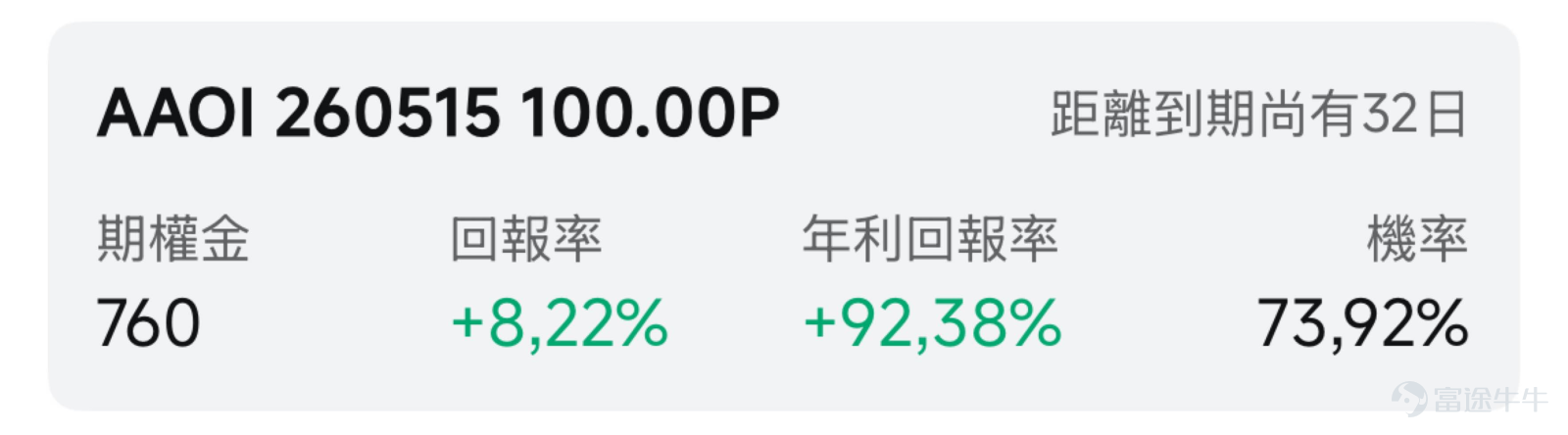
1、Sell 1 contract $Applied Optoelectronics (AAOI.US)$20260515 100P, estimated required margin (for reference only): $10000 ($100 × 100)

Opportunity filtering logic:The main logic driving AAOI's surge lies in the explosive demand for AI optical modules and the landing of super orders. In the short term, there are no negative catalysts in the optical module industry, with capital inflows reinforcing the upward trend. However, the technical picture shows overbought conditions, warranting caution against potential pullbacks from elevated levels.At this point, by selling puts, if the stock price continues to rise or consolidates at higher levels, substantial option premiums can be collected, enhancing the annualized return on idle funds. If the stock pulls back to $100, it presents an opportunity to acquire shares at a lower cost and position into the optical communication sector.
2、Sell 1 contract $Marvell Technology (MRVL.US)$ 20260515 110P, estimated required margin (for reference only): $11000 ($110 × 100)

Opportunity filtering logic:After MRVL's share price hit a new all-time high, it may face profit-taking pressure. Options market data shows that the Put/Call open interest ratio for MRVL is 1.21, indicating that some institutions are using options strategies to hedge against potential pullback risks.At this point, by selling puts, if the stock price continues to rise or consolidates at higher levels, substantial option premiums can be collected, enhancing the annualized return on idle funds. If the stock pulls back to $110, it provides an opportunity to take advantage of the dip and position into MRVL.
IV. Risk Control Reminder
Position management is key:The biggest risk for the seller strategy lies in black swan events.It is recommended that the margin占用 for a single position should not exceed 20% of the total funds. Never sell options beyond your capacity to handle them just for the sake of greedy premium collection.
Cash-secured put options should beware of 'left-tail risk':For cash-secured puts,if the stock price collapses due to deteriorating fundamentals (rather than normal pullbacks), don’t hold on stubbornly.At this point, it's advisable to cut losses or 'roll down' to gain time, waiting for volatility to normalize.
Case Selection Criteria
Open Futubull >> Market >> Options >> Seller Zone >> Filter; Common screening criteria for Cash Secured Put and Covered Call strategies: IV Percentile > 40%; Total option volume > 60,000 contracts; Days to expiration 0-45 days; Daily option volume/open interest > 500 contracts; ROI > 2%; Annualized ROI > 30%. Cash Secured Put: OTM Probability > 60%; Covered Call: OTM Probability > 70%;
Underlying selection rule: For each strategy, select the underlying asset with the highest probability of profit. Probability refers to the likelihood that the option contract will not be exercised, i.e., the out-of-the-money probability. The higher the probability, the lower the chance of assignment, and the greater the likelihood of earning steady option premiums. Data source: Futubull, information as of the closing price of the previous trading day; All data and information in the Option Seller Zone are for reference only and do not constitute any investment advice.
*This event is exclusive to invited HK users. Click to learn more.Detailed event rules>>

Options Risk Warning
An option is a contract that grants the holder the right, but not the obligation, to buy or sell an asset at a fixed price on a specific date or at any time before that date. The price of an option is influenced by various factors, including the current price of the underlying asset, the strike price, time to expiration, and implied volatility. Implied volatility reflects the market’s expectations for the level of volatility in the option over a future period. It is a data point derived inversely from the Black-Scholes option pricing model and is generally regarded as an indicator of market sentiment. When investors anticipate greater volatility, they may be more willing to pay a higher price for options to hedge risks, resulting in higher implied volatility. Traders and investors use implied volatility to assess the attractiveness of option prices, identify potential mispricings, and manage risk exposure.
Disclaimer
This content does not constitute any offer, solicitation, recommendation, opinion, or guarantee of any securities, financial products, or tools. The risk of loss in trading options can be substantial. In some cases, losses may exceed the initial margin deposited. Even if you set contingent orders such as 'stop-loss' or 'limit' orders, these may not prevent losses. Market conditions may make such orders unexecutable. You may be required to deposit additional margin within a short period. If you fail to provide the required amount within the specified time, your open positions may be liquidated. However, you will still be responsible for any shortfall in your account. Therefore, before trading, you should study and understand options and carefully consider whether such trading is suitable for you based on your financial situation and investment objectives. If you trade options, you should be familiar with the procedures for exercising options and the rights and obligations upon exercise and expiration. Options trading carries extremely high risks and is not suitable for all investors. Investors should carefully readCharacteristics and Risks of Standardized Options。
Risk Disclaimer: The above content only represents the author's view. It does not represent any position or investment advice of Futu. Futu makes no representation or warranty.Read more
Comments
to post a comment
19
20