
Over the past year, the new consumer sector in Hong Kong stocks has gained significant attention, and market expectations for new consumer companies have notably increased. Investors are no longer just focused on revenue growth but are more concerned about the quality behind that growth: whether it can be sustained, whether profit margins can improve, and whether the business model can endure through cycles.
The day before yesterday, Mingming Busy disclosed its first annual report since going public. Compared to merely looking at revenue and store counts, I believe what makes this earnings report more noteworthy is that during its continuous expansion, the company has already shown a simultaneous improvement in store operational efficiency and profitability.
After all, for a retail company still in rapid expansion, only by operating stores better can subsequent expansions proceed more steadily and over the long term.
I. Running quality stores enables opening more stores
If we only look at the surface-level data, this annual report itself is already impressive enough.
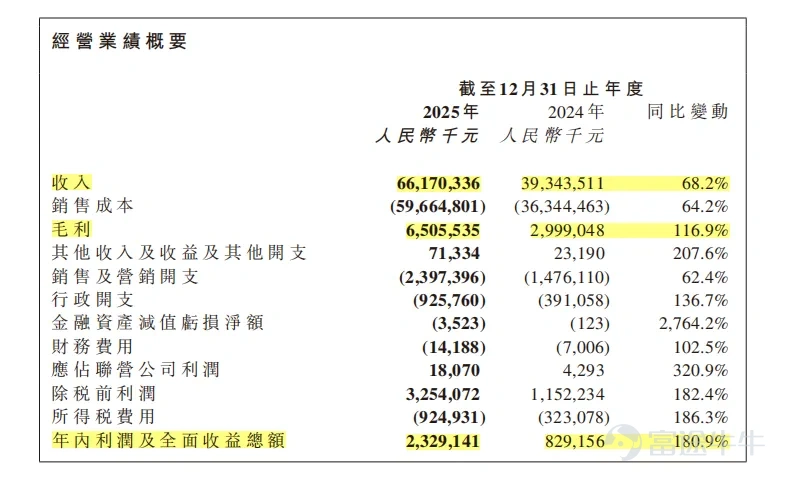
In 2025, Mingming Busy’s store GMV reached 93.569 billion yuan, a year-on-year increase of 68.5%; revenue amounted to 66.170 billion yuan, growing by 68.2% year-on-year. By the end of 2025, the total number of stores reached 21,948, an increase of 7,554 from 14,394 at the end of 2024.
The most important signal from this earnings report is that Mingming Busy has begun to demonstrate stronger operating leverage. For a company with over 20,000 stores, when profit margins improve, the corresponding economies of scale become very substantial.

According to management statements, store profitability in 2025 reached its highest historical level, and same-store performance this year may outperform 2025.
Before this earnings report, the market had been concerned that as the store network expanded, store revenues and profitability might be diluted—a common concern during the expansion phase of many chain consumer companies. However, so far, I haven't seen this issue with Mingming Busy.
For a bulk snack enterprise with over 20,000 stores, this is particularly commendable.
In addition to revenue and store count, profit margins also showed positive changes.
By 2025, Mingming Busy’s gross margin increased to 9.8%, up 2.2% from 7.6% in 2024.
Although the increase in gross margin may not seem particularly large on the surface, for a company of this scale, the operational leverage is very significant.

For example, if we look at last year’s profit levels.
In 2025, the company's annual profit reached 2.329 billion yuan, representing a year-on-year growth of 180.9%; the adjusted net profit was 2.692 billion yuan, a substantial increase from 913 million yuan in 2024.
The main reasons behind this are twofold: first, by procuring directly from manufacturers, the company reduced intermediary steps, and with the increase in procurement scale, its bargaining power with suppliers improved further; second, the collaborative efficiency of the supply chain, warehousing, logistics, and digital systems continued to rise. Meanwhile, optimization of the product mix likely contributed positively to the improvement in gross margin.
Profit growth significantly outpaced revenue growth, indicating that Mingming Busy's revenue expansion is no longer solely reliant on store openings, but also involves an increase in profitability of existing stores alongside scale expansion.

More importantly, this growth is not built on aggressive financial leverage but instead reflects ongoing improvements in the financial structure, entering a healthier positive cycle.
Financially, by the end of 2025, the company held 3.737 billion yuan in cash and cash equivalents, along with restricted cash totaling 3.744 billion yuan, reflecting a year-on-year increase of approximately 90%; the debt-to-asset ratio decreased from 43.7% to 35.8%; and there were no interest-bearing bank loans as of year-end.
If we delve deeper into specific items on the balance sheet, this improvement becomes even clearer. First, prepayments, deposits, and other receivables fell from 2.341 billion yuan at the end of 2024 to 1.936 billion yuan at the end of 2025, marking a year-on-year decrease of 17.3%. The company explicitly stated in its annual report that this was mainly due to reduced advance payments to suppliers, reflecting more active management of prepayment terms.
At the same time, trade payables and notes payable also decreased from 1.495 billion yuan to 1.177 billion yuan, representing a year-on-year decrease of 21.3%. The annual report attributes this to the company's enhanced management measures for accounts payable and notes payable. In other words, the company did not support its expansion by extending payment terms but instead optimized the management of upstream settlement cycles during the expansion process.

According to management statements, even as the scale continues to expand this year, with an increase in absolute amounts, the overall expense ratio has remained largely unchanged, and there is still room for further optimization going forward.
For a retail company that is still expanding rapidly, high growth in revenue and profits, along with continued improvement in the balance sheet and room for further improvements, is relatively rare among similar retail enterprises.

II. Efficiency Spillover from 20,000 Stores
Before Mingming Is Busy went public, many investors were curious about how such a low-price model could work and how the company managed to achieve profitability despite the low prices.
In the bulk snack industry, while it may appear on the surface to be about selling cheap snacks—some products are priced so low that consumers find it hard to believe—the essence of competition is not about being 'cheap' but rather about supply chain efficiency.
Mingming Is Busy reduces intermediary steps by sourcing directly from manufacturers. It leverages large-scale procurement to enhance bargaining power, then uses digitalization, warehousing, logistics, and franchise management to transmit these efficiencies to stores and consumers.
By the end of 2025, the company had established cooperative relationships with over 2,500 manufacturers, operating 56 warehouses with a total area of approximately 1.232 million square meters; stores are typically located within 300 kilometers of the nearest warehouse, allowing for delivery within 24 hours in most cases; the digital team consists of 432 members, with systems covering key areas such as store management, supply chain, inventory control, and the franchise system.
These figures may not seem as intuitive as revenue and profit, but the underlying investments that aren't visible determine why Mingming Is Busy can achieve 'high quality at a good price,' which forms the foundation for its ability to consistently offer high-quality products at competitive prices.
The concept of 'quality-price ratio' does not simply involve lowering prices but achieving savings by improving direct sourcing, warehousing, replenishment, and operational efficiency, thereby reducing costs traditionally lost in the supply chain, and passing those savings back to consumers.
From the consumer's perspective, we see 'cheaper products, more choices, faster updates,' but what truly drives these are the continuous optimization of the supply chain and the accumulation of organizational capabilities.
This is actually a characteristic of the bulk snack industry.
The larger the scale, the stronger the bargaining power; the stronger the bargaining power, the better the price-to-quality ratio; the better the price-to-quality ratio, the stronger the consumer demand; the stronger the consumer demand, the more the store network and scale effect will be amplified. This process is essentially a virtuous cycle where efficiency overflows, demand amplifies, and profits are released, all mutually reinforcing each other.
Three, how should Mingming Be Busy position itself in the future?
Considering the above perspectives, I believe that moving forward, we should change our understanding of Mingming Be Busy.
From an investor's perspective, the market’s future view of Mingming Be Busy may no longer just focus on 'how many more bulk snack stores can be opened,' but rather see it as an already established nationwide high-efficiency retail network.
In the future, the market may evaluate bulk snack companies like Mingming Be Busy based on the principle that good stores lead to more openings, gradually shifting from a 'store expansion logic' to one that emphasizes both expansion development and operational quality-efficiency.
From the consumer's perspective, what Mingming Be Busy offers is not just snacks themselves, but a high-frequency, low-barrier consumption supply that integrates into community life, satisfying everyday, low-decision, small-amount consumption needs: close to home, friendly prices, diverse choices, and fast updates.
Precisely because of this, Mingming Be Busy's store network has been able to penetrate counties, towns, and community streets, gradually forming a retail reach that closely aligns with everyday life scenarios. This is cross-cycle 'inclusive retail,' which is needed in any era.
In this sense, for consumers, it is becoming increasingly like a community-focused consumption entry point, rather than just a brand that sells snacks.
In terms of store distribution, by the end of 2025, the company's stores will reach 21,948, covering all 30 provinces and every city tier nationwide. Approximately 60% of these are located in county towns and rural townships, covering 1,401 counties with a national county coverage rate of about 75%.
There is still room for expansion in the number of stores in first- and second-tier cities. As consumers' awareness of high-quality snack channels gradually deepens, such stores also have the opportunity to build stronger consumer loyalty.
Several in-depth reports published by brokerages in March this year continue to emphasize that there is still considerable theoretical space for store openings nationwide. Some research, using Hunan’s mature market as a benchmark, estimates the theoretical nationwide store opening potential at approximately 100,000. Some sell-side analysts believe that China's bulk snack and beverage retail market size will be around 129.7 billion yuan in 2024 and is expected to reach 613.7 billion yuan by 2029, remaining in a high-growth track.

Conclusion
After the release of its first annual report, the market responded relatively positively to Mingming Very Busy’s performance and its guidance for continued expansion this year, with the stock price already seeing an increase.
Although recent geopolitical conflicts have weighed on the broader market, leading to weaker overall performance, once risk appetite recovers in subsequent trading, it is believed that the market will gradually recognize the significant improvement in the company's fundamentals, dispelling doubts about growth. When the new consumption trend returns, the company is expected to deliver strong performance.
Risk Disclaimer: The above content only represents the author's view. It does not represent any position or investment advice of Futu. Futu makes no representation or warranty.Read more
Comments
to post a comment
