
English
Back
Open Account
半导体行业观察
wrote a column · Mar 31 15:50

In the era of edge AI, storage has changed: Longsys launches full-scale efforts

The development over the past few years has proven that artificial intelligence is an established fact. Major model developers and infrastructure providers have successively joined the 'infrastructure race' to improve the capabilities and competitiveness of their models. However, another long-standing issue that has accompanied the birth of artificial intelligence — when will AI move from the cloud to terminal deployment — has garnered significant attention for many years.
With this question in mind, vendors around the world have made various attempts. For example, the 'lobster farming' craze ignited by OpenClaw since the end of last year is one typical scenario. This wave has further convinced everyone that 2026 will indeed be the first year of large-scale AI deployment.
To seize this opportunity, industry practitioners have, as always, developed corresponding software and hardware products based on different AI stages’ varying performance requirements. Among these, storage, which has moved to the forefront over the past six months, is undoubtedly the top priority. As a leading domestic semiconductor storage brand, Longsys has already made full preparations.
Edge AI Storage: Three Core Requirements
As is well known, during the wave of AI development before 2026, training was the main theme of the industry. The core task of its storage system was to handle massive data throughput amounting to trillions of tokens and meet the instantaneous writing demands of high-frequency, highly concurrent checkpoints during model training, ensuring that expensive GPUs do not stall due to I/O bottlenecks. Therefore, the industry focus at that time was entirely on read/write performance and reliability for supporting large-scale computing clusters. This is also one of the reasons why HBM and large-capacity SSDs have been highly sought after in recent years.
However, as we enter the field of edge AI applications, storage has changed.
Huang Qiang, Vice President of Longsys and General Manager of the Embedded Storage Division, pointed out during exchanges with Semiconductor Industry Observers at CFM | MemoryS 2026 that for edge AI applications, since they mainly focus on inference applications, their integration with application scenarios will be tighter, and there may be some differentiation, or even portability requirements. This necessitates better innovation in power consumption, performance, and size.
“Whether it’s training or inference, a key issue remains — the waste of efficiency (or computing power). Additionally, high costs, especially high token costs, pose significant challenges for edge AI. As a result, the industry hopes to introduce a hierarchical approach to storage processing to address these problems in a more granular way,” added Yan Shuyin, Vice President of Longsys and General Manager of the Enterprise Storage Division.
Indeed, in edge AI (such as AI smartphones, AI PCs, and smart cockpits), because the VRAM of edge SoCs is shared with the system memory, running large models requires constantly occupying several GBs of high-speed space, which directly compresses system smoothness and imposes extremely demanding bandwidth requirements on LPDDR5/5x to support real-time token generation. At the same time, to reduce high token computation costs and improve response speed, the system must frequently schedule large KV Caches (key-value caches). This ‘high-frequency, small-block, long-retention’ data access pattern forces underlying flash memory (UFS/SSD) to evolve from being a simple storage medium to adopting smarter methods to solve the sharp increase in power consumption and heating caused by frequent data transfers.
To solve this problem, apart from technological investments, innovation at the system level is also urgently needed.
The development over the past few years has proven that artificial intelligence is an established fact. Major model developers and infrastructure providers have successively joined the 'infrastructure race' to improve the capabilities and competitiveness of their models. However, another long-standing issue that has accompanied the birth of artificial intelligence — when will AI move from the cloud to terminal deployment — has garnered significant attention for many years. With this question in mind, vendors around the world have made various attempts. For example, the 'lobster farming' craze ignited by OpenClaw since the end of last year is one typical scenario. This wave has further convinced everyone that 2026 will indeed be the first year of large-scale AI deployment. To seize this opportunity, industry practitioners have, as always, developed corresponding software and hardware products based on different AI stages’ varying performance requirements. Among these, storage, which has moved to the forefront over the past six months, is undoubtedly the top priority. As a leading domestic semiconductor storage brand, Longsys has already made full preparations. Edge AI Storage: Three Core Requirements As is well known, during the AI construction boom before 2026, training was the main theme of the industry. The core task of its storage system was to handle massive data throughput of trillions of tokens and address the high-frequency, high-concurrency instantaneous checkpoint write demands in model training, ensuring expensive GPUs do not stall due to I/O bottlenecks. Therefore, the industry's focus was entirely concentrated on...
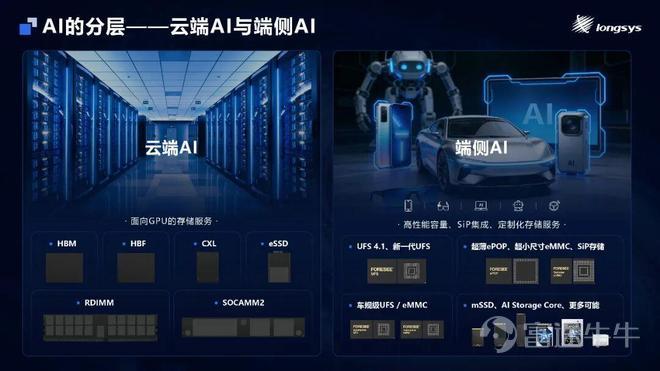
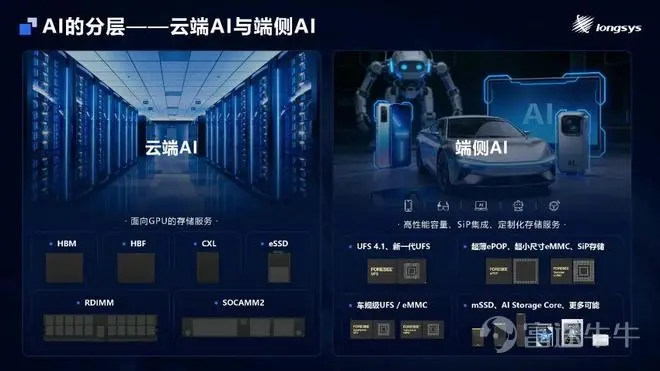
Based on over two decades of deep involvement and insights into the storage industry, Cai Huabo, Chairman and General Manager of Longsys, stated directly during his speech at the CFM | MemoryS 2026 summit: “Edge AI also requires deeply integrated customized storage solutions rather than generic standard storage products.” He further noted, “Cloud AI focuses on professional storage services for GPUs, while edge AI revolves around three core needs: high-performance capacity, SiP system-level integration packaging, and customized services. Its storage requirements fundamentally differ from the past standard storage ecosystem.”
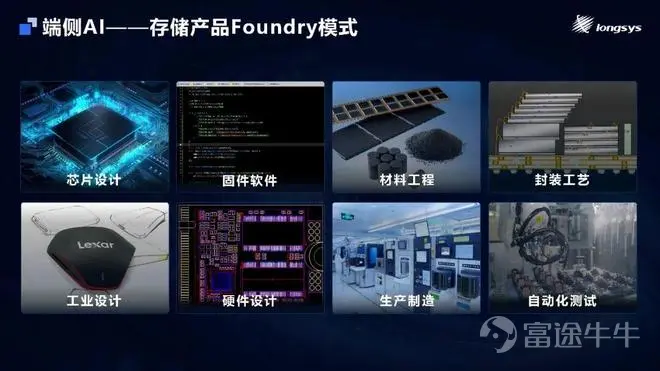
With this understanding, capabilities spanning chip design, firmware algorithms, material engineering, packaging, and testing manufacturing have been built up to undertake custom storage services for edge AI in a foundry model, breaking through the bottleneck of traditional single-dimensional storage upgrades and achieving comprehensive improvements.
The development over the past few years has proven that artificial intelligence is an established fact. Major model developers and infrastructure providers have successively joined the 'infrastructure race' to improve the capabilities and competitiveness of their models. However, another long-standing issue that has accompanied the birth of artificial intelligence — when will AI move from the cloud to terminal deployment — has garnered significant attention for many years. With this question in mind, vendors around the world have made various attempts. For example, the 'lobster farming' craze ignited by OpenClaw since the end of last year is one typical scenario. This wave has further convinced everyone that 2026 will indeed be the first year of large-scale AI deployment. To seize this opportunity, industry practitioners have, as always, developed corresponding software and hardware products based on different AI stages’ varying performance requirements. Among these, storage, which has moved to the forefront over the past six months, is undoubtedly the top priority. As a leading domestic semiconductor storage brand, Longsys has already made full preparations. Edge AI Storage: Three Core Requirements As is well known, during the AI construction boom before 2026, training was the main theme of the industry. The core task of its storage system was to handle massive data throughput of trillions of tokens and address the high-frequency, high-concurrency instantaneous checkpoint write demands in model training, ensuring expensive GPUs do not stall due to I/O bottlenecks. Therefore, the industry's focus was entirely concentrated on...
According to Cai Huabo, this model covers core links of the entire industrial chain, including chip design, hardware design, firmware software, packaging technology, industrial design, automated testing, material engineering, and production manufacturing. Through deep collaboration, technical integration, and open capabilities across all stages, it achieves full-link customization and efficiency in storage products from design to delivery, accurately matching diverse scenarios such as AI smartphones, AI-assisted driving, AI wearables, AI PCs, and embodied robots. It anchors clear scenario-oriented innovations for edge AI storage, complementing cloud AI storage.
Continuous Innovation + Technological Breakthroughs: Longsys Leads the AI Endpoint Storage Race
With over two decades of deep cultivation in the semiconductor storage field, Longsys has consistently responded to the storage demands of the endpoint AI era with innovative products, thanks to its profound accumulation in full-chain R&D, design, and manufacturing capabilities. At MemoryS 2026, Longsys showcased its leading products and technologies—a new generation of PCIe Gen5 mSSD high-speed storage media and SPU storage processors + iSA intelligent storage agents—offering a hardware-software collaborative innovation approach that addresses the performance, capacity, and scheduling challenges of endpoint AI storage, demonstrating its advanced positioning in this domain.
1.New Generation High-Speed Storage Media PCIe Gen5 mSSD: Compact Size with Big Power, Dual Breakthroughs in Heat Dissipation and Performance
As a new generation of high-speed storage media designed for endpoint AI devices, Longsys' PCIe Gen5 mSSD highlights 'small size, high performance, and multi-form factor,' precisely meeting the core needs of terminal devices like AI PCs. This product continues with the DRAM-less architecture and an ultra-compact size of 20×30mm, fully compatible with the M.2 2230 specification, and can flexibly evolve into multiple form factors such as M.2 2242/2280, AI storage cards, and PSSDs, enabling flexible deployment across various scenarios.
In terms of performance, this mSSD is equipped with the Maxio 1802 controller chip, delivering sequential read and write speeds of up to 11GB/s and 10GB/s respectively, with peak random read and write performance reaching 2,200K and 1,800K IOPS. The single-drive capacity supports up to 8TB, meeting the high-speed read and write requirements for massive data during AI PC operations.
The development over the past few years has proven that artificial intelligence is an established fact. Major model developers and infrastructure providers have successively joined the 'infrastructure race' to improve the capabilities and competitiveness of their models. However, another long-standing issue that has accompanied the birth of artificial intelligence — when will AI move from the cloud to terminal deployment — has garnered significant attention for many years. With this question in mind, vendors around the world have made various attempts. For example, the 'lobster farming' craze ignited by OpenClaw since the end of last year is one typical scenario. This wave has further convinced everyone that 2026 will indeed be the first year of large-scale AI deployment. To seize this opportunity, industry practitioners have, as always, developed corresponding software and hardware products based on different AI stages’ varying performance requirements. Among these, storage, which has moved to the forefront over the past six months, is undoubtedly the top priority. As a leading domestic semiconductor storage brand, Longsys has already made full preparations. Edge AI Storage: Three Core Requirements As is well known, during the AI construction boom before 2026, training was the main theme of the industry. The core task of its storage system was to handle massive data throughput of trillions of tokens and address the high-frequency, high-concurrency instantaneous checkpoint write demands in model training, ensuring expensive GPUs do not stall due to I/O bottlenecks. Therefore, the industry's focus was entirely concentrated on...
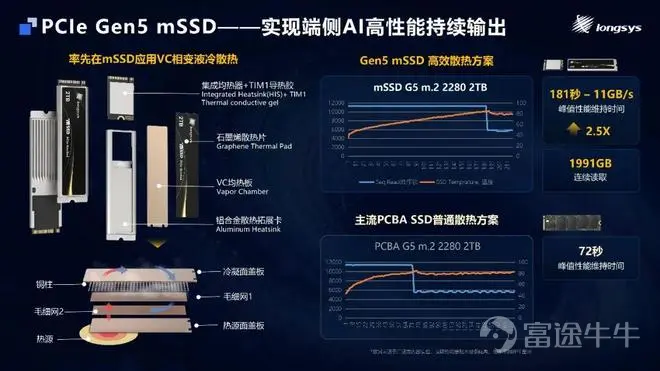
As Cai Huabo mentioned in his speech, 'The development of endpoint AI storage heavily relies on material engineering capabilities, with heat dissipation materials being a core technological challenge.' Regular Gen5 SSDs require effective heat dissipation, typically incorporating bulky heat sinks, making them suitable only for larger desktop computers. To address the heat dissipation issues associated with the compact size and high-performance operation of PCIe Gen5 mSSD, Longsys pioneered an exclusive high-efficiency cooling solution—integrating a vapor chamber, TIM1 thermal paste, graphene heat dissipation sheets, VC vapor chambers, and aluminum alloy heat dissipation expansion cards. These components are lightweight and thinner. Compared to conventional cooling solutions, Longsys' PCIe Gen5 mSSD maintains its peak performance of 11GB/s for up to 181 seconds, with continuous read capacity reaching 1,991GB—nearly 2.5 times that of standard PCBA SSD cooling solutions. This solution is specifically designed for high-load AI PC KV Cache scenarios, enabling real-time Gen5 high-performance throughput while maintaining compatibility with ultra-thin AI PC designs, balancing both high performance and device form factor requirements.
The development over the past few years has proven that artificial intelligence is an established fact. Major model developers and infrastructure providers have successively joined the 'infrastructure race' to improve the capabilities and competitiveness of their models. However, another long-standing issue that has accompanied the birth of artificial intelligence — when will AI move from the cloud to terminal deployment — has garnered significant attention for many years. With this question in mind, vendors around the world have made various attempts. For example, the 'lobster farming' craze ignited by OpenClaw since the end of last year is one typical scenario. This wave has further convinced everyone that 2026 will indeed be the first year of large-scale AI deployment. To seize this opportunity, industry practitioners have, as always, developed corresponding software and hardware products based on different AI stages’ varying performance requirements. Among these, storage, which has moved to the forefront over the past six months, is undoubtedly the top priority. As a leading domestic semiconductor storage brand, Longsys has already made full preparations. Edge AI Storage: Three Core Requirements As is well known, during the AI construction boom before 2026, training was the main theme of the industry. The core task of its storage system was to handle massive data throughput of trillions of tokens and address the high-frequency, high-concurrency instantaneous checkpoint write demands in model training, ensuring expensive GPUs do not stall due to I/O bottlenecks. Therefore, the industry's focus was entirely concentrated on...
2.SPU + iSA: Hardware-Software Synergy Empowering Intelligent Endpoint AI Storage
If the high-speed storage medium PCIe Gen5 mSSD is the 'high-speed carrier' for endpoint AI storage, then Longsys' newly released combination of SPU (Storage Processing Unit) and the first iSA (Intelligent Storage Agent) forms a 'chip hardware + intelligent scheduling' closed-loop technology synergy for endpoint AI storage.
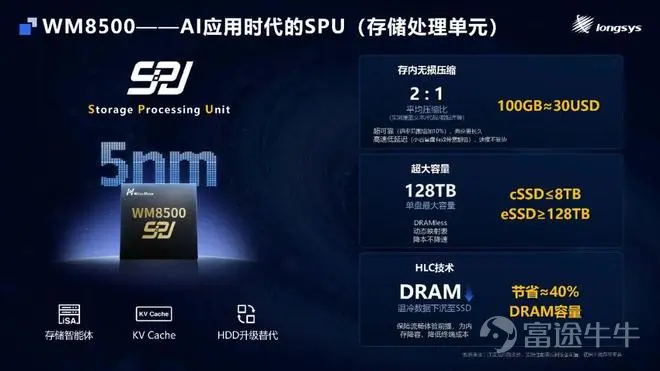
Unlike regular SSD controller chips, the SPU is Longsys’ core intelligent processing unit specifically designed for the AI application era. As Yan Shuyin from Longsys explained, 'The SPU acts like an intelligent processor at the endpoint, not just performing traditional passive data storage but actively managing storage instructions.'
Built on a 5nm advanced process technology, the chip offers a maximum single-drive capacity of 128TB, whereas mainstream cSSDs currently max out at 8TB, and large-capacity eSSD solutions come at a higher cost. The SPU effectively balances capacity and cost challenges, providing a cost-efficient alternative to HDDs, offering customers new possibilities for exploring eSSD solutions while potentially significantly reducing total cost of ownership. The SPU features two key capabilities: lossless in-memory compression and HLC (High-Level Cache) advanced caching technology. The average compression ratio for lossless in-memory compression reaches 2:1, tested across various data types including text, code, and databases, significantly saving SSD capacity and costs. Additionally, it uses HLC technology to offload warm and cold data to the SSD, reducing DRAM capacity needs by nearly 40%.
The development over the past few years has proven that artificial intelligence is an established fact. Major model developers and infrastructure providers have successively joined the 'infrastructure race' to improve the capabilities and competitiveness of their models. However, another long-standing issue that has accompanied the birth of artificial intelligence — when will AI move from the cloud to terminal deployment — has garnered significant attention for many years. With this question in mind, vendors around the world have made various attempts. For example, the 'lobster farming' craze ignited by OpenClaw since the end of last year is one typical scenario. This wave has further convinced everyone that 2026 will indeed be the first year of large-scale AI deployment. To seize this opportunity, industry practitioners have, as always, developed corresponding software and hardware products based on different AI stages’ varying performance requirements. Among these, storage, which has moved to the forefront over the past six months, is undoubtedly the top priority. As a leading domestic semiconductor storage brand, Longsys has already made full preparations. Edge AI Storage: Three Core Requirements As is well known, during the AI construction boom before 2026, training was the main theme of the industry. The core task of its storage system was to handle massive data throughput of trillions of tokens and address the high-frequency, high-concurrency instantaneous checkpoint write demands in model training, ensuring expensive GPUs do not stall due to I/O bottlenecks. Therefore, the industry's focus was entirely concentrated on...
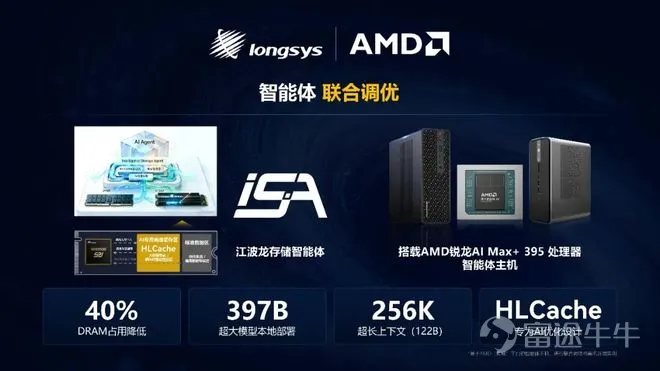
The iSA storage intelligent agent is a dedicated intelligent scheduling engine for on-device AI inference, acting as the 'brain' of the SPU. Its core value lies in addressing the pain points of storage scheduling during on-device AI inference. With the widespread application of large MoE models, issues such as vast parameters, rapid KV Cache expansion, and I/O latency affecting inference smoothness have become increasingly prominent. The iSA significantly enhances storage scheduling efficiency through MoE expert offloading, intelligent KV Cache management, and smart prefetching algorithms.
The deep collaboration between Longsys and AMD has fully validated the strength of this technological combination. Both parties conducted joint optimization based on the Ryzen AI Max+ 395 processor-powered intelligent host, successfully achieving local deployment of an ultra-large 397B model. In scenarios with an ultra-long context of 256K (122B), DRAM usage was reduced by nearly 40%, offering an innovative and practical solution for the efficient local deployment and scaled application of ultra-large models. As a long-term partner of AMD, this joint optimization further deepens the synergy between their ecosystems, and both will continue to leverage their respective technical strengths to advance the development of the on-device AI storage ecosystem.
The development over the past few years has proven that artificial intelligence is an established fact. Major model developers and infrastructure providers have successively joined the 'infrastructure race' to improve the capabilities and competitiveness of their models. However, another long-standing issue that has accompanied the birth of artificial intelligence — when will AI move from the cloud to terminal deployment — has garnered significant attention for many years. With this question in mind, vendors around the world have made various attempts. For example, the 'lobster farming' craze ignited by OpenClaw since the end of last year is one typical scenario. This wave has further convinced everyone that 2026 will indeed be the first year of large-scale AI deployment. To seize this opportunity, industry practitioners have, as always, developed corresponding software and hardware products based on different AI stages’ varying performance requirements. Among these, storage, which has moved to the forefront over the past six months, is undoubtedly the top priority. As a leading domestic semiconductor storage brand, Longsys has already made full preparations. Edge AI Storage: Three Core Requirements As is well known, during the AI construction boom before 2026, training was the main theme of the industry. The core task of its storage system was to handle massive data throughput of trillions of tokens and address the high-frequency, high-concurrency instantaneous checkpoint write demands in model training, ensuring expensive GPUs do not stall due to I/O bottlenecks. Therefore, the industry's focus was entirely concentrated on...
3.Full On-Device Implementation of HLC Technology: Solving the Performance-Cost Balance Challenge
In response to the issue of rising memory chip prices driving up the cost of end-user products like smartphones, Longsys released its self-developed HLC (High-Level Cache) technology earlier this year. By deeply integrating HLC with SPU and UFS, Longsys successfully implemented the technology across all on-device scenarios for AI PCs and embedded devices, precisely addressing the industry's core challenge of balancing performance and cost. This provides high-cost-performance storage solutions for product iteration in end-user devices.
On the AI PC side, HLC technology relies on SPU to achieve a tiered architecture design. The performance layer is specifically optimized for AI with a dedicated high-speed cache area, efficiently handling the offloading of large model experts/key-value pairs to ensure smooth on-device AI inference. The storage layer handles operating system and general data storage tasks using intelligent strategies such as prioritized read/write operations and low-priority I/O scheduling. While significantly enhancing the AI user experience, it effectively reduces the DRAM capacity requirements for end-user devices, thereby compressing hardware costs while achieving a balance between performance and cost.
On the embedded side, Longsys conducted in-depth joint development with Unisoc. Test data from Unisoc’s chip platform fully demonstrates the advantages of HLC technology: when paired with 4GB DDR, HLC technology enabled 20 apps to launch in just 851ms, with performance comparable to configurations with 6GB or 8GB DDR. Meanwhile, Longsys’ UFS 2.2 product, equipped with the WM7200 controller using a 14nm process, achieved breakthrough performance, with sequential read and write speeds reaching up to 1070MB/s and 1000MB/s, respectively, and random read/write IOPS reaching up to 240K and 210K. The performance exceeds industry mainstream levels, ensuring smooth device operation and component longevity while further reducing DRAM needs and optimizing overall BOM costs, meeting the low-cost, high-performance demands of embedded devices.
The development over the past few years has proven that artificial intelligence is an established fact. Major model developers and infrastructure providers have successively joined the 'infrastructure race' to improve the capabilities and competitiveness of their models. However, another long-standing issue that has accompanied the birth of artificial intelligence — when will AI move from the cloud to terminal deployment — has garnered significant attention for many years. With this question in mind, vendors around the world have made various attempts. For example, the 'lobster farming' craze ignited by OpenClaw since the end of last year is one typical scenario. This wave has further convinced everyone that 2026 will indeed be the first year of large-scale AI deployment. To seize this opportunity, industry practitioners have, as always, developed corresponding software and hardware products based on different AI stages’ varying performance requirements. Among these, storage, which has moved to the forefront over the past six months, is undoubtedly the top priority. As a leading domestic semiconductor storage brand, Longsys has already made full preparations. Edge AI Storage: Three Core Requirements As is well known, during the AI construction boom before 2026, training was the main theme of the industry. The core task of its storage system was to handle massive data throughput of trillions of tokens and address the high-frequency, high-concurrency instantaneous checkpoint write demands in model training, ensuring expensive GPUs do not stall due to I/O bottlenecks. Therefore, the industry's focus was entirely concentrated on...
4.On-Device AI SiP Technology: Self-Developed Empowerment Leveraging Supply Chain Strengths
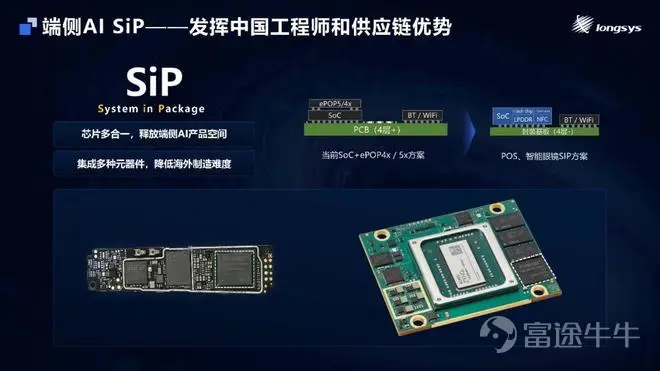
Additionally, leveraging the advantage of self-developed capabilities by Chinese engineers, Longsys completed the full-process design of SiP (System in Package) technology, establishing another core competency in on-device AI storage. This technology integrates multiple types of chips, such as SoC, eMMC/UFS, LPDDR, WiFi, Bluetooth, and NFC, into a single package, achieving a high level of hardware integration.
For end-user products with strict requirements on space, slimness, and heat dissipation—such as AI glasses, smartwatches, and POS machines—the SiP integrated solution significantly reduces hardware size, optimizes device structural layout, and improves heat dissipation performance, making it a highly competitive preferred solution for such devices. Furthermore, Longsys leverages the core capabilities of the domestic supply chain to maximize the benefits of SiP technology, not only saving internal space for on-device AI products but also converting these technological advantages into tangible value for overseas manufacturing, substantially reducing manufacturing complexity abroad. This allows flexible adaptation to product requirements in different global markets, further enhancing the global competitiveness of Chinese storage companies.
The development over the past few years has proven that artificial intelligence is an established fact. Major model developers and infrastructure providers have successively joined the 'infrastructure race' to improve the capabilities and competitiveness of their models. However, another long-standing issue that has accompanied the birth of artificial intelligence — when will AI move from the cloud to terminal deployment — has garnered significant attention for many years. With this question in mind, vendors around the world have made various attempts. For example, the 'lobster farming' craze ignited by OpenClaw since the end of last year is one typical scenario. This wave has further convinced everyone that 2026 will indeed be the first year of large-scale AI deployment. To seize this opportunity, industry practitioners have, as always, developed corresponding software and hardware products based on different AI stages’ varying performance requirements. Among these, storage, which has moved to the forefront over the past six months, is undoubtedly the top priority. As a leading domestic semiconductor storage brand, Longsys has already made full preparations. Edge AI Storage: Three Core Requirements As is well known, during the AI construction boom before 2026, training was the main theme of the industry. The core task of its storage system was to handle massive data throughput of trillions of tokens and address the high-frequency, high-concurrency instantaneous checkpoint write demands in model training, ensuring expensive GPUs do not stall due to I/O bottlenecks. Therefore, the industry's focus was entirely concentrated on...
As the wave of artificial intelligence shifts from the hubbub of large model centers to the end-user devices of countless households, the role of storage has transformed from being a cold data container to becoming the core engine empowering physical-world intelligence.
Longsys' major push at CFMS 2026 marks the beginning of a new era in high-performance storage for edge AI. In this ultimate competition concerning efficiency, power consumption, and cost, only pioneers like Longsys with full-chain innovation capabilities can anchor their positions amidst changes, not only helping AI truly migrate from the cloud to all terminals but also contributing a pioneering model for Chinese storage companies in reshaping the global storage industry landscape.
Longsys also emphasized that the company will adhere to the concept of 'Everything for Memory' in the future, continuing to focus on the storage sector, with technological innovation as the core driving force. By collaborating with global industry chain partners, it aims to jointly promote the innovative development of the edge AI industry.
Risk Disclaimer: The above content only represents the author's view. It does not represent any position or investment advice of Futu. Futu makes no representation or warranty.Read more
3851 Views
Report
Comments
Write a Comment...