
English
Back
Open Account
Earnings reports from Chinese giants raise concerns! Is it a good time to buy on dips?
Futubull Options Sir
joined discussion · Mar 18 11:32 ·

Earnings Options Strategy | Alibaba: AI Narrative Faces Crucial Test, Can Cloud Growth Offset E-commerce and Profitability Pressures?

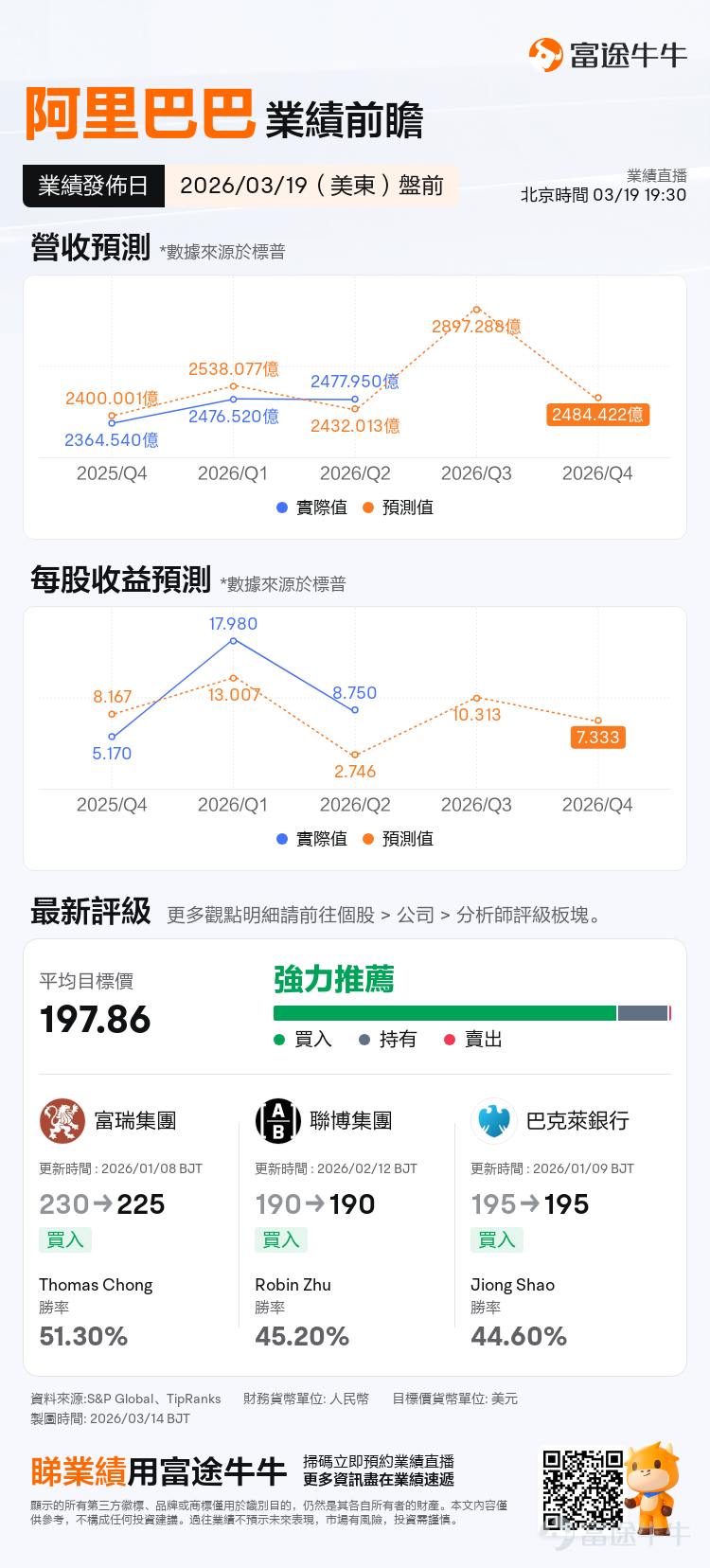
$Alibaba (BABA.US)$ $BABA-W (09988.HK)$ The earnings report will be released pre-market on March 19 Eastern Time;According to institutional forecasts, for Q3 of fiscal year 2026 (corresponding to the December quarter of 2025), revenue is expected to reach 289.729 billion yuan, representing a year-over-year increase of 3.42%; earnings per share are expected to be 10.313 yuan, reflecting a year-over-year decrease of 49.42%. The above data follows the US-GAAP accounting standard.
As of March 17, $Alibaba (BABA.US)$The stock price is approximately $136, up from the level reached in October last year 52-week high of $192Still down approximately 29%, and has been in a retracement state since the beginning of the year. The market remains cautiously priced on Alibaba.This earnings report focuses on whether the high growth of AI + cloud is sufficient to offset the pressures from China's e-commerce slowdown and investment in instant retail.
$Alibaba (BABA.US)$ $BABA-W (09988.HK)$ Scheduled to release earnings before the market opens on March 19, Eastern Time;According to institutional forecasts, Alibaba is expected to achieve revenue of RMB 289.729 billion in Q3 of fiscal year 2026 (corresponding to the December 2025 quarter), representing a year-over-year increase of 3.42%; expected earnings per share are RMB 10.313, marking a year-over-year decrease of 49.42%. The accounting standard used for the above data is US-GAAP. As of March 17, $Alibaba (BABA.US)$The stock price is approximately $136, which is still about 29% lower than the 52-week high of $192set in October last year, and has been in a retracement state since the beginning of the year; the market remains cautious in its valuation of Alibaba.This earnings report focuses on whether the high growth of AI + cloud is sufficient to offset the slowdown in China's e-commerce growth and the pressures brought by investments in instant retail. Cloud Business: Infrastructure and application-end efforts are being intensified simultaneously—can growth continue to accelerate? Over the past two quarters, Alibaba's cloud business has experienced strong growth. In the June quarter of 2025, cloud revenue increased year-over-year by 26%; by the September quarter of 2025, cloud revenue further accelerated to 34%, with AI-related product revenue achieving triple-digit growth for multiple consecutive quarters triple-digit growth。 Just two days before the earnings report, Alibaba completed a restructuring of its AI business, with CEO Wu Yongming leading the new AI business unit, ...
Cloud business: Strengthening both infrastructure and application ends, can growth continue to accelerate?
In the past two quarters, Alibaba's cloud business has seen strong growth.. For the June 2025 quarter, cloud revenue grew year-over-year by 26%; By the September 2025 quarter, cloud revenue further accelerated to 34%, with AI-related product revenue achieving triple-digit growth
Just two days before the earnings report, Alibaba completed the restructuring of its AI business. CEO Daniel Zhang personally led the new AI business unit and launched the enterprise AI Agent platform 'Wukong,' which will make the AI narrative during the earnings call particularly important.The market is no longer satisfied with the narrative of 'Alibaba having an AI story' but will instead focus on whether this storyline can continue to convert into revenue. Attention will be on whether cloud growth can remain at around 30% or even higher, and whether management will provide clearer guidance on AI commercialization.
Given the company's continuously expanding backlog of orders, Wu Yongming assesses that the potential for future data demand growth remains in a sustained acceleration phase, with expectations that Alibaba Cloud's revenue growth could further accelerate by FY26 Q3.
Looking ahead to 2026, the company aims to capture 80% of new share in China’s AI cloud market. The company’s full-stack strategy — large models, cloud services, and chips — is clear. Its chip subsidiary, Pingtouge, officially launched the high-end AI chip 'Zhenwu 810E' in January 2026, deploying multiple ten-thousand-card clusters on Alibaba Cloud, which could lower hardware costs and improve service efficiency.
Additionally, starting from November 2025, the company ramped up its C-end AI application business, integrating several C-end products such as Qwen, Quark, and UC Browser to establish the Qwen C-end Business Group. In January 2026, the Qwen app announced integration with Alibaba ecosystem services including Taobao, Taobao Flash Purchase, Fliggy, and Alipay, also revealing over 100 million monthly active users. Following billions in subsidies during the Spring Festival, Qwen’s daily active users (DAU) reached a secondary peak of 55.3 million but soon fell back to 40 million. Analysts are watching management's positioning statements regarding consumer-facing AI products.
$Alibaba (BABA.US)$ $BABA-W (09988.HK)$ Scheduled to release earnings before the market opens on March 19, Eastern Time;According to institutional forecasts, Alibaba is expected to achieve revenue of RMB 289.729 billion in Q3 of fiscal year 2026 (corresponding to the December 2025 quarter), representing a year-over-year increase of 3.42%; expected earnings per share are RMB 10.313, marking a year-over-year decrease of 49.42%. The accounting standard used for the above data is US-GAAP. As of March 17, $Alibaba (BABA.US)$The stock price is approximately $136, which is still about 29% lower than the 52-week high of $192set in October last year, and has been in a retracement state since the beginning of the year; the market remains cautious in its valuation of Alibaba.This earnings report focuses on whether the high growth of AI + cloud is sufficient to offset the slowdown in China's e-commerce growth and the pressures brought by investments in instant retail. Cloud Business: Infrastructure and application-end efforts are being intensified simultaneously—can growth continue to accelerate? Over the past two quarters, Alibaba's cloud business has experienced strong growth. In the June quarter of 2025, cloud revenue increased year-over-year by 26%; by the September quarter of 2025, cloud revenue further accelerated to 34%, with AI-related product revenue achieving triple-digit growth for multiple consecutive quarters triple-digit growth。 Just two days before the earnings report, Alibaba completed a restructuring of its AI business, with CEO Wu Yongming leading the new AI business unit, ...
Chinese E-commerce Giant: A high base may lead to pressure on growth rates; the company has set a goal to secure first place in the target market for Taobao Flash Purchase.
Alibaba’s core business remains e-commerce, and the market will ultimately return to this question: How stable is the foundation of Taobao/Tmall?In the quarters ending June and September 2025, Alibaba's customer management revenue (CMR) achieved 10% year-over-year growth; the company also disclosed that the scale of 88VIP members exceeded 56 million, and during the 11.11 period, the Taobao App achieved double-digit growth in consumer scale.
Impacted by factors such as weakened macro consumer demand and a high base effect of the take rate, the market expects CMR growth to slow this quarter:
1) The high base due to the addition of basic software service fees in September 2024;
2) A general slowdown in the e-commerce industry's growth. According to the National Bureau of Statistics, online physical retail sales will reach 13 trillion yuan in 2025, a year-on-year increase of 5.2%, significantly slowing from the 6.5% growth rate in the first three quarters. For Taobao's flash purchase business, the First Financial Daily reported that the company’s primary goal for 2026 is market share growth, with firm investment aiming to reach the top position in the market.
For flash purchases, the company aims to secure the absolute number one position in the instant retail market. Benefiting from optimized user structure, order structure, and fulfillment costs, flash purchase GMV and AOV will steadily increase this quarter.. In terms of profitability, the market widely expects the losses from the flash purchase business to narrow.
Other businesses
1) Alibaba International Digital Commerce Group: Alibaba International Digital Commerce Group (AIDC) turned EBITA positive on an adjusted basis in Q2 of fiscal year 2026, focus remains on sustainability of profits. AliExpress, Lazada, and other businesses are accelerating localization efforts comprehensively. Among them, AliExpress is expected to continue improving its profitability, with overall international business adjusted EBITA likely to keep improving. Meanwhile, potential impacts from Middle East conflicts on international operations will also be a key focus for the market.
2) All other businesses: We expect increased investments in C-end ventures like Qwen APP and continued spending on businesses like AutoNavi and Hema, resulting in a wider EBITA loss for all other businesses in FY26 Q3 compared to the previous quarter.
Options strategy
Alibaba's revenue mix has improved over the past two quarters, but pressure on profits and cash flow has intensified.In the June quarter of 2025, Alibaba's free cash flow turned to -18.815 billion RMB; in the September quarter, free cash flow further dropped to -21.84 billion RMB. The company stated that the pressure mainly came from increased capital expenditures on cloud infrastructure.andInstant retail/quick commerce investment
If the message conveyed by management is 'cloud and AI still have high growth, but capital expenditures continue to increase, the subsidy war for instant retail will persist, and profit recovery will be delayed further,' then even if revenue exceeds expectations, the stock price reaction may only be a short-lived rise followed by a pullback. On the other hand, if the company can demonstrate:Cloud growth remains at a high level, unit economics for instant retail continue to improve, and margin pressures start to ease, then market sentiment is expected to improve.
Technically, the bearish trend has not yet reversed, but short-term stabilization signals have emerged, indicating a need for a technical rebound. Currently, there is intense competition between bulls and bears, with the stock price facing key moving average resistance.
In the options market, the Put/Call Ratio on March 17 was 0.73, with the current IV for BABA.US at 45.66%, and the IV percentile at 46%, which is at a medium level over the past year.
$Alibaba (BABA.US)$ $BABA-W (09988.HK)$ Scheduled to release earnings before the market opens on March 19, Eastern Time;According to institutional forecasts, Alibaba is expected to achieve revenue of RMB 289.729 billion in Q3 of fiscal year 2026 (corresponding to the December 2025 quarter), representing a year-over-year increase of 3.42%; expected earnings per share are RMB 10.313, marking a year-over-year decrease of 49.42%. The accounting standard used for the above data is US-GAAP. As of March 17, $Alibaba (BABA.US)$The stock price is approximately $136, which is still about 29% lower than the 52-week high of $192set in October last year, and has been in a retracement state since the beginning of the year; the market remains cautious in its valuation of Alibaba.This earnings report focuses on whether the high growth of AI + cloud is sufficient to offset the slowdown in China's e-commerce growth and the pressures brought by investments in instant retail. Cloud Business: Infrastructure and application-end efforts are being intensified simultaneously—can growth continue to accelerate? Over the past two quarters, Alibaba's cloud business has experienced strong growth. In the June quarter of 2025, cloud revenue increased year-over-year by 26%; by the September quarter of 2025, cloud revenue further accelerated to 34%, with AI-related product revenue achieving triple-digit growth for multiple consecutive quarters triple-digit growth。 Just two days before the earnings report, Alibaba completed a restructuring of its AI business, with CEO Wu Yongming leading the new AI business unit, ...
The implied volatility in the options market suggests an earnings day fluctuation of ±5.34%.
$Alibaba (BABA.US)$ $BABA-W (09988.HK)$ Scheduled to release earnings before the market opens on March 19, Eastern Time;According to institutional forecasts, Alibaba is expected to achieve revenue of RMB 289.729 billion in Q3 of fiscal year 2026 (corresponding to the December 2025 quarter), representing a year-over-year increase of 3.42%; expected earnings per share are RMB 10.313, marking a year-over-year decrease of 49.42%. The accounting standard used for the above data is US-GAAP. As of March 17, $Alibaba (BABA.US)$The stock price is approximately $136, which is still about 29% lower than the 52-week high of $192set in October last year, and has been in a retracement state since the beginning of the year; the market remains cautious in its valuation of Alibaba.This earnings report focuses on whether the high growth of AI + cloud is sufficient to offset the slowdown in China's e-commerce growth and the pressures brought by investments in instant retail. Cloud Business: Infrastructure and application-end efforts are being intensified simultaneously—can growth continue to accelerate? Over the past two quarters, Alibaba's cloud business has experienced strong growth. In the June quarter of 2025, cloud revenue increased year-over-year by 26%; by the September quarter of 2025, cloud revenue further accelerated to 34%, with AI-related product revenue achieving triple-digit growth for multiple consecutive quarters triple-digit growth。 Just two days before the earnings report, Alibaba completed a restructuring of its AI business, with CEO Wu Yongming leading the new AI business unit, ...
(1) For those with light positions or no positions who want to participate in the upside after earnings
If optimistic about Alibaba's performance post-earnings, one could consider using a Bull Call Spread to capture upside potential by purchasing one call option above the current price.At-the-money or slightly in-the-money Call, while simultaneously selling aCall with a higher strike price above, with the expiration date set forone to three weeks after the earnings report
The options market has already priced in a significant level of volatility. The bullish thesis for Alibaba depends onthe growth rate of its cloud business, the commercialization progress of AI, and whether pressure on profit margins/cash flow eases. In such uncertain scenarios,a bull call spreadis a better fit than buying a naked Call. If the direction is correct, it can capture the main movement; if wrong, the loss is strictly capped at the net premium.
(The design images displayed on screen are for illustrative purposes only and do not constitute any investment advice or guarantees; market conditions fluctuate frequently, and the option prices shown do not represent real-world values.)
$Alibaba (BABA.US)$ $BABA-W (09988.HK)$ Scheduled to release earnings before the market opens on March 19, Eastern Time;According to institutional forecasts, Alibaba is expected to achieve revenue of RMB 289.729 billion in Q3 of fiscal year 2026 (corresponding to the December 2025 quarter), representing a year-over-year increase of 3.42%; expected earnings per share are RMB 10.313, marking a year-over-year decrease of 49.42%. The accounting standard used for the above data is US-GAAP. As of March 17, $Alibaba (BABA.US)$The stock price is approximately $136, which is still about 29% lower than the 52-week high of $192set in October last year, and has been in a retracement state since the beginning of the year; the market remains cautious in its valuation of Alibaba.This earnings report focuses on whether the high growth of AI + cloud is sufficient to offset the slowdown in China's e-commerce growth and the pressures brought by investments in instant retail. Cloud Business: Infrastructure and application-end efforts are being intensified simultaneously—can growth continue to accelerate? Over the past two quarters, Alibaba's cloud business has experienced strong growth. In the June quarter of 2025, cloud revenue increased year-over-year by 26%; by the September quarter of 2025, cloud revenue further accelerated to 34%, with AI-related product revenue achieving triple-digit growth for multiple consecutive quarters triple-digit growth。 Just two days before the earnings report, Alibaba completed a restructuring of its AI business, with CEO Wu Yongming leading the new AI business unit, ...
(2) If you already hold Alibaba shares and are concerned about the uncertainty of the earnings report
This is suitable for investors who already have a base position but are worried that post-earnings concerns such as “weaker-than-expected cloud business, continued margin pressure, and cautious management guidance” could lead to a pullback in share price. These investors can consider a Collar strategy. While maintaining their stock position, they can buy a protective Put option expiring shortly after the earnings release and simultaneously sell an out-of-the-money Call option above the current price to offset the premium cost. This approach allows them to retain some upside potential if the earnings report exceeds expectations while capping downside risk ahead of time.
(The design images displayed on screen are for illustrative purposes only and do not constitute any investment advice or guarantees; market conditions fluctuate frequently, and the option prices shown do not represent real-world values.)
$Alibaba (BABA.US)$ $BABA-W (09988.HK)$ Scheduled to release earnings before the market opens on March 19, Eastern Time;According to institutional forecasts, Alibaba is expected to achieve revenue of RMB 289.729 billion in Q3 of fiscal year 2026 (corresponding to the December 2025 quarter), representing a year-over-year increase of 3.42%; expected earnings per share are RMB 10.313, marking a year-over-year decrease of 49.42%. The accounting standard used for the above data is US-GAAP. As of March 17, $Alibaba (BABA.US)$The stock price is approximately $136, which is still about 29% lower than the 52-week high of $192set in October last year, and has been in a retracement state since the beginning of the year; the market remains cautious in its valuation of Alibaba.This earnings report focuses on whether the high growth of AI + cloud is sufficient to offset the slowdown in China's e-commerce growth and the pressures brought by investments in instant retail. Cloud Business: Infrastructure and application-end efforts are being intensified simultaneously—can growth continue to accelerate? Over the past two quarters, Alibaba's cloud business has experienced strong growth. In the June quarter of 2025, cloud revenue increased year-over-year by 26%; by the September quarter of 2025, cloud revenue further accelerated to 34%, with AI-related product revenue achieving triple-digit growth for multiple consecutive quarters triple-digit growth。 Just two days before the earnings report, Alibaba completed a restructuring of its AI business, with CEO Wu Yongming leading the new AI business unit, ...
(The design images displayed on screen are for illustrative purposes only and do not constitute any investment advice or guarantees; market conditions fluctuate frequently, and the option prices shown do not represent real-world values.)
Finally, here's a small perk for fellow investors—welcome to claim it!Options Beginner Pack
This event is exclusively for invited HK users, click to learn moreDetailed event rules >>
Futu's simulated trading challenge is now open for registration! Zero cost, zero risk, and you could win stock cash vouchers!For more details, click here
$Alibaba (BABA.US)$ $BABA-W (09988.HK)$ Scheduled to release earnings before the market opens on March 19, Eastern Time;According to institutional forecasts, Alibaba is expected to achieve revenue of RMB 289.729 billion in Q3 of fiscal year 2026 (corresponding to the December 2025 quarter), representing a year-over-year increase of 3.42%; expected earnings per share are RMB 10.313, marking a year-over-year decrease of 49.42%. The accounting standard used for the above data is US-GAAP. As of March 17, $Alibaba (BABA.US)$The stock price is approximately $136, which is still about 29% lower than the 52-week high of $192set in October last year, and has been in a retracement state since the beginning of the year; the market remains cautious in its valuation of Alibaba.This earnings report focuses on whether the high growth of AI + cloud is sufficient to offset the slowdown in China's e-commerce growth and the pressures brought by investments in instant retail. Cloud Business: Infrastructure and application-end efforts are being intensified simultaneously—can growth continue to accelerate? Over the past two quarters, Alibaba's cloud business has experienced strong growth. In the June quarter of 2025, cloud revenue increased year-over-year by 26%; by the September quarter of 2025, cloud revenue further accelerated to 34%, with AI-related product revenue achieving triple-digit growth for multiple consecutive quarters triple-digit growth。 Just two days before the earnings report, Alibaba completed a restructuring of its AI business, with CEO Wu Yongming leading the new AI business unit, ...
Disclaimer
This content does not constitute any offer, solicitation, recommendation, opinion, or guarantee of any securities, financial products, or tools. The risk of loss in buying and selling options can be substantial. In some cases, your losses may exceed the initial margin amount deposited. Even if you set contingent orders, such as 'stop-loss' or 'limit' orders, these may not necessarily prevent losses. Market conditions may make these orders unexecutable. You might be required to deposit additional margin within a short period. If you fail to provide the required amount within the specified time, your open positions may be liquidated. However, you will still be responsible for any account deficit arising from this. Therefore, before trading, you should study and understand options and carefully consider whether such trading suits you based on your financial situation and investment objectives. If you trade options, you should be familiar with the procedures upon exercising options and at expiration, as well as your rights and obligations when exercising options and at expiration.
Risk Disclaimer: The above content only represents the author's view. It does not represent any position or investment advice of Futu. Futu makes no representation or warranty.Read more
Thumbs Up
52
Heart
1
452K Views
Report
Comments (3)
Write a Comment...
3
53
32