Source: Zhitong Finance
Net profit surged nearly 100% year-over-year, marking the second consecutive year of annual profitability. With the support of innovative R&D and BD transactions, Abbisko-B (02256) once again delivered impressive annual results in 2025, validating expectations for sustained profitability at scale and sending a positive signal to the market regarding asset allocation.$ABBISKO-B (02256.HK)$
Net profit surged nearly 100% year-over-year, marking the second consecutive year of annual profitability. With the support of innovative R&D and BD transactions, Abbisko-B (02256) once again delivered impressive annual results in 2025, validating expectations for sustained profitability at scale and sending a positive signal to the market regarding asset allocation.
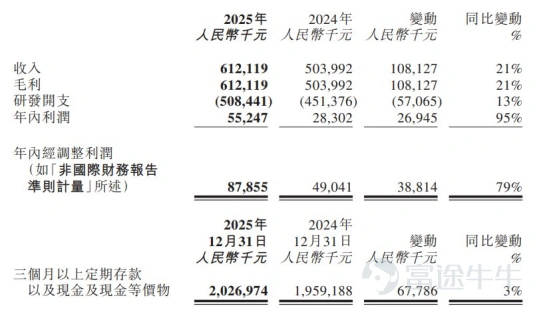
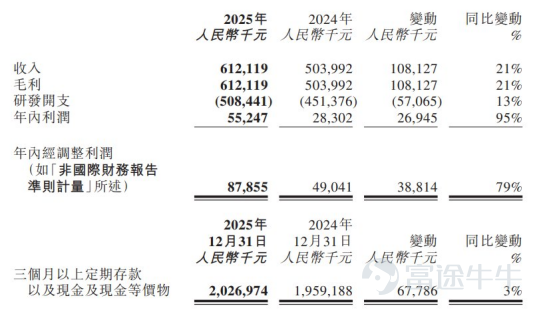
According to Zhitong Finance's APP, recently, Abbisko's 2025 annual results were freshly released. The financial report shows that in 2025, Abbisko achieved total annual consolidated revenue of approximately RMB 722 million, an increase of 19% year-over-year; the company's net profit for the period reached RMB 55.247 million, increasing by approximately 95% year-over-year; the corresponding adjusted net profit for the period was RMB 87.855 million, surging about 79% year-over-year. This marks the second consecutive year of full-year profitability following the first-ever achievement in 2024.
While achieving continuous innovation-driven revenue and profitability at scale, Abbisko's cash flow position has become increasingly robust, with the company’s cash and bank balances reaching RMB 2.027 billion, providing substantial funding assurance for medium- to long-term innovative R&D.

As one of the few innovative pharmaceutical companies in the Hong Kong Stock Exchange's Chapter 18A that consistently rewards investors through stock buybacks with 'real money,' Hebao spent 68.7 million Hong Kong dollars repurchasing 22.594 million shares in 2024. In March 2025, the company once again received board approval to allocate 200 million Hong Kong dollars for share repurchases on the market. By the end of 2025, the company had cumulatively repurchased 10.229 million shares, accounting for 1.51% of the total number of shares outstanding at the beginning of the year, involving a total expenditure of 84.67 million Hong Kong dollars. On the secondary market, Hebao's share price surged by 182.83% in 2025, truly reflecting increased market confidence and shareholder value.
Looking ahead to 2026, as the core product Beijiemai® (Pimitespib Hydrochloride Capsules) receives domestic approval for its first-ever new drug application globally, Abbisko enters its first year of commercialization while stepping into a new value cycle model ofHardcore Innovation - Commercial Monetization - Performance Validation.
Under the strong commercialization outlook for Beijiemai®, Hebao is also expected to maintain a significantly positive net cash position, thereby driving its innovative R&D to new heights and laying a solid foundation for future valuation growth.
The commercialization of the 'billion-dollar molecule' brings high investment certainty.
In the current environment, an important hallmark of high investment certainty for an innovative pharmaceutical company is transitioning the cash flow pillar from financing activities to operating cash flow. This requires the company to have a 'phenomenal' cash cow product as support. Now, the official approval and market launch of Beijiemai® provide key conditions for the steady growth of Hebao's investment value.
According to Zhitong Finance, thanks to Beijiemai's outstanding 'billion-dollar molecule' potential, Abbisko entered into a BD deal with the renowned multinational pharmaceutical company Merck at the end of 2023 featuring 'high upfront payment, high milestones, and high royalties.' In early 2024, Abbisko received an upfront payment of $70 million. As Beijiemai’s R&D and commercialization process continued to advance, on April 1, 2025, Merck announced the exercise of its global commercialization option, paying $85 million to secure the global rights to Pimicotinib. This became one of the direct drivers for Abbisko’s second consecutive year of annual profitability in 2025.
In fact, including this option exercise payment from Merck, the BD cooperation has brought Abbisko over $150 million in cash. According to the previous agreement, Abbisko will also receive development milestone payments and sales milestone payments from Merck, with a potential total payment amount reaching up to $606 million, excluding double-digit net sales royalties. These funds will become the company's ongoing cash flow, providing clear profit realization for Abbisko in the fiscal year 2026 and beyond.
Beyond the benefits brought by Merck’s option exercise, the larger driving force behind the increasing investment certainty for Abbisko comes from the realization of Beijiemai’s 'billion-dollar molecule' global commercial value.
On December 22 last year, Abbisko announced that based on positive data from the global Phase III MANEUVER study, China's National Medical Products Administration (NMPA) approved the world’s first new drug application for Beijiemai®. On January 13 this year, Abbisko further announced that the New Drug Application (NDA) for Beijiemai® for systemic treatment of Tenosynovial Giant Cell Tumor (TGCT) patients was formally accepted by the U.S. FDA, with approval expected soon.
The dual listing of Beijiemai in the U.S. and China means that this 'billion-dollar molecule' is about to take a critical step toward global commercialization, marking a key milestone for Abbisko as it transitions from groundbreaking innovative research to the global commercialization of its first product.
From a market perspective, Pimitespib is primarily used to treat TGCT unsuitable for surgery. According to a report by the National Organization for Rare Disorders (NORD), the incidence rate of TGCT is approximately 43 per million. Currently, the main competitor in the market is Daiichi Sankyo's First-in-Class product Pexidartinib, which, as a systemic therapy for severe TGCT that cannot be improved through surgery, was approved in the U.S. in 2019 but carries serious liver toxicity and has been issued a 'black box warning' by the FDA. Despite this, Pexidartinib still generated revenue of 5.3 billion yen in 2023.
By comparison, Pimicotinib has been consistently validated to achieve optimal efficacy in treating tenosynovial giant cell tumors while significantly improving safety. Therefore, after its market approval, as treatment opportunities across various indications continue to be explored, its global commercial potential is expected to accelerate realization.
Previously, CICC published a report stating that Abbisko’s developed Pimicotinib is the most effective CSF-1R small molecule globally. The firm believes that Merck has high hopes for this molecule, which could achieve peak global sales close to $1.5 billion, further unlocking its 'billion-dollar molecule' potential and becoming a 'blockbuster' that enhances Abbisko’s global revenue and profits, raising the company’s investment certainty.
Accelerating differentiated innovation, FIC/BIC pipeline potential highlighted
Financial reports show that in 2025, Abbisko confirmed R&D investment reached 508 million yuan, a 13% year-on-year increase. It is evident that robust revenue growth and cash flow reserves have provided strong support for innovation at the R&D end. With strong R&D efforts, Abbisko is now accelerating differentiated innovation, with multiple FIC/BIC candidates in the innovative pipeline showing significant potential.
In recent years, Abbisko Pharmaceutical has focused on precision oncology treatments and immunotherapy, covering popular targets such as EGFR, FGFR, CSF-1R, and PMRT5, establishing 22 globally competitive differentiated innovative R&D pipelines. Several of these investigational new drugs have the potential to be 'best-in-class' or 'first-in-class'.
For example, Ipagotinib (ABSK011), the second 'billion-dollar molecule' in Ascletis’ pipeline, has achieved a leading position in the global small-molecule pipeline and is expected to emerge as a Global First-in-Class/Best-in-Class drug with its excellent efficacy and safety.
On May 26 last year, Ascletis announced that Ipagotinib had been designated as a breakthrough therapy for the treatment of advanced hepatocellular carcinoma patients with FGF19 overexpression who had previously failed treatments with immune checkpoint inhibitors (ICI) and multi-target tyrosine kinase inhibitors (mTKI). This marks the second major product from Ascletis to receive breakthrough therapy designation, following Pimitinib. Later in December of the same year, Ipagotinib also received Fast Track Designation (FTD) from the US FDA.
According to GlobalData forecasts, by 2029, the global liver cancer market will be around $5.3 billion, with immunotherapy accounting for about 72.2% of the market share, reaching $3.8 billion. Referring to previously marketed small molecule kinase inhibitors like Sorafenib, its ORR for liver cancer indications is less than 20%. Even so, its global sales in 2021 still exceeded $500 million, indirectly reflecting the large unmet treatment needs in the current market.
Against this market backdrop, Epetentanib is expected to become Abbisko's second 'billion-dollar molecule,' with advantages in high drug development certainty, better compliance and economic benefits as a small molecule compared to other FGFR4 targeted therapies, and a leading position in the competitive landscape.
Following the first patient dosing in June last year for the registrational study of Epetentanib in treating HCC patients who had previously received systemic therapy and overexpress FGF19, Abbisko completed the first U.S. patient dosing in the expanded phase of a global multicenter Phase I study in February this year. Currently, Epetentanib has achieved a 'curve overtaking' at the R&D level, and is expected to become the first breakthrough drug for treating HCC patients with FGF19 overexpression, with potential blockbuster BD value.
In addition to these two core products with 'billion-dollar molecule' potential, Abbisko’s innovative pipeline includes several potential First-in-Class or Best-in-Class products.
Zhitong Finance APP observed that since December last year, several innovative products within the company's pipelines have successively reached new R&D milestones. Ascletis has disclosed the latest progress on its oral small-molecule PD-L1 inhibitor ABSK043, oral small-molecule KRAS G12D inhibitor ABSK141, and FGFR2/3 inhibitor ABSK061.
Within 2025, Ascletis’ early-stage candidates have continued to advance at a strong pace. During this period, the company obtained six new IND approvals, with ABSK141 (KRAS G12D inhibitor) receiving approval from both the US FDA and China’s NMPA. Additionally, three preclinical candidates—ABSK211 (Pan-KRAS), ABSK191 (CDK4/2 inhibitor), and ABSK192 (brain-penetrant CDK4 inhibitor)—have entered the IND preparation stage. The bispecific ADC project P020 has moved into the lead compound optimization phase. In the fields of autoimmune diseases and cardio-metabolic disorders, the company has also launched projects P151, P022, and P023, expanding its early-stage pipeline into non-oncology areas, further enriching its innovative R&D portfolio. Continuous R&D-driven positives are accelerating the release of intrinsic value for Ascletis, building substantial momentum.
Summary
It is not difficult to see that, supported by the commercialization of core products and ample cash flow, Abbisko is accelerating its transformation towards Biopharma through an increasingly complete integrated innovation loop, competing systematically across multiple domains such as global R&D, overseas registration, and international commercialization.
Based on optimistic expectations for Abbisko’s future growth, several institutions including CICC, Shenwan Hongyuan, and Zhongtai Securities updated their research reports on the company, reiterating 'Buy' or 'Outperform Industry' ratings.
Among these developments, CICC maintains its 'Outperform Industry' rating for the company and suggests investors focus on key events in 2026: the progress of Pimitinib’s US launch, the Phase 2 registration clinical trial updates and Phase 1 plans for Ipagotinib, potential data readouts for ABSK061 and ABSK043, and the development progress of early molecules including ABSK131 and ABSK141. Based on the DCF model, the firm maintains its Outperform Industry rating and target price of HKD 20, which represents nearly 60% upside potential from the current share price.
Risk Disclaimer: The above content only represents the author's view. It does not represent any position or investment advice of Futu. Futu makes no representation or warranty.Read more
Comments
to post a comment