
13F Big Reveal | Google Q4 Holdings Unveiled! Why Are ASTS and PL at the Core?
Recently, many US hedge funds have submitted their Q4 holdings reports (13F filings) from last year, revealing the latest moves of asset management giants.
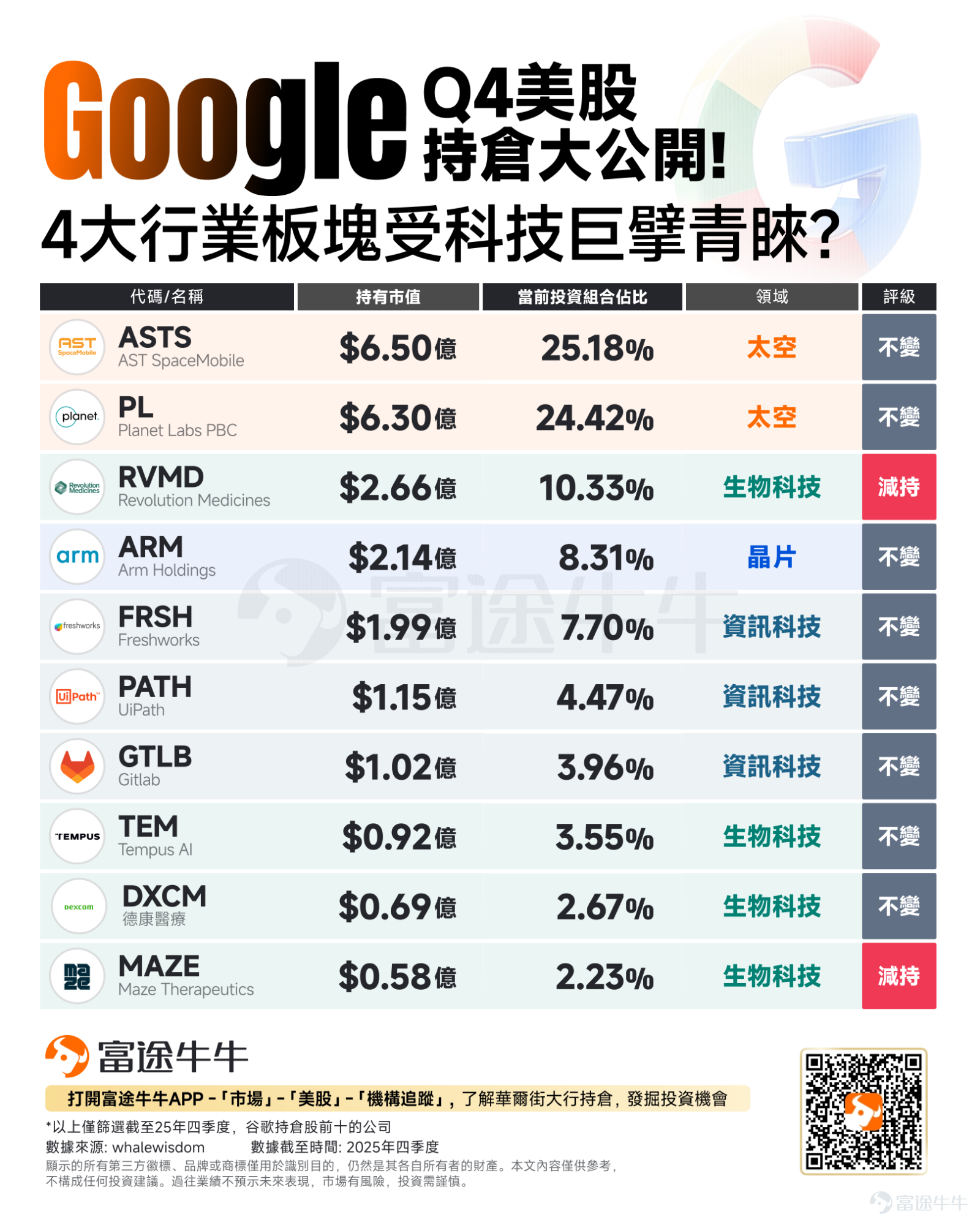
$Alphabet-C (GOOG.US)$ The 13F filing submitted by Alphabet, the parent company, to the U.S. SEC shows that Google's top two holdings remain the leading stock in the U.S. satellite phone sector. $AST SpaceMobile (ASTS.US)$ and the satellite intelligence firm $Planet Labs PBC (PL.US)$ 。

Additionally,This time, Google did not establish any new positions or increase its stake in any company.Therefore, this article will focus on introducing Google's top ten major holdings. Specifically as follows:
I. Space Economy: The 'Interstellar Leap' of Communication and Data
$AST SpaceMobile (ASTS.US)$ and $Planet Labs PBC (PL.US)$ These two companies account for 49.6% of the top ten holdings, nearly half of the portfolio.
First, let’s take a look at $AST SpaceMobile (ASTS.US)$ , a company that is the world’s first cellular broadband network directly connected to smartphones based in space. By launching high-performance satellites, it provides seamless connectivity services to areas with network blind spots globally.
Imagine standing in a desert, deep mountain, or at sea, with no cell towers nearby, but your phone still has a signal allowing you to make calls, send messages, and even browse the internet – this is what ASTS is building: 'direct-to-phone satellite connection'!

Unlike traditional networks, which rely on thousands of interconnected base stations forming a dense cellular grid, space-based networks depend on satellites orbiting the Earth at high speeds.These satellites are essentially "flying base stations" that transmit signals directly back to the core terrestrial network, offering a centralized coverage model akin to a vast celestial canopy that can effortlessly overcome physical obstacles to achieve comprehensive connectivity.
Of course, ASTS’s solution differs from SpaceX's Starlink; Starlink requires a dedicated 'satellite dish' to receive signals, while ASTS’ goal is:Your phone becomes your satellite receiver, offering greater convenience by comparison.
To achieve this goal, ASTS has launched satellites equipped with the largest commercial communication antennas in history, covering an area of nearly 700 square feet, acting like a giant ear in space with extremely high sensitivity designed to capture faint signals from ordinary mobile phones on the ground. The test satellite, BlueWalker 3, has already successfully demonstrated in space the ability to make 4G and 5G calls and data transmissions using unmodified smartphones, proving that ASTS's technology is viable and not merely theoretical!
Looking ahead, ASTS's progress in satellite deployment is the most important catalyst for stock price fluctuations.Currently, the company has successfully deployed its first five commercial satellites (BlueBird) into low Earth orbit and plans to complete 40 satellites by early 2026, reaching 45-60 by the end of the year, with production capacity increasing to six per month.
In summary, ASTS is still in the early stages of commercialization; however, its unique technological approach, strong strategic partnerships, and clear satellite deployment plan have enabled it to achieve differentiated competition in the space sector.
Secondly,$Planet Labs PBC (PL.US)$ is a global leader in Earth observation and satellite data, operating the largest constellation of satellites in orbit, with a unique ability to conduct full global land coverage scans every day.
It is committed to building a 'dynamic index of Earth's physical properties,' providing critical data support for fields such as agricultural monitoring, defense intelligence, energy infrastructure management, and climate sustainability by capturing high-frequency, continuous satellite imagery. The company is now actively leveraging AI technology to mine its vast repository of historical data.This accelerates its transition from being a simple 'satellite imagery provider' to a high-value-added 'geospatial data and insights service provider.'
Planet Labs’ business landscape is undergoing an evolution from a 'resource-based' model to a 'service-oriented' one, supported primarily by three core business lines:
First Layer: Photographer of the Earth (Data Subscription) This is Planet’s most well-known service. Relying on its extensive satellite network, it provides global customers with high-frequency satellite imagery akin to subscribing to a newspaper. Whether it’s the Pentagon or a farmer, what they purchase isn’t just a single image but rather ongoing access to daily changes on Earth. This gives Planet a steady cash flow similar to SaaS businesses.
Second Layer: Actuary of Data (Analytical Services) Raw imagery is merely the raw material. Planet is attempting to use AI to process this data into actionable insights. Through computer vision technologies, it can automatically identify the number of ships in ports or assess wildfire damage. This means clients no longer need to hire people to analyze images themselves but can directly purchase 'analytical results.' The expansion of this layer indicates that Planet is gaining control over key pricing power.
Third Layer: Space Contractor (Satellite Services)This strategic line of business addresses the growing demand for 'sovereign space capabilities.' By offering comprehensive 'manufacturing + launch + operation and maintenance' services to national or institutional clients, Planet can quickly increase its backlog and remaining performance obligations (RPO). More importantly, this financial model allows the company to use customer funds to build up satellite capacity, which significantly optimizes capital expenditure efficiency, despite fluctuations in gross margins due to hardware costs and partnership models.

Notably, the company's earnings call also mentioned the following three key themes, which could influence the stock price performance in the near term.
On the core business (government side): Planet Labs is showing a clear 'government-focused' trend. The explosive growth of its D&I (Defense and Intelligence) segment validates the irreplaceability of its products, providing a solid safety net for revenue. However, the reduction in EOCL (Electro-Optical Commercial Layer) and NASA orders highlights the risk of 'single dependency': fluctuations in U.S. fiscal budget cycles and appropriations will directly translate into 'noise' in quarterly financial reports. The market is currently grappling with whether to assign a 'certainty premium' due to high order visibility or apply a 'dependency discount' due to reliance on government budgets. This tug-of-war between these two forces will determine the company’s valuation center in the medium term.
On growth drivers (AI): Selling imagery is a red ocean; selling answers is a blue ocean. AI-driven transformation from 'data' to 'decision-making' is key to determining Planet's long-term market cap ceiling. The management team repeatedly emphasized Maritime Domain Awareness and change detection, essentially attempting to upgrade the business model from a low-margin 'data provider' to a high-barrier 'intelligence/decision system service provider.' Only when Planet stops merely selling images and starts delivering 'actionable answers' through AI will demand from commercial customers in insurance, finance, and supply chain truly reach an inflection point, enabling reacceleration.

On new technology (GPUs in space):Owl (edge computing powered by NVIDIA GPUs) and Suncatcher (a space TPU developed in collaboration with Google) create a highly imaginative technological narrative.They represent the future of 'space computing' and are extremely eye-catching in the capital markets.However, investors should remain clear-headed: at this stage, they are more like 'R&D-oriented call options.' What will support profitability in the short term remains government contract execution and existing satellite services.

II. Biotechnology: AI-driven transformation in life sciences
The top ten heavily invested companies by Google include $Revolution Medicines (RVMD.US)$ 、 $Tempus AI (TEM.US)$ 、 $DexCom (DXCM.US)$ 、 $Maze Therapeutics (MAZE.US)$four biotech firms, demonstrating Google's attempt to establish a 'matrix-style' position in the biotech field.
$Revolution Medicines (RVMD.US)$Focuses on developing RAS(ON) inhibitors.RAS mutations are present in 30% of cancers and have been extremely difficult to target in the past.Although Google reduced its holdings somewhat in Q4,its position as the third-largest holding reflects significant confidence in its potential to develop a 'universal cancer drug.'
$Tempus AI (TEM.US)$is an AI-driven precision medicine platform.It owns the world's largest clinical and molecular database. It leverages AI to assist doctors in diagnosis and treatment selection, making it the most direct target for Google's AI healthcare implementation.
$DexCom (DXCM.US)$ This company dominates the continuous glucose monitoring (CGM) system market.As a leader in wearable health monitoring, with the promotion of its new product Stelo in 2026, Dexcom is transitioning from single diabetes monitoring to a broader health management market.
$Maze Therapeutics (MAZE.US)$ This company also saw a minor reduction in holdings by Google this time around; it focuses on kidney and cardiometabolic diseases.MAZE’s Compass platform can precisely identify genetic variations, aligning with Google’s preference for data-driven R&D through its 'platform biotech' logic.
III. Information Technology and Software: The Execution Gateway for Agentic AI
$Freshworks (FRSH.US)$ The business highlight is AI-powered enterprise customer and employee experience management.Its EX (Employee Experience) platform will see strong growth in 2026. FRSH stands out by reducing corporate operational costs through AI, making it essential for SME digital transformation.
$UiPath (PATH.US)$ The business highlight lies in Robotic Process Automation (RPA) and Agentic AI.This company is transitioning from simple automation to 'Agentic' automation. It represents an important technical execution platform for Google’s AI implementation in enterprises, replacing tedious manual processes.
$Gitlab (GTLB.US)$ is a one-stop AI Native DevSecOps platform.Overall, full-process automation from code writing to deployment. In the era of AI-generated code, Gitlab is the 'choke point' controlling the developer ecosystem.
Fourth, Semiconductors: The fundamental infrastructure of the computing power world
$Arm Holdings (ARM.US)$ It has built the underlying rules of the global digital world. Not only does it hold an absolute monopoly of 99% in the smartphone market, but also, with its architecture's extremeenergy efficiency ratio,it has become the indispensable 'computing oxygen' for AI data centers and edge computing. For Google, holding Arm carries dual strategic significance:
1. Ecosystem Defense: Ensuring the stability of the underlying architecture of Android’s global ecosystem.
2. Cloud Offense: Google Cloud’s self-developed Axion processor is built based on the Arm architecture.
Asv9 architectureWith the rapid penetration and the explosive demand for low-energy computing power in data centers, Arm is evolving from a pure IP licensor to the 'core tax collector' of the AI era, enjoying high certainty premium in the computing power arms race.
Summary
This list reveals Google's core ambition——‘Connecting the world via space, tackling cancer with AI, and reshaping productivity through automation’For investors, these companies are often ‘technology monopolists’ within their respective vertical tracks.
 Understand institutional holdings and stay up-to-date with the latest investment trends, Market > US Stocks > Institutional Tracking
Risk Disclaimer: The above content only represents the author's view. It does not represent any position or investment advice of Futu. Futu makes no representation or warranty.Read more


Comments (10)
to post a comment
314
336