
Software stocks continue to strengthen—has concern over AI disruption dissipated?

Nanhua Futures: Insights from US Tech Giants' Earnings Reports and Market Feedback
Key Insights:
After experiencing 2-3 years of growth, the current attitude of the US stock market towards the technology sector has shifted from 'storytelling' to 'examining financial reports.' While early markets were willing to buy into visions, they now demand tangible financial returns. Nanhua Futures believes this means valuations are unlikely to rise further, and any minor flaws in earnings reports may lead investors to vote with their feet. This situation in the US stock market serves as a warning for the technology sector in the A-share market. In terms of index valuation, the enthusiasm for growth in A-shares far exceeds that of US stocks. Some individual stocks have achieved several-fold or even tenfold increases over the past 1-2 years. As the US stock market cools down, they may also need to undergo tests of performance and market sentiment. Therefore, investments in the technology sector this year should be prepared for volatility.
Since January, major US tech giants have been releasing their earnings reports. Although most companies exceeded expectations, the market reacted with concern rather than joy. The Nasdaq 100 Index has been oscillating at high levels for more than a quarter, seemingly on shaky ground, with some spillover effects impacting the A-share market's spring rally. This article by Nanhua Futures provides a brief analysis of several giant companies that have released their results to assess industry trends and the state of capital markets, offering further insights for the technology sector in the A-share market.
I. Analysis of Tech Giants’ Performance
1. Taiwan Semiconductor (TSM)
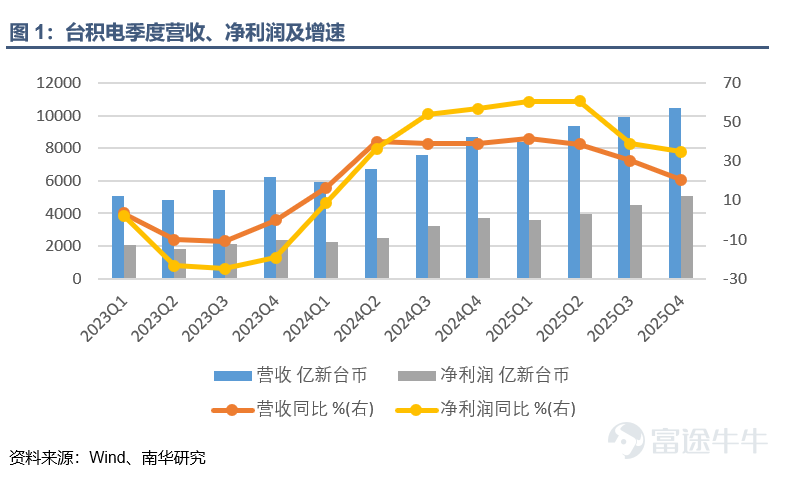
Taiwan Semiconductor released its earnings report on January 15, benefiting from the continued strong demand for AI hardware, with profits significantly exceeding expectations. Revenue for Q4 2025 was NT$1,046.09 billion, a year-on-year increase of 20.5%; net profit was NT$505.74 billion, up 35% year-on-year. The Q4 gross margin reached 62.3%, surpassing the previously guided range of 59%-61%. The company expects the Q1 2026 gross margin to be between 63% and 65%. The company has significantly raised its 2026 capital expenditure guidance to $52-56 billion, far exceeding market estimates of $48-50 billion. The CEO stated that direct communication with downstream customers has validated that AI demand is real, with AI chip supply being a bottleneck for customer growth. Nanhua Futures analysis suggests that even after Taiwan Semiconductor accelerates its capital spending and steadily advances its global capacity layout, the AI chip supply gap is unlikely to be resolved in the short term. The company expects its full-year 2026 revenue to achieve nearly 30% year-on-year growth.

2. Microsoft (MSFT)
Microsoft released its earnings report on February 4, showing robust overall performance. Revenue for Q4 2025 was $81.27 billion, up 16.7% year-on-year; net profit was $38.46 billion, an increase of 59.5% year-on-year, including one-time gains from the valuation increase of its OpenAI investment. Among business segments, Intelligent Cloud had the fastest revenue growth, Productivity and Business Processes showed steady revenue growth, while Personal Computing declined. Amid the wave of AI development, cloud services became the key driver of the company's performance, but Q4 Azure revenue growth was slightly below expectations. Q4 capital expenditure hit a record $37.5 billion, up 66% year-on-year, primarily for purchasing computing chips and building AI data centers. However, the significant investment did not translate into a leap in Azure’s growth rate, raising market concerns. Management revealed that Azure is facing production capacity constraints, meaning the company is prioritizing valuable computing resources for strategic products like Copilot and internal R&D projects, with Azure's performance release needing to wait for new capacity to come online and supply chain constraints to ease. With disclosed commercial remaining performance obligations reaching $625 billion, Nanhua Futures analysis believes that cloud service demand is huge, making Azure’s performance release only a matter of time. However, much of this relies on agreements with OpenAI, which, while locking in long-term revenue, increases the company's single-customer risk.


3. Google (GOOG)
Google released its earnings report on February 5, showing comprehensive outperformance across revenue and profit metrics. Revenue was $113.83 billion, up 18% year-on-year; net profit was $34.46 billion, a 29.8% year-on-year increase. Benefiting from the deep integration of AI technology, core revenue segment Google Services grew steadily. Cloud business maintained explosive growth, with revenue surging 48% year-on-year, becoming the company’s primary growth engine, driven by strong demand for enterprise AI infrastructure, enterprise AI solutions, and Google Cloud Platform products. In terms of AI strategy, the launch of the self-developed Gemini 3 model in Q4 was a significant milestone, with Gemini applications reaching over 750 million monthly active users, and AI technology continuing to drive growth in core businesses like search and cloud. To meet AI-related infrastructure needs and business expansion, capital expenditure for 2026 is projected at $175-185 billion, nearly double that of 2025.


4. Meta (META)
Meta released its earnings report on January 28. Q4 2025 revenue was $59.893 billion, up 23.8% year-on-year; net profit was $22.768 billion, a 9.3% year-on-year increase, both exceeding market expectations. Revenue outperformance was mainly due to the strong performance of the advertising business, with the company's investments in AI enhancing ad targeting precision and effectiveness. Q4 ad impressions increased by 18% year-on-year, while the average price per ad rose by 6% year-on-year. The metaverse business continued to incur losses, with the company cutting about 1,000 employees from the Reality Labs department in early January and shutting down some internal VR R&D studios, gradually shifting R&D focus from metaverse-related projects to artificial intelligence and wearable devices. The company is now fully betting on superintelligence, with projected 2026 capital expenditure between $115-135 billion, almost double that of 2025, mainly for infrastructure investments needed by Meta’s Superintelligence Lab and core business operations. The company expects Q1 2026 revenue to be between $53.5-56.5 billion, higher than market expectations.


II. AI Development Trends and Capital Market Feedback
Nanhua Futures believes that although all four companies reported strong performances, their stock price reactions after the earnings announcements varied significantly. Taiwan Semiconductor remained firm, Microsoft continued to plummet after already accumulating substantial declines, Google experienced major volatility, while Meta rebounded strongly after prior adjustments.

Nanhua Futures analysis indicates that in the industrial chain, Taiwan Semiconductor, as the world's leading semiconductor foundry, almost monopolizes the high-end chip manufacturing market and serves as the cornerstone of AI hardware, positioned upstream. The other three companies are mid-to-downstream: Microsoft provides AI platforms, cloud services, and popular AI applications; Google has built a full-stack ecosystem encompassing self-developed chips, large models, cloud services, and end-user applications; Meta focuses on developing large AI models and deeply integrating AI capabilities into its social product matrix. Both Microsoft and Google’s earnings reports indicate that cloud computing services continue to have strong demand.
Moreover, the application layers of the three companies have started to generate commercial returns after being empowered by AI, but their monetization capabilities vary. To maintain competitiveness, each company continues to push forward with massive infrastructure investments, which in turn drives up computational power demands and prompts Taiwan Semiconductor to expand its capital expenditure accordingly. According to an analysis by Nanhua Futures, while the AI industry is booming, the most predictable performance still lies in the upstream of the industrial chain, which explains why Taiwan Semiconductor’s stock price remains strong. In contrast, major internet firms and large model providers face market skepticism due to their enormous capital expenditures. As huge investments erode free cash flow, investors are increasingly focusing on return on investment and financial stability.
After experiencing 2-3 years of growth, Nanhua Futures’ analysis suggests that the current capital market has evolved from 'storytelling' to a 'focus on financial statements.' While the early market was willing to pay for vision, it now demands tangible financial returns. This means valuations are unlikely to rise further, and simply having good-looking earnings is no longer enough to satisfy investors. Any slight flaw in financial reports could lead to investor pullback. This situation in the US stock market serves as a warning to the technology sector in A-share markets. In terms of index valuation, A-shares exhibit much stronger enthusiasm for growth compared to US stocks. Some individual stocks have seen multiples or even tenfold increases over the past 1-2 years. As related sectors in the US market cool down, A-shares might also need to undergo tests of both performance and market sentiment. Although the long-term outlook for AI remains vast, this year’s tech sector investments should prepare for potential volatility.


Author: Xu Chenxi, Nanhua Research Institute Z0001908

Risk Disclaimer: The above content only represents the author's view. It does not represent any position or investment advice of Futu. Futu makes no representation or warranty.Read more

Comments
to post a comment
2