

How to view the post-holiday market trend in Hong Kong stocks?

Critical Test at the $35 Support Level: The Leverage Relationship Between Xiaomi's Technical Levels and Discounted Put Warrants
As of February 13, 2026, Xiaomi Group (01810) stock is showing a tug-of-war between bulls and bears at the price level of $36.52. Market news such as Southbound funds net purchasing over 50 billion yuan for three consecutive days and Xiaomi repurchasing 4.05 million shares worth 148 million yuan on February 12 indicates that long-term capital is making strategic moves during this adjustment period. However, Huatai Securities' latest report pointed out that due to rising memory chip prices and subsidy rollbacks, short-term profitability is under pressure, resulting in a target price downgrade to $47. Amidst intertwined fundamentals and capital flows, the coordination between technical levels and derivatives will be crucial in the short term. Today (February 13), Xiaomi's share price closed at $36.42.
Technical Analysis and Key Levels
From the daily chart observation, Xiaomi’s share price reflects significant divergence between bulls and bears. Regarding the moving average system, the MA10 ($35.36) has shifted from resistance to initial support, but the MA30 ($36.6) and MA60 ($38.53) continue to maintain downward dispersion, forming multiple technical barriers. Notably, data from February 12 shows that the RSI was at 53, within the neutral zone; multiple oscillation indicators like the Stochastic Oscillator and CCI also show neutral signals. However, the Rate of Change (ROC) and VR Volume Ratio indicators are issuing 'oversold, potentially bottoming' buy signals, corroborating the bullish divergence phenomenon observed in early February.
Regarding support levels, the first short-term defense is at the psychological $35 level, corresponding to both the February 6 low and the forced liquidation price of UBS bull certificate 56689, providing some psychological support; the second support level lies at $33.9, identified in the February 12 data as a key support zone. On the resistance side, $38.4 represents a critical near-term barrier, aligning with MA60 pressure and the rebound high point seen earlier in February; further resistance is found around $39.1, near the upper band of the Bollinger Bands.

Review of Warrants and Analysis of Bull-Bear Certificate Advantages
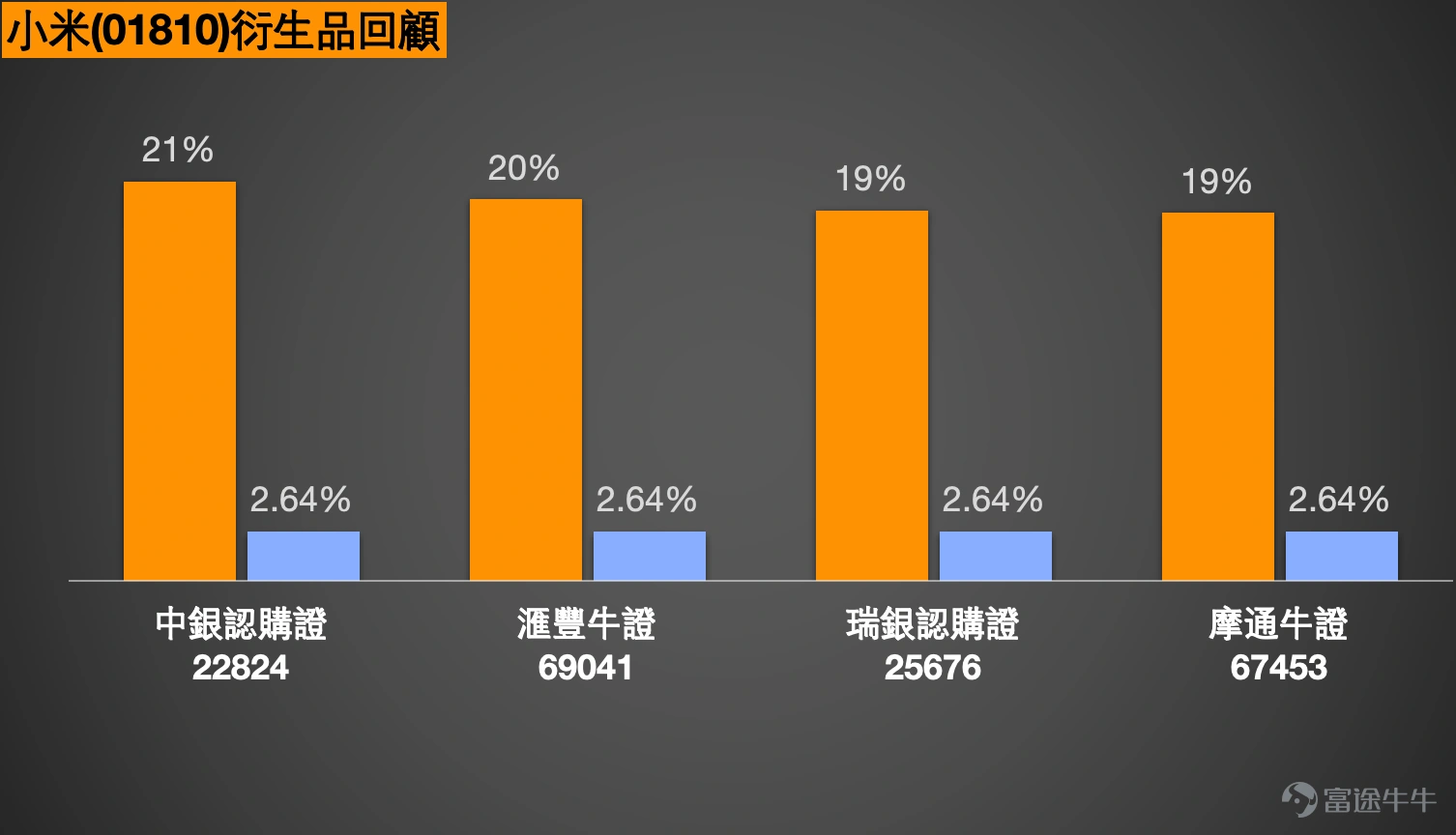
Reviewing the four products mentioned on February 10, against the backdrop of a 2.64% increase in the underlying stock over the following two trading days, the performance of derivatives fully reflected their efficiency in tracking the underlying. HSBC Bull Certificate 69041 recorded a 20% increase, J.P. Morgan Bull Certificate 67453 rose 19%, while UBS Call Warrant 25676 and Bank of China Call Warrant 22824 also saw respective gains of 19% and 21%. From this set of data, the fundamental structural differences between bull-bear certificates and warrants are clearly visible.$UBXIAMI@EC2605F.C (25676.HK)$$BIXIAMI@EC2605C.C (22824.HK)$
Current Product Deployment Strategy
Considering the first resistance level at HK$38.4 and the first support level at HK$35, bullish positions can focus on at-the-money and medium-term bull certificates. UBS Bull Certificate 56157 has a stop-loss price of HK$32, offering actual leverage of 6.8 times, with low premium implying lower financing costs; Bank of China Bull Certificate 60479 offers even higher actual leverage at 6.5 times, with a stop-loss price of HK$32.33 providing about a 12% buffer zone, suitable for capturing rebound waves. For call warrants, Bank of China Call Warrant 13186 has an exercise price of HK$37.15, forming a ladder with the HK$38.4 resistance level; HSBC Call Warrant 22791 has an exercise price of HK$37.12, both offering 3.9 times leverage and low implied volatility characteristics, making them potential options for tracking breakouts.$BIXIAMI@EC2612A.C (13186.HK)$$HSXIAMI@EC2612C.C (22791.HK)$
For bearish positions, UBS Put Warrant 22136 and HSBC Put Warrant 22196 have identical exercise prices of HK$35.16, exactly corresponding to the first support level, with leverage reaching 8.2 times and 8.1 times respectively. If the share price breaks below the HK$35 mark, the delta of these near-the-money put warrants will increase, accelerating price changes. Among bear certificates, UBS Bear Certificate 62251 has a stop-loss price of HK$41, with the lowest premium among its peers, offering actual leverage of 9.1 times; BNP Paribas Bear Certificate 61089 has a stop-loss price of HK$41.8, with actual leverage of 7.6 times, maintaining a reasonable distance from the second resistance level at HK$39.1, reducing the risk of forced liquidation.$BI#XIAMIRC2612E.C (60479.HK)$$UB#XIAMIRP2812B.P (62251.HK)$$UB#XIAMIRC2606G.C (56157.HK)$

Interactive Questions:
Do you think Xiaomi Group's short-term trend will first break through the HK$38.4 resistance or retest the HK$35 support?
When deploying for a rebound, would you choose bull certificates without time decay, or call warrants with lower implied volatility? Feel free to share your views in the comments.
Disclaimer: This article does not constitute any investment advice.
This article is for reference only and does not constitute any investment advice. The market data, opinions, and analysis contained herein may change at any time without prior notice. We are not responsible for any loss or damage caused by reliance on the information in this article. Technical analysis only shows whether certain technical conditions are met; a comprehensive assessment of asset performance should combine other data and should not solely rely on this article to make trading decisions. Please note that past performance is not indicative of future results. Follow Jenny's insights on Hong Kong stock warrants for more professional analysis.
#Xiaomi stock price #Technical analysis #Support and resistance levels #Warrants #Bull and bear certificates #Implied volatility #
Risk Disclaimer: The above content only represents the author's view. It does not represent any position or investment advice of Futu. Futu makes no representation or warranty.Read more

Comment (1)
to post a comment
3