How to view the post-holiday market trend in Hong Kong stocks?
From 2025 to early 2026, the Hong Kong stock market will welcome two distinct yet resonant sources of capital inflows: mainland Southbound funds, with a record-breaking annual net purchase of 1.41 trillion Hong Kong dollars, becoming the core architect of Hong Kong stock pricing power; meanwhile, Korean retail investor funds, characterized by concentrated bets in an 'Eastward Ant-like' approach, high-leverage trading, and a fervent pursuit of cutting-edge technology, are creating structural waves in niche areas of the Hong Kong market. One group focuses on long-term allocation anchored by value, while the other engages in high-frequency trading driven by industry narratives, collectively mapping out a new landscape of diversified funding sources and layered pricing logic for Hong Kong stocks.
Scale and Structure: The Absolute Mainstay and Marginal Catalysts
There is a significant hierarchical difference in the scale of funds between Southbound capital and Korean investors in the Hong Kong stock market, but their functional roles and market influence are irreplaceable in their own right.
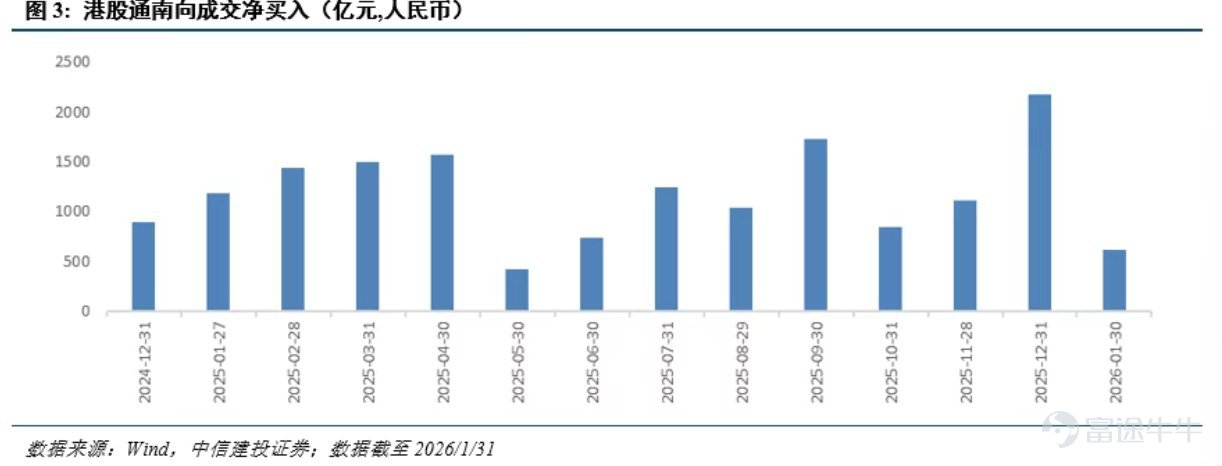
Southbound funds have become the core incremental source and reshaper of the valuation system for Hong Kong's stock market. By the end of 2025, cumulative net inflows from southbound funds reached 5.11 trillion Hong Kong dollars, with a net purchase of 1.41 trillion Hong Kong dollars in 2025 alone, nearly matching the total from 2022 to 2024. The market value of holdings exceeded 6.3 trillion Hong Kong dollars, accounting for 12.7% of Hong Kong’s total market capitalization. This magnitude indicates that southbound funds have moved beyond the 'marginal supplement' stage, evolving into an 'endogenous pricing variable' for Hong Kong's stock market.

The scale of Korean retail investors in Hong Kong's stock market is relatively limited. However, their trading behavior is highly concentrated, significantly leveraged, and exhibits strong community synchronization effects in decision-making, enabling them to create short-term pricing impacts and shape liquidity premiums in specific targets—particularly new economy IPOs, semiconductor supply chains, and AI theme leaders. In early 2026, Korean retail investors net purchased over 20 million US dollars worth of MiniMax-WP shares within a single month. The stock’s IPO recorded an oversubscription rate of 1837 times, with Korean capital being a crucial catalyst for the initial valuation premium post-listing.
Industry Preferences: Layered Allocation of Value Anchoring and Growth Sharpness
The two sources of capital show significant hierarchical differentiation in industry coverage and limited resonance in investment themes, reflecting fundamental differences in capital attributes, return objectives, and decision-making horizons.
Financials and high-dividend utilities are the 'independent allocation domains' for southbound funds. Systematic increases of billions of Hong Kong dollars were made in positions such as Construction Bank (00939), ICBC (01398), Ping An (02318), China Mobile (00941), and China Shenhua (01088). Core driving factors include high dividend yields, low valuation levels, RMB asset characteristics, and perpetual operation assumptions. Korean investors hold nearly zero positions in this sector.

Southbound funds heavily invested in Alibaba-W (09988) (with a market cap increase of 191.3 billion Hong Kong dollars), Meituan-W (03690), and Tencent (00700). Their investment logic evolved from 'valuation repair' in 2024 to 'value reevaluation' in 2025, characterized by cross-cycle, low-turnover, and left-side accumulation traits indicative of institutional-style investing.
In 2025, Korean retail investors focused on Xiaomi Group (01810), with a net purchase of 87.75 million US dollars, but swiftly shifted to MiniMax-WP (20.67 million US dollars) at the start of 2026. Their capital flow exhibits high elasticity, high turnover, and narrative-driven trading patterns. Both groups share a systematic bullish view on Chinese tech leaders, but differ significantly in stock selection and holding periods.
In 2025, southbound funds net purchased 508 million shares of SMIC (00981), increasing their stock value by 36 billion Hong Kong dollars, playing the role of an absolute leader in sector pricing. Meanwhile, Korean investors net purchased 33.11 million US dollars during the same period, forming a dual-layer pricing structure where institutional funds anchor while trading funds assist, collectively pushing up the sector’s valuation center.
At the start of 2026, Korean capital rapidly rotated into Lanthus Technology (06809), Innoscience (02577), and the China Semiconductor ETF, showing industrial sub-sector rotation and tool-based allocation strategies; southbound funds continued steady purchases of SMIC, demonstrating rigid allocation and pronounced holding inertia. The divergence between the two in the semiconductor space reflects differing strategic decisions at different stages of the industry cycle for institutional vs. trading capital.
Horizonrobot-W (09660) entered the top 20 list of southbound investments in 2025 with a market cap increase of 21.4 billion Hong Kong dollars, indicating that southbound funds have begun left-side positioning in intelligent driving computing layers, though overall still in the cognitive introduction phase. The IPO frenzy of MiniMax-WP was mainly driven by Korean retail investors—with monthly net purchases exceeding 20 million US dollars and an oversubscription rate of 1837 times—their decision path shows typical features of strong community consensus and weak institutional reliance. Korean capital exhibited clear risk-premium pricing intentions in this space, providing southbound funds with dual indications for validating industry narratives and anchoring valuations.

BeiGene (06160), Wuxi XDC (02268), and Ascletis Pharma (01672) show an annual rotation in the portfolios of South Korean retail investors. Their entry and exit timings are highly correlated with global liquidity expectations and the US biopharmaceutical index, representing trading behavior driven by global beta.

BYD (01211) $BYD COMPANY (01211.HK)$ Li Auto (02015) $LI AUTO-W (02015.HK)$ Other whole-vehicle stocks have been consistently allocated by southbound funds as part of a long-term bottom-up strategy. Decision anchors include penetration rate curves, production capacity cycles, and global validation, reflecting an allocation-driven approach that tracks industry alpha. The duration mismatch between trading-oriented and allocation-oriented strategies is most evident in these high-growth sectors characterized by high valuation volatility and substantial R&D investment—South Korean capital speculates on marginal changes, while southbound funds bet on the industry's long-term outcome.
Institutional Allocation Paradigm vs. Extreme Global Trading Behavior
The trading behaviors of southbound funds and South Korean retail investors reflect fundamental distinctions between institutionalization and retail participation, value anchoring and narrative-driven speculation, and long-term cycles versus high-frequency rotations.
The decision anchors for southbound funds include dividend yield, ROE stability, free cash flow generation capability, and valuation percentiles. Trading characteristics involve continuous accumulation, contrarian buying, and stable holding. For instance, in the case of China Construction Bank, despite stock price fluctuations, there was a net purchase of 7.389 billion shares in 2025, increasing the holding value by HKD 55.8 billion. 'Buying more as prices drop' is not an emotional response but rather reflects allocation behavior driven by rising dividend yields and strengthened safety margins as stock prices decline.
Through consistent, predictable, and large-scale capital inflows, southbound funds are gradually aligning the valuation systems of Hong Kong-listed financials and telecom operators with those of mainland-listed companies. In the case of China Construction Bank and China Mobile, holdings now exceed 20%.
The decision anchors for South Korean retail investors include the intensity of industrial narratives, social media buzz, and community consensus. Their pricing logic is not based on 'what a company is worth' but rather on 'how much the next entrant is willing to pay.' Trading characteristics default to high leverage. South Korea has 62 million active stock accounts, 1.2 times its population, and overseas stock margin financing peaked at over KRW 18 trillion (approximately USD 12.6 billion).
Notably, data from the Korea Exchange shows that the average holding period for domestic individual investors' stock portfolios is less than three months. Turnover rates for some popular US and Hong Kong stocks even surpass those of certain cryptocurrencies. This contrasts sharply with southbound funds, which often hold positions for years. High-frequency trading not only generates substantial commissions (in 2025, 12 major brokerages earned KRW 1.95 trillion in overseas stock trading fees) but also extreme sensitivity to market sentiment.
Zhitong Finance APP believes that the label of 'gambling nature' attributed to South Korean retail investors is, in fact, a rational adaptive behavior shaped by institutional environments and industrial structures. Although South Korea boasts global semiconductor manufacturing giants, it lacks representative companies in soft technology fields such as internet platforms, cloud computing, and large AI models, leading to compensatory trading impulses — heavily investing in Alibaba is akin to betting on 'the Amazon that South Korea doesn’t have,' while aggressively buying into MiniMax represents the search for 'the OpenAI that South Korea lacks.'
For the Hong Kong stock market, the influx of South Korean investors serves both as a source of incremental liquidity and an important step towards diversifying the investor base. Unlike southbound funds that allocate state-owned major banks for dividend yields over years, or international long-term funds that rigorously demand ESG data, this type of capital can exacerbate volatility at certain times. However, at other moments — such as the IPO of MiniMax-WP — it can directly redefine the pricing dynamics during the initial listing phase.
In summary, southbound funds with trillion-level scale are reshaping the valuation foundation of Hong Kong stocks, while South Korean retail investors inject liquidity premiums into niche areas through aggressive trading. These two types of capital, guided by two distinct logics, jointly foster a 'dual pricing structure and parallel narratives' new normal in the Hong Kong stock market — requiring both the resilience of allocation-focused strategies and the acumen of trading-oriented approaches.
Risk Disclaimer: The above content only represents the author's view. It does not represent any position or investment advice of Futu. Futu makes no representation or warranty.Read more
Comments
to post a comment
1
1
