
English
Back
Open Account
Fresh changes in the fresh e-commerce landscape? Meituan plans to acquire Dingdong
咏竹坊
joined discussion · Feb 6 21:53

DingDong takes drastic measures, sells its China business to Meituan

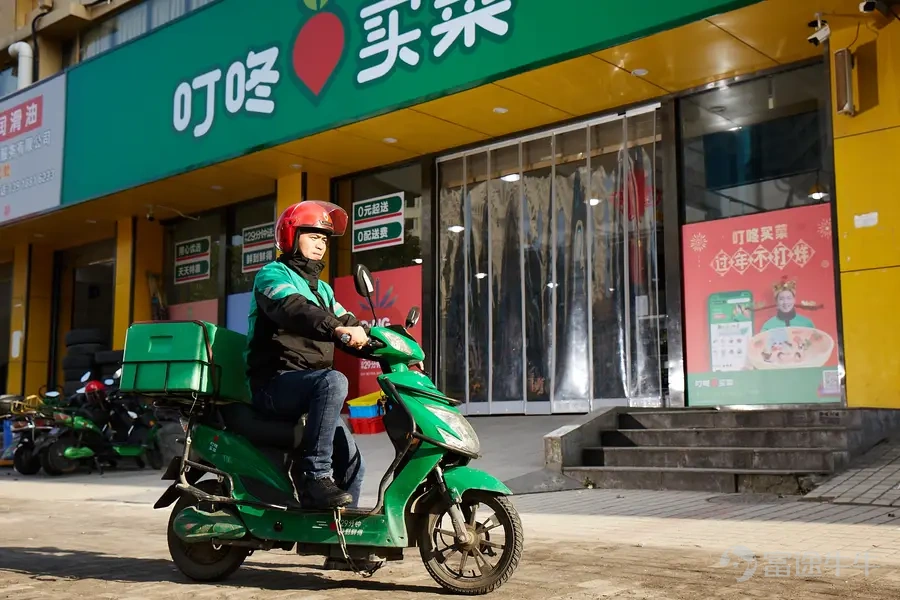
DingDong, one of China’s earliest online fresh produce platforms, will be sold to its competitor Meituan for $717 million, marking one of the largest acquisition deals in China’s rapidly evolving instant retail market.
DingDong, one of the earliest online fresh produce platforms in China, will be sold to its rival Meituan for $717 million, marking one of the largest acquisitions in China's rapidly evolving instant retail market Key points: * After DingDong announced the sale of its core China business to rival Meituan for $717 million, its stock price plunged 14%, reducing its market value to approximately $700 million * Founder Liang Changlin likely made this decision after realizing that it would be unsustainable for DingDong to continue operating independently as an online fresh produce platform in China’s fast-changing instant retail market   This article was authored by Yang Ge China's retail landscape is being completely reshaped by the fierce competition in instant retail, and the biggest victim has already emerged. This is our immediate assessment based on Thursday's[Share Link: announced news], one of China's earliest online fresh produce platforms and also considered one of the first instant retailers, $Dingdong (DDL.US)$ , officially moves under the umbrella of its rival $MEITUAN-W (03690.HK)$, a much larger 'shopping cart'. Few online industries in China have integrated through such mergers and acquisitions, partly because most companies are led by highly independent founders who would rather let their empires collapse than sell them to others. This was the case when DingDong's main rival Missfresh collapsed in 2022, despite there being several potential buyers willing to acquire it at the time. Therefore, from this perspective, we must commend DingDong founder Changxin Liang for recognizing the trend while the company still...
Key points:
* After DingDong announced the sale of its core China business to competitor Meituan for $717 million, its stock price dropped 14%, reducing its market value to approximately $700 million.
* Founder Changxin Liang likely made this decision after realizing that DingDong, as an independent online fresh produce platform, would struggle to survive in China's fast-changing instant retail market.
 
This article was authored by Yang Ge
China's retail landscape is being completely engulfed by the fires of instant retail competition, and the biggest victim has now emerged. This is our immediate take on Thursday’sannounced news,with DingDong, one of China’s earliest online fresh produce platforms and also considered one of the first instant retailers, $Dingdong (DDL.US)$ , officially joining forces with its rival $MEITUAN-W (03690.HK)$Meituan’s larger 'shopping cart.'
China's online industries rarely consolidate through such mergers and acquisitions, partly because most companies are led by highly independent founders who would rather let their empires collapse than sell to someone else. This was the case when DingDong's main rival, MissFresh, collapsed in 2022, despite there being several potential buyers willing to step in at the time.
Therefore, from this perspective, we must commend DingDong founder Changxin Liang for recognizing the trend and choosing to sell while the company still had value. The DingDong website describes Liang as a serial entrepreneur who founded multiple e-commerce companies before launching the online fresh produce business in 2017, when China’s retail environment was vastly different from today.
It is particularly worth noting that, as$Alibaba (BABA.US)$Compared with $JD.com (JD.US)$The entry of these two e-commerce giants has caused China’s instant retail market to explode over the past year. Fresh produce, which is perishable and can be quickly delivered from local warehouses, became one of the earliest categories to achieve instant retail, with food delivery following a similar logic.
However, Alibaba, JD.com, and even Meituan have recently taken instant retail to new heights. Their rapid delivery programs are no longer limited to fresh produce and food delivery but now cover many items that previously took days to arrive. Now, the competition focuses on who can deliver the fastest, with promises to deliver even non-perishable goods within 30 minutes.
All of this comes at a high cost. Alibaba, JD.com, and Meituan have all subsidized their instant retail operations using profits from other businesses, likely making Changxin Liang realize that DingDong could not compete head-to-head with these giants over the long term. The impact of subsidy wars has been particularly evident for Meituan, which swung to a loss of 18.6 billion yuan (about $2.68 billion) in Q3 last year after posting a profit of 12.9 billion yuan in the same period the previous year.
Against this backdrop, let’s take another look at DingDong's deal, which actually has a fairly simple structure. Both parties stated that Meituan will acquire DingDong's core China business for a total price of $717 million, with 90% paid immediately and the remaining 10% to be paid after settling relevant tax matters.
Disappointingly, neither company mentioned the fierce competition that drove the deal in their statements, focusing only on their shared commitment to freshness and quality. DingDong’s American shareholders clearly were not convinced, as its stock dropped 14.4% on Thursday, nearly wiping out all gains over the past 52 weeks. However, the company’s market cap after the sell-off remains around $700 million, roughly equivalent to Meituan's acquisition price. Meituan’s shareholders also reacted coolly, with its shares falling 1.5% during early trading Friday in Hong Kong.
Fresh food giant
From a market perspective, the merger of DingDong and Meituan’s online fresh produce businesses (primarily Xiaoxiang Supermarket and Kuailv) will create an industry leader. DingDong's revenue in Q3 was 6.66 billion yuan, but growth momentum was limited, increasing by just 1.9% year-on-year. According to Meituan’s disclosures,Trading data, DingDong currently operates over 1,000 forward warehouses in China, with more than 7 million active monthly transaction users.
Meituan's fresh produce business constitutes a significant portion of the new business segment in its financial report. This segment's third-quarter revenue increased by 15.9% year-on-year to 28 billion yuan. This segment also includes Meituan's overseas food delivery brand Keeta, which has expanded quite aggressively over the past year. We speculate that most, if not all, of the growth in this new business segment actually comes from this overseas food delivery operation.
Even so, after the merger of the two companies, quarterly sales related to fresh produce will approach 35 billion yuan, equivalent to about 140 billion yuan annually, a non-trivial scale. For comparison, Kroger (KR.US), the leading US fresh produce company, recorded 147 billion US dollars in revenue in the 12 months ending September last year, approximately six times that of DingDong, while the US market itself is much more mature.
However, it must be emphasized that this deal essentially pertains to instant retail rather than just fresh produce. When DingDong founder Liang Changlin decided to sell, he likely realized this: his independent fresh produce platform simply cannot compete with giants like Alibaba, JD.com, and Meituan because these giants, under their instant retail systems, sell not only fresh produce but also offer food delivery and various daily necessities, ranging from kitchenware to clothing.
Notably, DingDong did not sell the entire company to Meituan but only sold its core China operations. DingDong stated that the company still retains its international business, which will become the listed company's primary remaining business asset after the completion of the transaction, along with a substantial amount of cash.
This also raises speculation about what will happen to the DingDong brand and the listed company Dingdong (Cayman) after the completion of the deal. We speculate that the DingDong brand may eventually fade out and be integrated into Meituan’s Little Elephant system, similar to how Alibaba is currently integrating its Ele.me food delivery brand into the newer Taobao instant retail.
In addition to the $717 million paid by Meituan, the listed company Dingdong (Cayman) still held $549 million in cash and short-term investments as of the end of September last year. This means that upon the completion of the transaction, its cash on hand will exceed $1.2 billion. Theoretically, Liang Changlin could return this capital to investors as a large dividend, equivalent to a premium of about 70% over the current price. However, considering his background as a serial entrepreneur, we are more inclined to believe that he might use this company and its massive cash position to attempt another entrepreneurial venture, whether within or outside of China.
If someone bets on a large dividend payout, they can choose to stay and wait for the dividend while locking in substantial returns; however, if Liang Changlin chooses to start another business, such as beginning with DingDong’s existing overseas foundation, then investors may ultimately just receive an unpredictable fresh produce blind box.
Risk Disclaimer: The above content only represents the author's view. It does not represent any position or investment advice of Futu. Futu makes no representation or warranty.Read more
Thumbs Up
3
596K Views
Report
Comments
Write a Comment...
3
4