
English
Back
Open Account
Wash takes over from Powell, marking a new era for the Federal Reserve?
Views 10.1M Contents 374

The Fed's First Meeting of 2026: The Start of a Repricing of the US Dollar's Credibility

The first interest rate meeting of the Federal Reserve in 2026 appears to be a pause in rate cuts and a wait-and-see approach, but in reality, it marks a phase anchor point in the competition over the US dollar. This reinforces our core view that the 'long-term dominance of the US dollar is fading.' A deeper analysis of the meeting reveals that all policy signals sent to the global market essentially answer three key questions about the future of the dollar: First, under political pressure from the Trump administration, can the Federal Reserve maintain its policy independence, avoid being held hostage by political demands, and safeguard the integrity of its policy process? Second, can the short-term resilience of the US economy overcome cyclical bottlenecks and translate into fundamental support for the long-term stability of the dollar? Third, how will the inflation logic driven by tariff policies evolve, thereby rewriting the future pace of easing and policy path of the Federal Reserve? Answers to these three questions are the core basis for assessing the subsequent trend of the dollar.
[Short-Term Resilience]
We believe that the short-term trend of the US dollar may have moved away from the traditional logic purely driven by economic data, shifting towards a pattern supported by policy orientations dominated by US comprehensive strength and political influence. The policy details, statement wording, and committee positions from the Federal Reserve’s January 2026 interest rate meeting specifically reflect this shift in logic.
The interest rate decision meeting concluded with a vote of 10 in favor and 2 against, smoothly passing the resolution to maintain the interest rate unchanged. The US federal funds rate was kept stable at 3.50%-3.75%, consistent with market expectations. Although this interest rate decision appeared to be a routine operation under consensus without unexpected fluctuations, a closer examination of the voting structure reveals that it was far from a simple consensus vote. Instead, it was an implicit test of the Fed's internal governance capabilities and policy cohesion, as well as a concentrated exposure of internal position differences. The dissenting votes came from Milan, who has consistently held a dovish stance, and Waller, who previously maintained a neutral position. Though their reasons for opposition differed, behind them lay policy gamesmanship, with Waller’s shift in stance being particularly noteworthy. As a representative of the neutral faction within the Fed, Waller explicitly supported interest rate cuts for the first time, echoing the recent sustained pressure on the Fed by the Trump administration.
Further analysis shows that this pattern of 'surface consensus, internal division' may have a 'short-term support, long-term risk' effect on the US dollar. In the short term, the consensus among most Fed voters to maintain stability, combined with the positive adjustment of the statement on the US economy (changing the description of economic activity from 'moderate expansion' to 'robust expansion' and removing the phrase 'rising downside risks in the job market' repeatedly mentioned in previous meetings), prevented the market's expectations of excessive Fed easing from heating up, providing short-term support for the US dollar. The final revision of the US real GDP annualized quarter-on-quarter growth rate for Q3 2025 was raised to 4.4% (from an initial value of 4.3%), accelerating further from the Q2 growth rate of 3.8%. This data strongly supports the notion of 'robust expansion' in the US economy, becoming the core fundamental factor bolstering the short-term resilience of the US dollar.
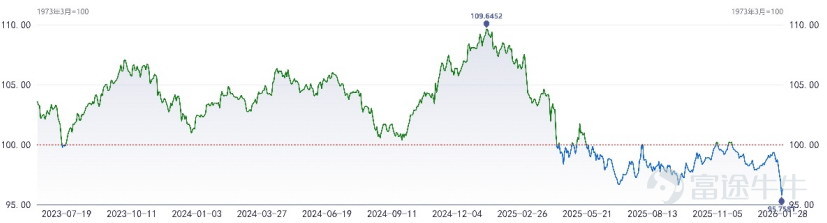
Notably, on January 30, US President Trump officially nominated former Fed Governor Kevin Warsh as the next Fed Chair to succeed Powell, whose term will end in May. Following the announcement of the nomination, the US Dollar Index surged rapidly, fully reflecting the market's expectation of Warsh's 'hawkish' policy stance, becoming another key factor supporting the short-term resilience of the US dollar. This further confirms the judgment that the short-term trend of the US dollar is closely related to politically driven policy directions. As a financial elite spanning Wall Street, the White House, and the Fed, Warsh’s core policy proposal is 'parallel interest rate cuts and balance sheet reduction.' The expectation of rapid balance sheet reduction under his 'hawkish' stance further strengthened the market’s bullish sentiment on the US dollar, aligning with the current logic of short-term US dollar resilience. If Warsh officially takes office, the US Dollar Index is expected to rise further to around 100 points.
The Fed’s cautious balancing in its inflation narrative, along with the ongoing implementation of the Reserve Management Purchases (RMP) program, formed a dual short-term protection of policy statements and tool support. On the issue of inflation, Powell did not shy away from the reality that the current inflation level remains above the long-term target of 2%, clearly mentioning the high inflation situation. However, he also explained that most of the overshoot in inflation was due to one-time price increases caused by tariff policy shocks, rather than a sustained rise in intrinsic inflationary pressures within the real economy. This wording adjustment avoided creating market expectations of aggressive tightening policies due to excessive concerns about runaway inflation while not denying the possibility of long-term easing, achieving a policy balance of 'stabilizing expectations and leaving room.'
In terms of liquidity, the Fed continued the RMP program initiated in December 2025, with the core aim of supporting liquidity stability in the banking system and avoiding market volatility caused by liquidity tightness. On the surface, this liquidity operation has no direct connection to the US dollar’s trend, but in fact, it indirectly helped the US dollar hold key support levels by stabilizing liquidity in the banking system and calming market panic. This reflects the market pricing of the US dollar’s short-term resilience and is also a phased achievement of the Fed’s efforts to safeguard the integrity of policy procedures and maintain market confidence under pressure from the Trump administration.
During the press conference after this interest rate decision meeting, when asked for advice for his successor, Powell stated, 'Do not get involved in electoral politics; never do that.' We believe this statement contains multiple deep meanings: Firstly, it serves as an indirect warning to the Trump administration, suggesting that nominating an overly politicized candidate would damage the Fed’s credibility and market confidence. Secondly, it acts as 'onboarding training' for potential successors, hinting that they should be prepared to face similar political pressures while adhering to professional judgment. Lastly, it defends the institutional culture of the Fed, emphasizing the tradition of decision-making based on data rather than political preferences.
From a historical perspective, the tradition of the Fed Chair’s independence was established during the Volcker and Greenspan eras. By adhering to this tradition, Powell attempts to institutionalize the Fed’s independence beyond personal tenure. For the US dollar, Powell’s statement provided some short-term stability, but the market will reassess the dollar’s prospects after the nomination of the new Fed Chair is announced.
[Mid-term Trend]
In the mid-term, whether the US dollar can hold the key fluctuation range of 94-99 points, thus avoiding a breakdown, may no longer depend on whether CPI data reaches a specific target, but rather on the final game among three core variables: personnel, economy, and tariffs.
Firstly, the game over personnel arrangements is the core dominant factor determining the pace of the US dollar’s mid-term decline and the biggest source of uncertainty for its mid-term trend. The nomination process for the new Fed Chair has brought this uncertainty to the forefront. Recently, Trump officially nominated Warsh as the next Fed Chair. However, whether the nomination can pass Senate confirmation remains an uncertainty, a process that will directly determine the core direction of the Fed’s mid-term policy, thereby becoming a key variable affecting the US dollar’s trend.
Further analysis shows that during this interest rate meeting, Waller's shift from a neutral to a "dovish" stance unveiled the beginning of internal personnel maneuvering within the Federal Reserve. Behind this maneuvering lies the inescapable political influence of the White House. Recently, the Trump administration has been intensifying pressure on the Federal Reserve, not only publicly criticizing Powell’s policy stance but also initiating a criminal investigation against him, while continuously pushing for a "weak dollar" policy. The aim is to influence the Fed’s policy direction to serve its own political demands and economic goals.
Secondly, whether the resilience of the US economy can be sustained is key to determining whether the dollar can maintain its range-bound fluctuations. In the statement from this interest rate meeting, the Federal Reserve upgraded its assessment of US economic activity from "moderate expansion" to "robust expansion." This adjustment forms the core logic supporting the dollar in the short term and has also given the market some expectations regarding the medium-term outlook of the US economy. However, objectively speaking, whether the current "robust expansion" of the US economy can be sustained remains fraught with concerns, and no solid long-term support logic has been established.
Finally, tariff policies may cause disturbances to the dollar's trend. At the press conference, Powell mentioned that the Federal Reserve's judgment on tariffs and inflation is based on the premise of "no new significant tariff hikes," while explicitly acknowledging that uncertainty remains regarding whether the Trump administration will introduce new tariff policies. While this statement appears mild, it conceals underlying concerns about medium-term inflation trends and reveals the potential impact of tariff policies on the dollar's medium-term trajectory.
[Long-term Destiny]
From a longer-term perspective, the dollar's long-term fate may no longer be an optional question of whether its hegemony can continue, but rather a mandatory question of how its credibility will be repriced. The core signals conveyed at this Federal Reserve interest rate meeting—whether Powell's adherence to policy independence or the initial signs of personnel maneuvering—are essentially the beginning of the repricing of the dollar’s credibility.
Currently, the strategic balancing act by the Trump administration has already set the tone for the dollar’s long-term trend. Against the backdrop of global industrial restructuring and rising trade protectionism, the Trump administration is attempting to weaken the dollar's hegemony to enhance the competitiveness of American export products, attract global industries back to the US, and thereby achieve upgrades in domestic industry repair while reducing persistently high trade deficits to strengthen the long-term foundation of the US economy. This strategy, which sacrifices part of the dollar’s hegemony in exchange for domestic industrial recovery and a reduction in trade deficits, is not an impulsive policy choice but an irreversible strategic balance.
The nomination of Warsh and his potential policy orientation also add a new variable to the repricing of the dollar’s long-term credit. If Warsh, after taking office, can uphold "hawkish" policy stances while safeguarding the Federal Reserve’s policy independence, avoiding becoming a tool for political demands, his strategy of "rate cuts alongside balance sheet reduction" might strike a balance between liquidity contraction and economic stability, aligning with the process of repairing American industries and promoting a moderate depreciation of the dollar. Conversely, if the Federal Reserve’s policy is overly influenced by politics or if imbalances between rate cuts and balance sheet reductions lead to a collapse in market confidence, even if American industries see some recovery, it would be difficult to prevent a systemic credit discount of the Federal Reserve, potentially triggering a deep restructuring of the global monetary order and exposing the dollar to the risk of disorderly collapse. Moreover, Warsh’s view of oil prices as a core tool for rate cuts and balance sheet reduction means that his inclination toward oil price regulation will further influence the long-term credit pricing of the dollar through the “oil-dollar” cycle, becoming an important implicit variable affecting the dollar’s long-term trajectory.
Thus, the long-term value center of the dollar will depend on the balance between two core factors: industrial repair and credit preservation, which will also determine the future structure of the global monetary order. This can be divided into two scenarios:
In the first scenario, if the repair of domestic American industries achieves expected results, with manufacturing returning and export competitiveness improving gradually, and if the Federal Reserve successfully maintains its policy independence and preserves its institutional credibility without excessive political interference, then the dollar may experience a "managed moderate depreciation" trend, gradually shedding its long-standing strong image but avoiding an uncontrolled collapse, allowing the global monetary order to remain relatively stable.
In the second scenario, if the Federal Reserve’s institutional credibility depreciates too quickly, failing to maintain policy independence and becoming a tool serving domestic political demands in the US, losing the trust of global investors, then even if there are some achievements in repairing American industries, it will not be enough to reverse the dollar’s long-term decline. At that point, a far deeper and broader restructuring of the global monetary order than the "Plaza Accord" will occur, shaking the dollar’s long-term hegemonic status and gradually stripping it of its core advantages as a global reserve currency.
The chart shows the trend of the US Dollar Index
[Summary and Risk Advisory]
The Federal Reserve's interest rate meeting in January 2026 will be an important starting point for the repricing of the US dollar's credibility. Notably, the baseline scenario for the subsequent movement of the US dollar in this article is largely based on the interpretation of the content of the January Federal Reserve interest rate meeting and the extrapolation of related variables. Going forward, four key factors should be closely monitored: First, the approval process for the nomination of the new Federal Reserve Chair; second, the intensity of policy implementation by Wash after taking office, especially the balance between the pace of quantitative tightening and interest rate cuts; third, fluctuations in oil prices and potential adjustments to US tariff policies; and fourth, the sustainability of the resilience of the US economy. If the aforementioned core variables experience unexpected changes, it could lead to deviations between the actual movement of the US dollar and the baseline forecast. (Author: Zhou Ji Z0017101, Assistant Director of the Nan Hua Research Institute)
The Fed's First Meeting of 2026: The Start of a Repricing of the US Dollar's Credibility
Risk Disclaimer: The above content only represents the author's view. It does not represent any position or investment advice of Futu. Futu makes no representation or warranty. Read more
See Original
Report
90K Views
Comment
Sign in to view/post comments
avatar
NANHUA FUTURES
The Official Account of NANHUA FUTURES
16K
Followers
18K
Visitors
Follow
Market Insights
HK Tech and Internet Stocks
View More
Nancy Pelosi Portfolio
Tariff game between the US and Europe shakes the market! Will TACO happen again?
Amidst the global market turbulence triggered by the US-Europe dispute over Greenland, a single post by Trump instantly reversed market tren Show More