
How to view the post-holiday market trend in Hong Kong stocks?

2026 Hong Kong stocks start with a bang! Gold + semiconductor sectors lead the gains | In-depth analysis | Research report | Potential stocks | Gold | Semiconductors
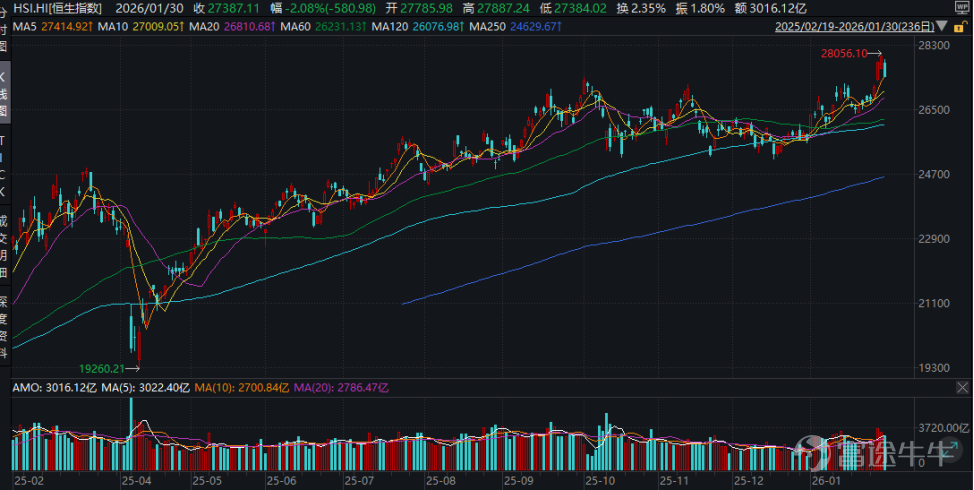
In January 2026, the Hong Kong stock market welcomed a strong start, with the Hang Seng Index and Hang Seng Tech Index climbing sharply. The Hang Seng Index rose by a cumulative 6.85%, breaking through the 28,000-point level on January 29th to hit its highest point since July 2021. Although there was some pullback in the broader market on January 30th, the Hang Seng Index successfully held above the 27,000-point level for the month. Meanwhile, the Hang Seng Tech Index gained 3.67% in January, comfortably surpassing the 5,700-point mark. It is believed that trading activity in the Hong Kong stock market remains vibrant, with standout performances from various sectors including gold and non-ferrous metals, semiconductors, oil and gas stocks, and real estate. Is there still an opportunity to position in Hong Kong stocks now? Can the upward trend continue in the future?
Hong Kong stocks have shown strong performance at the start of the year, reaching a new high for the period. Does it still present a good opportunity for positioning?
In January 2026, the Hong Kong stock market exhibited a one-sided upward trend, with core indices performing strongly. As of January 30th, $Hang Seng Index (800000.HK)$ The Hang Seng Index closed at 27,387.11 points, with a cumulative increase of approximately 6.85% in January. It reached an intraday high above 28,000 points on the 29th, marking a new multi-year high since July 2021 (nearly four and a half years). By the close on January 30, it successfully held above the key 27,000-point level, showing strong short-term upward momentum. $Hang Seng TECH Index (800700.HK)$ The Hang Seng Tech Index also strengthened. By the close on January 30, the index stood firmly above the 5,700-point level, representing a cumulative gain of approximately 3.67% compared to the closing price on December 31, 2025. Throughout January, the Hang Seng Tech Index trended upwards with volatility, repeatedly setting new multi-year highs and breaking free from its previous consolidation pattern. A comprehensive valuation recovery rally has begun in the tech sector.
Figure 1: Performance of the Hang Seng Index over the past year

Source: Wind
Figure 2: Performance of the Hang Seng Tech Index over the past year

Source: Wind
*Strong performance across multiple sectors, led by leading stocks
In January, Hong Kong's stock market exhibited a 'multi-sector rotation' pattern with standout performances across various sectors including semiconductors and real estate. Leading stocks drove increased activity in these sectors. In terms of trading volume, daily turnover in Hong Kong stocks exceeded HKD 250 billion several times in January, peaking at HKD 361.523 billion on January 28, which was the highest daily turnover for the month. Data shows that the average daily turnover for January reached HKD 241.4 billion, significantly higher than last month’s average of nearly HKD 199.2 billion, reflecting a substantial increase in trading activity. On the capital front, two main sources provided support: First, Southbound funds continued to increase their allocations, acting as a 'stabilizer' for Hong Kong stocks. In 2025, net purchases through Southbound trading surpassed HKD 1.4 trillion, setting a historical record, and this inflow continued into January 2026, accumulating to HKD 69 billion so far this year, primarily flowing into core sectors such as finance, AI, and consumer goods. Second, foreign capital returned to buy the dip. The market widely expects the Federal Reserve to cut interest rates 2-3 times in 2026, totaling about 50-75 basis points. Easing dollar liquidity prompted global funds to reallocate towards emerging markets. With the current P/E ratio of Hong Kong stocks at only 12.7 times, significantly lower than major global markets, combined with a temporary easing of US-China relations, foreign capital sentiment shifted from cautious to optimistic, resulting in continuous net inflows recently, mainly focusing on technology and resource sectors.
Figure 3: Southbound fund inflows

Source: Wind
*Gold sector and oil & gas resource stocks
The gold sector was one of the biggest highlights of Hong Kong's stock market in January, leading market gains. Driven by an over 15% rise in international gold prices at the start of the year, core leader $ZIJIN GOLD INTL (02259.HK)$ Zijin Gold International (2259.HK) performed particularly well, with a cumulative gain of up to 49.7% in January. Its acquisition of an African gold mine for HKD 28 billion further boosted the stock price. $SD GOLD (01787.HK)$ Shandong Gold (1787.HK), $ZHAOJIN MINING (01818.HK)$ Zhaojin Mining (1818.HK), and other individual stocks also performed well, with the entire sector’s trading volume once surpassing 5 billion HKD. The People's Bank of China’s continuous 14-month gold purchase has become a key support for the sector’s strength, with clear fundamental logic and high investor attention. Additionally, the non-ferrous metal sector delivered an overall impressive performance in January. Apart from gold stocks, $JIANGXI COPPER (00358.HK)$ Jiangxi Copper (0358.HK), $CMOC (03993.HK)$ Luoyang Molybdenum (3993.HK), and other individual stocks also showed significant increases, enriching investment opportunities within the resources sector.
In the oil and gas sector, supported by fluctuating upward international oil prices and the recovery of global energy demand, the sector achieved steady growth, with leading stocks performing notably. $CNOOC (00883.HK)$ CNOOC (0883.HK), $PETROCHINA (00857.HK)$ PetroChina (0857.HK) as core leaders, had strong performances in January. By January 30th, CNOOC (0883.HK) closed at 24.38 HKD, marking a 14.46% increase from the beginning of the month, with a monthly trading volume of 52.4 billion HKD. PetroChina (0857.HK) closed at 9.28 HKD on January 30th, with an accumulated increase of 10.74% in January. Global energy supply-demand tensions, compounded by geopolitical factors, have driven up international oil prices, directly boosting valuation recovery in Hong Kong's oil and gas sector, making it one of the standout sectors of the Hong Kong stock market in January.
*Semiconductor, Real Estate, and Financial Sectors
Regarding the semiconductor sector, benefiting from the recovery of the global semiconductor industry cycle and the acceleration of domestic substitution, the sector saw significant gains. $SMIC (00981.HK)$ SMIC (0981.HK), $HUA HONG GRACE (01347.HK)$ Leading stocks such as Huahong Semiconductor (1347.HK) have performed impressively. Huahong Semiconductor (1347.HK) surged over 50% in January alone, while SMIC (0981.HK), despite experiencing short-term fluctuations during the month, maintained an overall upward trend, posting daily gains multiple times since January. Market expectations for the semiconductor industry chain's prosperity continue to rise, with foreign capital and institutional funds actively investing, making it one of the hottest sectors in the Hong Kong stock market in January.
In terms of the real estate sector performance, the real estate segment saw a strong rebound in January, becoming one of the popular sectors in the Hong Kong stock market for the month, with widespread gains across individual stocks. Benefiting from continued easing of real estate policies in mainland China and Hong Kong, progress in debt restructuring by real estate companies, and a recovery in second-hand home transactions, leading stocks performed notably. $SHK PPT (00016.HK)$ Sun Hung Kai Properties (0016.HK) surged over 32% cumulatively in January, closing at HKD 125.7 on January 30. $R&F PROPERTIES (02777.HK)$ R&F Properties (2777.HK), $CK ASSET (01113.HK)$ Cheung Kong Holdings (01113.HK) and other real estate firms showed steady trends, closing at HKD 0.57 and HKD 45.84 respectively on January 30, with most stocks in the sector rising over 10%. The completion of debt restructuring eased market concerns, while the recovery in second-hand home transactions confirmed the industry’s recovery momentum, driving continuous valuation repair within the sector.
In the banking and insurance sector, there has been a dual boost from valuation recovery and earnings improvement, showing robust performance. $AIA (01299.HK)$ AIA (1299.HK) posted a significant cumulative gain of 13.08% in January. $CCB (00939.HK)$ China Construction Bank (0939.HK) delivered stable performance with a cumulative increase of approximately 2.86% in January, being heavily accumulated by southbound capital. The entire sector benefited from the economic recovery in mainland China, improved interest rate environments, alleviated pressure on bank interest spreads, steady growth in premium income for the insurance industry, and increasingly prominent investment value.
Does the current Hong Kong stock market still offer good investment opportunities?
After comprehensive analysis, considering the four dimensions of current Hong Kong stock market valuations, capital flow, fundamentals, and policy outlook, we believe that the Hong Kong stock market still presents significant investment opportunities, although caution should be exercised regarding potential pullbacks due to excessive short-term gains. The reasoning is as follows:
*Valuation Advantage and Capital Support
In terms of valuation, the Hong Kong stock market still shows a significant valuation advantage with a high margin of safety: after the valuation recovery since 2024, Hong Kong stocks remain in a valuation trough among major global markets. The current price-to-earnings (P/E) ratio of the Hang Seng Index is only 12.7 times, significantly lower than its historical high valuation (about 22 times), showing a clear discount advantage. Additionally, compared to other markets such as A-shares (with the CSI 300 at a P/E ratio of 14.2 times and the SZSE 50 at 27.02 times) and US stocks (with the S&P 500 at a P/E ratio of 29.2 times), the core assets of Hong Kong stocks (especially in finance, real estate, and some technology leaders) are undervalued, offering substantial room for valuation recovery and outstanding long-term allocation cost-effectiveness.
Figure Four: Comparison of Hong Kong Stock Valuation with Other Markets

Source: Wind
In terms of capital flow, it is believed that the capital support for the Hong Kong stock market remains strong, with high certainty of new capital inflow: there is still significant room for Southbound funds to increase their allocation to Hong Kong stocks, as mainland investors are currently underweight in Hong Kong stocks. With the ongoing trend of 'deposit migration,' retail funds flowing into Hong Kong stocks through ETF channels are expected to continue. According to Goldman Sachs estimates, excluding foreign capital, an incremental inflow of 3.6 trillion yuan is expected into China's stock market this year, part of which will flow into the Hong Kong stock market via the Shanghai-Hong Kong and Shenzhen-Hong Kong Stock Connects. In 2026, domestic individual investors aiming to increase their stock allocation will bring about 2 trillion yuan into the stock market; on the institutional side, led by insurance companies increasing their allocation to equity assets, around 1.6 trillion yuan is expected to flow into Chinese equities. Meanwhile, with the expectation of interest rate cuts by the Federal Reserve in 2026, the global liquidity environment will become more accommodative, potentially improving the underweight status of foreign capital in Chinese equities, leading to a possible unexpected scale of foreign capital returning to the Hong Kong market, providing continuous capital support for the Hong Kong stock market.
*Fundamentals Bottoming Out and Rebounding, Earnings Expectations Continue to Improve
The fundamentals of the Hong Kong stock market have reached an inflection point of bottoming out and rebounding, with consensus earnings expectations continuously being revised upward, forming the core underlying logic supporting the market trend. According to Bloomberg consensus forecasts, the overall earnings growth rate of Hong Kong stocks is expected to bottom out in 2025, with revenue and net profit growth rates of the Hang Seng Composite Index at 3.6% and 3.5%, respectively, during a low-speed grinding phase. As internal and external favorable factors materialize, revenue growth for this index is projected to rise to 5.5% in 2026, with profit growth significantly increasing to 9.2%, demonstrating stronger earnings recovery than revenue growth, indicating improved profitability efficiency for Hong Kong-listed companies. Revenue and profit growth rates are expected to stabilize at high levels by 2027, providing long-term performance support for the market.
The sustained advancement of domestic economic recovery and the concentrated implementation of the '15th Five-Year Plan' policies are the core drivers of Hong Kong stock performance recovery. Mainland China’s economy is steadily transitioning to an active inventory replenishment phase, with demand across industrial chains warming up. The synergy of the three major drivers—consumption, investment, and exports—is bringing operational increments to Hong Kong-listed companies. The plan focuses on empowering core directions like high-end manufacturing and digital economy with precise complementary policies, opening up new revenue growth spaces for relevant enterprises. Against this backdrop, the earnings growth logic of Hong Kong-listed companies is shifting from short-term 'profit repair' driven by cost control to sustainable 'revenue expansion' based on core business expansion, creating a positive trend of synchronized revenue and profit growth. This not only solidifies intrinsic company value but also enhances market valuation recognition, providing robust support for Hong Kong stock price increases and medium to long-term fund deployment.
*Summary and Outlook
In January 2026, the Hong Kong stock market started strongly, with the Hang Seng Index and Hang Seng Tech Index surging to new highs. Multiple sectors, including oil and gas, semiconductors, real estate, gold, and non-ferrous metals, performed well, with trading remaining active and both market sentiment and capital flow showing positive trends. Overall, Hong Kong stocks currently present a strong layout opportunity, with significant valuation advantages, sufficient capital support, and continuous fundamental improvement, highlighting long-term allocation value. However, caution should be exercised regarding the risk of short-term pullback due to excessive gains, and rational deployment is necessary to avoid chasing highs. Going forward, Hong Kong stocks are unlikely to experience a one-sided surge, but rather will likely continue in a pattern of 'volatile climb and steady upward movement.' The Hang Seng Index is expected to gradually break through the 28,000-point level, while the Hang Seng Tech Index is expected to continue recovering and climbing from the base of 5,700 points. Core drivers for this sustained climb include policy catalysts, loose liquidity, and fundamental recovery. For sector allocation, investors can focus on Hong Kong's core growth tracks, prioritizing two main lines: technology and new consumption. The new consumption sector emphasizes triple growth logic driven by emotional consumption, new scenario expansion, and national trend upgrades, while the technology sector focuses on highly certain development paths such as AI application commercialization, semiconductor localization, and cloud computing.
Disclaimer: Any information provided in this report regarding or related to any investment or potential transaction is subject to the applicable laws and regulatory requirements of your jurisdiction, and you are solely responsible for ensuring compliance with such laws and regulations. The content of this report is for reference purposes only and does not constitute investment advice. Our company has made every effort to ensure the accuracy of the financial information provided, but we assume no responsibility or provide any form of guarantee regarding the accuracy, completeness, or effectiveness of all or any part of the content. We will not be held liable for any errors or omissions. Please also note that securities and virtual asset prices can fluctuate, particularly with very high risks associated with virtual assets, and investors should exercise caution and bear investment risks on their own.
———————————————————————
About the author:
Victory Securities—Hong Kong’s Leading Virtual Asset Broker
Victory Securities (08540.HK), with over 50 years of deep roots in Hong Kong, is a comprehensive full-service brokerage firm providing four main business services to individual investors, institutional investors, high-net-worth clients, and corporations: wealth management, asset management, virtual assets, and capital markets. The firm has garnered numerous awards and core business qualifications across the Asia-Pacific region. In 2023, Victory Securities became the first licensed brokerage in Hong Kong to hold licenses issued by the Securities and Futures Commission (SFC) for virtual asset trading, advisory, and asset management services. It was also approved by the SFC to offer retail investors access to compliant and legal Bitcoin and Ethereum trading, exchange, and deposit/withdrawal services on a one-stop basis.
Risk Disclaimer: The above content only represents the author's view. It does not represent any position or investment advice of Futu. Futu makes no representation or warranty.Read more

Comments
to post a comment
7
1