
Waller's new policy measures are in the works! How should investors respond?

Official announcement tonight! Trump plans to nominate Kevin Warsh to head the Federal Reserve. How will this affect investors' 'wallets'?
In the game of financial markets, nothing tightens investors' nerves more than the transition of the 'Federal Reserve Chair'.
As Trump announced he will reveal the Federal Reserve nominee on Friday morning local time (tonight Beijing time), a peak drama involving power, monetary policy, and market expectations officially enters the countdown.
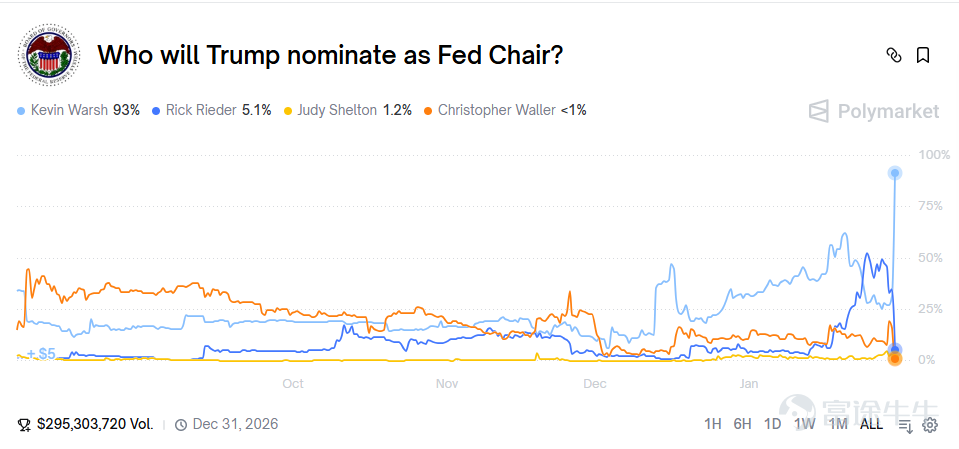
Following Trump’s announcement that the Fed Chair pick will be revealed tonight, market expectations for Kevin Warsh to take over as the head of the Federal Reserve have surged. The prediction market Polymarket's latest data shows,The probability of Warsh being nominated by Trump as the new Fed Chair skyrocketed to 93%.

Standing at the crossroads of monetary policy transition, the market focus has quickly shifted: what is the monetary stance of this 'reformist' Warsh? How will his policy stance reshape global asset pricing logic? This article will delve into his policy style and its potential impact on the market.
What is Wash's stance on monetary policy?
At a crossroads of changing monetary policy, the market is eager to assess the credentials of this potential leader. Wash is not a traditional academic bureaucrat; his competitive edge can be summarized as follows:
– Orthodoxy and Experience:Served as a Federal Reserve Board governor from 2006 to 2011, playing a key role in addressing the financial crisis, with extremely high market trust.
– Political and Personal Connections:As a close friend and key adviser to Trump, he wields direct political influence reaching into the White House.
– Cross-sector Perspective: With experience spanning Wall Street, the White House, and the Federal Reserve, he possesses an exceptionally sharp market intuition.
–“Balance sheet reduction in exchange for low interest rates” proposal:He has openly stated that inflation is the Fed’s responsibility, advocating for a “revival” rather than a complete overhaul or “revolution” of the Fed. Regarding the challenge of high interest rates,Wash argues that room for lower interest rates can be achieved by reducing the balance sheet.

Deutsche Bank analyzes Kevin Warsh’s potential election as Fed Chair,suggesting his policy stance could present a unique combination of ‘rate cuts alongside balance sheet reduction.’Deutsche Bank believes the implementation of ‘rate cuts alongside balance sheet reduction’ hinges on regulatory reforms lowering banks' reserve requirements, with short-term feasibility in question. The market needs to closely watch whether the new chair can maintain independence under Trump's pressure for significant rate cuts and how their policy credibility is established.
However, Cathay HT Securities noted,regardless of who is nominated as the next Fed Chair, the core demand of the Trump administration involves intervening in the Fed’s economic decision-making; analyzing potential methods and pathways of Trump's economic policy intervention is crucial.
By observing Trump's behavior in attempting to influence the Fed over his two terms,the bank believes the Trump administration has been probing long-term, multi-dimensional interventions in the Fed’s decisions, aiming to weaken the Fed’s independence.The main methods are summarized as follows:
1) Testing legal limits to impose restrictions on the Fed's monetary policy implementation;
2) Forcing the Fed's monetary policy to follow through fiscal policy, undermining the credibility of the Fed's decision-making;
3) Probing through rhetoric, sending confusing signals to the market about White House intervention in the Fed’s decision-making;
4) Enhancing the White House’s influence over the Fed’s decisions by appointing governors whose independence is questionable and threatening to dismiss key officials.

What are the impacts and differences of a change in the Fed chair?
With the new Fed chair taking office, monetary policy is likely to continue its dovish tone, with the weak dollar trend persisting. Guotai Haitong Securities believes that different Fed chair candidates will primarily affect the market in three ways: 1) The pace and intensity of interest rate cuts; 2) The extent to which the Fed’s independence is weakened; 3) Their stance on quantitative tightening. Based on the different policy positions of the candidates, the following inferences can be made regarding the potential impact on major asset classes under each candidate’s hypothetical election:

For the US Dollar Index:In the short term, all candidates, including Warsh, have shown a relatively dovish attitude. However, markets infer that among the other three candidates excluding Warsh, Hassett’s interest rate cut decisions would be more strongly influenced by the White House, whereas Waller and Reed are more inclined to be influenced by market conditions and economic data. Therefore, regardless of who among these three is elected, the short-term impact on the US dollar will be bearish.Due to Warsh’s hawkish tendency on interest rates but his aggressive stance on balance sheet reduction, while he appears dovish in the short term, the long-term impact on the US Dollar Index is relatively difficult to determine.
For the precious metals market:Hassett’s election could raise concerns about the Fed’s independence and the stability of monetary policy, weakening the credibility of the US dollar. Safe-haven assets like gold and silver may see an accelerated rise.For Wash and Reed, their dovish stance is also beneficial for gold and silver.Waller's election represents stronger policy stability and Federal Reserve independence for the market, having a relatively smaller impact on gold and silver assets.
Gold is the most representative core variety among precious metals. The bank predicts that gold demand will likely continue to strengthen. Analyzing from the perspective of gold prices, the price of gold is mainly determined through its threefold attributes: commodity, currency, and financial. The commodity attribute has a relatively limited impact on pricing due to a relatively balanced supply and demand; therefore, gold pricing primarily depends on its currency and financial attributes. The bank believes that 1) the sustained weakening of the US Dollar Index will stimulate demand based on gold’s currency attribute; 2) sluggish global economic growth, marginal decline in real interest rates, and the continuously decreasing opportunity cost of gold—combined with uncertainties surrounding Trump administration policies—further elevate risk levels for dollar assets and global geopolitical risks, activating demand based on gold’s financial attributes. Dual benefits from currency and financial attributes provide strong support for the rise in gold prices.

For the equity market:Although Wash, Reed, and Waller have shown varying degrees of inclination towards balance sheet reduction, the election of any of the three may lead to relatively tighter liquidity in both the U.S. and global markets. However, except for Waller, all candidates advocate for interest rate cuts,Thus, in the short term, the election of anyone other than Waller is overall positive for the global equity market,Waller's election would be neutral for the global equity market.

Summary
For a long time, the relationship between Trump and the Federal Reserve under Powell's leadership has remained tense. Although Powell was personally nominated by Trump, he later publicly criticized him multiple times for not lowering interest rates fast enough.
Just this Thursday, Trump stated outright,"Regardless of what the Federal Reserve does, interest rates will eventually go down."This statement once again pushed the dispute over monetary policy to the forefront.
The selection of the new leader is not only a personnel change but also a key recalibration of the balance between 'fighting inflation' and 'supporting growth' for the Federal Reserve.
If Warsh ultimately takes the helm, market participants expect the Fed's policy framework to undergo substantial restructuring. This 'policy earthquake' emanating from Washington will profoundly reshape the pricing dynamics and growth outlook of global financial markets.
Risk Disclaimer: The above content only represents the author's view. It does not represent any position or investment advice of Futu. Futu makes no representation or warranty.Read more


Comments (26)
to post a comment
98
303