
English
Back
Open Account
钛媒体APP
wrote a column · Jan 30 11:00

Twenty-three years after its founding, the first chapter of Tesla's story has come to an end

By Jinduan
By Jinduan After the US market closed on the 28th Eastern Time, Tesla released its financial report for the fourth quarter of 2025, recording total revenue of $24.901 billion, a year-on-year decline of 3.1%, slightly higher than analysts' relatively pessimistic expectations. Operating profit was $1.409 billion, and EPS under Non-GAAP recorded $0.5, slightly below analysts' expectations. For a one-picture summary of the earnings report, see the figure below (unless otherwise specified, all units are in billions of US dollars):  Figure: Summary of Tesla's financial report, Source: Corporate Earnings Report, compiled by Jinduan Research Institute Tesla's financial reports are usually broken down into several parts for understanding. The market’s perception of different businesses varies; for example, investors in energy storage and vehicle manufacturing are more concerned about sustainability and specific gross margin performance. Meanwhile, investors in Optimus and Robotaxi focus more on early development layouts and technology implementation. Previously, we used the Gartner curve to roughly explain Tesla's business layout and development stage.  Figure: Tesla product lines combined with the Gartner curve, Source: Jinduan Research Institute In this year’s latest earnings call, following the completion of the investment in xAI, Tesla has completed its separation from the physical world. Musk’s discussions on vehicle lineup and profitability trends in car manufacturing have waned in interest, with the narrative focus shifting to relatively cutting-edge topics such as Robotaxi, Optimus, and AI Infrastructure. This essentially means that in 2003...
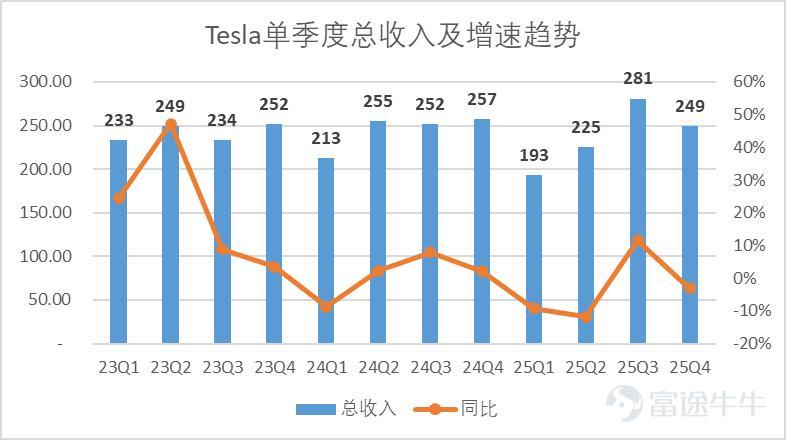
After the US market closed on the 28th Eastern Time, Tesla released its financial report for the fourth quarter of 2025, recording total revenue of $24.901 billion, a year-on-year decline of 3.1%, slightly higher than analysts' relatively pessimistic expectations. Operating profit was $1.409 billion, and EPS under Non-GAAP recorded $0.5, slightly below analysts' expectations.
For a one-picture summary of the earnings report, see the figure below (unless otherwise specified, all units are in billions of US dollars):
By Jinduan After the US market closed on the 28th Eastern Time, Tesla released its financial report for the fourth quarter of 2025, recording total revenue of $24.901 billion, a year-on-year decline of 3.1%, slightly higher than analysts' relatively pessimistic expectations. Operating profit was $1.409 billion, and EPS under Non-GAAP recorded $0.5, slightly below analysts' expectations. For a one-picture summary of the earnings report, see the figure below (unless otherwise specified, all units are in billions of US dollars):  Figure: Summary of Tesla's financial report, Source: Corporate Earnings Report, compiled by Jinduan Research Institute Tesla's financial reports are usually broken down into several parts for understanding. The market’s perception of different businesses varies; for example, investors in energy storage and vehicle manufacturing are more concerned about sustainability and specific gross margin performance. Meanwhile, investors in Optimus and Robotaxi focus more on early development layouts and technology implementation. Previously, we used the Gartner curve to roughly explain Tesla's business layout and development stage.  Figure: Tesla product lines combined with the Gartner curve, Source: Jinduan Research Institute In this year’s latest earnings call, following the completion of the investment in xAI, Tesla has completed its separation from the physical world. Musk’s discussions on vehicle lineup and profitability trends in car manufacturing have waned in interest, with the narrative focus shifting to relatively cutting-edge topics such as Robotaxi, Optimus, and AI Infrastructure. This essentially means that in 2003...
Figure: Summary of Tesla's financial report, Source: Corporate Earnings Report, compiled by Jinduan Research Institute
Tesla's financial reports are usually broken down into several parts for understanding. The market’s perception of different businesses varies; for example, investors in energy storage and vehicle manufacturing are more concerned about sustainability and specific gross margin performance. Meanwhile, investors in Optimus and Robotaxi focus more on early development layouts and technology implementation.
Previously, we used the Gartner curve to roughly explain Tesla's business layout and development stage.
By Jinduan After the US market closed on the 28th Eastern Time, Tesla released its financial report for the fourth quarter of 2025, recording total revenue of $24.901 billion, a year-on-year decline of 3.1%, slightly higher than analysts' relatively pessimistic expectations. Operating profit was $1.409 billion, and EPS under Non-GAAP recorded $0.5, slightly below analysts' expectations. For a one-picture summary of the earnings report, see the figure below (unless otherwise specified, all units are in billions of US dollars):  Figure: Summary of Tesla's financial report, Source: Corporate Earnings Report, compiled by Jinduan Research Institute Tesla's financial reports are usually broken down into several parts for understanding. The market’s perception of different businesses varies; for example, investors in energy storage and vehicle manufacturing are more concerned about sustainability and specific gross margin performance. Meanwhile, investors in Optimus and Robotaxi focus more on early development layouts and technology implementation. Previously, we used the Gartner curve to roughly explain Tesla's business layout and development stage.  Figure: Tesla product lines combined with the Gartner curve, Source: Jinduan Research Institute In this year’s latest earnings call, following the completion of the investment in xAI, Tesla has completed its separation from the physical world. Musk’s discussions on vehicle lineup and profitability trends in car manufacturing have waned in interest, with the narrative focus shifting to relatively cutting-edge topics such as Robotaxi, Optimus, and AI Infrastructure. This essentially means that in 2003...
Figure: Tesla product lines combined with the Gartner curve, Source: Jinduan Research Institute
In this year’s latest earnings call, following the completion of the investment in xAI, Tesla has completed its separation from the physical world. Musk’s discussions on vehicle lineup and profitability trends in car manufacturing have waned in interest, with the narrative focus shifting to relatively cutting-edge topics such as Robotaxi, Optimus, and AI Infrastructure.
This essentially means that Tesla, founded in 2003 and led by Musk since 2024, has, after 23 years of development, nearly concluded the first chapter of its narrative on new energy electric vehicles.
Therefore, following this thread, let us discuss Tesla's financial performance and future expectations in two parts: 'the Old World' and 'the New World.'
First, the 'old world,' based on the financial report of existing operations:
1. Vehicle manufacturing business: Expected decline, Model S/X making way for Optimus
By Jinduan After the US market closed on the 28th Eastern Time, Tesla released its financial report for the fourth quarter of 2025, recording total revenue of $24.901 billion, a year-on-year decline of 3.1%, slightly higher than analysts' relatively pessimistic expectations. Operating profit was $1.409 billion, and EPS under Non-GAAP recorded $0.5, slightly below analysts' expectations. For a one-picture summary of the earnings report, see the figure below (unless otherwise specified, all units are in billions of US dollars):  Figure: Summary of Tesla's financial report, Source: Corporate Earnings Report, compiled by Jinduan Research Institute Tesla's financial reports are usually broken down into several parts for understanding. The market’s perception of different businesses varies; for example, investors in energy storage and vehicle manufacturing are more concerned about sustainability and specific gross margin performance. Meanwhile, investors in Optimus and Robotaxi focus more on early development layouts and technology implementation. Previously, we used the Gartner curve to roughly explain Tesla's business layout and development stage.  Figure: Tesla product lines combined with the Gartner curve, Source: Jinduan Research Institute In this year’s latest earnings call, following the completion of the investment in xAI, Tesla has completed its separation from the physical world. Musk’s discussions on vehicle lineup and profitability trends in car manufacturing have waned in interest, with the narrative focus shifting to relatively cutting-edge topics such as Robotaxi, Optimus, and AI Infrastructure. This essentially means that in 2003...
On the same day as the earnings release, Tesla officially announced the completion of its investment in xAI, shifting market focus rapidly from traditional existing businesses to future expectations. However, let’s first examine Tesla's current fundamentals.
Looking solely at the financial report's figures, Tesla's vehicle manufacturing performance in Q4 was poor but within expectations, with quarterly revenue reaching $17.7 billion, a year-on-year decrease of 10.6%. The main reason was the expiration of subsidies, which caused a surge in growth in Q3, followed by inevitable weak demand.
By Jinduan After the US market closed on the 28th Eastern Time, Tesla released its financial report for the fourth quarter of 2025, recording total revenue of $24.901 billion, a year-on-year decline of 3.1%, slightly higher than analysts' relatively pessimistic expectations. Operating profit was $1.409 billion, and EPS under Non-GAAP recorded $0.5, slightly below analysts' expectations. For a one-picture summary of the earnings report, see the figure below (unless otherwise specified, all units are in billions of US dollars):  Figure: Summary of Tesla's financial report, Source: Corporate Earnings Report, compiled by Jinduan Research Institute Tesla's financial reports are usually broken down into several parts for understanding. The market’s perception of different businesses varies; for example, investors in energy storage and vehicle manufacturing are more concerned about sustainability and specific gross margin performance. Meanwhile, investors in Optimus and Robotaxi focus more on early development layouts and technology implementation. Previously, we used the Gartner curve to roughly explain Tesla's business layout and development stage.  Figure: Tesla product lines combined with the Gartner curve, Source: Jinduan Research Institute In this year’s latest earnings call, following the completion of the investment in xAI, Tesla has completed its separation from the physical world. Musk’s discussions on vehicle lineup and profitability trends in car manufacturing have waned in interest, with the narrative focus shifting to relatively cutting-edge topics such as Robotaxi, Optimus, and AI Infrastructure. This essentially means that in 2003...
In terms of delivery volume, Tesla delivered a total of 418,200 vehicles in Q4, with both quarter-on-quarter and year-on-year declines of about 15%. Fortunately, gross margin remained stable. According to the conference call, higher-margin regions such as the Asia-Pacific and new markets (Southeast Asia, EMEA) contributed to an increase in the automotive business's gross margin.
Clearly, launching customized models for different regions (long-range models in China, reduced configurations in Europe),精细化运营 has indeed helped Tesla stabilize its fundamentals, with gross margin even reaching its highest level since Q1 2023.
By Jinduan After the US market closed on the 28th Eastern Time, Tesla released its financial report for the fourth quarter of 2025, recording total revenue of $24.901 billion, a year-on-year decline of 3.1%, slightly higher than analysts' relatively pessimistic expectations. Operating profit was $1.409 billion, and EPS under Non-GAAP recorded $0.5, slightly below analysts' expectations. For a one-picture summary of the earnings report, see the figure below (unless otherwise specified, all units are in billions of US dollars):  Figure: Summary of Tesla's financial report, Source: Corporate Earnings Report, compiled by Jinduan Research Institute Tesla's financial reports are usually broken down into several parts for understanding. The market’s perception of different businesses varies; for example, investors in energy storage and vehicle manufacturing are more concerned about sustainability and specific gross margin performance. Meanwhile, investors in Optimus and Robotaxi focus more on early development layouts and technology implementation. Previously, we used the Gartner curve to roughly explain Tesla's business layout and development stage.  Figure: Tesla product lines combined with the Gartner curve, Source: Jinduan Research Institute In this year’s latest earnings call, following the completion of the investment in xAI, Tesla has completed its separation from the physical world. Musk’s discussions on vehicle lineup and profitability trends in car manufacturing have waned in interest, with the narrative focus shifting to relatively cutting-edge topics such as Robotaxi, Optimus, and AI Infrastructure. This essentially means that in 2003...
However, operational and product strategies clearly cannot solve the current issues in Tesla's vehicle manufacturing business. On one hand, Tesla’s vehicle manufacturing business has little room to achieve further economies of scale or reduce costs. It can only maintain relatively stable inventory through some balancing of production and sales, thereby addressing pricing pressures with relative ease.
On the other hand, Tesla's current focus in capacity construction is not on the vehicle manufacturing business. In fact, the vehicle production lines need to give way to robotics. During the earnings call, management officially announced the discontinuation of Model S/X production, explicitly stating that it was to allocate capacity to Optimus III.
By Jinduan After the US market closed on the 28th Eastern Time, Tesla released its financial report for the fourth quarter of 2025, recording total revenue of $24.901 billion, a year-on-year decline of 3.1%, slightly higher than analysts' relatively pessimistic expectations. Operating profit was $1.409 billion, and EPS under Non-GAAP recorded $0.5, slightly below analysts' expectations. For a one-picture summary of the earnings report, see the figure below (unless otherwise specified, all units are in billions of US dollars):  Figure: Summary of Tesla's financial report, Source: Corporate Earnings Report, compiled by Jinduan Research Institute Tesla's financial reports are usually broken down into several parts for understanding. The market’s perception of different businesses varies; for example, investors in energy storage and vehicle manufacturing are more concerned about sustainability and specific gross margin performance. Meanwhile, investors in Optimus and Robotaxi focus more on early development layouts and technology implementation. Previously, we used the Gartner curve to roughly explain Tesla's business layout and development stage.  Figure: Tesla product lines combined with the Gartner curve, Source: Jinduan Research Institute In this year’s latest earnings call, following the completion of the investment in xAI, Tesla has completed its separation from the physical world. Musk’s discussions on vehicle lineup and profitability trends in car manufacturing have waned in interest, with the narrative focus shifting to relatively cutting-edge topics such as Robotaxi, Optimus, and AI Infrastructure. This essentially means that in 2003...
Of course, the current production and sales volume of Model S/X is not substantial, so it won’t significantly impact the fundamentals of the vehicle manufacturing business in the short term. However, for Tesla, a balance of 450,000 units of production and sales, along with fluctuations in gross margin of around 20%, may become the norm for quite some time, making significant growth in the vehicle manufacturing business unlikely.
Perhaps, as Musk mentioned in response to a netizen, in the future, no one might remember that Tesla ever made cars.
2. Energy storage business: Maintaining high growth rates, praised by Musk
The energy storage business is considered the best-performing segment of Tesla in 2025, with no rivals. The performance of the already launched Megapack 3.0 and Powerwall has been solid, with overall revenue from the energy storage business reaching $3.837 billion in Q4, marking a year-over-year increase of 25.4% despite a high base.
Throughout 2025, Tesla's energy storage business achieved a growth rate of 26.62%. More crucially, the gross margin for the energy storage business improved by 360 basis points over the entire year, directly driving Tesla's overall gross margin upward.
By Jinduan After the US market closed on the 28th Eastern Time, Tesla released its financial report for the fourth quarter of 2025, recording total revenue of $24.901 billion, a year-on-year decline of 3.1%, slightly higher than analysts' relatively pessimistic expectations. Operating profit was $1.409 billion, and EPS under Non-GAAP recorded $0.5, slightly below analysts' expectations. For a one-picture summary of the earnings report, see the figure below (unless otherwise specified, all units are in billions of US dollars):  Figure: Summary of Tesla's financial report, Source: Corporate Earnings Report, compiled by Jinduan Research Institute Tesla's financial reports are usually broken down into several parts for understanding. The market’s perception of different businesses varies; for example, investors in energy storage and vehicle manufacturing are more concerned about sustainability and specific gross margin performance. Meanwhile, investors in Optimus and Robotaxi focus more on early development layouts and technology implementation. Previously, we used the Gartner curve to roughly explain Tesla's business layout and development stage.  Figure: Tesla product lines combined with the Gartner curve, Source: Jinduan Research Institute In this year’s latest earnings call, following the completion of the investment in xAI, Tesla has completed its separation from the physical world. Musk’s discussions on vehicle lineup and profitability trends in car manufacturing have waned in interest, with the narrative focus shifting to relatively cutting-edge topics such as Robotaxi, Optimus, and AI Infrastructure. This essentially means that in 2003...
At the start of the earnings call, Musk specifically commended the achievements of Tesla's energy team. Musk believes that the potential of the solar market has been severely underestimated and predicts that annual production capacity will reach 100 GWh of solar cells, building a complete supply chain from raw materials to finished products.
Clearly, compared to traditional vehicle manufacturing, the energy storage business is closely related to artificial intelligence data centers. For Tesla, the growth expectations for the energy storage business look more promising for 2026. Tesla will also produce Megapack 4 and Megablock, new products at its Houston plant, which are likely to become the core drivers of Tesla's incremental business.
3. Operating situation: Fees remain high, and 2026 is the year of FSD expansion.
In 2025, Tesla experienced its first-ever annual revenue decline in its history. GAAP (Generally Accepted Accounting Principles) net profit was approximately $3.8 billion, down about 46% year-over-year.
In the market, Tesla's performance in 2025 was far from optimistic when compared to other tech companies. Over the past 18 months, it has consistently failed to break through the $500 mark.
However, as mentioned earlier, although the growth rate of the vehicle manufacturing business has significantly decreased, through refined operations across different markets, the gross margin for this business has stabilized at 20%. If we assume that after transferring production capacity, the vehicle manufacturing business won't see large-scale growth, then aside from the energy storage business, Tesla must fill this business gap, and their solution is FSD.
By Jinduan After the US market closed on the 28th Eastern Time, Tesla released its financial report for the fourth quarter of 2025, recording total revenue of $24.901 billion, a year-on-year decline of 3.1%, slightly higher than analysts' relatively pessimistic expectations. Operating profit was $1.409 billion, and EPS under Non-GAAP recorded $0.5, slightly below analysts' expectations. For a one-picture summary of the earnings report, see the figure below (unless otherwise specified, all units are in billions of US dollars):  Figure: Summary of Tesla's financial report, Source: Corporate Earnings Report, compiled by Jinduan Research Institute Tesla's financial reports are usually broken down into several parts for understanding. The market’s perception of different businesses varies; for example, investors in energy storage and vehicle manufacturing are more concerned about sustainability and specific gross margin performance. Meanwhile, investors in Optimus and Robotaxi focus more on early development layouts and technology implementation. Previously, we used the Gartner curve to roughly explain Tesla's business layout and development stage.  Figure: Tesla product lines combined with the Gartner curve, Source: Jinduan Research Institute In this year’s latest earnings call, following the completion of the investment in xAI, Tesla has completed its separation from the physical world. Musk’s discussions on vehicle lineup and profitability trends in car manufacturing have waned in interest, with the narrative focus shifting to relatively cutting-edge topics such as Robotaxi, Optimus, and AI Infrastructure. This essentially means that in 2003...
Q4 marked Tesla's first disclosure of FSD penetration rates. Currently, there are about 1.1 million FSD units in use, with a penetration rate of 12.4%, up from only 10.96% at the end of 2024. Clearly, the subscription model and the capabilities of FSD V12 have indeed driven significant demand.
Considering management's statements on FSD, as the Robotaxi project advances, FSD is expected to be one of the few promising growth areas for Tesla and its vehicle-related businesses this year.
By Jinduan After the US market closed on the 28th Eastern Time, Tesla released its financial report for the fourth quarter of 2025, recording total revenue of $24.901 billion, a year-on-year decline of 3.1%, slightly higher than analysts' relatively pessimistic expectations. Operating profit was $1.409 billion, and EPS under Non-GAAP recorded $0.5, slightly below analysts' expectations. For a one-picture summary of the earnings report, see the figure below (unless otherwise specified, all units are in billions of US dollars):  Figure: Summary of Tesla's financial report, Source: Corporate Earnings Report, compiled by Jinduan Research Institute Tesla's financial reports are usually broken down into several parts for understanding. The market’s perception of different businesses varies; for example, investors in energy storage and vehicle manufacturing are more concerned about sustainability and specific gross margin performance. Meanwhile, investors in Optimus and Robotaxi focus more on early development layouts and technology implementation. Previously, we used the Gartner curve to roughly explain Tesla's business layout and development stage.  Figure: Tesla product lines combined with the Gartner curve, Source: Jinduan Research Institute In this year’s latest earnings call, following the completion of the investment in xAI, Tesla has completed its separation from the physical world. Musk’s discussions on vehicle lineup and profitability trends in car manufacturing have waned in interest, with the narrative focus shifting to relatively cutting-edge topics such as Robotaxi, Optimus, and AI Infrastructure. This essentially means that in 2003...
This quarter, Tesla will complete the transition of FSD to a subscription model. In the short term, this may impact gross margin (especially service revenue), but in the long run, the monthly subscription model for FSD will undoubtedly drive an increase in penetration rates, thereby boosting gross margin growth.
Tesla indeed needs to improve FSD penetration to offset cost expenses. In Q4, Tesla's R&D expenses and sales & administrative expenses reached $1.783 billion and $1.655 billion respectively, both setting new quarterly records. Coupled with relatively weak revenue performance in Q4, overall expense ratios reached 7.2% and 6.6%, nearing three-year highs.
By Jinduan After the US market closed on the 28th Eastern Time, Tesla released its financial report for the fourth quarter of 2025, recording total revenue of $24.901 billion, a year-on-year decline of 3.1%, slightly higher than analysts' relatively pessimistic expectations. Operating profit was $1.409 billion, and EPS under Non-GAAP recorded $0.5, slightly below analysts' expectations. For a one-picture summary of the earnings report, see the figure below (unless otherwise specified, all units are in billions of US dollars):  Figure: Summary of Tesla's financial report, Source: Corporate Earnings Report, compiled by Jinduan Research Institute Tesla's financial reports are usually broken down into several parts for understanding. The market’s perception of different businesses varies; for example, investors in energy storage and vehicle manufacturing are more concerned about sustainability and specific gross margin performance. Meanwhile, investors in Optimus and Robotaxi focus more on early development layouts and technology implementation. Previously, we used the Gartner curve to roughly explain Tesla's business layout and development stage.  Figure: Tesla product lines combined with the Gartner curve, Source: Jinduan Research Institute In this year’s latest earnings call, following the completion of the investment in xAI, Tesla has completed its separation from the physical world. Musk’s discussions on vehicle lineup and profitability trends in car manufacturing have waned in interest, with the narrative focus shifting to relatively cutting-edge topics such as Robotaxi, Optimus, and AI Infrastructure. This essentially means that in 2003...
Now let’s take a look at the 'new world.' Based on Musk and management’s comments during the earnings call, here’s an update on the progress of business developments not reflected in the financial report:
1. Unsupervised Robotaxi operations have started, albeit at a slightly slower pace than expected.
According to management's disclosures during the earnings call, by the end of last year, Tesla's Robotaxi had resolved a large number of long-tail issues. Earlier this year, an unsupervised autonomous taxi service was launched in the Austin area.
For the Robotaxi business, this represents significant progress, though it was within expectations. In Q3 of last year, Tesla proactively downgraded the timeline for Robotaxi development, and currently, the actual progress still lags behind expectations.
By the end of 2025, the total number of Robotaxis providing services in the San Francisco Bay Area and Austin will exceed 500 vehicles. However, in previous conference calls, the expectation for the end of 2025 was around 100 vehicles. That said, deployment areas and the removal of supervisors have been achieved, and overall, the Robotaxi business has developed well, albeit slightly slower than anticipated.
2. Musk aims to create a product superior to all robots currently under development in China, but the mass production progress of Optimus III remains uncertain.
The progress on another future business line, Optimus, remains unclear. When discussing robotics, Musk spent a considerable amount of time praising China’s robotics industry, even using his signature phrase: 'Most people underestimate China’s capabilities, especially in robotics.'
From manufacturing capabilities to large model capabilities, Musk praised China's robotics industry across the board. Of course, he eventually returned to Tesla itself, stating that the biggest advantage Optimus currently has is its dexterous hands, AI system, and mass production capability.
Musk indicated that Tesla’s planned Optimus will be more advanced than any robot currently under development in China. When discussing the specific progress of Optimus, Tesla announced that a prototype of Optimus V3 will be launched in the first quarter.
However, on the topic of mass production progress, Musk seems to be lowering expectations again. Although he did not change the mass production plan by the end of 2026, he deliberately mentioned: 'The production ramp-up curve for Optimus will be relatively flat.' Whether there will be further delays this year remains uncertain.
Guidance of $20 billion — Tesla’s capital expenditure year, as Musk plans to build a wafer fab
Tesla's capital expenditure in the third quarter was recorded at $2.393 billion, down 13.9% year-on-year. Judging solely from the earnings report, Tesla’s total capital expenditure for 2025 would only amount to $8.527 billion, which is even lower than its own guidance of $9 billion, let alone compared to peers.
By Jinduan After the US market closed on the 28th Eastern Time, Tesla released its financial report for the fourth quarter of 2025, recording total revenue of $24.901 billion, a year-on-year decline of 3.1%, slightly higher than analysts' relatively pessimistic expectations. Operating profit was $1.409 billion, and EPS under Non-GAAP recorded $0.5, slightly below analysts' expectations. For a one-picture summary of the earnings report, see the figure below (unless otherwise specified, all units are in billions of US dollars):  Figure: Summary of Tesla's financial report, Source: Corporate Earnings Report, compiled by Jinduan Research Institute Tesla's financial reports are usually broken down into several parts for understanding. The market’s perception of different businesses varies; for example, investors in energy storage and vehicle manufacturing are more concerned about sustainability and specific gross margin performance. Meanwhile, investors in Optimus and Robotaxi focus more on early development layouts and technology implementation. Previously, we used the Gartner curve to roughly explain Tesla's business layout and development stage.  Figure: Tesla product lines combined with the Gartner curve, Source: Jinduan Research Institute In this year’s latest earnings call, following the completion of the investment in xAI, Tesla has completed its separation from the physical world. Musk’s discussions on vehicle lineup and profitability trends in car manufacturing have waned in interest, with the narrative focus shifting to relatively cutting-edge topics such as Robotaxi, Optimus, and AI Infrastructure. This essentially means that in 2003...
However, during the earnings call, Musk shifted tone and referred to 2026 as Tesla’s capital expenditure year, providing a relatively high guidance of $20 billion—more than double last year’s figure. For Tesla, which currently generates around $1 billion in free cash flow per quarter, this is indeed a significant amount.
Specific capital expenditure details revolve around Robotaxi and Optimus, as well as energy operations. Tesla plans to build six new factories in 2026: a Cybercab model factory for Robotaxi services, an Optimus production capacity plant, and an LFP battery factory, among others.
At the same time, Musk also mentioned current shortcomings in AI infrastructure — specifically AI computing chips. Musk believes that memory chips have a larger gap than logic chips, which could significantly constrain AI development. Therefore, he is eager to build a local wafer fab and noted that geopolitical risks are far more severe than many people realize.
However, this wafer fab is not included in Tesla’s $20 billion capital expenditure plan. In other words, if Tesla were to build the wafer fab as part of its operations, future capital expenditures would only increase further.
To conclude, here's a summary of Tesla's Q4 earnings report and earnings call:
Overall, as investments in xAI come to fruition, Elon Musk is leading Tesla toward a clear separation from the physical world. At this stage, the businesses reflected in the financial reports are mostly limited to energy storage, which is closely related to AI infrastructure, while growth and highlights in other segments remain relatively modest. The economies of scale in vehicle manufacturing have peaked, and production lines may gradually shift focus to Optimus and Cybercab.
As capital expenditures accelerate, Tesla is rapidly moving toward a digital-focused future. Whether it’s Optimus or Robotaxi, both are fundamentally businesses centered around the xAI computing brain. However, these developments are not expected to appear in the financial reports in the short term (at least not within this year).
In short, Tesla is currently in a transitional vacuum period between two eras, systematically reconstructing its core business operations and redefining its value boundaries.
We cannot price Tesla based on its existing businesses (current financials), nor do we have sufficient data to evaluate the pricing of Tesla’s future businesses. Market valuation largely hinges on investors' level of trust in Musk—or perhaps has entered a “flow state” mode.
Of course, this narrative style is consistent with Musk’s longstanding approach. Based on past experiences, Musk, as an entrepreneur, has generally provided the market with relatively strong positive feedback in most cases.
If Tesla redefined electric vehicles over the past decade, what will Tesla redefine in the next ten years?
Risk Disclaimer: The above content only represents the author's view. It does not represent any position or investment advice of Futu. Futu makes no representation or warranty.Read more
51K Views
Report
Comments
Write a Comment...