
Trump to launch trade investigation, another tariff war on the way?
At the start of 2026, the precious metals market has been continuously setting new historical records. As of January 23rd, gold prices have approached the $5,000 per ounce mark, while silver prices are making their final push towards $100. Notably, an intriguing phenomenon has recently emerged in the market:Against the backdrop of easing geopolitical tensions in Greenland, precious metals experienced only a brief pullback before resuming their upward trajectory.What core driving forces are hidden behind this trend? And where are the medium- to long-term investment anchors?
Geopolitical risks recede, gold and silver rally intensifies
On January 21st, US President Trump announced at Davos that due to reaching a framework agreement with NATO regarding the future of Greenland, tariffs on certain European countries would be postponed, and he publicly ruled out the option of 'acquiring Greenland by force.' This statement significantly reduced market concerns about an immediate escalation of US-EU trade conflicts.
Following the announcement, all three major US stock indices rose, while gold and silver, traditionally seen as safe-haven assets, experienced a temporary pullback. The market's immediate reaction to the Greenland situation fully aligned with the classic logic of 'safe-haven sentiment wanes, precious metals retreat.'However, the narrative took a dramatic turn over the next two days, as gold and silver resumed their accelerated rise after consolidation, approaching key levels one after another.
In fact, the risk related to Greenland has only superficially eased; beneath the surface, undercurrents continue to swirl. This is not only about geopolitical interests in the Arctic but also represents a recalibration of relations within the entire Western alliance.
What was achieved at Davos was merely a highly ambiguous agreement framework, essentially shelving thorny issues for now. Its core might involve the US securing greater military presence and resource access in Greenland without touching Denmark’s sovereignty, a deal inherently fraught with uncertainties.
Trump's subsequent remarks about zero-cost full access to Greenland, as well as threats of massive retaliation against European countries selling US assets, indicate that tensions could flare up at any time.
Canadian Prime Minister Carney delivered a significant speech in Davos, clearly pointing out that 'the rules-based order is dead, and middle powers should unite to resist coercion by certain major powers.' European leaders also stated that transatlantic trust has suffered a 'major blow'.The unusual rise in precious metals is no longer trading on isolated geopolitical conflicts but rather pricing the cracks in the entire Western credit system.
Are the foundations of the bull market solid?
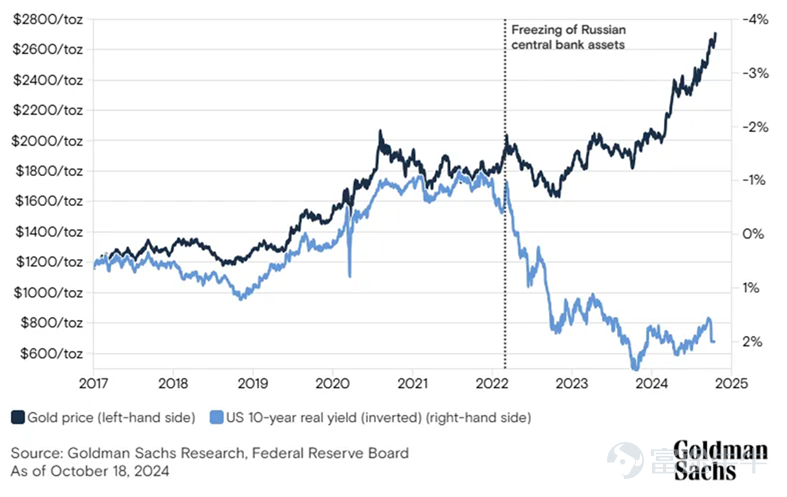
Before 2022, the market had a long-term and relatively stable core anchor for gold pricing: the US real interest rate (i.e., nominal Treasury yields minus inflation expectations). Gold does not yield interest; when interest-bearing assets like Treasuries have high real returns, holding gold becomes expensive, putting downward pressure on gold prices. Conversely, when real interest rates are low, the opportunity cost of holding gold is low, driving gold prices higher.
For decades, the price of gold showed a clear inverse relationship with Treasury yields, often viewed as two sides of the same coin. This model was concise and effective, serving as the mainstream framework for analyzing gold in the market at the time.
Gold acts as the cornerstone of the entire precious metals spectrum (gold, silver, platinum, palladium, rhodium), and its relative value against other assets also serves as a corresponding anchor. For example, the gold-silver ratio has long been an anchor for analyzing silver prices, forming an interconnected pricing structure in the metals world.

(The actual interest rate values in the figure are in reverse order.)
After 2022, while real interest rates remained relatively high, gold broke away from its downward trend and began to surge against the tide. The traditional old framework could no longer explain gold prices, marking the official entry of gold into a 'chaotic era'.
In the old era, the main market contradiction was the change in opportunity costs brought by economic cycles and central bank interest rate policies. In recent years, however, the main contradiction has shifted to concerns over the sustainability of sovereign currency credibility (especially the US dollar) and the resulting structural trend towards diversification of international reserve assets.
The perception of gold's role in the asset class has changed. It is no longer merely a financial asset compared with bonds and stocks for yield, but to some extent, it is once again regarded as the ultimate quasi-currency to hedge against national credit risk. Central bank gold purchases have become a significant driving force supporting gold prices.
During these years of the 'de-anchoring era,' many institutions and investors have attempted to lock gold into a new pricing model, but they often fail to capture the large movements of recent years.
Goldman Sachs proposed a disruptive approach in its latest research report: rather than trying to eliminate the residual in the model, it is better to acknowledge its validity.
Analysts redefined these statistically unexplainable 'noises' as the market’s structural norm. This residual essentially reflects invisible forces that traditional factors cannot capture – such as defensive hoarding of physical gold by high-net-worth individuals, and the non-linear push on gold prices by high-risk appetite funds in the options market. After reconstruction, Goldman Sachs raised its gold price target for 2026 to $5,400.

Compared with gold, silver has weaker financial attributes and stronger industrial ones. Industrial demand already accounts for over half of total silver demand, forming a rigid 'cornerstone demand.'The photovoltaic industry is the largest demand driver for silver, while the new energy vehicle, 5G, and AI industries also steadily boost silver usage.

Global silver supply growth lacks elasticity, with most production being a byproduct of mining copper, lead, and zinc. Independent silver mines make up a small proportion. Low mining capital expenditure and aging ore bodies constrain supply. The World Silver Association predicts that the market has been in a structural supply deficit for multiple consecutive years. Compared to gold, silver exhibits greater price elasticity and significantly higher short-term volatility.
It should be noted that in recent years, the grand narratives surrounding precious metals, whether evolving geopolitical games or subtle reconstructions of the monetary system, are inherently complex.Short-term surges are often accompanied by rapid expectation fulfillment, followed by fluctuations and reversals, especially when approaching important round-number levels, which tend to intensify long-short divergences.
Options strategy
As gold and silver face a historical level threshold, options provide more flexible strategic choices, applicable for directional speculation, risk management, and arbitrage.
$SPDR Gold ETF (GLD.US)$ 、 $iShares Silver Trust (SLV.US)$ Precious metal ETFs can be traded as easily as stocks, with huge daily trading volumes and narrow bid-ask spreads, making them suitable instruments for implementing options strategies.
Currently, the implied volatility of both is at a historical high of 98%, which is not favorable for option buyers. It is wiser to avoid single-leg purchases and instead build spread or combination strategies.
(1) Moderately bullish, cost control: Bull Call Spread
Simultaneously buy a call option with a lower strike price and sell a call option with the same expiration date but a higher strike price. The premium received from selling the option can partially offset the cost of buying the option.

(2) Existing positions, generating extra income in high volatility: Covered Call
While holding the underlying asset, investors can earn premiums by selling call options when prices stagnate or fluctuate. If the stock price rises above the strike price, the asset can be sold at a target price.
For instance, if you hold 100 shares of SLV and believe that the silver price will not rise to $110 per ounce (corresponding to an SLV price of approximately $99.5), you can sell a call option with a strike price of $99.5 expiring in one week.
If the silver price is below $110 per ounce at expiration, the option expires worthless, and you keep the premium. If the price exceeds $100, you can sell these 100 shares at the strike price, locking in profits but missing out on further gains.

In addition to mainstream products like GLD and SLV, investors with higher risk tolerance may also consider $ProShares Ultra Silver (AGQ.US)$ 、 $Proshares Ultrashort Silver (ZSL.US)$ Leveraged precious metal ETFs such as UGL.
Although such products offer higher elasticity, investors must be wary of the erosion caused by their daily rebalancing mechanism. If the price falls first and then rebounds, although the gold/silver price remains unchanged, your investment value will decrease.
Finally, here's a small perk for fellow investors—welcome to claim it!Beginner's Options Package
This event is exclusively for invited HK users, click to learn moreDetailed event rules >>
Major upgrade to the US options mechanism! New Monday and Wednesday options added for nine major symbols including Tesla and NVIDIA. A step-by-step guide to profiting from end-of-term options using the NiuNiu tool >>

Disclaimer
This content does not constitute any offer, solicitation, recommendation, opinion, or guarantee of any securities, financial products, or tools. The risk of loss in buying and selling options can be substantial. In some cases, your losses may exceed the initial margin amount deposited. Even if you set contingent orders, such as 'stop-loss' or 'limit' orders, these may not necessarily prevent losses. Market conditions may make these orders unexecutable. You might be required to deposit additional margin within a short period. If you fail to provide the required amount within the specified time, your open positions may be liquidated. However, you will still be responsible for any account deficit arising from this. Therefore, before trading, you should study and understand options and carefully consider whether such trading suits you based on your financial situation and investment objectives. If you trade options, you should be familiar with the procedures upon exercising options and at expiration, as well as your rights and obligations when exercising options and at expiration.
Risk Disclaimer: The above content only represents the author's view. It does not represent any position or investment advice of Futu. Futu makes no representation or warranty.Read more
Comments (5)
to post a comment
61
66
