English
Back
Open Account
Outlook falls short of expectations! Is Intel still worth holding onto?

Futubull Options Sir
joined discussion · ·

Earnings and Options Strategy | Intel Plummets Post-Earnings, How Were the Financials and What’s Next for the Market?

Intel released its Q4 earnings after hours on Thursday. Despite better-than-expected financial figures, weak guidance for Q1 triggered significant post-market volatility. Strong demand for AI server CPUs faced supply bottlenecks, with the yield ramp of 18A becoming the core focus of market dynamics in the next phase. This article breaks down key performance data and provides trading strategy insights based on signals from the options market.
$Intel (INTC.US)$ Intel released its highly anticipated Q4 earnings report after the US stock market closed on Thursday. As a recent 'pioneer' in the semiconductor sector rebound, Intel's stock had surged to a four-year high before the earnings release. However, this 'mixed' report quickly dampened bullish sentiment: although key metrics for Q4 exceeded expectations, weaker-than-expected guidance following the report led to repricing, causing the stock to plummet over 13% in after-hours trading, retreating to around $47.
Is this the end of the upward trend, or an opportunity to buy the dip? Here is a detailed breakdown.
Earnings Breakdown: Q4 Exceeds Expectations, but Q1 Sees Unexpected Weakness
In terms of Intel's key financial metrics, revenue/gross margin/EPS beat expectations, showing signs of recovery; however, guidance for Q1 fell below consensus estimates due to short-term supply bottlenecks and high costs associated with the 18A yield ramp-up.
Key Financial Data for Q4 2025:
Revenue: $13.7 billion, a 4% year-over-year decrease, slightly above the market's previous expectation of $13.4 billion.
Gross Margin: Gross margin for Q4 remained under pressure year-over-year, with GAAP at 36.1% and Non-GAAP at 37.9%, but expenses contracted significantly.
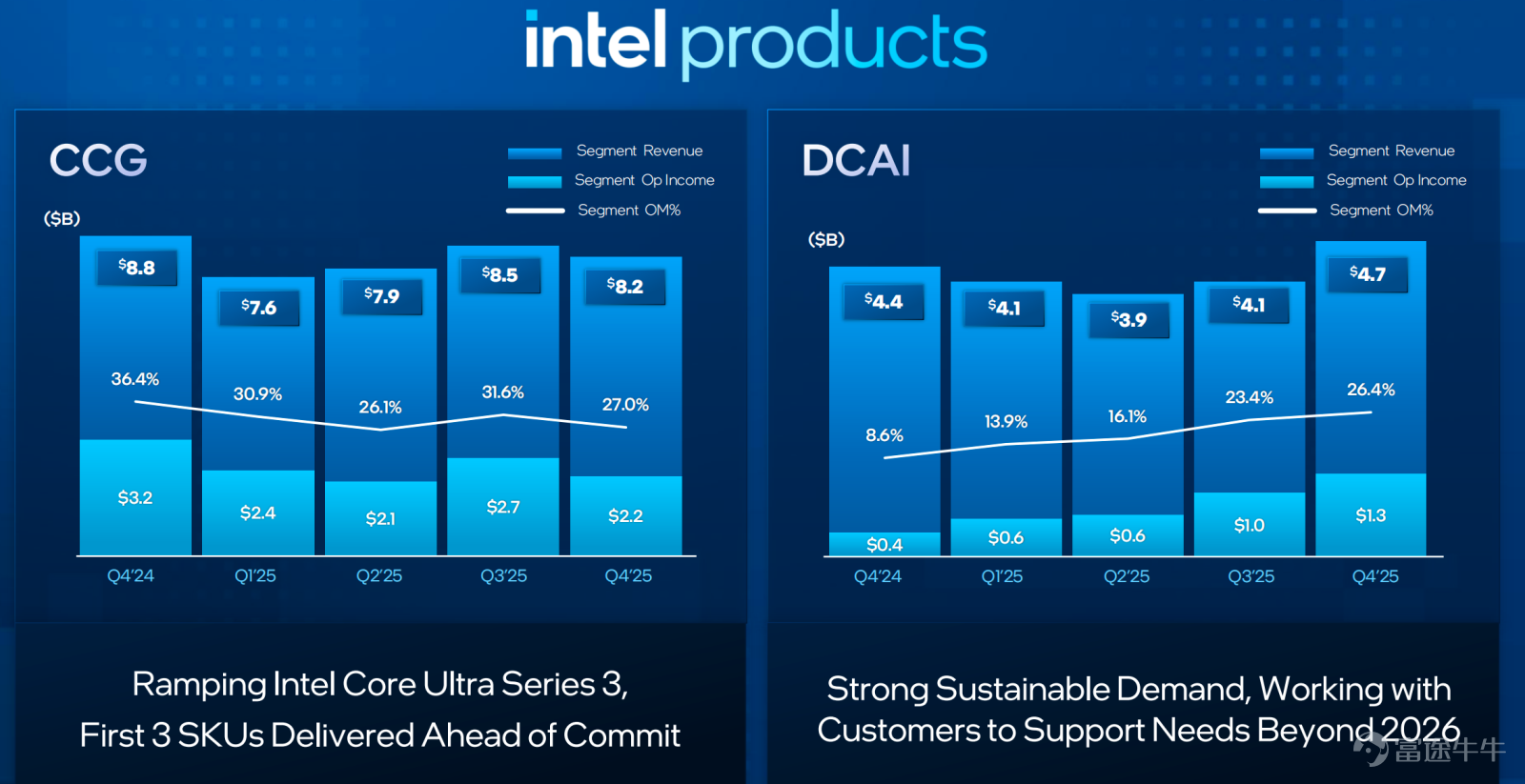
   ◦ DCAI (Data Center and AI): Revenue of USD 4.7 billion, year-over-year +9%. This validates that the demand for CPUs, as complementary to GPUs, is rebounding amid the AI wave.
   ◦ CCG (Client Computing Group): Revenue of USD 8.2 billion, year-over-year -7%, the PC market remains under pressure.
Segment Performance:
Intel released its Q4 earnings after hours on Thursday. Despite better-than-expected financial figures, weak guidance for Q1 triggered significant post-market volatility. Strong demand for AI server CPUs faced supply bottlenecks, with the yield ramp of 18A becoming the core focus of market dynamics in the next phase. This article breaks down key performance data and provides trading strategy insights based on signals from the options market. $Intel (INTC.US)$ Intel released its highly anticipated Q4 earnings report after the US stock market closed on Thursday. As a recent 'pioneer' in the semiconductor sector rebound, Intel's stock had surged to a four-year high before the earnings release. However, this 'mixed' report quickly dampened bullish sentiment: although key metrics for Q4 exceeded expectations, weaker-than-expected guidance following the report led to repricing, causing the stock to plummet over 13% in after-hours trading, retreating to around $47. Is this the end of the upward trend, or an opportunity to buy the dip? Here is a detailed breakdown. Earnings Breakdown: Q4 Exceeds Expectations, but Q1 Sees Unexpected Weakness In terms of Intel's key financial metrics, revenue/gross margin/EPS beat expectations, showing signs of recovery; however, guidance for Q1 fell below consensus estimates due to short-term supply bottlenecks and high costs associated with the 18A yield ramp-up. Key Financial Data for Q4 2025: – Revenue: $13.7 billion, a 4% year-over-year decrease, slightly above the market's previous expectation of $13.4 billion. ...
However, regarding the guidance for Q1 2026, the revenue guidance is between 11.7 billion and 12.7 billion USD, with the midpoint below the market expectation of 12.5 billion USD. Management explained that the weakness in Q1 is mainly attributed to supply-side issues. The CFO stated that available supply in Q1 will be at its lowest point for the year, but improvement is expected starting from Q2; capacity alignment and supply challenges make it difficult to meet short-term demand for AI data center-related server CPUs.
Intel released its Q4 earnings after hours on Thursday. Despite better-than-expected financial figures, weak guidance for Q1 triggered significant post-market volatility. Strong demand for AI server CPUs faced supply bottlenecks, with the yield ramp of 18A becoming the core focus of market dynamics in the next phase. This article breaks down key performance data and provides trading strategy insights based on signals from the options market. $Intel (INTC.US)$ Intel released its highly anticipated Q4 earnings report after the US stock market closed on Thursday. As a recent 'pioneer' in the semiconductor sector rebound, Intel's stock had surged to a four-year high before the earnings release. However, this 'mixed' report quickly dampened bullish sentiment: although key metrics for Q4 exceeded expectations, weaker-than-expected guidance following the report led to repricing, causing the stock to plummet over 13% in after-hours trading, retreating to around $47. Is this the end of the upward trend, or an opportunity to buy the dip? Here is a detailed breakdown. Earnings Breakdown: Q4 Exceeds Expectations, but Q1 Sees Unexpected Weakness In terms of Intel's key financial metrics, revenue/gross margin/EPS beat expectations, showing signs of recovery; however, guidance for Q1 fell below consensus estimates due to short-term supply bottlenecks and high costs associated with the 18A yield ramp-up. Key Financial Data for Q4 2025: – Revenue: $13.7 billion, a 4% year-over-year decrease, slightly above the market's previous expectation of $13.4 billion. ...
Why has Intel been experiencing continuous gains recently?
Intel's stock has surged impressively, up 84% cumulatively since 2025, with a nearly 40% increase in just the past month. This sharp 'turnaround from adversity' rally has been driven by three main factors:
1. CES 2026 Process Milestone: At CES 2026, Intel launched the Core Ultra Series 3 (Panther Lake), which Intel claims as the first platform based on Intel 18A, covering over 200 PC designs. The top-tier SKU is said to deliver up to 60% better multi-threaded performance, though the yield rate for 18A is still ramping up.
2. AI Computing Spillover Effect: The market is beginning to realize that the expansion of AI data centers requires not only GPUs but also massive amounts of CPUs for scheduling. Both management and media have repeatedly emphasized this logic, reinforcing expectations for the recovery of Intel’s DCAI business.
3. ‘Renaissance Narrative’ and Government Capital Endorsement: Since 2025, several external investments and government-related shareholding announcements have significantly restored market confidence in Intel’s 'too big to fail' risk profile.
Intel released its Q4 earnings after hours on Thursday. Despite better-than-expected financial figures, weak guidance for Q1 triggered significant post-market volatility. Strong demand for AI server CPUs faced supply bottlenecks, with the yield ramp of 18A becoming the core focus of market dynamics in the next phase. This article breaks down key performance data and provides trading strategy insights based on signals from the options market. $Intel (INTC.US)$ Intel released its highly anticipated Q4 earnings report after the US stock market closed on Thursday. As a recent 'pioneer' in the semiconductor sector rebound, Intel's stock had surged to a four-year high before the earnings release. However, this 'mixed' report quickly dampened bullish sentiment: although key metrics for Q4 exceeded expectations, weaker-than-expected guidance following the report led to repricing, causing the stock to plummet over 13% in after-hours trading, retreating to around $47. Is this the end of the upward trend, or an opportunity to buy the dip? Here is a detailed breakdown. Earnings Breakdown: Q4 Exceeds Expectations, but Q1 Sees Unexpected Weakness In terms of Intel's key financial metrics, revenue/gross margin/EPS beat expectations, showing signs of recovery; however, guidance for Q1 fell below consensus estimates due to short-term supply bottlenecks and high costs associated with the 18A yield ramp-up. Key Financial Data for Q4 2025: – Revenue: $13.7 billion, a 4% year-over-year decrease, slightly above the market's previous expectation of $13.4 billion. ...
What will the market focus on in the next phase?
Intel's decline after earnings is a typical 'expectation gap correction.' For Intel’s medium- to short-term stock price trend, the market is closely watching the following four variables:
1. The pace of supply bottleneck recovery: Management stated that Q1 was the low point for supply, with improvements starting in Q2. The market needs to see the Q2 earnings report or mid-quarter updates to verify whether this commitment has been fulfilled.
2. DCAI order fulfillment capability: Given strong demand, can the issue of 'having orders but being unable to ship due to supply constraints' translate into real revenue and profit release in the second half of the year?
3. 18A yield rate and cost curve: This is an obvious drag factor. The CEO admitted that yields are 'still below ideal levels,' which will continue to weigh on gross margins. If yield improvements lag expectations, it will undermine the core logic of the transformation.
4. Foundry external customer progress: Management revealed that two customers are evaluating 14A technical details. Future capital expenditure inflection points will be key indicators for determining whether major orders have been secured.
Signals and Strategy Layout in the Options Market
Earnings reports often come with significant volatility. Using options strategies to optimize positions and plan next steps is a good choice.
Market Pricing Review
Pre-earnings expectations: The volatility range priced by the options market was approximately ± 10%
Actual performance: The after-hours drop of about 13% slightly exceeded the implied volatility range of the options market, meaning investors who sold strangles (Short Strangle) may face tail risk.
Volatility status: Pre-earnings IV was as high as 72%, and typically experiences IV Crush
Intel released its Q4 earnings after hours on Thursday. Despite better-than-expected financial figures, weak guidance for Q1 triggered significant post-market volatility. Strong demand for AI server CPUs faced supply bottlenecks, with the yield ramp of 18A becoming the core focus of market dynamics in the next phase. This article breaks down key performance data and provides trading strategy insights based on signals from the options market. $Intel (INTC.US)$ Intel released its highly anticipated Q4 earnings report after the US stock market closed on Thursday. As a recent 'pioneer' in the semiconductor sector rebound, Intel's stock had surged to a four-year high before the earnings release. However, this 'mixed' report quickly dampened bullish sentiment: although key metrics for Q4 exceeded expectations, weaker-than-expected guidance following the report led to repricing, causing the stock to plummet over 13% in after-hours trading, retreating to around $47. Is this the end of the upward trend, or an opportunity to buy the dip? Here is a detailed breakdown. Earnings Breakdown: Q4 Exceeds Expectations, but Q1 Sees Unexpected Weakness In terms of Intel's key financial metrics, revenue/gross margin/EPS beat expectations, showing signs of recovery; however, guidance for Q1 fell below consensus estimates due to short-term supply bottlenecks and high costs associated with the 18A yield ramp-up. Key Financial Data for Q4 2025: – Revenue: $13.7 billion, a 4% year-over-year decrease, slightly above the market's previous expectation of $13.4 billion. ...
Reference for subsequent strategy planning
After the impact of earnings reports on the stock price subsides, Intel's performance is expected to return to its original logic and be stimulated by some industry news during this period. However, breaking through to new highs will require substantial and real positive catalysts.
   ◦ Strategy: Bull Call Spread, with a duration of 1-3 months.
   ◦ Logic: By buying in-the-money Calls while selling out-of-the-money Calls, partially offset the impact of IV decline and reduce opening costs. Suitable for investors who believe the stock price will gradually recover over time after the earnings report.
Approach A: Bullish, but guarding against pullbacks
Intel released its Q4 earnings after hours on Thursday. Despite better-than-expected financial figures, weak guidance for Q1 triggered significant post-market volatility. Strong demand for AI server CPUs faced supply bottlenecks, with the yield ramp of 18A becoming the core focus of market dynamics in the next phase. This article breaks down key performance data and provides trading strategy insights based on signals from the options market. $Intel (INTC.US)$ Intel released its highly anticipated Q4 earnings report after the US stock market closed on Thursday. As a recent 'pioneer' in the semiconductor sector rebound, Intel's stock had surged to a four-year high before the earnings release. However, this 'mixed' report quickly dampened bullish sentiment: although key metrics for Q4 exceeded expectations, weaker-than-expected guidance following the report led to repricing, causing the stock to plummet over 13% in after-hours trading, retreating to around $47. Is this the end of the upward trend, or an opportunity to buy the dip? Here is a detailed breakdown. Earnings Breakdown: Q4 Exceeds Expectations, but Q1 Sees Unexpected Weakness In terms of Intel's key financial metrics, revenue/gross margin/EPS beat expectations, showing signs of recovery; however, guidance for Q1 fell below consensus estimates due to short-term supply bottlenecks and high costs associated with the 18A yield ramp-up. Key Financial Data for Q4 2025: – Revenue: $13.7 billion, a 4% year-over-year decrease, slightly above the market's previous expectation of $13.4 billion. ...
   ◦ Strategy:Short Straddle/Short Strangle, but strict position management is required to prevent unexpected risks).
   ◦ Logic: Given that Q1 guidance was weak but Q4 results were acceptable, the stock may lack momentum for a unilateral breakout. Before IV fully reverts to its mean, there is still room for volatility shorting.
Approach B: Limited rebound, entering a consolidation range
Intel released its Q4 earnings after hours on Thursday. Despite better-than-expected financial figures, weak guidance for Q1 triggered significant post-market volatility. Strong demand for AI server CPUs faced supply bottlenecks, with the yield ramp of 18A becoming the core focus of market dynamics in the next phase. This article breaks down key performance data and provides trading strategy insights based on signals from the options market. $Intel (INTC.US)$ Intel released its highly anticipated Q4 earnings report after the US stock market closed on Thursday. As a recent 'pioneer' in the semiconductor sector rebound, Intel's stock had surged to a four-year high before the earnings release. However, this 'mixed' report quickly dampened bullish sentiment: although key metrics for Q4 exceeded expectations, weaker-than-expected guidance following the report led to repricing, causing the stock to plummet over 13% in after-hours trading, retreating to around $47. Is this the end of the upward trend, or an opportunity to buy the dip? Here is a detailed breakdown. Earnings Breakdown: Q4 Exceeds Expectations, but Q1 Sees Unexpected Weakness In terms of Intel's key financial metrics, revenue/gross margin/EPS beat expectations, showing signs of recovery; however, guidance for Q1 fell below consensus estimates due to short-term supply bottlenecks and high costs associated with the 18A yield ramp-up. Key Financial Data for Q4 2025: – Revenue: $13.7 billion, a 4% year-over-year decrease, slightly above the market's previous expectation of $13.4 billion. ...
Finally, here's a small perk for fellow investors—welcome to claim it!Beginner's Options Package
This event is exclusively for invited HK users, click to learn moreDetailed event rules >>
Major upgrade to the US stock options mechanism! Monday and Wednesday options added for nine major stocks including Tesla, NVIDIA, and others.A step-by-step guide to using the Bull's Eye tool to profit from end-of-term options>>
Intel released its Q4 earnings after hours on Thursday. Despite better-than-expected financial figures, weak guidance for Q1 triggered significant post-market volatility. Strong demand for AI server CPUs faced supply bottlenecks, with the yield ramp of 18A becoming the core focus of market dynamics in the next phase. This article breaks down key performance data and provides trading strategy insights based on signals from the options market. $Intel (INTC.US)$ Intel released its highly anticipated Q4 earnings report after the US stock market closed on Thursday. As a recent 'pioneer' in the semiconductor sector rebound, Intel's stock had surged to a four-year high before the earnings release. However, this 'mixed' report quickly dampened bullish sentiment: although key metrics for Q4 exceeded expectations, weaker-than-expected guidance following the report led to repricing, causing the stock to plummet over 13% in after-hours trading, retreating to around $47. Is this the end of the upward trend, or an opportunity to buy the dip? Here is a detailed breakdown. Earnings Breakdown: Q4 Exceeds Expectations, but Q1 Sees Unexpected Weakness In terms of Intel's key financial metrics, revenue/gross margin/EPS beat expectations, showing signs of recovery; however, guidance for Q1 fell below consensus estimates due to short-term supply bottlenecks and high costs associated with the 18A yield ramp-up. Key Financial Data for Q4 2025: – Revenue: $13.7 billion, a 4% year-over-year decrease, slightly above the market's previous expectation of $13.4 billion. ...
Disclaimer
This content does not constitute any offer, solicitation, recommendation, opinion, or guarantee regarding any securities, financial products, or tools. Trading options may involve substantial risk of loss. In some cases, your losses may exceed the initial margin deposited. Even if you have set up contingency instructions such as 'stop-loss' or 'limit orders,' these may not necessarily prevent losses. Market conditions may cause these instructions to fail execution. You may be required to deposit additional margin within a short time frame. If you fail to provide the required amount within the specified period, your open positions may be liquidated. However, you will still be responsible for any account deficits resulting from this. Therefore, you should study and understand options trading and carefully assess whether such trading suits your financial situation and investment objectives before proceeding. If you trade options, you should familiarize yourself with the procedures related to exercising options and their expiration, as well as your rights and obligations during exercise and expiration.
Risk Disclaimer: The above content only represents the author's view. It does not represent any position or investment advice of Futu. Futu makes no representation or warranty.Read more
Thumbs Up
19
Heart
4
Emm
1
Sob
1
60K Views
Report
Comment (1)
Write a Comment...
1
25
51