English
Back
Open Account

2025, The Ten Faces of China's AI: Collective Awakening from 'Follower' to 'Definer'

avatar
IVD MEDICAL wrote a column · Jan 21 03:36
If future historians look back on 2025, they may find that it was the first time in human history that artificial intelligence no longer existed merely as a 'Silicon Valley spectacle,' but like the steam engine of the 19th century and the internet of the 20th century, completely shattered and restructured our real lives.
This year, China's AI has gone through the most tumultuous 365 days. We experienced the technological shock at the beginning of the year when DeepSeek emerged, witnessed the rapid surge in the Agent (intelligent entity) sector in the middle of the year, and ultimately, at the end of the year, observed the substantive layout of “deep divers” like JD.com Health and Ant Group’s Alipay in the trillion-dollar medical track.
This is a life-or-death leap from 'showing off technology' to 'real-world implementation,' and it serves as an authentic illustration of how China’s AI moves from the lab to the operating room and into the daily lives of ordinary people. The following ten representative companies collectively depict the coming-of-age ceremony for China’s AI in 2025.
1. DeepSeek: Breaking the 'computing power hegemony' with extreme ingenuity
From late 2024 to January 2025, the successive releases of DeepSeek-V3 and R1 models were regarded as a 'Schindler-like breakout' for China’s AI in the global computing power race (top Silicon Valley investor Marc Andreessen called it AI’s 'Sputnik moment'). With only about $5.5 million in training costs, DeepSeek directly outperformed GPT-4o, which had cost hundreds of millions of dollars to develop, in logical reasoning, math ability, and programming benchmark tests (HumanEval).
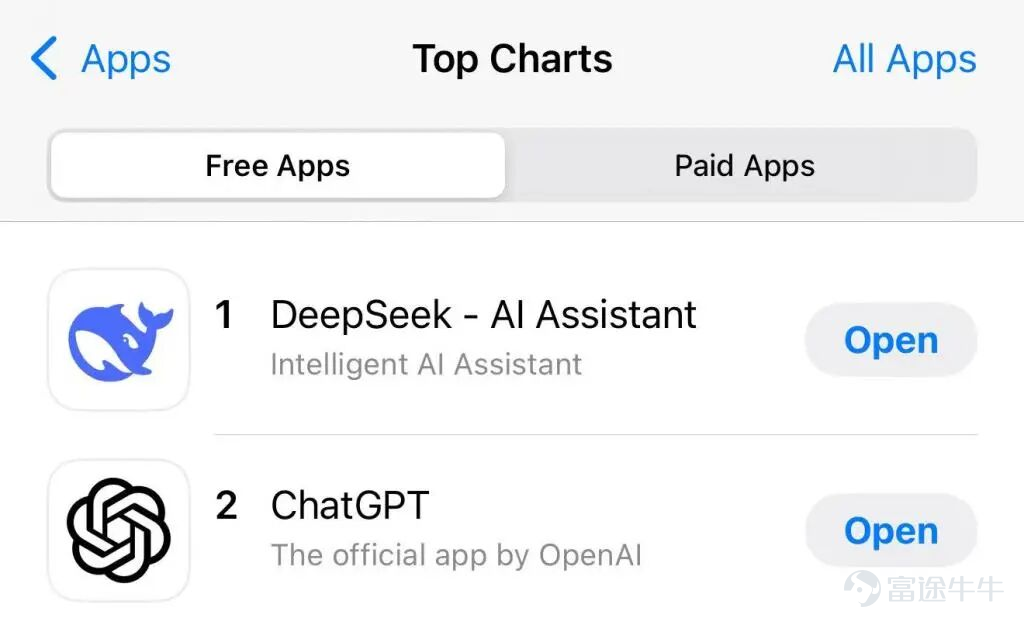
On January 27, the DeepSeek app topped the free app download rankings in Apple’s US App Store, surpassing ChatGPT on the US download chart. On the same day, Apple’s China App Store free app chart also showed that DeepSeek ranked first in China.
Apple US App Store
Apple US App Store
This was an 'open-source nuclear bomb' dropped by China onto the global stage, shattering the long-standing technical cognitive walls set by a few major players. DeepSeek’s success proved that low cost and high performance are not mutually exclusive in the AI field, and open source can become the sharpest market breakthrough and ecosystem-building strategy. It forced the world to reassess China’s AI innovation capabilities; its profound impact does not lie in the code itself but in shaking upthe old logic that 'technological hegemony must remain closed', giving global developers new choices through comparisons.
On December 1, DeepSeek released the more powerful DeepSeek-V3.2 series model, achieving inference capabilities on par with GPT-5 and Gemini 3.0 Pro, proving the sustainability of its technological leadership.
2. Manus: The Action-Oriented Endgame from 'Conversation' to 'Execution'
The sudden emergence of Manus transformed AI agents overnight from a sci-fi-like lab concept into a tangible, interactive form of 'productivity'.
In March 2025, Manus exploded onto social media as the 'world’s first general-purpose AI agent.' Its core highlight was ending the era of AI that 'only chats.' Manus can autonomously browse the web, operate virtual machines, process complex document flows, and ultimately deliver results—whether helping HR screen thousands of resumes or planning and booking an entire travel itinerary for tourists. Initially, during its beta phase, invitation codes were in such high demand that they were resold on secondary platforms for up to 50,000 yuan or more, sparking a wave of 'invitation code hunting' across the internet—a collective vote by the public on‘What can AI actually do for me?’Manus’ defining moment came in December 2025 when this team with deep Chinese roots was acquired by Meta (formerly Facebook) for billions of dollars. Founder Xiao Hong will become Meta's Vice President. This cross-border acquisition not only confirmed the world-class level of China’s AI agent technology but also sparked in-depth discussions about AI technology exports and national strategic competition, making it the most controversial overseas success story of the year.
3. Zhipu (02513.HK): The 'Stabilizing Force' of Domestic Large Models and New Capital Darling
In July 2025, Zhipu released its next-generation flagship large model, GLM-4.5. In multiple authoritative evaluations, the model ranked third globally, first among domestic and open-source models. Shortly after release, it quickly rose to the top ranks of Hugging Face, a globally renowned open-source community, with four out of the top five spots on the list occupied by domestic models,rewriting the global open-source landscape
As one of the first models natively integrating reasoning, coding, and intelligent agent (Agent) capabilities, GLM-4.5 demonstrates the potential for AI to move from 'chatting' to 'getting things done.' For example, with just a single command, it can generate a fully operational game or website, clearly pointing to future industry trends.
In November, LMArena, the globally authoritative AI evaluation platform, updated its Code Arena (programming and code generation) specialized rankings. Zhipu GLM-4.6 ranked at the top globally alongside leading models like Anthropic Claude and OpenAI GPT-5.
2025 is the year when Zhipu completes its ultimate leap from a 'scientist team' to a 'commercial giant.' As a model example of technology transfer from Tsinghua University, Zhipu officially passed the Hong Kong Stock Exchange listing hearing in December and was listed in January 2026, becomingthe 'world's first large model stock'. Its next-generation foundational model, GLM-4.7, also topped the rankings among domestic models in several authoritative programming and agent leaderboards. Additionally, its MaaS (Model as a Service) platform successfully implemented a large-scale profitable business model.
Image source: Zhipu
Image source: Zhipu
With fully localized chip compatibility capabilities and an all-star lineup of cornerstone investors, Zhipu declared to the world with a market capitalization of hundreds of billions of Hong Kong dollars (peaking at over 1 trillion Hong Kong dollars during its highest period) amidst the capital winter of 2025: China's large models can not only survive but also thrive with significant commercial dignity.
4. Cambricon (688256.SH): Dual Outbreak of Capital and Technology by the AI Chip Leader
In 2025, Cambricon, the AI chip leader on the STAR Market, reached its 'qualitative leap moment' in commercial implementation. Its highlight was the significant increase in market share for its new-generation Siyuan series chips in domestic large model training scenarios. Especially after the explosive popularity of open-source models like DeepSeek, Cambricon became the preferred solution for domestic intelligent computing center construction due to its excellent computational efficiency and mature software ecosystem.
In the capital markets, Cambricon's performance in 2025 was stunning: In August, it disclosed first-half revenue of 2.881 billion yuan, a year-on-year surge of 4347.82%, and a net profit of 1.038 billion yuan, achieving profitability for the first time in a half-year period. During the same period, its stock price once broke through 1,460 yuan,briefly surpassing Kweichow Maotai to become the 'king of stocks' in the A-share market,with a market capitalization exceeding 600 billion yuan, making it the market focus.
As the logic of 'localized computing power' was fully reinforced, Cambricon's stock price repeatedly hit new historical highs in 2025, stabilizing its market capitalization firmly within the 100-billion-yuan club. Its annual gains outperformed the broader market, not only completing a financial turnaround marked by narrowing losses but also showcasing to global investors the vast commercial potential of China's self-instruction set AI chips.
In the '2025 Hurun China AI Top 50' report released in early 2026, Cambricon topped the list with a valuation of 630 billion yuan, officially recognized by the authoritative ranking as one of the most-watched AI companies of the year.
5. JD.com Health (Jingyi Qianxun 2.0 - 06618.HK): 'Super Supply Chain' redefining the boundaries of AI healthcare
In September 2025, JD.com Health unveiled 'AI Hospital 1.0' at the Tech Explorers Conference, marking the transition of medical AI from 'single-point applications' to 'full-process management.' The upgraded 'Jingyi Qianxun 2.0' large-scale medical model achieved breakthroughs in trusted reasoning and multi-modal capabilities, enabling it to conduct multiple rounds of consultations while strictly adhering to evidence-based medical logic like a human attending physician. It has builta complete business loop of 'medical examination, diagnosis, and pharmaceuticals'—AI can not only provide suggestions but also directly issue electronic prescriptions and coordinate with JD.com's vast pharmaceutical supply chain for same-day delivery.
Image Source: JD Health
Through the 'AI Thousand Doctors' initiative, JD.com Health successfully created digital avatars for tens of thousands of top-tier hospital experts, bringing premium medical expertise into rural clinics in 2025.
In the capital markets, JD.com Health demonstrated clear independent performance in 2025. As 'AI + Healthcare' transformed from vision to tangible revenue, JD.com Health's price-to-earnings ratio saw restorative growth in the fourth quarter.
At the beginning of 2026, JD.com Health, in collaboration with the First Affiliated Hospital of Wenzhou Medical University and the National Health Commission's Key Laboratory of Clinical Nutrition and Intervention, launched the 'AI-Driven Standardized Full-Process Clinical Nutrition Management Solution' at the 2026 Digital Intelligence Healthcare Conference. Based on a clinical nutrition large model, the solution covers screening, assessment, diagnosis, treatment, control, management, and education throughout the entire process, automatically generating personalized nutrition prescriptions and serving over 4.7 million people. Throughthe 'AI + Supply Chain'model, the solution will be expanded to medical institutions nationwide, improving the efficiency and accessibility of nutritional care.
6. DouBao (ByteDance): System-level 'national gateway' with DAU surpassing 100 million
DouBao, under ByteDance, achieved a 'miracle through great efforts' in terms of traffic in 2025. Relying on the Douyin ecosystem, DouBao'sdaily active users broke through the 100 million markand launched a technology preview version of the groundbreaking 'DouBao Mobile Assistant,' collaborating with manufacturers such as ZTE to attempt a reconstruction of human-computer interaction at the mobile system level.
DouBao made the leap from 'pure chatting' to 'shopping guidance and services,' officially integrating with Douyin Mall and supporting cross-application full-process automation. Through system-level voice activation and AI side key wake-up modes, DouBao fundamentally changed Chinese users’ app usage habits in 2025, becoming the undisputed 'traffic king' of the AI era.
The rise of DouBao marks the transition of domestic AI from 'technology demonstration' to a new phase of 'large-scale application.' Its approach, balancing foundational technological innovation, C-end user ecosystems, and B-end industrial implementation, not only solidified ByteDance’s leading position in the AI field but also propelled AI to become an everyday tool for individuals and a productivity engine for businesses, accelerating the democratization of AI.
7. Future Doctor (MedGPT): The 'professional gatekeeper' relentlessly focused on accuracy
In August 2025, Medlinker, a Chinese medical technology company, officially published its latest research results on the Arxiv platform at Cornell University—its independently developed large medical model MedGPT comprehensively outperformed OpenAI-o3 in authoritative international comparative evaluations, becoming the global leader in this field.
Based on the technological achievements of MedGPT, Medlinker launched the 'Future Doctor' authoritative expert online consultation platform on August 2, 2025, bringing together authoritative expert teams from renowned national Class A tertiary hospitals who serve as chairpersons or vice-chairpersons of national academic societies, achievingpermanent free text and image consultations by top experts.
In December 2025, a Chinese research team composed of Future Doctor and 32 top clinical experts published the world's first 'Clinical Safety-Effectiveness Dual Benchmark' (CSEDB) for evaluating the clinical applicability of medical AI in npj Digital Medicine, a top global digital medicine journal under Nature. This benchmark includes 30 indicators and 2,069 real clinical questions, assessing the clinical applicability of AI from both safety and effectiveness dimensions for the first time. In this 'mandatory test,' Future Doctor's MedGPT model excelled, ranking first in overall scores, effectiveness, and safety, demonstrating its potential as a reliable 'clinical partner' for doctors.
Source: Future Doctor, MedGPT safety score (0.912), effectiveness score (0.861)
MedGPT is committed to making medical AIthink like a doctorrather than just 'speaking like a doctor.' Its underlying technical architecture simulates the cognitive logic of the human brain, rather than relying on the 'emergence of large model wisdom' through massive data input.
As early as 2023, MedGPT demonstrated strong clinical adaptability in clinical trials involving real patients—achieving 96% diagnostic consistency with attending physicians at tertiary hospitals.Now, this capability continues to evolve: over 10,000 doctors interact with patients through the Future Doctor platform, generating 20,000 pieces of 'real treatment feedback' weekly. Through a flywheel mechanism of 'feedback equals iteration,' MedGPT’s accuracy improves by 1.2%-1.5% each month, continuously advancing the clinical diagnostic capabilities of medical AI to higher levels.
MedGPT's breakout in 2025 marks the formal crossing of medical AI beyond the boundaries of 'entertainment and inquiry,' earning its ticket into serious clinical scenarios.
8. Huajian Medical (01931.HK): The 'M&A Reformer' of AI Healthcare
In November 2025, Huajian Medical invested 500 million yuan to gain controlling interest in Chuangye Hui Kang (300451.SZ). This move is considered the most strategically profound AI healthcare layout of 2025. Huajian Medical realized thatthe hardest barrier in AI healthcare is not algorithms but the 'mining rights' to clinical data.Through this acquisition, Huajian Medical has taken control of the digital entry point for 300 million resident health records and over 100 million electronic medical records in China.
Its crowning achievement lies in the pioneering launch of the 'Reverse NewCo' model—using its vast hospital channel network (K1 curve) and data ecosystem as an 'entry ticket' to attract top global AI technologies to establish joint ventures in China. Huajian Medical, with the posture of a mergers and acquisitions giant, is reshaping the value distribution order of the global healthcare industry.
9. Moore Threads (688795.SH): Sci-Tech Innovation Board listing builds a 'computational power Great Wall'
Over the past year, Moore Threads completed its transformation from a 'unicorn' toChina's 'first full-function GPU stock.'On December 5, 2025, Moore Threads officially listed on the Sci-Tech Innovation Board of the Shanghai Stock Exchange, marking a significant milestone in the domestic GPU industry’s path toward self-reliance and control.
With an issue price of 114.28 yuan per share, the opening price on the first day was 650 yuan (a 468.8% increase), reaching a high of 688 yuan during trading, and closing at 600.50 yuan, with a 425.26% gain on the first day.A single lot (500 shares) yielded a maximum floating profit of over 280,000 yuan., with a closing floating profit of 243,100 yuan, becoming the 'most profitable new stock' on the STAR Market in 2025, highlighting the market's pursuit of domestically produced full-function GPU scarce targets.
Source: Moore Threads
In addition to its impressive capital market performance, Moore Threads' highlights in 2025 also include the release of the 'Huagang' architecture GPU and the maturity of the 'Kua'e' ten-thousand-card intelligent computing cluster. These not only solved the scalability challenges of intelligent computing at a scale of hundreds of thousands of cards but also achieved significant progress in single-card inference performance for the DeepSeek-R1 full model, catching up to international giants.
As a leader in domestic GPUs, Moore Threads' successful listing on the STAR Market has proven to the capital markets that Chinese enterprises in the core strategic field of AI computing power infrastructure now possess both independent research and development capabilities and the ability for large-scale delivery.
10. Ant Fortune: A 'Digital Health Manager' for 30 Million People
In December 2025, Ant Group officially released the fully upgraded AI health intelligence agent 'Ant Fortune.' With 15 million monthly active users accumulated previously, Fortune announced at the start of 2026 that its monthly active user base had exceeded 30 million, supporting professional health inquiries and integrating a complete service chain including online registration, medical insurance payments, and report interpretation.
Fortune successfully achieveda deep dive from 'chat box' to 'service loop closure.'Through its robust medical large model foundation, it resolved the issues of professionalism and trust deficiency of general AI in the healthcare field. Fortune’s breakout success demonstrated that in an aging China with tiered medical treatment, AI is not just technology but also the final and most efficient mile of accessible healthcare.
Image source: Ant Afu
From 'Tool Revolution' to 'System Reconstruction'
Looking at these ten enterprises, a clear picture of China’s 2025 AI landscape has emerged: we are transitioning from the 'tool revolution' stage focused on singular model performance to a new era where AI serves as the core to reconstruct industrial systems, business ecosystems, and even societal rules. Technological breakthroughs, commercialization, standard-setting, ecosystem building, and infrastructure independence—these five dimensions intertwine, jointly composing the multi-layered symphony of China’s AI development.
Their stories are worth widespread public discussion because these are no longer tech news unrelated to ordinary people. Instead, they offer a vivid preview of the future ways of working, medical experiences, financial services, and even national technological competitiveness.
Among these AI giants, who do you think has truly changed your life? Feel free to share your thoughts in the comments section.
Risk Disclaimer: The above content only represents the author's view. It does not represent any position or investment advice of Futu. Futu makes no representation or warranty. Read more
2
+0
3
See Original
Report
9038 Views
Comment
Sign in to view/post comments
avatar
IVD MEDICAL
華檢醫療官方賬號
16K
Followers
5844
Visitors
Follow
Market Insights
HK Tech and Internet Stocks
View More
Nancy Pelosi Portfolio
Tariff game between the US and Europe shakes the market! Will TACO happen again?
Amidst the global market turbulence triggered by the US-Europe dispute over Greenland, a single post by Trump instantly reversed market tren Show More