
English
Back
Open Account
Davos Forum welcomes a new face! Musk makes a surprise 'appearance'
Futubull Options Sir
joined discussion · Jan 20 16:45 ·

Major Changes in US Options Market: Tesla, NVIDIA, and Seven Other Key Stocks to Launch Monday and Wednesday Options. How Should Investors Adapt to the New Environment?

The trend of '0DTE' (Zero Days to Expiration) options began gaining popularity in the US market in 2022, driving trading volumes in the options market to record highs. Now, Wall Street is looking to push this 0DTE options frenzy even further.
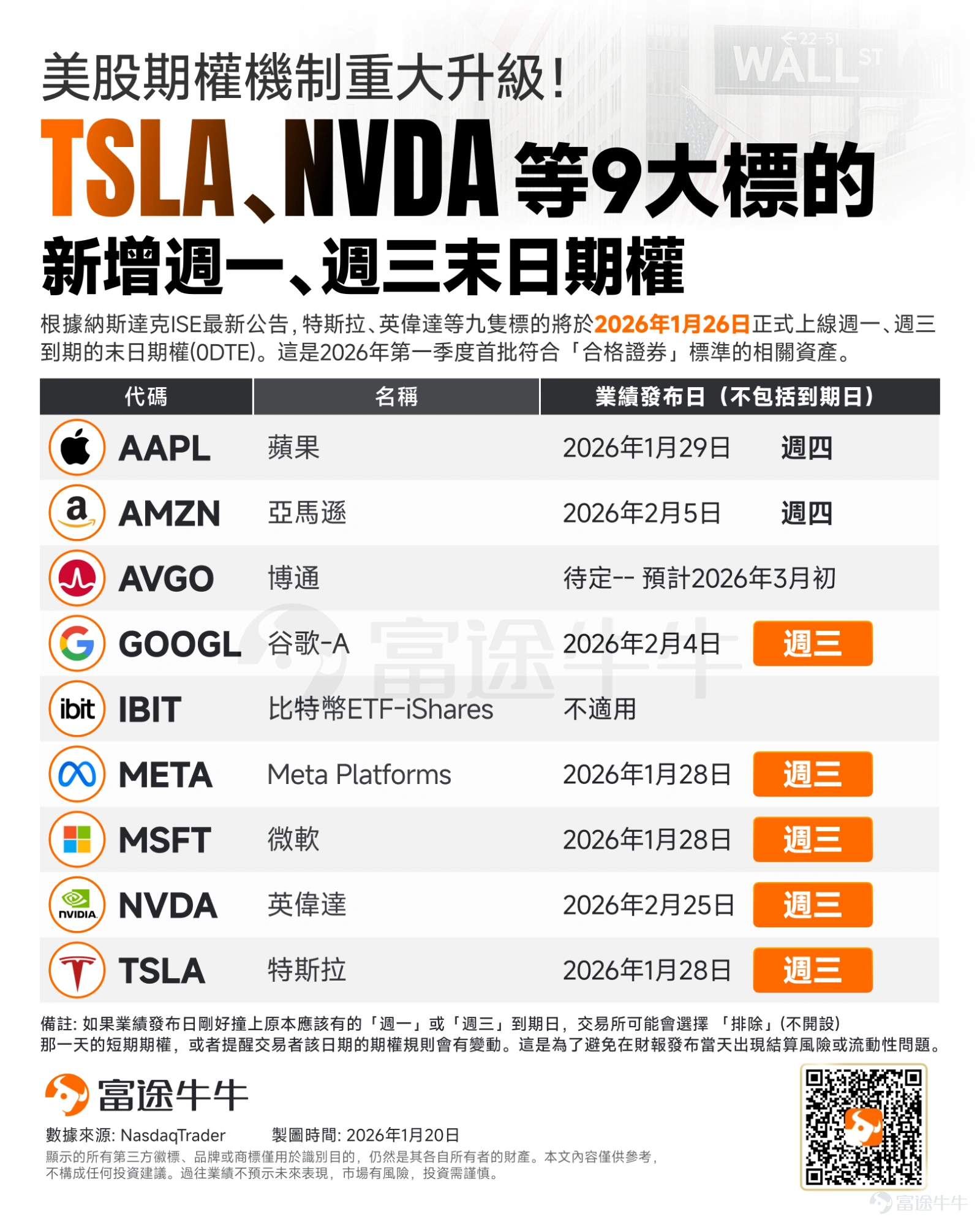
According to the latest news, the US Securities and Exchange Commission (SEC) has officially approved Nasdaq's proposal.Starting from January 26, 2026, the US stock market 'Magnificent Seven' will begin trading. $Apple (AAPL.US)$$Amazon (AMZN.US)$$Alphabet-A (GOOGL.US)$$Meta Platforms (META.US)$$Microsoft (MSFT.US)$$NVIDIA (NVDA.US)$$Tesla (TSLA.US)$ and $Broadcom (AVGO.US)$$iShares Bitcoin Trust (IBIT.US)$These specific stocks will have new options contracts expiring on Mondays and Wednesdays, starting from February 2nd.This key decision not only breaks the traditional pattern where individual stock options typically expire only on Fridays but also marks the US stock market accelerating towards the normalization of 'daily expirations' for single-stock options.
The trend of '0DTE' (Zero Days to Expiration) options began gaining popularity in the US market in 2022, driving trading volumes in the options market to record highs. Now, Wall Street is looking to push this 0DTE options frenzy even further. According to the latest news, the US Securities and Exchange Commission (SEC) has officially approved Nasdaq's proposal.Starting January 26, 2026, the 'Magnificent Seven' US stocks will begin listing on the market.$Apple (AAPL.US)$ 、 $Amazon (AMZN.US)$ 、 $Alphabet-A (GOOGL.US)$ 、 $Meta Platforms (META.US)$ 、 $Microsoft (MSFT.US)$ 、 $NVIDIA (NVDA.US)$ 、 $Tesla (TSLA.US)$ and $Broadcom (AVGO.US)$ 、 $iShares Bitcoin Trust (IBIT.US)$These specific stocks will add Monday and Wednesday expiration options contracts, with the first expirations beginning on February 2.This key decision not only breaks the traditional pattern where single-stock options typically expired only on Fridays but also marks the US stock market accelerating toward the normalization of daily expirations for single-stock options. In the past, apart from$SPDR S&P 500 ETF (SPY.US)$ 、 $Invesco QQQ Trust (QQQ.US)$和 ...
In the past, except for $SPDR S&P 500 ETF (SPY.US)$$Invesco QQQ Trust (QQQ.US)$ and $iShares Russell 2000 ETF (IWM.US)$ a few major ETFs like , which already had daily expiration mechanisms, the trading rhythm for individual stock options was relatively fixed. Some in the investment community jokingly called this the advent of the 'era of speculation,' but from a market microstructure perspective, it represents a 'liquidity tier leap' achieved by top-tier assets.This article will provide a detailed explanation of the significance behind this change and how investors should respond.
What is the significance of this change?
1. Rule Change: From 'Friday Frenzy' to 'Midweek Normalization'
According to the latest revision by Nasdaq ISE, these nine targets have become the first batch of assets that meet the 'Eligible Securities' standards for the first quarter of 2026.The selection threshold is extremely high:The market capitalization at the end of the last fiscal quarter must exceed $700 billion (or ETF assets under management over $50 billion), monthly options trading volume surpass 10 million contracts, open interest be at least 250,000 contracts, and participation in the 'Price Improvement Program' required. This list, in itself, represents the 'crown jewels of liquidity' in the US stock market.
The trend of '0DTE' (Zero Days to Expiration) options began gaining popularity in the US market in 2022, driving trading volumes in the options market to record highs. Now, Wall Street is looking to push this 0DTE options frenzy even further. According to the latest news, the US Securities and Exchange Commission (SEC) has officially approved Nasdaq's proposal.Starting January 26, 2026, the 'Magnificent Seven' US stocks will begin listing on the market.$Apple (AAPL.US)$ 、 $Amazon (AMZN.US)$ 、 $Alphabet-A (GOOGL.US)$ 、 $Meta Platforms (META.US)$ 、 $Microsoft (MSFT.US)$ 、 $NVIDIA (NVDA.US)$ 、 $Tesla (TSLA.US)$ and $Broadcom (AVGO.US)$ 、 $iShares Bitcoin Trust (IBIT.US)$These specific stocks will add Monday and Wednesday expiration options contracts, with the first expirations beginning on February 2.This key decision not only breaks the traditional pattern where single-stock options typically expired only on Fridays but also marks the US stock market accelerating toward the normalization of daily expirations for single-stock options. In the past, apart from$SPDR S&P 500 ETF (SPY.US)$ 、 $Invesco QQQ Trust (QQQ.US)$和 ...
In the past, options trading heavily relied on Friday expiration dates, resulting in a 'tidal pattern' of liquidity where Fridays were crowded but the beginning of the week was quiet. Now, with the denser distribution of intraweek expirations, trading demand has been evenly spread throughout the week. What this brings is not merely an accumulation of trading volume buta qualitative change in market microstructure: on any trading day, at any time, the market can provide sufficient depth to support rapid execution and hedging. The result is reduced transaction friction costs and more stable, continuous bid-ask spreads from market makers.
II. Liquidity Leap: How Derivatives 'Feed Back' into Underlying Stocks?
The underlying logic of this transformation lies in:Options are no longer merely a 'shadow' of the underlying stocks; they have evolved into an 'engine' driving liquidity for those stocks.
With the normalization of Monday and Wednesday 0DTE (zero-day-to-expiration options), high-frequency hedging demands faced by market makers and quantitative funds will grow exponentially. To manage substantial options inventory risk, institutions must continuously engage in mechanical buying and selling in the underlying stock market.
Even if these giants don’t have major news on a given day, their stock prices will still see sustained buying and selling due to dynamic adjustments of options positions. This leads to more active and evenly distributed trading in the underlying stocks, making prices 'more tradable' and preventing liquidity droughts. These leading stocks have officially upgraded into 'market infrastructure,' becoming the most robust containers for capital capacity.
III. Double-Edged Sword: More Efficient Pricing vs. Noisier Volatility
The reshaping of the liquidity structure will also alter the 'price formation mechanism' of these instruments:
The advantage is more precise pricing. More expiration dates mean the market can map macro data (such as Wednesday’s CPI), breaking news, and even intraday sentiment more accurately onto specific options contracts. The term structure of implied volatility (IV) will become more granular, significantly improving price discovery efficiency.
However, a side effect is increased intraday noise. Since 0DTE options are extremely sensitive to short-term price movements, the Gamma effect of options may dominate intraday trends as the market approaches the close. Stock prices may experience 'impulse-like' fluctuations unrelated to fundamentals—this is purely mechanical trading by market makers to balance their Delta.
Investor Guide: How to Navigate the New Environment?
This transformation means entirely different scenarios for different types of investors:
For short-term traders and quantitative funds: This is an absolute positive. More expiration dates and higher liquidity mean more room for various trading strategies. Increased capital capacity, reduced slippage, and trading options will become the norm.
For long-term investors:
Opportunities: Hedging costs decrease. You can more flexibly buy put options on Monday or Wednesday to protect short-term positions without being forced to purchase expensive forward contracts.
Challenges: The ability to filter out "noise" needs improvement. Stock price volatility on Mondays and Wednesdays may intensify, so be careful not to misinterpret liquidity-driven fluctuations as fundamental signals.
Notably, although Monday/Wednesday expirations have been added,the exchange has established an 'exclusion rule'.If the earnings of these nine major stocksare released ona Monday or Wednesday (for example,Meta and Tesla are expected to release their earnings reports on Wednesday, January 28,the short-term options that would normally be available on that day might be suspended or adjusted. Traders enjoying the convenience of 0DTE must keep an eye on the earnings calendar to avoid strategy failures.
Conclusion
Overall, while this change won't directly alter the long-term valuation models of these companies, it will significantly enhance their tradability and capital capacity. These giants are accelerating their transformation into 'market infrastructure' for U.S. stocks, evolving from simple investment targets to the preferred vehicles for high-frequency quant trading, institutional hedging, and short-term speculation.
For long-term allocators, this means adapting to a new normal where 'efficient pricing' coexists with 'short-term noise'; from a macro perspective, it marks the formal transition of these core assets into a new paradigm centered on intraday liquidity.
Looking back at history, the evolution of US stock options from monthly to weekly expirations, and now to near-daily coverage for core assets, reflects the market’s pursuit of maximum efficiency.
For companies like Tesla and NVIDIA, this is not just a game of trading volume but a qualitative shift in market position: they have become the 'core hubs' of the US stock derivatives market,facilitating the flow and competition of global capital. Whether or not you participate in options trading, this new era where 'intraday liquidity is king' has officially arrived.
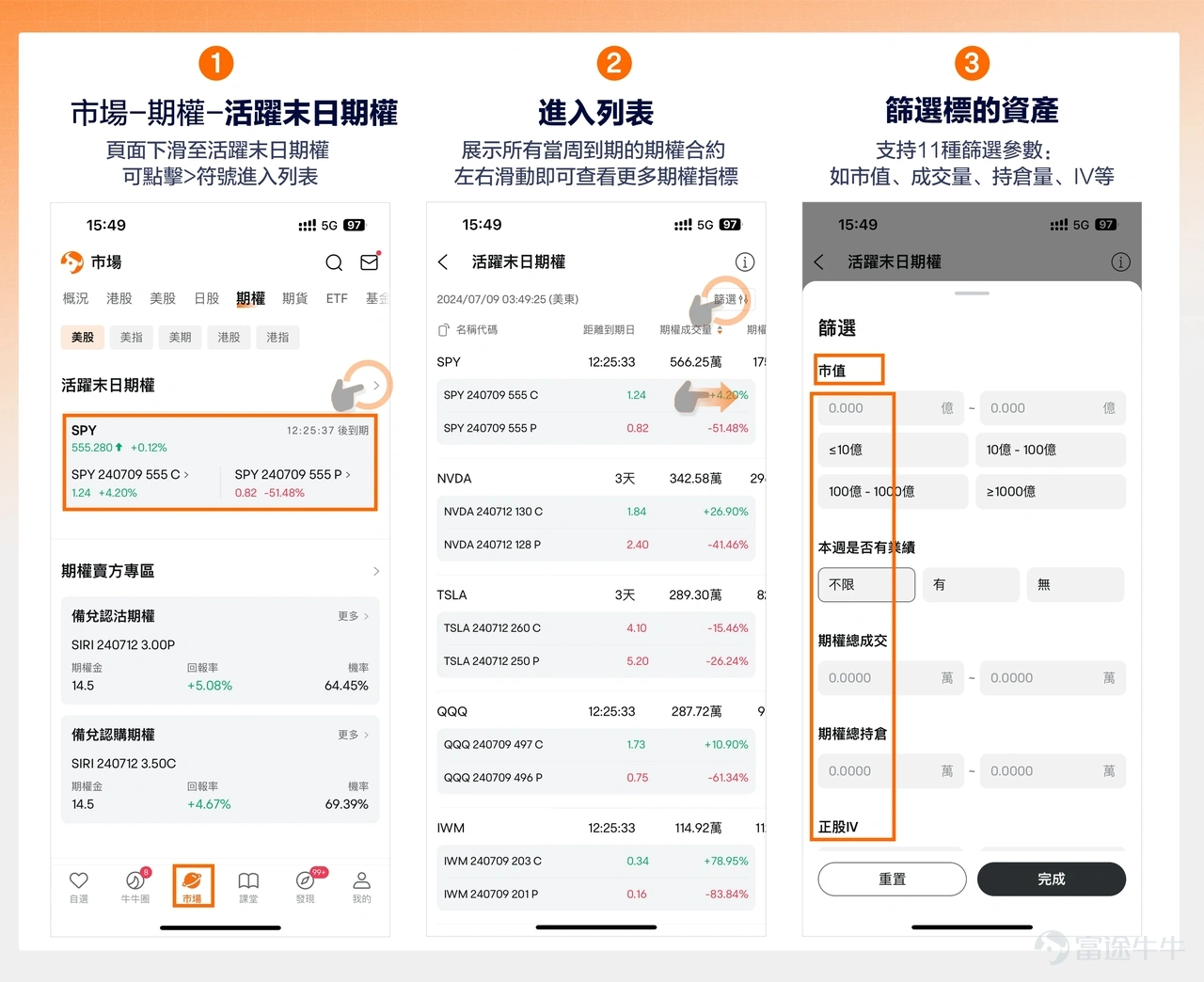
To learn more about end-of-month options, open Futubull[End-of-Month Options Section],where you can find all option contracts expiring within the current week!
Steps: Market > Options > Active End-of-Month Options > Click into list > Filter options
The trend of '0DTE' (Zero Days to Expiration) options began gaining popularity in the US market in 2022, driving trading volumes in the options market to record highs. Now, Wall Street is looking to push this 0DTE options frenzy even further. According to the latest news, the US Securities and Exchange Commission (SEC) has officially approved Nasdaq's proposal.Starting January 26, 2026, the 'Magnificent Seven' US stocks will begin listing on the market.$Apple (AAPL.US)$ 、 $Amazon (AMZN.US)$ 、 $Alphabet-A (GOOGL.US)$ 、 $Meta Platforms (META.US)$ 、 $Microsoft (MSFT.US)$ 、 $NVIDIA (NVDA.US)$ 、 $Tesla (TSLA.US)$ and $Broadcom (AVGO.US)$ 、 $iShares Bitcoin Trust (IBIT.US)$These specific stocks will add Monday and Wednesday expiration options contracts, with the first expirations beginning on February 2.This key decision not only breaks the traditional pattern where single-stock options typically expired only on Fridays but also marks the US stock market accelerating toward the normalization of daily expirations for single-stock options. In the past, apart from$SPDR S&P 500 ETF (SPY.US)$ 、 $Invesco QQQ Trust (QQQ.US)$和 ...
Risk Disclaimer: The above content only represents the author's view. It does not represent any position or investment advice of Futu. Futu makes no representation or warranty.Read more
Thumbs Up
45
Leek
1
Awkward
1
Lol
2
337K Views
Report
Comments (16)
Write a Comment...
16
49
172