2026 AI Healthcare Boom Incoming! Giants Making Moves, Is Now the Golden Time to Invest? | In-Depth Analysis | Research Report | Promising Stocks | AI Healthcare
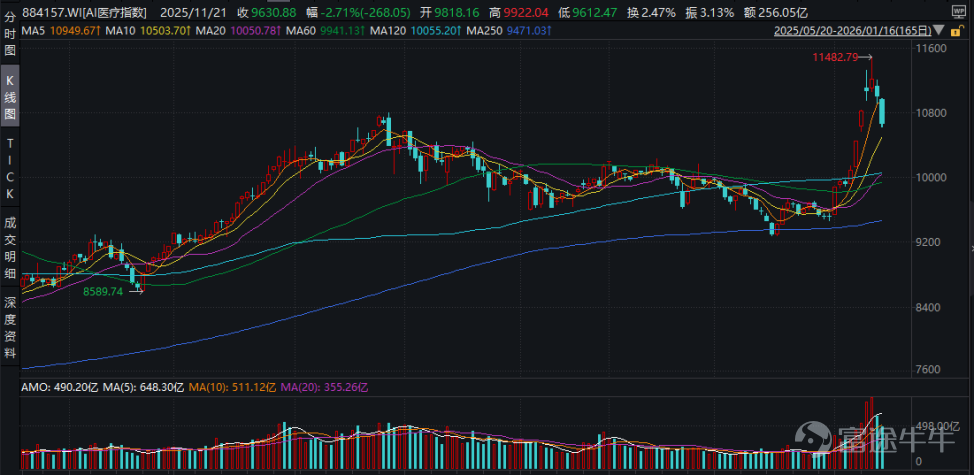
Since the start of 2026, the AI healthcare sector has continued to heat up, with domestic and overseas tech and pharmaceutical giants making strategic moves. The industry is experiencing multiple catalysts. Domestically, Ant Group's Alipay Health new version topped Apple Store’s free app chart for a month after launch; internationally, OpenAI introduced ChatGPT Health capable of integrating medical data, NVIDIA partnered with Eli Lilly and Co to establish a lab accelerating AI drug discovery, and Google released MedGemma 1.5, an open-source AI model enhancing medical imaging capabilities. Since the beginning of the year, AI healthcare remains highly popular in the capital markets. In terms of sector performance, as of January 16th closing, The medical sector index (884157.WI) has shown strong performance, with a monthly increase of over 12%.The core investment logic for the AI healthcare track is expected to undergo significant changes by 2026, driven primarily by clearer and more capable payment mechanisms. Against this backdrop, the certainty of commercialization in the industry is likely to improve significantly, further expanding the commercial potential of AI healthcare.
Tech giants are entering the field! With rising interest in AI healthcare, is now the golden time to invest?
Since the beginning of 2026, the AI healthcare sector has seen a flurry of positive developments, with international tech and pharmaceutical giants accelerating their investments, sparking a new wave of technological and commercial competition. Google has successively launched the next-generation open-source medical AI model MedGemma 1.5 and the medical speech-to-text model MedASR. While enhancing medical imaging analysis capabilities, the former also adds support for various types of images such as CT and MRI scans, along with anatomical positioning functions. Together with the latter, it creates a multi-modal open-source technology stack covering text, voice, and imaging, significantly lowering the application threshold for global developers. OpenAI quickly followed suit by launching ChatGPT Health mode, which connects electronic health records and health apps to provide personalized health solutions to users. NVIDIA has partnered deeply with Eli Lilly and Co., jointly establishing a research lab focused on breakthroughs in AI-driven drug discovery, boosting efficiency in the pharmaceutical industry. Additionally, Anthropic has swiftly entered the race, introducing dedicated healthcare and life sciences services that allow users to access and utilize personal health records via the Claude platform. Competition in the international arena is heating up.
The domestic market is also seeing widespread activity, with policy support and market forces jointly accelerating the commercialization of AI healthcare. Ant Group's newly updated 'Ant Alipay' AI health app surpassed 30 million monthly active users within just one month of its release and ranked consistently among the top ten free apps in Apple’s App Store, reflecting strong market demand for AI healthcare applications. Baichuan Intelligence released an open-source new-generation medical large model, Baichuan-M3, which achieved an impressive composite score of 65.1 in the HealthBench evaluation, showcasing the technical prowess of domestic medical large models. At the policy level, the implementation guidelines issued by five departments including the National Health Commission continue to offer benefits, setting a goal of achieving near-universal coverage of intelligent clinical decision support at grassroots healthcare facilities by 2030, providing clear direction for the industry's development. Furthermore, the AI healthcare sector has performed well in the capital markets; as of the close on January 16, the AI healthcare sector index (884157.WI) showed robust growth, with a monthly increase exceeding 12%. In the Hong Kong stock market, the Hang Seng Medical Theme Index also rose by 17.79% during the same period.The sector as a whole shows a strong upward trend in both volume and price, reflecting high market recognition of the high growth potential of AI healthcare.
Figure 1: Performance of the AI Healthcare Sector Index
Bright Prospects for AI Healthcare Driven by Policy Implementation
* Accelerated Evolution of AI Technology Deeply Empowers the Healthcare Sector
With the rapid iteration of artificial intelligence technology, its empowering effects on the healthcare industry continue to deepen. AI healthcare leverages technologies like machine learning, natural language processing, and computer vision to build intelligent application systems that assist clinical decisions, optimize treatment processes, and enhance the efficiency of medical services by analyzing vast amounts of complex medical data. Supported by Internet and IoT technologies, AI healthcare can mobilize limited medical human resources and equipment, leverage the technical advantages of top-tier hospitals, establish regional health record and medical information platforms, and facilitate interaction between patients, healthcare providers, medical institutions, and medical devices. This enables information-based, mobile, and remote medical services in scenarios such as disease diagnosis, condition monitoring, and clinical treatment.
The core technologies of AI healthcare encompass four major directions: medical image analysis, which is based on deep learning algorithms to identify CT, MRI, and other imaging, excelling in the screening of tumors and cardiovascular diseases with a pulmonary nodule detection accuracy rate exceeding 95%; natural language processing, applied in the structural transformation of electronic medical records and the construction of clinical knowledge graphs, represented by the IBM Watson Oncology system; drug discovery empowerment using AI tools to accelerate target discovery and compound screening processes, with DeepMind's AlphaFold protein structure prediction model as a benchmark case; and intelligent health management that integrates physiological data collected from wearable devices with AI algorithms to achieve real-time monitoring and risk warnings for chronic diseases.
In terms of application, AI healthcare has comprehensively penetrated the entire healthcare chain, coveringMedical image diagnosis(Using AI to improve the detection rate of small lesions and optimize 3D reconstruction to assist surgical planning),Pathological diagnosis(Achieving precise screening for diseases like cervical cancer through digital pathology image analysis systems),Clinical decision support and surgical assistance(Relying on large medical models to complete intelligent triage and develop personalized surgical plans),Drug discovery(Using AI to shorten R&D cycles, reduce costs, and expedite the development of innovative drugs and targeted therapies), while also extending into scenarios such as remote diagnostics in primary healthcare and risk warnings in health management, becoming a core supporting force in alleviating the supply-demand imbalance in medical resources and promoting precision medicine and universal healthcare.
Figure 2: Analysis of AI Healthcare Application Scenarios
*Track Explosion: Dual Empowerment from Policy and Market, AI Healthcare Emerges as a New Investment Blue Ocean
The popularity of the AI healthcare track is no accident but an inevitable result of the convergence of technological iteration maturity, continuous policy support, and strong market demand. Tech giants such as OpenAI, Google, and Alibaba are all aggressively entering the healthcare field, which not only confirms the enormous commercial value embedded in this track but also accelerates the industry’s leap from technical concept to essential application.
From a market size perspective, this track shows particularly robust growth momentum. In 2024, the global AI healthcare market size has surpassed $26.65 billion, and industry forecasts predict that by 2033, this figure will soar to $505.59 billion, with a compound annual growth rate (CAGR) of 38.8% during this period. The Chinese market, leveraging unique advantages, is becoming the most promising growth pole in the global AI healthcare domain. Continuous efforts on the policy front inject even more vigorous development momentum. In November 2025, five departments including the National Health Commission jointly issued the 'Implementation Opinions on Promoting and Regulating the Application Development of “Artificial Intelligence + Healthcare”', clearly anchoring two phased goals — establishing a complete AI healthcare application system by 2027 and achieving deep integration of artificial intelligence with the healthcare sector by 2030, focusing especially on core scenarios like primary care diagnosis and hospital intelligent construction. With the dual benefits of policy incentives and skyrocketing market demand,The Chinese AI healthcare market size is expected to climb to 315.7 billion RMB by 2033, with a CAGR of 43.1% from 2023-2033,Already emerging as one of the most certain new investment hotspots.
*Which companies in Hong Kong's AI healthcare sector are likely to benefit?
As tech giants such as OpenAI, Google, and Alibaba deploy their technological, computational, and capital advantages intensively into the AI healthcare track, their deep investments in areas like large medical models research, multimodal medical data governance, and intelligent primary care diagnostic equipment development are injecting robust momentum into the industry from the technology supply side. With the deep integration of AI technologies into clinical diagnosis, drug discovery, and hospital management, the potential for cost reduction and efficiency improvement, along with clear commercialization pathways, will continuously emerge, leading to another round of value release for the entire industry. Coinciding with the opening year of the '15th Five-Year Plan', the emphasis on technological innovation and healthcare from the policy end continues to rise. From the fiscal funding allocation perspective, subsequent annual budgets are expected to send out more positive signals, tilting towards key areas such as AI healthcare infrastructure, intelligent transformation of primary care institutions, and clinical validation of large medical models. Against this backdrop, the policy certainty and growth potential of the AI healthcare track stand out, making investment opportunities in related technological R&D, scenario implementation, and industrial chain support worth special attention.
Ping An Good Doctor (1833.HK)
$PA GOODDOCTOR (01833.HK)$ As the flagship of Ping An Group's healthcare and elderly care ecosystem, driven by AI technology as its core, it has built an industry-leading “7+N+1” medical AI product matrix, becoming a benchmark for AI medical implementation. Its self-developed multimodal large model, 'Ping An Doctor Connect,' trained on 1.44 billion diagnostic data points and 30 million medical documents, increases the accuracy of multidisciplinary consultation solutions for complex diseases to nearly 90%, with the AI-assisted consultation rate reaching as high as 98%. Core AI products such as 'Ping An Medical Brain' and 'Dr. An' have not only been selected as innovative application cases in the first batch of open-source large models by the China Academy of Information and Communications Technology (CAICT), but also received international authoritative certifications from organizations like the World Organization of Family Doctors, enabling round-the-clock online consultations, report interpretations, rehabilitation guidance, and other full-scenario services, allowing users to enjoy professional medical support anytime, anywhere. Financially, the company’s performance growth is stable. Ping An Good Doctor (1833.HK) delivered an impressive report card for the first half of 2025 with double-digit revenue and net profit growth: total revenue was 2.5 billion yuan, a year-on-year increase of 19.5%, and net profit attributable to shareholders was 134 million yuan, a significant year-on-year increase of 136.8%.Profitability has significantly improved, with net profit margin attributable to shareholders reaching 5.4%, and adjusted net profit margin rising to 6.6%.。
Figure 3: Revenue and Net Profit Growth of Ping An Good Doctor (1833.HK)
The unique closed-loop “medical-insurance synergy” ecosystem and comprehensive service network make Ping An Good Doctor (1833.HK) form a hard-to-replicate competitive advantage. Relying on Ping An Group's “integrated finance + healthcare and elderly care” strategy, it connects nearly 50,000 internal and external doctors, 37,000 cooperative hospitals, and 241,000 cooperative pharmacies, achieving 100% coverage of tertiary hospitals. Moreover, through strategic cooperation with Meituan, it builds an O2O closed loop of “consultation-medication delivery,” delivering prescription drugs within 30 minutes. To meet grassroots healthcare needs, its “Three Strengths and Four Supports” model has been piloted in community health service centers in multiple cities across the country. AI chronic disease management platforms and teleconsultation services effectively bridge the urban-rural medical gap, enabling even chronic disease patients in remote mountainous areas to receive continuous management by director-level teams. It is believed that Ping An Good Doctor (1833.HK)With five core advantages—AI technology empowerment, medical-insurance synergy ecosystem, family doctor services, full-cycle health management, and extensive medical networks—it has constructed an irreplicable industry barrier, possessing long-term investment value.
Ali Health (0241.HK)
$ALI HEALTH (00241.HK)$ As Alibaba Group's strategic holding listed platform in the healthcare sector, driven by AI technology as its core, it has established a fully linked ecological closed loop of “medicine + pharmacy + insurance + data,” becoming a core target in the AI healthcare track in the Hong Kong stock market. Leveraging Alibaba’s computing power, algorithms, and data advantages, it has deeply deployed in medical large models, multi-modal medical imaging analysis, and intelligent diagnosis. Through equity investments, it holds over 6% of the operating entity of 'Ant Health,' whose monthly active users have exceeded 15 million, firmly ranking first among domestic AI health management applications. Meanwhile, Ali Health’s (0241.HK) self-developed AI skin testing, digital medical aesthetics consulting systems, and primary-level intelligent diagnosis solutions are rapidly penetrating scenarios such as medical beauty institutions and community health service centers, effectively improving service efficiency and precision, promoting the intelligent upgrade and universal access of medical services.
Leveraging the traffic and resource synergy of the Alibaba ecosystem, Ali Health (0241.HK) has built an irreplicable industry barrier, forming a complete service chain of “diagnosis-pharmacy-payment-health management.” On one hand, it links super traffic entry points such as Alipay and Taobao, converting massive consumer users into healthcare service users, achieving daily consultation volumes and drug search volumes in the tens of millions. On the other hand, through strategic cooperation with Ele.me, it creates an O2O distribution network of “30-minute medication delivery,” covering more than 300 cities nationwide, with emergency drug delivery times compressed to 45 minutes. More notably, its 'Code Trust' platform has established a drug traceability network covering 4,500 pharmaceutical companies, handling over 20 million traceability queries daily, safeguarding drug safety. Additionally, Ali Health (0241.HK) collaborates with nearly 10,000 hospitals and hundreds of thousands of licensed physicians, achieving 100% coverage of tertiary hospitals, providing users with end-to-end services from online consultation, prescription issuance to drug delivery.
In terms of financial performance, Ali Health (0241.HK) has entered a high-quality growth phase, with profitability continuously improving, making it a high-quality target in the Hong Kong stock market with both growth potential and certainty. Mid-term data for fiscal year 2026 showsRevenue reached 16.697 billion yuan, a year-on-year increase of 17%; net profit was 1.267 billion yuan, a sharp year-on-year increase of 64.7%.The growth in performance was mainly driven by the enhanced marginal effect from the platform's high-growth advertising business and the stable gross profit contribution from the self-operated business due to improved SKU efficiency and cost optimization. As the domestic Internet healthcare services platform with the highest number of annual active users and leading annual GMV, Ali Health (0241.HK) derives nearly 70% of its revenue from prescription drugs, making it one of the biggest beneficiaries of the opening-up of online first-consultation policies. With the nationwide implementation of online medical insurance payments and the continuous expansion of AI medical application scenarios, the company’s long-term value will be further unlocked.
Figure 4: Revenue and Net Profit Growth of Ali Health (0241.HK)
Disclaimer: Any information provided in this report regarding or related to any investment or potential transaction is subject to the applicable laws and regulatory requirements of your jurisdiction, and you are solely responsible for ensuring compliance with such laws and regulations. The content of this report is for reference purposes only and does not constitute investment advice. Our company has made every effort to ensure the accuracy of the financial information provided, but we assume no responsibility or provide any form of guarantee regarding the accuracy, completeness, or effectiveness of all or any part of the content. We will not be held liable for any errors or omissions. Please also note that securities and virtual asset prices can fluctuate, particularly with very high risks associated with virtual assets, and investors should exercise caution and bear investment risks on their own.
———————————————————————
About the author:
Victory Securities—Hong Kong’s Leading Virtual Asset Broker
About the author:
Victory Securities—Hong Kong’s Leading Virtual Asset Broker
Victory Securities (08540.HK), with over 50 years of deep roots in Hong Kong, is a comprehensive full-service brokerage firm providing four main business services to individual investors, institutional investors, high-net-worth clients, and corporations: wealth management, asset management, virtual assets, and capital markets. The firm has garnered numerous awards and core business qualifications across the Asia-Pacific region. In 2023, Victory Securities became the first licensed brokerage in Hong Kong to hold licenses issued by the Securities and Futures Commission (SFC) for virtual asset trading, advisory, and asset management services. It was also approved by the SFC to offer retail investors access to compliant and legal Bitcoin and Ethereum trading, exchange, and deposit/withdrawal services on a one-stop basis.
Risk Disclaimer: The above content only represents the author's view. It does not represent any position or investment advice of Futu. Futu makes no representation or warranty.
Read more
Comment
Sign in to view/post comments