
Inflation heats up, central banks turn hawkish! Is the wind changing for gold prices?

Surpassing NVIDIA, it rises to become the world's second-largest asset! Silver and gold meet at their peaks — how should we respond?
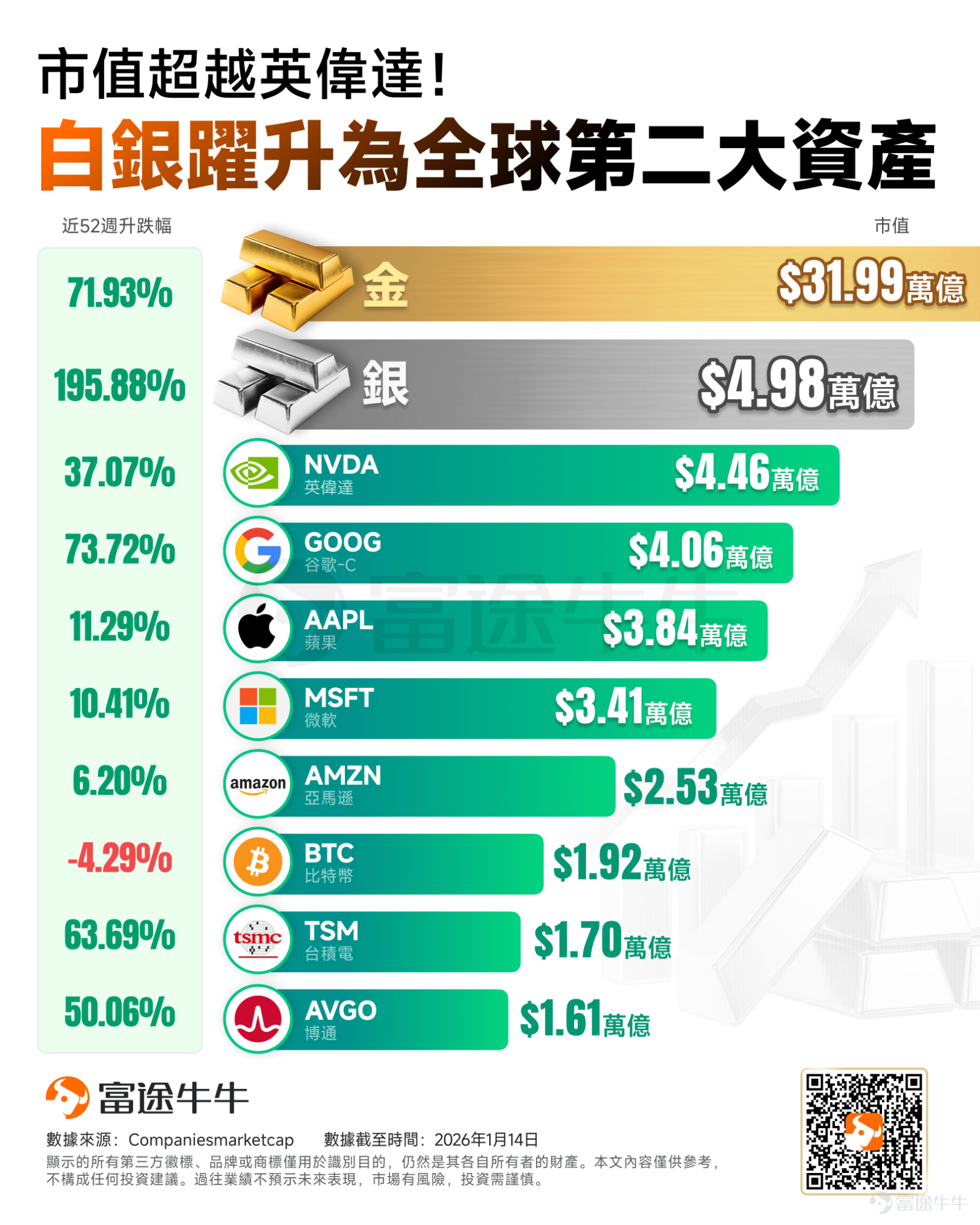
At the start of 2026, precious metals like gold and silver continue their unstoppable rise, repeatedly setting new all-time highs.On January 14th, a historic moment occurred as silver’s market capitalization surpassed $NVIDIA (NVDA.US)$, ranking as the world’s second-largest asset, second only to gold.
Gold and silver have now jointly claimed the top spots in global asset rankings, leaving the seven giants of the U.S. stock market, Bitcoin, and even $Taiwan Semiconductor (TSM.US)$ 、 $Broadcom (AVGO.US)$ AI newcomers like NVIDIA in the shade. From 'safe-haven assets' to 'dominant assets,' the surge in gold and silver reflects the interplay of macroeconomic, microeconomic, financial, and industrial factors.

Both gold and silver prices have reached historic peaks amid heated sentiment. The magnitude of daily fluctuations has been staggering; after hitting a new high, silver once plummeted more than 5%. Will the feast be followed by continued revelry or face adjustments and divergence? What strategies can be deployed?
The 'historic convergence' of gold and silver
The Gold-Silver Ratio is a key indicator for observation and trading. Historically, when the ratio is at a high level (i.e., silver is significantly undervalued relative to gold), there is often a 'catch-up rally' in silver, quickly restoring the ratio.
The correction of the gold-to-silver ratio in this cycle began in mid-2025 and declined at an extremely rapid rate. The gold-to-silver ratio has dropped significantly from its historical highs, and the latest reading is around 50, which is below the historical average.
During the previous bull market in 2011, the gold-to-silver ratio once dropped to 30. When viewed over a longer time frame, the bottom of the ratio has risen somewhat, but it has not yet reached the trend line over recent decades. If gold prices remain strong or continue to rise, there is still room for silver to 'catch up' through a delayed rally.
Military actions by the US in Venezuela, escalating tensions in the Middle East, and potential geopolitical competition among major powers have significantly increased gold's strategic value as the ultimate safe-haven asset.To diversify foreign exchange reserves and address concerns about the credibility of the US dollar, central banks (especially the People’s Bank of China) continue to purchase gold, creating a large, price-insensitive long-term demand that has established a solid floor for gold prices.

As a member of the precious metals group, silver shares the same safe-haven and currency-hedging characteristics as gold, though not as pronounced.At the same time, silver also possesses unique industrial/commodity attributes.
Emerging sectors such as AI computing centers, photovoltaic renewable energy, energy storage, and robotics are widely considered new growth drivers for silver’s industrial demand. The development of these sectors forms a long-term and robust physical demand for silver.
In November 2025, the US added silver to its list of critical minerals. On one hand, this brings potential tariff risks (which might trigger pre-emptive stockpiling); on the other hand, it highlights silver’s strategic importance in resource competition between major powers, prompting strategic reserve demand from various countries.
The global silver market has experienced supply deficits for five consecutive years, with a gap of approximately 95 million ounces in 2025, expected to widen further in 2026. Meanwhile, visible inventories available for delivery (such as those held by the London Bullion Market Association) have dropped to historically low levels, decreasing by about 75% from their peak. This tight inventory situation makes prices highly sensitive to any capital flows, making it prone to short-squeezes. Citi recently raised its target price for silver from $65 to $100.
In summary, the convergence of silver and gold is no coincidence.It is the result catalyzed by three macro trends: the downward real interest rate guided by the Fed's rate cuts, global central bank gold purchases, and geopolitical risk aversion, compounded by silver’s own epic supply-demand imbalance and industrial revolution.
How to deploy using options?
For investors, silver is a high-elasticity asset in the precious metals bull market.Its investment value, after gold establishes an upward trend, can potentially yield gains surpassing those of gold (Beta > 1) through exposure to silver. However, correspondingly, it also requires bearing much greater price volatility and short-term pullback risks than gold.
After the last trading day, $iShares Silver Trust (SLV.US)$ the IV rank and percentile have both surged to extreme levels; simply buying Calls/Puts to bet on direction no longer offers good value.

Investors holding silver-related assets may consider constructing a collar strategy: while holding shares, buy downside Puts to hedge against downward risks, and sell upside Calls to offset the premium costs with the collected premiums.Although this locks in some upside potential, it effectively builds a safety cushion, achieving a low-cost defensive allocation.

For those without positions, given silver’s extremely high volatility, directly adopting a short Put strategy to 'build positions at lower levels' could lead to potential losses during subsequent pullbacks, forcing them to take delivery or even face forced liquidation risks. A short volatility strategy would be more suitable.
Short Iron Condoris essentially a protected form of 'rent collection,' or an upgraded version of the Short Straddle/Strangle strategy.Although both strategies can profit from a decline in volatility, it is important to note that the theoretical loss risk for both is unlimited.

The Iron Condor strategy builds on the Short Strangle by adding two additional option legs, which lock in the maximum potential loss in advance.
Lower spread (put side)Sell a put option with a lower strike price while buying another put option with an even lower strike price. The purchased option provides downside protection for the sold put, capping the maximum possible loss in the downward direction.
Upper spread (call side)Sell a call option with a higher strike price while buying another call option with an even higher strike price. The purchased option provides upside protection for the sold call, capping the maximum possible loss in the upward direction.
Lower breakeven point= Put strike price - Net premium
Higher breakeven point= Call strike price + Net premium

Gold has shown relatively stable and resilient performance. Even during pullbacks, the declines are limited, while uptrends proceed steadily with small incremental gains, making it regarded as the 'stabilizing force' in the precious metals market.
For GLD, the Cash Secured Put strategy mentioned earlier is more applicable: reserve sufficient cash in the account to take delivery (if exercised). If the price continues to rise or moves sideways, the value of the put option will expire worthless, allowing you to keep the full premium received from selling the option. If the price falls below the strike price, the actual cost basis = strike price - per-share option premium. This is equivalent to building a position at a discounted price after a market rise and subsequent pullback.
What other options are available for investing in precious metals?
In addition to mainstream products like GLD and SLV, investors with higher risk tolerance may also consider $ProShares Ultra Silver (AGQ.US)$ 、 $Proshares Ultrashort Silver (ZSL.US)$ 、 $ProShares Ultra Gold (UGL.US)$ leveraged precious metals ETFs.
Although such products offer greater elasticity, investors must be wary of the erosion caused by their daily rebalancing mechanisms.If the price first drops and then rebounds, even though the gold/silver price remains unchanged, your investment value could still decrease.
Additionally, besides precious metals ETFs themselves, one can also explore gold stocks/silver stocks and related ETFs.Investing in mining companies requires not only tracking precious metal price movements but also gaining deeper insights into the company’s mineral resources, production costs, and operational capabilities.Larger gold mining companies include$Newmont (NEM.US)$ and $Barrick Mining (B.US)$ , while silver is represented by $First Majestic Silver (AG.US)$ and $Hecla Mining (HL.US)$ and others.
OptionSir has also included the relevant underlying assets here. Fellow investors can conduct further research based on their own risk preferences~


Finally, here's a small perk for fellow investors—welcome to claim it!Beginner's Options Package
This event is exclusive to invited HK users. Click to learn more.Detailed rules of the event >>
Say goodbye to all-night option trading! Choose good exit timing and set 'conditional orders' so you don’t lose sleep over missed opportunities in the middle of the night.

Disclaimer
This content does not constitute any offer, solicitation, recommendation, opinion, or guarantee of any securities, financial products, or tools. The risk of loss in buying and selling options can be substantial. In some cases, your losses may exceed the initial margin amount deposited. Even if you set contingent orders, such as 'stop-loss' or 'limit' orders, these may not necessarily prevent losses. Market conditions may make these orders unexecutable. You might be required to deposit additional margin within a short period. If you fail to provide the required amount within the specified time, your open positions may be liquidated. However, you will still be responsible for any account deficit arising from this. Therefore, before trading, you should study and understand options and carefully consider whether such trading suits you based on your financial situation and investment objectives. If you trade options, you should be familiar with the procedures upon exercising options and at expiration, as well as your rights and obligations when exercising options and at expiration.
Risk Disclaimer: The above content only represents the author's view. It does not represent any position or investment advice of Futu. Futu makes no representation or warranty.Read more


Comments (189)
to post a comment
275
117