
Options Square: Micron's earnings guidance was explosive—how should options be positioned for the me

Intel and AMD soar; is the 'memory moment' for CPUs approaching?
I. Market Recap: The Overlooked 'Capacity Squeeze' Effect
The US semiconductor sector yesterday witnessed a long-awaited 'duel of the titans.' While $NVIDIA (NVDA.US)$ was consolidating, $Intel (INTC.US)$ and $Advanced Micro Devices (AMD.US)$ showed strong performance. Intel’s stock rebounded significantly, and AMD also surged, with both rising over 6%, accompanied by increased trading volumes.
The catalyst for the surge came from a report by KeyBanc Capital Markets, a well-known Wall Street institution, which raised Intel's target price to $60 and AMD's target price to $270.
KeyBanc's Core Argument:
“As cloud service providers (CSP) continue aggressively expanding their AI infrastructure, by 2026, Intel and AMD's server CPU capacity will be nearly sold out.” AMD server CPUs are expected to increase in price by 10-15% in the first quarter of 2026.
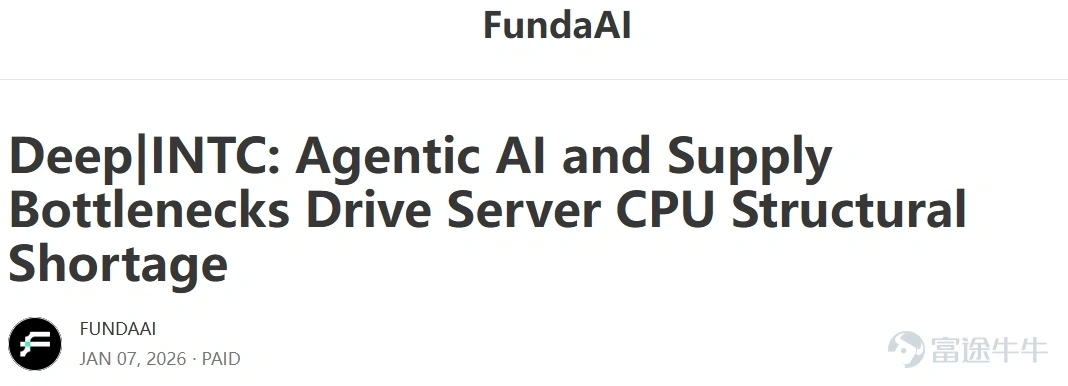
Coincidentally, last week FundaAI also released a report on the CPU market, echoing similar views. FundaAI stated,“While market attention is currently focused on the shortage of general-purpose GPUs and AI ASICs, the CPU sector is brewing a crisis of equal severity.。」,Server CPUs face structural shortages caused by foundry constraints.

Second, the underlying logic: Why is there a CPU shortage?
This is a case ofan advanced packaging capacity racetriggering 'supply-side displacement.' The core logic chain is as follows:
1. Zero-sum game in capacity: Bottlenecks in CoWoS and advanced packaging
Currently, high-performance AI GPUs (such as NVIDIA’s Blackwell series) and high-end server CPUs heavily rely on the production capacity of foundries like Taiwan Semiconductor. According to KeyBanc research, Taiwan Semiconductor will only be able to meet about 80% of CPU wafer demand by 2026. The main reason is that advanced process capacity is tilting towards AI GPUs and AI ASICs, with revenue from processes below 7nm already accounting for 74% (of which 5nm and 3nm account for 37% and 23%, respectively).The capacity for the processes required by server CPUs has been further squeezed.
Hyperscale cloud providers (CSPs) such as Meta, Google, Microsoft, and AWS have significantly increased their 2026 server procurement plans. Meanwhile, DRAM prices have continued to soar since the second half of 2025, leading to rising overall machine costs. Some OEM manufacturers have delayed consumer PC shipments and instead prioritized limited resources to safeguard high-margin server businesses.This 'structural shift in demand' has exacerbated the shortage of server CPUs.
To prioritize the high-margin demand for AI GPUs, foundries have allocated the majority of their advanced packaging capacity to NVIDIA. The packaging capacity left for server CPUs has been physically compressed. With the 2025 wave of AI-driven server upgrades approaching, compounded by limited supply-side capacity,CPUs will flip instantly from a 'buyer's market' to a 'seller's market,' with not only guaranteed sales volume but also significant room for ASP (average selling price) increases.
2. From the demand side, the return of associated demand
The large-scale deployment of GPU clusters does not exist in isolation but relies heavily on CPU servers to form a 'collaborative computing power system.' Intel has previously mentioned multiple times that some product lines are experiencing tight supply, providing a credible basis for the shortage narrative. Recently, the market has further developed a new logic:In the Agentic AI era, the importance of CPUs is increasing — due to the need for extensive scheduling, preprocessing, and task orchestration, which often revolves around GPU clusters but is highly dependent on CPU support.
III. Benefiting Targets and Investment Logic
Under this logic, the direct beneficiaries are undoubtedly Intel and AMD, the two oligopolists with pricing power, though their respective benefiting mechanisms differ slightly.
– Rationale for Benefit: AMD’s market share in the server segment continues to rise steadily. According to Mercury Research data cited by Tom's Hardware, AMD's unit market share of server CPUs reached 27.8% in Q3 2025 (up from 27.3% in Q2 2025). Mercury also noted that, thanks to a higher proportion of EPYC products in its portfolio, AMD's server revenue hit a record high, although specific revenue proportions were not disclosed. Its EPYC series is highly attractive to cloud providers in terms of energy efficiency.
– Key observations: Pay attention to the cross-selling effect between its MI300 series GPUs and EPYC CPUs, as well as its influence in Taiwan Semiconductor’s capacity allocation.
– Rationale for Benefit: As an IDM (Integrated Device Manufacturer), Intel possesses its own packaging capacity. In the short term, Intel can directly meet market demand driven by the Server CPU shortage through its flagship server CPU, Xeon 6 Granite Rapids, based on the Intel 3 process. In the long term, the 18A process serves as a core revaluation lever for investors.
– Key observations: Yield realization of the 18A process node
Other targets include:
$NVIDIA (NVDA.US)$ : Its Vera CPU is specifically designed for Agentic AI inference scenarios and is the first CPU to support FP8 precision, capable of efficiently handling inference-related tasks when GPU computing power is saturated, filling the computing gap. Against the backdrop of a Server CPU shortage, this unique positioning highlights the value of its CPU business, making it a key beneficiary.
$Arm Holdings (ARM.US)$ : The Arm architecture is an important alternative solution amid x86 shortages. By 2025, nearly 50% of computing devices shipped by hyperscale cloud providers will adopt the Arm architecture, with AWS's newly added data center chip production capacity over the past two years showing that Arm CPUs account for more than 50%. The supply gap in x86 could drive increased demand for Arm architecture as an alternative.
$Qualcomm (QCOM.US)$ : Qualcomm has broken through its previous business boundaries focused on PC CPUs and plans to re-enter the data center CPU market. Its customized CPU can be closely integrated with NVIDIA’s platform (including the NVLink Fusion ecosystem). This strategic move allows Qualcomm to enter the high-growth Server CPU sector, gaining new growth opportunities during the shortage cycle, positioning it as a beneficiary under the narrative of 'CPU importance rebounding.'
IV. Options Trading Strategy Analysis
$Intel (INTC.US)$The stock price has broken through the long-term resistance level, hitting a 21-month high. Moving averages are aligned in a bullish pattern, but the RSI (Relative Strength Index) may be nearing the overbought zone, indicating a potential short-term pullback.The upcoming earnings report on January 22, combined with the positive news of 'sold-out capacity,' has driven IV (Implied Volatility) to an extremely high level of 86%.
$Advanced Micro Devices (AMD.US)$ The resistance level above is in the $230-$235 range, with strong support below at around $210, and IV has reached a high of 75%. Both call and put options are relatively expensive. Recently, INTC and AMD’sPut/Call ratioBoth showed a decline, indicating bullish sentiment is gathering.
1. Acknowledge the narrative of CPU shortages and aim to control risk with a bullish strategy (for investors without positions seeking high leverage).
Bull Call Spread.The current implied volatility (IV) for INTC and AMD is relatively high. Compared to directly buying Calls, constructing a spread can reduce the risk of time decay and volatility pullback.
Based on buying a Call, an additional higher strike price Call is sold to reduce the cost of purchase. Selling an out-of-the-money Call limits maximum profit but also lowers the breakeven point, making it suitable for short-term upward movements. The biggest risk of this strategy is losing all premium paid at the initial position setup.

2. A prudent accumulation strategy (for cash-rich investors aiming to buy at a low price).
Cash-secured Put cash-secured put options.Technicals currently show overbought risks in the stock price. If you're concerned about a potential short-term pullback but want to accumulate at lower prices, based on the long-term shortage logic through 2026, this qualifies as a 'left-side trade' where you'd be willing to buy at this price anyway. Here, the premium acts as a discount on share acquisition.
Near-term INTC has significant Put open interest near key support levels of $40 and $35, providing strong support. You can take advantage of the current high volatility to earn premiums. If the stock pulls back, you acquire shares at your ideal low price (strike price - premium); if the stock rises or moves sideways, you simply pocket the premium, adding to your margin of safety. Strike prices can be chosen below support levels or at prices where investors are willing to establish positions.

3. Position enhancement strategy (for investors holding underlying stocks who want to reduce costs).
Covered Call or Long Collar strategy.Intel's short-term price movement tends to be impulsive, followed by consolidation. KeyBanc's forecast focuses on a long-term logic for 2026; if you believe that INTC may still be bottoming out in the short term, selling call options above the current price to collect premiums can significantly reduce your holding cost. If the stock price surges and the option is exercised, it would still present a good opportunity for profit-taking.

Finally, here's a small perk for fellow investors—welcome to claim it!Beginner's Options Package
This event is exclusive to invited HK users. Click to learn more.Detailed rules of the event >>
Say goodbye to all-night option trading! Choose good exit timing and set 'conditional orders' so you don’t lose sleep over missed opportunities in the middle of the night.

Disclaimer
This content does not constitute any offer, solicitation, recommendation, opinion, or any guarantee regarding securities, financial products, or tools. The risk of loss in trading options can be substantial. In some cases, losses may exceed the initial margin deposited. Even if you have set contingency orders, such as 'stop-loss' or 'limit' orders, they may not necessarily prevent losses. Market conditions may render these orders unexecutable. You may be required to deposit additional margin within a short period. If you fail to provide the required amount within the specified time, your open positions may be liquidated. However, you will still be responsible for any deficit balance in your account. Therefore, before trading, you should study and understand options and carefully consider whether such trading suits your financial situation and investment objectives. If you trade options, you should be familiar with the procedures related to exercising options and the expiration of options, as well as your rights and obligations upon exercising options and at expiration.
Risk Disclaimer: The above content only represents the author's view. It does not represent any position or investment advice of Futu. Futu makes no representation or warranty.Read more


Comments (3)
to post a comment
61
164