
English
Back
Open Account
Agora
wrote a post · Jan 14 14:40

A huge hit at CES! This world’s smallest AI-powered educational device transforms 'learning' into 'craving'

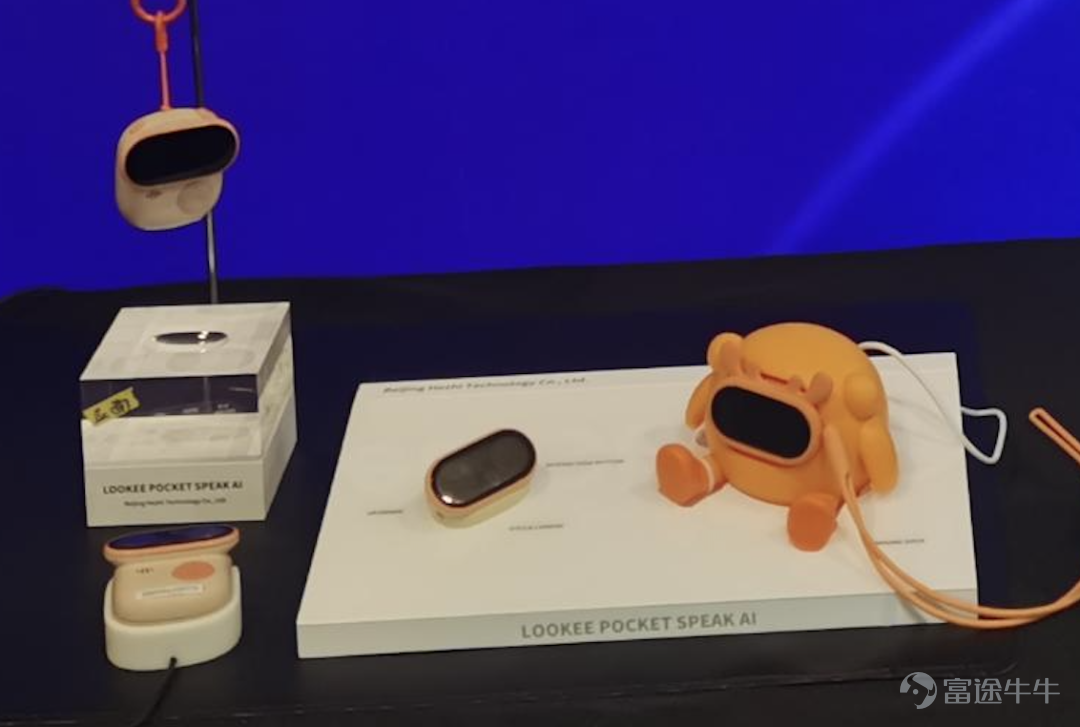
At CES 2026, an exquisitely designed and endearing AI hardware device drew crowds of eager users around it at all times—this was Lookee, the newly launched speaking companion from Hezhi Technology. In a short period, this surge of industry attention has quietly found its way onto many families’ New Year shopping lists. It responds not only to educational developers’ reflections but also to parents’ heartfelt hopes:Can we help children naturally fall in love with speaking English, so that learning happens effortlessly whenever they seek companionship?
At CES 2026, a sleek and adorable AI hardware device drew crowds of eager users—a testament to Lookie, the newly launched English-speaking companion from Hezhi Tech. In just a short time, this surge of industry attention has quietly made its way onto many families’ holiday shopping lists. It speaks not only to educators’ reflections on pedagogy but also to parents’ heartfelt hopes:Can we help children naturally fall in love with speaking English—so learning becomes something they crave when seeking companionship? Lookee debuts at Agora’s CES 2026 booth This hope points to two long-standing pain points in education:The ineffectiveness of 'mute English' learning and the common fate of smart devices being quickly abandoned after initial use.Lookee, together with Agora—the provider of real-time communication (RTC) technology behind it—is delivering a thoughtful solution. Breaking the 'mute English' dilemma: Shifting from 'screen dependency' back to 'real conversation' Chinese children commonly face the challenge of 'mute English' in their language learning. Research shows that when learning relies simultaneously on on-screen text and audio, the brain prioritizes visual information, thereby suppressing the development of listening and speaking skills—an important root cause behind the widespread phenomenon where many children can read but cannot speak. Therefore, Hezhi Technology did not opt to pack richer multimedia content onto the screen; instead, it made a counterintuitive yet critical product decision:Completely remove the screen and return interaction to its purest form.Behind this choice lies a full simulation of authentic spoken-language communication environments....
Lookee debuts at Agora’s booth at CES 2026
This hope addresses two long-standing pain points in education:The inefficacy of 'mute English' learning and the common fate of smart devices quickly gathering dust after purchase.Lookee, together with Agora—the provider of real-time communication (RTC) technology behind it—is jointly offering a thoughtful solution.
Breaking the "mute English" dilemma:
Returning from "screen dependence" to "real conversation"
Chinese children commonly face the challenge of "mute English." Research shows that when learning relies simultaneously on on-screen text and audio, the brain prioritizes visual information, thereby suppressing the development of listening and speaking skills—a key reason behind the widespread phenomenon where many children can read but cannot speak.
Therefore, instead of piling richer multimedia content onto screens, Hezhi Technology made a counterintuitive yet critical product decision:Completely remove the screen and return interaction to its purest form.Behind this lies a full-scale simulation of authentic language communication environments.
Thus emerged Lookee Oral Pal: lightweight as an earphone case and weighing under 50 grams, it supports standalone 4G connectivity. Designed from the outset to slip into a pocket or hang from a child’s chest, it accompanies them on sofas, in cars, or on park benches—ready to spark relaxed conversations at any moment the child feels at ease. This may well be exactly what many families today are seeking:A learning approach that doesn’t strain children’s eyesight, avoids parent-child friction, and seamlessly integrates into daily life anytime, anywhere.
At CES 2026, a sleek and adorable AI hardware device drew crowds of eager users—a testament to Lookie, the newly launched English-speaking companion from Hezhi Tech. In just a short time, this surge of industry attention has quietly made its way onto many families’ holiday shopping lists. It speaks not only to educators’ reflections on pedagogy but also to parents’ heartfelt hopes:Can we help children naturally fall in love with speaking English—so learning becomes something they crave when seeking companionship? Lookee debuts at Agora’s CES 2026 booth This hope points to two long-standing pain points in education:The ineffectiveness of 'mute English' learning and the common fate of smart devices being quickly abandoned after initial use.Lookee, together with Agora—the provider of real-time communication (RTC) technology behind it—is delivering a thoughtful solution. Breaking the 'mute English' dilemma: Shifting from 'screen dependency' back to 'real conversation' Chinese children commonly face the challenge of 'mute English' in their language learning. Research shows that when learning relies simultaneously on on-screen text and audio, the brain prioritizes visual information, thereby suppressing the development of listening and speaking skills—an important root cause behind the widespread phenomenon where many children can read but cannot speak. Therefore, Hezhi Technology did not opt to pack richer multimedia content onto the screen; instead, it made a counterintuitive yet critical product decision:Completely remove the screen and return interaction to its purest form.Behind this choice lies a full simulation of authentic spoken-language communication environments....
However,Realizing the concept of "screen-free immersive conversation" first requires voice interaction quality comparable to real human dialogue.Any lag, delay, or background noise would disrupt a child’s train of thought and immersion. This is precisely where Agora’s technology plays a pivotal role:
Through its self-developed SD-RTN™ network and high-definition, weak-network-resilient, noise-suppressing audio solution, it ensures that children’s conversations with Lookee remain consistently clear, smooth, and stable—whether they’re on the move or in areas with unstable connectivity.
Meanwhile, for ultra-compact, low-power hardware like Lookee, Agora achieves top-tier call quality through highly efficient audio processing and minimalist transmission optimization, helping the device strike a balance between battery life and performance so thatextreme lightweight designdoes not compromisehigh-quality interaction.
Solving the 'low retention rate' challenge:
Building a dual closed-loop of emotional connection and effective engagement
Educational hardware faces the risk of becoming idle because it fails to become a child’s daily companion—one that is both loved and needed. Hezhi Technology has addressed this through systematic design, creating a growth loop where emotional bonding and effective learning reinforce each other.
Emotionally intelligent companionship is key to long-term user stickiness. Behind Lookee’s empathetic-looking big eyes lies a proprietarydynamic regulation system (AURA) that senses children’s emotions and comprehension levels in real time.To deliver such nuanced emotional feedback, the system must complete the entire loop—from recognition to response—within milliseconds. Agora’s ultra-low-latency audio pipeline ensures smooth and seamless emotional interaction, making every response feel natural and timely, thereby fostering authentic and trustworthy emotional connections.
At CES 2026, a sleek and adorable AI hardware device drew crowds of eager users—a testament to Lookie, the newly launched English-speaking companion from Hezhi Tech. In just a short time, this surge of industry attention has quietly made its way onto many families’ holiday shopping lists. It speaks not only to educators’ reflections on pedagogy but also to parents’ heartfelt hopes:Can we help children naturally fall in love with speaking English—so learning becomes something they crave when seeking companionship? Lookee debuts at Agora’s CES 2026 booth This hope points to two long-standing pain points in education:The ineffectiveness of 'mute English' learning and the common fate of smart devices being quickly abandoned after initial use.Lookee, together with Agora—the provider of real-time communication (RTC) technology behind it—is delivering a thoughtful solution. Breaking the 'mute English' dilemma: Shifting from 'screen dependency' back to 'real conversation' Chinese children commonly face the challenge of 'mute English' in their language learning. Research shows that when learning relies simultaneously on on-screen text and audio, the brain prioritizes visual information, thereby suppressing the development of listening and speaking skills—an important root cause behind the widespread phenomenon where many children can read but cannot speak. Therefore, Hezhi Technology did not opt to pack richer multimedia content onto the screen; instead, it made a counterintuitive yet critical product decision:Completely remove the screen and return interaction to its purest form.Behind this choice lies a full simulation of authentic spoken-language communication environments....
Provides an all-in-one solution
Empowers enterprises to focus on crafting exceptional 'experiences'
At the level of effective motivation, Lookee deeply integrates gamification mechanics andinnovatively targets high-demand scenarios such as Cambridge English exam preparation (including KET, PET, FCE, IELTS, etc.)high-demand scenarios. By combining engaging daily conversations with intelligent flashcards and AI-powered mock exams, Lookee links fun interactions with a clear, authoritative, and visualized pathway for skill development, making learning outcomes tangible. In demanding contexts like simulated speaking tests, stable and crystal-clear voice interaction is critical. Agora’s smooth experience ensures accurate and reliable AI scoring, providing measurable evidence for every step of progress.
At CES 2026, a sleek and adorable AI hardware device drew crowds of eager users—a testament to Lookie, the newly launched English-speaking companion from Hezhi Tech. In just a short time, this surge of industry attention has quietly made its way onto many families’ holiday shopping lists. It speaks not only to educators’ reflections on pedagogy but also to parents’ heartfelt hopes:Can we help children naturally fall in love with speaking English—so learning becomes something they crave when seeking companionship? Lookee debuts at Agora’s CES 2026 booth This hope points to two long-standing pain points in education:The ineffectiveness of 'mute English' learning and the common fate of smart devices being quickly abandoned after initial use.Lookee, together with Agora—the provider of real-time communication (RTC) technology behind it—is delivering a thoughtful solution. Breaking the 'mute English' dilemma: Shifting from 'screen dependency' back to 'real conversation' Chinese children commonly face the challenge of 'mute English' in their language learning. Research shows that when learning relies simultaneously on on-screen text and audio, the brain prioritizes visual information, thereby suppressing the development of listening and speaking skills—an important root cause behind the widespread phenomenon where many children can read but cannot speak. Therefore, Hezhi Technology did not opt to pack richer multimedia content onto the screen; instead, it made a counterintuitive yet critical product decision:Completely remove the screen and return interaction to its purest form.Behind this choice lies a full simulation of authentic spoken-language communication environments....
During free-form conversations, Lookee naturally guides children to reflect on emotions expressed in music, the meaning of friendship, and even fascinating phenomena in physics and chemistry,breaking down disciplinary silos and enabling language to truly become a tool for exploring the world.Meanwhile, the ‘shake-to-discover’ feature introduces unexpected topics, creating authentic communication scenarios that stimulate children’s adaptability and organizational skills—making each conversation full of surprises and challenges, and seamlessly cultivating their expressive abilities without conscious effort.
At CES 2026, a sleek and adorable AI hardware device drew crowds of eager users—a testament to Lookie, the newly launched English-speaking companion from Hezhi Tech. In just a short time, this surge of industry attention has quietly made its way onto many families’ holiday shopping lists. It speaks not only to educators’ reflections on pedagogy but also to parents’ heartfelt hopes:Can we help children naturally fall in love with speaking English—so learning becomes something they crave when seeking companionship? Lookee debuts at Agora’s CES 2026 booth This hope points to two long-standing pain points in education:The ineffectiveness of 'mute English' learning and the common fate of smart devices being quickly abandoned after initial use.Lookee, together with Agora—the provider of real-time communication (RTC) technology behind it—is delivering a thoughtful solution. Breaking the 'mute English' dilemma: Shifting from 'screen dependency' back to 'real conversation' Chinese children commonly face the challenge of 'mute English' in their language learning. Research shows that when learning relies simultaneously on on-screen text and audio, the brain prioritizes visual information, thereby suppressing the development of listening and speaking skills—an important root cause behind the widespread phenomenon where many children can read but cannot speak. Therefore, Hezhi Technology did not opt to pack richer multimedia content onto the screen; instead, it made a counterintuitive yet critical product decision:Completely remove the screen and return interaction to its purest form.Behind this choice lies a full simulation of authentic spoken-language communication environments....
Thus, Lookee’s true breakthrough lies in its multimodal real-time perception and generation capabilities. To bring this perception to life and make it interactive, Agora’s real-time dialogue 'neural hub' plays an indispensable role—seamlessly collaborating with Lookee’s visual perception and large-model capabilities to close the loop from environmental awareness and intent understanding to natural response. It is precisely this deep integration that endows the hardware with initial potential to serve as an 'entry point for interacting with the world.'
A 'small step' for user experience,
A 'giant leap' for AI companionship
Lookee’s popularity stems from its precise execution of that 'small step'—solving real user pain points: delivering high-quality interaction during fragmented time, creating authentic conversational scenarios despite the lack of a language-immersive environment, and striking a balance between eye health protection and sparking interest. Children see it not as a tool requiring formal attention, but as a companion they can chat with, share with, and explore the unknown alongside.This design philosophy—transforming learning into a social behavior driven by curiosity and emotion—is the fundamental reason why children love it and parents trust it.
At CES 2026, a sleek and adorable AI hardware device drew crowds of eager users—a testament to Lookie, the newly launched English-speaking companion from Hezhi Tech. In just a short time, this surge of industry attention has quietly made its way onto many families’ holiday shopping lists. It speaks not only to educators’ reflections on pedagogy but also to parents’ heartfelt hopes:Can we help children naturally fall in love with speaking English—so learning becomes something they crave when seeking companionship? Lookee debuts at Agora’s CES 2026 booth This hope points to two long-standing pain points in education:The ineffectiveness of 'mute English' learning and the common fate of smart devices being quickly abandoned after initial use.Lookee, together with Agora—the provider of real-time communication (RTC) technology behind it—is delivering a thoughtful solution. Breaking the 'mute English' dilemma: Shifting from 'screen dependency' back to 'real conversation' Chinese children commonly face the challenge of 'mute English' in their language learning. Research shows that when learning relies simultaneously on on-screen text and audio, the brain prioritizes visual information, thereby suppressing the development of listening and speaking skills—an important root cause behind the widespread phenomenon where many children can read but cannot speak. Therefore, Hezhi Technology did not opt to pack richer multimedia content onto the screen; instead, it made a counterintuitive yet critical product decision:Completely remove the screen and return interaction to its purest form.Behind this choice lies a full simulation of authentic spoken-language communication environments....
It is precisely these solid 'small steps' that collectively constitute a 'giant leap' from an industry perspective. It validates the feasibility of the formula: “Premium hardware experience = deep insight into educational essentials × reliable technical execution” At the same time, it offers users a new form of child-centered, life-integrated AI companionship.
Therefore, it is not merely an AI learning companion, but also an active exploration ofhow to use 'RTE + AI' technology to create more meaningful interactions and enriching possibilities for childhood.This may well be the most noteworthy significance carried by this compact product.
At CES 2026, a sleek and adorable AI hardware device drew crowds of eager users—a testament to Lookie, the newly launched English-speaking companion from Hezhi Tech. In just a short time, this surge of industry attention has quietly made its way onto many families’ holiday shopping lists. It speaks not only to educators’ reflections on pedagogy but also to parents’ heartfelt hopes:Can we help children naturally fall in love with speaking English—so learning becomes something they crave when seeking companionship? Lookee debuts at Agora’s CES 2026 booth This hope points to two long-standing pain points in education:The ineffectiveness of 'mute English' learning and the common fate of smart devices being quickly abandoned after initial use.Lookee, together with Agora—the provider of real-time communication (RTC) technology behind it—is delivering a thoughtful solution. Breaking the 'mute English' dilemma: Shifting from 'screen dependency' back to 'real conversation' Chinese children commonly face the challenge of 'mute English' in their language learning. Research shows that when learning relies simultaneously on on-screen text and audio, the brain prioritizes visual information, thereby suppressing the development of listening and speaking skills—an important root cause behind the widespread phenomenon where many children can read but cannot speak. Therefore, Hezhi Technology did not opt to pack richer multimedia content onto the screen; instead, it made a counterintuitive yet critical product decision:Completely remove the screen and return interaction to its purest form.Behind this choice lies a full simulation of authentic spoken-language communication environments....
Risk Disclaimer: The above content only represents the author's view. It does not represent any position or investment advice of Futu. Futu makes no representation or warranty.Read more
Emm
1
Thumbs Up
1
25K Views
Report
Comments
Write a Comment...
2
1