
Hong Kong-listed AI 'twin leaders' see active trading! How to position in the AI sector for the Year

Alibaba's strong rebound: Has a new main narrative for Chinese stocks been established as AI enthusiasm overtakes e-commerce concerns?
The AI application theme is heating up, and Chinese tech stocks are seeing significant recovery
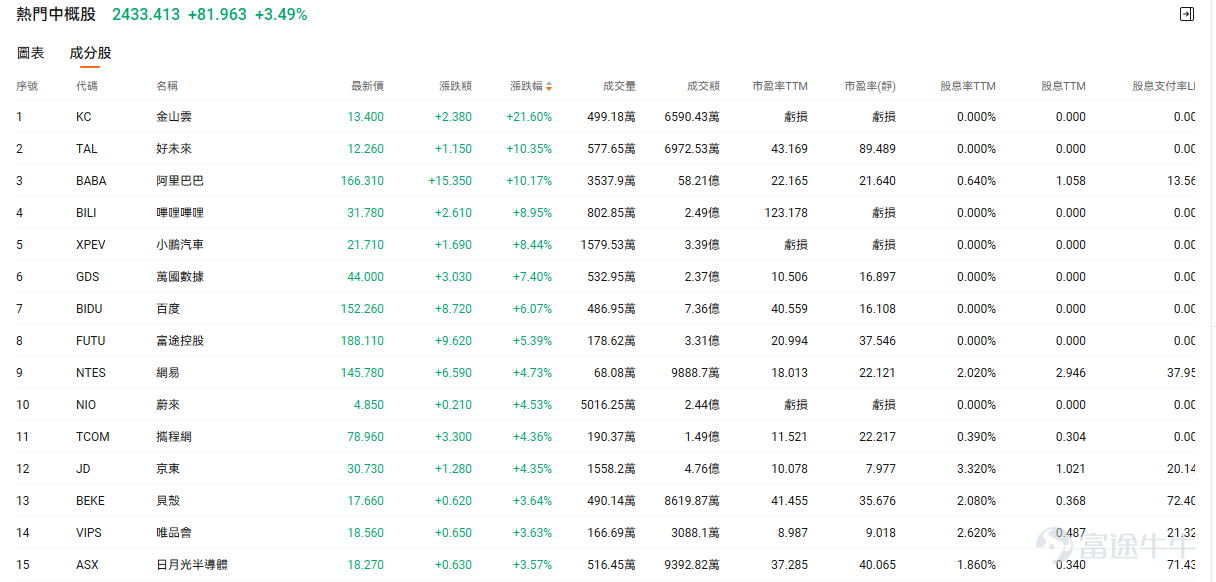
On January 12 (Monday), $Alibaba (BABA.US)$ the stock surged over 10% in a single day, closing above the $166 mark, with one bullish candle engulfing three bearish ones, recording the largest daily gain in nearly a month.
This is not just Alibaba's show. Amid frequent positive developments in AI applications, funds are shifting to more aggressive tech growth stocks. Apart from Alibaba, other popular Chinese tech stocks with AI implementation scenarios such as $Baidu (BIDU.US)$ 、 $JD.com (JD.US)$ 、 $XPeng (XPEV.US)$ 、 $Kingsoft Cloud (KC.US)$ 、 $TAL Education (TAL.US)$ 、 $Bilibili (BILI.US)$ also recorded substantial gains. In the Hong Kong market, companies in the AI application sector like $KUAISHOU-W (01024.HK)$ 、 $TENCENT (00700.HK)$ 、 $MINIMAX-W (00100.HK)$、 $KNOWLEDGE ATLAS (02513.HK)$、 $MININGLAMP-W (02718.HK)$ also saw decent increases.
"To chase or not to chase?" This is the question many investors are facing amid the surge in the AI application sector. The current red-hot momentum across AI-related sectors, with high investor enthusiasm, has once again put investors in a dilemma:Is this a short-lived burst driven by speculative funds, or a genuine trend opportunity brought about by industrial transformation?

Alibaba’s 'fall-first-rise-later'? A game of pricing power
Looking back at the past few trading days, Alibaba's stock price showed an 'emotional reversal' with a fall followed by a rise. After hitting a historic high of $192 on October 2, Alibaba's stock performance in Q4 was less than ideal, with a quarterly decline of 18%; just last week (around January 7), Alibaba’s stock was still under pressure and trending downward, while Monday’s big rally reflects the underlying contradiction between old logic and new narratives colliding.

The logic behind the decline is 'anxiety over the fundamentals of e-commerce.'。Based on recent public disclosures, Alibaba's latest updates in a small-scale investor communication indicated that the e-commerce business growth for Q4 might fall short of expectations (corresponding to the natural quarter, hereinafter the same). After communicating with management, Wall Street giants like Morgan Stanley issued somewhat pessimistic research reports, lowering their target price from $200 to $180.The reason cited was 'a weakening consumer environment has started to deteriorate the core e-commerce business,' adding that this segment 'may continue to face pressure in the first half of fiscal year 2027 due to high base effects.'
Although the official full data for December has not yet been released (typically announced in the second half of January next year), online retail sales under the November social retail measure grew by only 1.5% YoY. Moreover, reduced government subsidies in 2026 coupled with the pull-forward consumption effect,has led to a phase of slowdown in the e-commerce industry. As the leading platform, Alibaba cannot remain unscathed, and foreign investors have generally lowered their profit forecasts for its e-commerce business.
Regarding instant retail (flash purchases), multiple media reports indicate that Taobao Flash maintained stable order share in Q4, with GMV share growing and AOV (average order value) continuing to rise. Due to Alibaba’s emphasis that 'the primary goal for Taobao Flash in 2026 is market share growth, with a firm commitment to increase investment to achieve absolute market leadership,' the market is concerned that it may ramp up subsidies to maintain market share at the expense of short-term profitability.This earnings outlook based on 'intense competition' has triggered a preemptive stock price correction—a typical risk-aversion behavior.
On the other hand, the rationale for upward movement lies in the 'AI revaluation narrative.'。Cloud business performance continues to reinforce Alibaba's positioning as 'China’s best AI enabler.' Goldman Sachs expects Alibaba Cloud revenue growth to accelerate to 35% YoY or higher, following a 34% growth rate in Q3, with Q4 showing steady improvement, which aligns with management's guidance.
The implementation progress of Qwen large models in vertical fields such as enterprise services and healthcare has exceeded expectations. According to the latest statistics from Hugging Face, a global AI open-source community, by January 2026, the cumulative download volume of the Tongyi Qianwen series models under Alibaba Cloud has surpassed 700 million times, making it the most downloaded open-source AI series on the platform; 'Ant Alipay' also announced impressive data, with the new version breaking 30 million monthly active users in less than a month since its launch, responding to over 10 million health-related questions daily.Capital is shifting its focus from the fiercely competitive 'e-commerce red ocean' to the promising 'AI monetization blue ocean.'
AI Applications: A Flash in the Pan or the Main Theme of the Year?
The nature of the current market trend is primarily driven by the recent密集落地 (intensive implementation) of significant industry events, for three reasons:
1. Policy 'Tone Setting':'AI+' is no longer just a spontaneous corporate initiative but has become a national-level industrial upgrade strategy. This means that capital expenditures (Capex) in this field will benefit from better policy support, and there may even be specific fiscal subsidies or credit support down the line.
2. Large model enterprises $MINIMAX-W (00100.HK)$ ,$KNOWLEDGE ATLAS (02513.HK)$Recently listed on the Hong Kong stock exchange, the stock price has performed strongly, providing a key anchor point for the industry valuation system; Elon Musk’s aggressive statements have drawn global attention,In a recent in-depth interview, he made a disruptive prediction that AGI (Artificial General Intelligence) could be achieved by 2026, significantly strengthening market expectations regarding the speed of AI technology implementation and its application scenarios.
3. DeepSeek, a Chinese AI unicorn, is expected to release its new model, DeepSeek V4, before the 2026 Chinese New Year.This model aims at the enterprise-level code generation market, with internal testing performance reportedly surpassing Claude and the GPT series.
In the US stock market, overseas giants plan to acquire Manus at an amount and valuation exceeding market expectations, demonstrating the independent value of AI application layers. Companies like AppLovin provide excellent对标样本 (benchmark examples) for Chinese stocks.The market has started to look for similar '映射股' (corresponding stocks) within Chinese assets.— those companies with massive data, mature scenarios, and the ability to generate revenue through AI applications, such as Alibaba (e-commerce + cloud), Tencent (social + gaming), and Baidu (search + automotive), are indispensable core assets.
Short-term catalysts are merely the surface of market movements; the core issue the market is truly grappling with is: Has the singularity of AI applications arrived?Considering the industry's qualitative changes and underlying logic restructuring since 2025, AI applications have not yet reached the ultimate singularity but have entered a 'critical threshold toward the application singularity.' From a technical foundation perspective, AI has transitioned from 'single-point breakthroughs' to 'system maturity,' with models like GPT-5, Gemini 3, and Qwen-Max now demonstrating strong tool integration, multi-modal understanding, and autonomous planning capabilities.The market is willing to assign higher premiums to companies that can prove in their financial reports that 'AI contributed to revenue.'
Although the logic is sound, investors still need to be wary of 'expectation overruns.',From a risk perspective, the first concern is the sustainability risk of commercialization — most AI application companies are still in the 'investment phase,' with some explicitly stating that their related businesses have yet to form a mature business model and contribute zero revenue. If subsequent scenario replication falls short of expectations, it may trigger a valuation correction.
Moreover, the increasing difficulty in stock selection has become a prominent feature of the current track.. Unlike the single logic of 'trading computing power, trading models' in 2023, the investment logic for AI applications in 2026 has been subdivided into 'scenario barriers' and 'profit models'. Therefore, if you think buying individual stocks directly is too difficult, you can also consider ETFs. Investors can find many ETF options in the China concept ETF sector, such as $Direxion Daily FTSE China Bull 3X Shares ETF (YINN.US)$ , $Direxion Daily CSI China Internet Index Bull 2x Shares ETF (CWEB.US)$ , $KraneShares CSI China Internet ETF (KWEB.US)$ , $iShares China Large-Cap ETF (FXI.US)$ 。

Options strategy
$Alibaba (BABA.US)$ Short-term technical indicators show strong momentum, with price and volume working together to break through previous highs. Clear bullish signals are present from both major capital inflows and the options market, but rising overbought indicators and volatility suggest caution when chasing higher prices.The short-term support zone is $145-$155, with resistance at $168-$180.
Option chain data shows that Alibaba's put/call ratio plummeted to around 0.46 on Monday; the trading volume was mainly concentrated in call options with strike prices between $160 and $170, expiring this week, mostly driven by short-term speculative funds betting on a breakout. The distribution of strike prices indicates that the put option at $150 has a relatively high open interest, forming a short-term support level.
In the current extreme market condition where the stock's daily price fluctuation exceeds 10%, the implied volatility (IV) is at a medium-to-high percentile (IV Rank approximately 56%), indicatingexpensive option prices。
Two key variables need to be dynamically tracked:First, the actual disclosed values for e-commerce profits and AI business revenue in Alibaba’s Q4 earnings report at the end of February; second, the overall market sentiment toward the AI application sector, which could impact Alibaba’s valuation through sentiment spillover.
(1) For investors who already hold the underlying stock and wish to 'take profits' or 'enhance returns' — “Low-cost insurance”
Suitable for long-term holders with lower cost bases who are concerned about short-term pullbacks or want to increase cash flow before the earnings report. A Long Collar strategy can be considered.。
This strategy involves holding the underlying stock while using 'buying Puts' to hedge against downside risk. The income from 'selling Calls' offsets part of the cost of buying Puts, thereby achieving risk hedging at a lower cost. If the income from selling Calls can cover the cost of buying Puts, a 'zero-cost' insurance portfolio can be constructed. If the underlying stock rises, the portion of 'sold Calls B' may be exercised, limiting the overall profit potential. If the underlying stock falls, the portion of 'bought Puts A' will generate profits, capping the maximum loss.

(2) For those who do not hold the underlying stock but want to buy at a low price or control risks — 'Conservative entry'
If investors missed the buying opportunity and feel that chasing highs now is risky, but are also worried about missing out, they can consider selling put options (Sell Put).This is a high-probability strategy. By taking advantage of high implied volatility (IV), substantial premiums can be earned. Profits can be made if the stock price rises, moves sideways, or even declines slightly (as long as it doesn't fall below the strike price). The risk lies in being obligated to buy the stock at the strike price if the stock price falls below it; to avoid this, the strike price can be set below a strong support level of the stock price.

(3) Extremely bullish on the AI theme, seeking high growth — 'Aggressive speculation'.
Suitable for investors with high risk tolerance, small capital, and looking to bet on the 'main upward wave,' they can consider a ratio call spread.By leveraging market enthusiasm for out-of-the-money calls, buy 1 low-strike call option and sell N (N≥2) high-strike call options, such as the classic '1-buy-2-sell' ratio. Compared to a regular bull call spread, this further reduces the cost of the strategy, and may even achieve 'zero cost.'
It should be noted that this strategy requires active management. It generates significant profits during moderate rallies or early in strong uptrends, but excessive price increases could lead to substantial losses, exposing the uncovered sold call to risk.Strict risk control is needed, including position sizing and timely stop-loss measures.
That’s all for today.
Finally, here's a small perk for fellow investors—welcome to claim it!Beginner's Options Package
This event is exclusive to invited HK users. Click to learn more.Detailed rules of the event >>
Say goodbye to all-night option trading! Choose good exit timing and set 'conditional orders' so you don’t lose sleep over missed opportunities in the middle of the night.

Risk Disclaimer: The above content only represents the author's view. It does not represent any position or investment advice of Futu. Futu makes no representation or warranty.Read more


Comment (1)
to post a comment
67
69