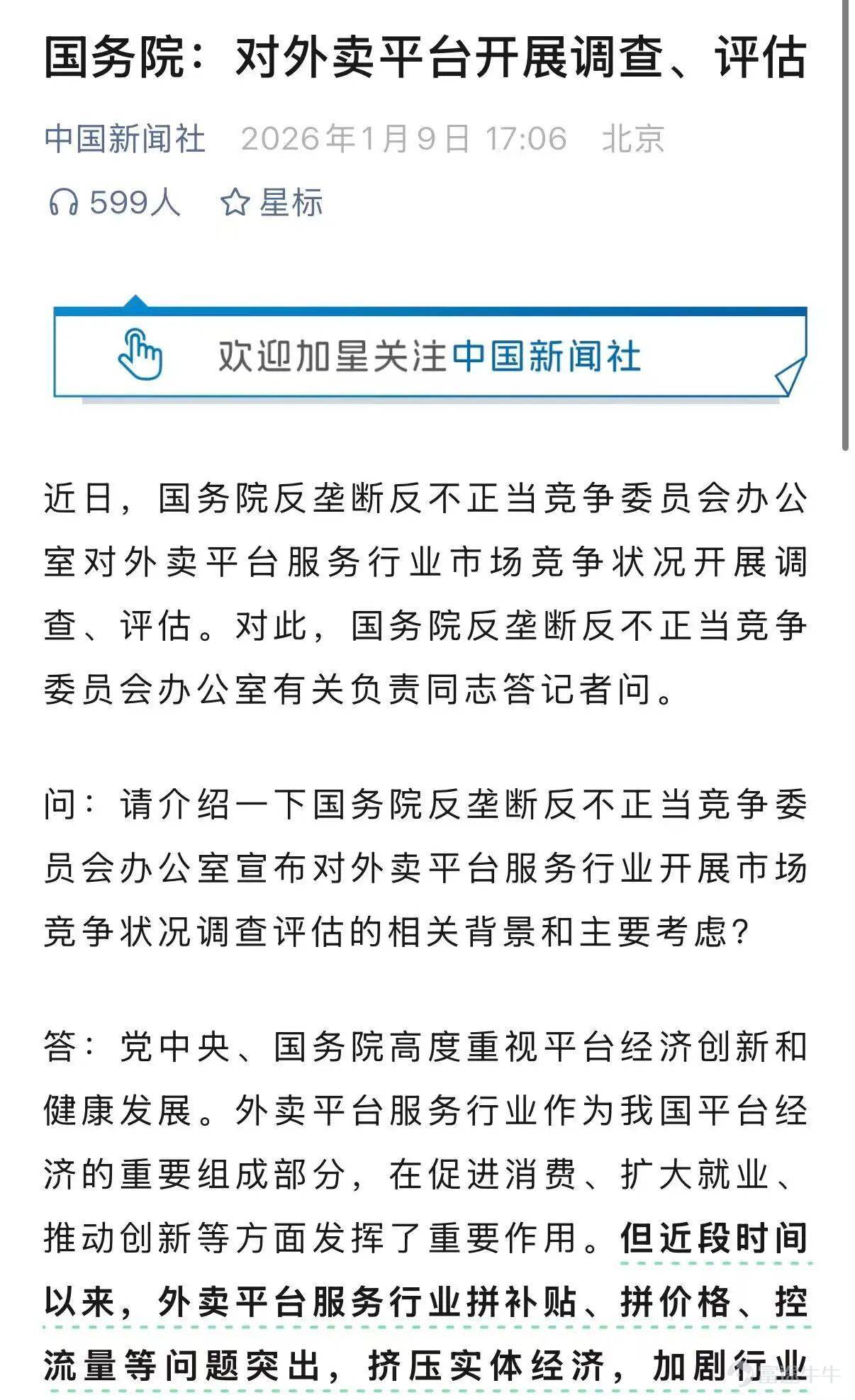

State media: The food delivery war should end! Is it time to add positions?
Just the other day, Alibaba's Q4 earnings preview came out, with a particular emphasis on firmly increasing investment in Taobao's flash sales to achieve absolute dominance in the market. The very next day, news broke that antitrust and anti-unfair competition regulators are going to investigate the food delivery industry.
How to put it? It’s a bit awkward.
After reviewing the Q&A with reporters, the focus is still on combating internal competition — identifying subsidy wars, price wars, and traffic control as key issues. The hope is for competition not to come at the expense of disrupting market order. The tone is quite serious, though it’s still in the investigation phase.
Meituan was the first to respond. In the short term, whether the intensity of competition in food delivery will ease doesn’t depend solely on what Meituan thinks. But just like in industries such as new energy, excessive competition is bound to be addressed. The emergence of such fierce battles indicates that this business is far from perfect, which serves as a reminder for Meituan: in this low-margin, tough industry, how to lead everyone out of the vicious cycle of over-competition may be the real moat.
In fact, Meituan woke up last year. For example, they allocated more subsidies and traffic to transparent kitchens, allowing merchants who open their kitchens to earn extra income.
Examples include paying delivery riders who don't run red lights and eliminating late penalties, which can all be seen as wake-up calls from the competition.
This year, will there be more changes that benefit merchants and riders, or will intense subsidy wars continue?
In reality, the unresolved issues in the food delivery industry go beyond just the number of orders. If one only looks at orders, they might overshadow everything else, making other problems invisible.
The direction encouraged by policy should be that when platforms resolve these other issues, they will naturally receive orders from users' voluntary choices, along with the appropriate market share.
The term 'involution' has been popular for a long time, evolving from an academic and outdated concept to a hot topic of discussion on the internet, and even appearing in national policy documents. It has become a malignant tumor that every industry is eager to avoid.
The most straightforward explanation is that effort and reward are not proportional. The harder you work, the more you stay in the same place, with no choice but to participate.
When delivery riders notice more and more peers joining while per-order prices keep dropping, restaurant order volumes surge, yet their earnings remain unchanged. Platforms endure losses, bleeding red ink in each financial report, while investors are approaching their limits of patience.
Though users are said to be the biggest beneficiaries, judging by reviews, there’s no widespread positive feedback about the food delivery war. Instead, people generally adopt a 'free-riding' mindset, taking advantage of cheap deals without fostering trust in the platforms.
If after a game of Mahjong, all four players feel they haven't won, then clearly something is wrong.
Coincidentally, yesterday, the State Administration also held a press conference unveiling the achievements of the 2025 comprehensive campaign against 'involution-style' competition. Item six specifically targeted food delivery: establishing general requirements for managing platform services to reduce disorderly competition.
Regardless, it's good news that this issue is finally being taken seriously. If the keel is bent, the ship can’t sail far; better to dock for repairs than sink at sea. This isn’t just an industry-specific problem—it concerns every participant in the micro-economy, their production and labor deserving dignity.


Risk Disclaimer: The above content only represents the author's view. It does not represent any position or investment advice of Futu. Futu makes no representation or warranty.Read more
Comments
to post a comment
1
