English
Back
Open Account
Share your most unforgettable trade in 2025 using three keywords!
Views 39.4M Contents 4058

2025 Hong Kong and US stock market review, driven by the AI boom and cyclical recovery? | Research report | In-depth analysis | Potential stocks | AI

The 2025 global financial market progresses amidst intertwined variables. Factors such as fluctuations in U.S. tariff policies, the explosive growth of the AI industry, adjustments in the Federal Reserve's monetary policy, and the divergent global economic recovery collectively shape the annual trends of the Hong Kong and U.S. stock markets. The two markets exhibit characteristics of 'overall divergence, partial resonance': the U.S. stock market achieves significant gains supported by the tech wave and liquidity easing, hitting new highs in market value; the Hong Kong stock market oscillates and recovers amid the tug-of-war between domestic and external demand, with structural opportunities concentrated in sectors like non-ferrous metals cycles, consumer goods, and technology. This article will comprehensively review the 2025 Hong Kong and U.S. stock markets from four dimensions: market performance, core drivers, key events, and future outlook.
2025 Hong Kong and U.S. stock market review: Resonance within divergence and structural opportunities
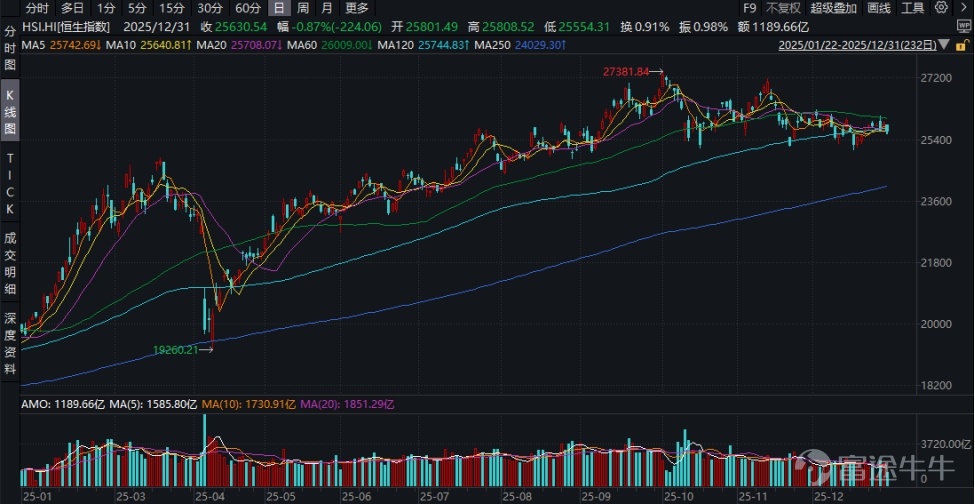
The global financial market in 2025 unfolds its annual dynamics amidst a complex mix of variables. Repeated adjustments to the U.S.'s 'reciprocal tariff' policy, explosive growth in the AI industry, multiple interest rate cuts by the Federal Reserve combined with technical balance sheet expansion measures, and the divergent recovery patterns between developed economies and emerging markets collectively dominate the year’s trends for Hong Kong and U.S. stocks. In the Hong Kong market, the year 2025 sees a volatile upward trend, marking the best annual performance in years. $Hang Seng Index (800000.HK)$The cumulative increase for the year reached 27.77%, hitting a new high since 2017. $Hang Seng TECH Index (800700.HK)$A rise of 23.45% was recorded, achieving the best historical performance since the index's inception. Policy support, the return of domestic and foreign capital, and structural opportunities have become core drivers. The technology giants, hard tech, gold stocks, and innovative drug sectors performed exceptionally well, while Hong Kong's IPO market also saw explosive growth, with total fundraising ranking at the top of global exchanges.
In the U.S. market, 2025 continues the strong momentum, with the three major indices achieving double-digit gains for the third consecutive year. $S&P 500 Index (.SPX.US)$An increase of approximately 16.4% for the year. $Nasdaq Composite Index (.IXIC.US)$A surge of 20.4%, $Dow Jones Industrial Average (.DJI.US)$Up 12.9%. Despite a short-term plunge in early April due to tariff threats, it quickly rebounded supported by Federal Reserve rate cuts, the AI boom, and resilient corporate earnings. Market liquidity remains abundant, with continuous inflows from retail funds and corporate buybacks; however, high valuations and the pressure to realize AI-driven profits also become potential risks at year-end.
Figure 1: Performance of the Hang Seng Index since the beginning of the year
Source: Wind
Source: Wind
Figure 2: Performance of the S&P 500 Index since the beginning of the year
Source: Wind
Source: Wind
U.S. Stock Market: A Tech Frenzy Intertwined with Policy Impacts, Market Caps Reach New Heights
The core logic behind the US stock market's rise in 2025 lies in the powerful resonance formed by the explosion of the artificial intelligence industry and the Federal Reserve’s accommodative monetary policy. In the AI sector, the construction of global AI infrastructure has entered a period of explosive growth, with computing power demand increasing exponentially, driving both earnings and valuations higher for companies across related supply chains. $NVIDIA (NVDA.US)$ NVIDIA, with its GPU and CUDA ecosystem, monopolizes 80%-90% of the AI chip market, emerging as the biggest winner. On October 29, its market capitalization surpassed the $5 trillion mark, making it the first company globally to achieve this milestone. NVIDIA's market value jumped from $4 trillion to $5 trillion in just 113 days, showcasing astonishing growth momentum. Notably, although NVIDIA's October quarterly earnings report exceeded expectations for both revenue and net profit, and projected $500 billion in revenue visibility for future Blackwell and Rubin chips, the AI sector still saw high openings followed by declines the next day, with related stocks falling collectively, reflecting market caution over an AI bubble. The AI boom further spread to the storage sector, kicking off a 'super storage cycle.' $SanDisk (SNDK.US)$ With a year-to-date increase of 376%, it became the top-performing stock in the S&P 500. $Micron Technology (MU.US)$ As the leader in storage, it delivered outstanding performance, with annual revenue reaching $37.378 billion and net profit at $8.539 billion. First-quarter revenue grew 56.7% year-over-year to $13.64 billion, while operating profit surged 168.1% year-over-year to $6.419 billion, with its stock price rising over 200% year-to-date. $Western Digital (WDC.US)$ $Seagate Technology (STX.US)$ Other major storage giants also saw their stock prices rise more than 200% year-to-date.
In terms of monetary policy, the Fed's rate-cutting cycle provided ample liquidity support for the market. Despite the initial market impact from tariff policies, easing inflationary pressures allowed the Fed to gradually embark on an accommodative cycle. Expectations for policy easing continued to strengthen, driving sustained capital inflows into the equity market. The accommodative environment not only supported the valuation expansion of tech stocks but also provided conditions for the repair of the U.S. economy. In Q3 2025, the U.S. real GDP annualized growth rate reached 4.3%, the fastest since Q3 2023, surpassing market expectations of 3.3% and higher than Q2’s 3.8%, further solidifying market confidence.
Figure 3: The Fed’s December Dot Plot
Data Source: FED
Data Source: FED
*Key Events: Developments in the Tariff Storm and AI Bubble Controversy
The core turning points and controversies in the US stock market in 2025 revolved around key events. In early April, U.S. President Trump signed an executive order announcing 'reciprocal tariffs' on all trading partners, triggering panic selling in the market and causing a 'Black 48 Hours' crash. The US stock market lost $6.6 trillion in value over two days. $S&P 500 Index (.SPX.US)$ The cumulative decline over two days reached 10.53%, $Russell 2000 Index (.RUT.US)$ and $Nasdaq Composite Index (.IXIC.US)$ Successively falling into a technical bear market, hitting the lowest point of the market for the year. Thereafter, as the Trump administration gradually rolled back aggressive tariff measures, market panic subsided, compounded by the ongoing fermentation of AI themes, US stocks embarked on a strong rebound. The S&P 500 index surged from its low of 4835.04 points on April 7 to reach a maximum increase of 43.65% by year-end, completing a deep recovery.
By year-end, the debate over an AI bubble became the market's focus. Michael Burry, the real-life inspiration for 'The Big Short,' re-emerged, pointing out that the current AI craze has evolved into an irrational frenzy, questioning issues such as the lifespan of NVIDIA chips and equity dilution, while targeting core AI stocks via put options. Behind this controversy lies market concern over high valuations: the Buffett Indicator (total stock market capitalization/GDP) has risen to 223%, far exceeding the reasonable range of 70%-80%, even surpassing the peak during the dot-com bubble in 2000, signaling potential market correction risks. On the industry level, doubts have been raised about OpenAI's solvency; its massive collaborations with cloud vendors and chip companies exceed current revenue, coupled with debt financing issues for partners like CoreWeave, further intensifying market vigilance toward the AI bubble. Meanwhile, Google’s release of the Gemini 3 model outperforms ChatGPT and is trained on proprietary TPUs, reducing reliance on NVIDIA chips, impacting sector sentiment. $Oracle (ORCL.US)$ The rollercoaster ride of Mixue Group’s market value also epitomizes the market's rational return. In September, its market value skyrocketed due to optimistic cloud service performance expectations, briefly making the founder the world's richest person. However, subsequent issues such as deteriorating free cash flow and high debt led to a stock price correction of over 40%, highlighting how the market began scrutinizing the profitability of AI narratives.
Hong Kong Stock Market: Structural Opportunities Amid Volatile Recovery, Non-Ferrous Metals Become the Main Theme
In 2025, Hong Kong's stock market exhibited the characteristic of ‘volatile bottoming-out and gradual recovery,’ with the core index fluctuation narrowing throughout the year, and structural opportunities becoming prominent. Closing data shows that Hong Kong's three major indices maintained an upward trend, recording annual gains for the second consecutive year. Specifically, $Hang Seng Index (800000.HK)$ It rose cumulatively by 27.77% for the entire year, $Hang Seng TECH Index (800700.HK)$ With an annual increase reaching 23.45%, $Hang Seng China Enterprises Index (800100.HK)$ Also achieving an annual gain of 22.27%. From trading data, liquidity in Hong Kong's stock market showed characteristics of ‘phased improvement,’ with some trading days at year-end breaking through HKD 200 billion in turnover, indicating increasing attention from investors to Hong Kong stocks, though overall liquidity remained weaker than in the US stock market.
*Core Driving Factors: Strengthening Commodities and Expectations of Domestic Demand Recovery
The structural trends in Hong Kong stocks in 2025 are driven by two main logics: first, the opportunity in cyclical sectors brought about by rising commodity prices; second, the left-side allocation opportunity in consumer sectors amid a weak recovery in domestic demand. In the commodities sector, the weakening credibility of the US dollar has driven significant price increases in precious metals like gold. Gold rose more than 50% for the year, while silver surged over 140%, hitting a five-year high. Industrial metals such as copper and aluminum accelerated upward in the second half of the year, forming a dual logic of 'monetary attribute revaluation + commodity attribute support.' Correspondingly, in the Hong Kong stock market, cyclical sub-sectors such as non-ferrous metals, gold stocks, and chemicals gained capital favor due to their cost-performance advantages, becoming one of the best-performing sectors of the year.
In the consumer sector, although November economic data showed that domestic demand remains weak and the recovery in real estate is uncertain, Southbound funds have continuously rotated between high and low valuations over the past three months, increasing positions in retail trade, consumer services, and other sectors, reflecting defensive portfolio adjustments. At present, the overall valuation of Hong Kong's consumer sector is at the 30th percentile of the past five years, making it attractive on a global scale, particularly with $POP MART (09992.HK)$ $LAOPU GOLD (06181.HK)$ $MIXUE GROUP (02097.HK)$ the 'new consumption trio,' represented by Mixue Group, showing particularly representative performance. The three saw significant stock price increases in the first half of the year but underwent deep adjustments in the second half. As of the December 31 close, they had fallen 45%, 43%, and 33.8%, respectively, from their highest points of the year. From a performance perspective, the fundamentals of these companies have not deteriorated. For example, Mixue Group’s revenue and net profit growth in the first half of the year reached 39.3% and 44.1%, respectively, while Laopu Gold’s adjusted net profit under non-IFRS standards grew 290.6% year-on-year in the first half. Current valuations have returned to reasonable levels. Additionally, the travel chain (hotels, airlines, online travel agencies) benefited from optimized supply-demand dynamics, and the auto sector, spurred by policies like L3 autonomous driving, presents left-side allocation value. The steady appreciation of the renminbi also boosts foreign capital confidence in allocating to Hong Kong stocks, providing extra support for market recovery.
*Market Characteristics: Internal and external factors in play, significant sector divergence
Throughout the year, Hong Kong stocks were significantly influenced by internal and external factors, leading to clear sector divergence. Externally, the style rotation in U.S. stocks (from tech to pro-cyclical sectors) had some spillover effects on Hong Kong stocks. However, the recovery pace of pro-cyclical sectors in Hong Kong lagged behind that of U.S. stocks, presenting catch-up potential. Internally, the pace of domestic demand recovery and adjustments in real estate policy continued to affect market sentiment, causing the consumer sector to exhibit a 'volatile bottoming-out' trend. The Hang Seng Tech Index, representing Hong Kong's tech companies, followed the global tech stock trend with oscillatory gains throughout the year. However, due to stable domestic regulatory policies and lower correlation with AI industry chains, its increase was lower than that of the Nasdaq Composite Index, highlighting the divergence between Hong Kong tech stocks and U.S. tech stocks.
Figure Four: Annual Sector Gains Statistics for Hong Kong Stocks
Source: Wind
Source: Wind
It is worth noting that risk factors in the Hong Kong stock market have not been completely eliminated. The divergence over whether the U.S. economy will 're-accelerate' or fall into 'stagflation' may impact global risk appetite, which could then spill over into Hong Kong stocks. Additionally, potential factors like geopolitical risks and expectations of tightening global liquidity could still lead to periodic volatility in the Hong Kong market.
*Summary and Outlook
Looking back at 2025, U.S. stocks achieved strong gains supported by the tech boom and accommodative policies, but the risk of a bubble caused by high valuations has raised market concerns. Meanwhile, Hong Kong stocks completed a volatile recovery amidst internal and external factor interactions, with structural opportunities emerging but overall liquidity still needing improvement. Looking ahead to 2026, both markets face new opportunities and challenges. In the first quarter, as the year kicks off, core issues will focus on the pace of policy implementation and the earnings verification window, potentially increasing market volatility.
For U.S. stocks, attention should be focused on the pace of the Federal Reserve's monetary policy implementation. According to the minutes of the Fed's December meeting, there are clear divisions within the Fed regarding the path of interest rate cuts in 2026. The market currently bets on two rate cuts within the year, with the January and March FOMC meetings serving as key guidance. Meanwhile, the AI industry chain will face its first earnings verification window in 2026. Broadcom and other leaders have already forecasted Q1 AI chip revenue to double year-on-year to $8.2 billion. If more AI companies deliver on earnings, this could ease market concerns about a bubble. Otherwise, it might trigger a short-term correction in the tech sector.
In the Hong Kong stock market, Spring Festival consumption data will be the core observation point for domestic demand recovery. Sectors such as travel chains and retail commerce may see short-term catalysts. The sustainability of commodity prices and the trend of the RMB exchange rate will influence the performance of cyclical sectors and foreign capital flows. Coupled with the previous slower recovery pace of Hong Kong's pro-cyclical sectors compared to U.S. stocks, there may be structural opportunities in Q1. In the medium to long term, the U.S. stock market needs to focus on the sustainability of AI profit realization, the pace of Fed policy adjustments, and whether sector rotation can continue. Meanwhile, Hong Kong stocks are expected to benefit from continued strength in commodity prices, accelerating domestic demand recovery, and foreign capital inflows. The catch-up potential of pro-cyclical sectors and valuation repair opportunities in consumer sectors are worth anticipating.
For investors, operations in the first quarter of 2026 need to focus on short-term key variables: the U.S. stock market must balance the growth dividends and valuation risks of technology stocks, closely tracking the Q1 earnings guidance and realization of AI industry chain leaders while paying attention to policy signals from the Fed meetings to avoid targets with high valuations and insufficient earnings support. In the Hong Kong stock market, one can seize the window period of Spring Festival consumption data, position in undervalued consumer leaders and travel chain targets, and pay attention to upward opportunities in growth sectors such as AI applications and commercial aviation. Positions should be flexibly adjusted based on domestic policies and RMB exchange rate fluctuations. In the medium to long term, it is still necessary to be wary of periodic impacts brought by global macro risks (such as divergence in U.S. economic recovery and geopolitical volatility), focusing on structural mainline opportunities in both markets.
Disclaimer: Any information or related content provided in this report regarding any investment or potential transactions is subject to the laws and regulatory requirements applicable in your jurisdiction, and you are solely responsible for ensuring compliance with such laws and regulations. The content of this report is for reference only and does not constitute any investment advice. The company has made every effort to ensure the accuracy of the financial information provided herein but assumes no responsibility or provides any form of guarantee for the accuracy, completeness, or effectiveness of all or part of the content. The company shall not be liable for any omissions or errors. Please note that securities and virtual asset prices can fluctuate, especially virtual assets, which carry extremely high risks. Investors should exercise caution regarding these products and assume investment risks independently.
———————————————————————
About the author:
Victory Securities—Hong Kong’s Leading Virtual Asset Broker
Victory Securities (08540.HK), with over 50 years of deep roots in Hong Kong, is a comprehensive full-service brokerage firm providing four main business services to individual investors, institutional investors, high-net-worth clients, and corporations: wealth management, asset management, virtual assets, and capital markets. The firm has garnered numerous awards and core business qualifications across the Asia-Pacific region. In 2023, Victory Securities became the first licensed brokerage in Hong Kong to hold licenses issued by the Securities and Futures Commission (SFC) for virtual asset trading, advisory, and asset management services. It was also approved by the SFC to offer retail investors access to compliant and legal Bitcoin and Ethereum trading, exchange, and deposit/withdrawal services on a one-stop basis.
Risk Disclaimer: The above content only represents the author's view. It does not represent any position or investment advice of Futu. Futu makes no representation or warranty. Read more
See Original
Report
368K Views
Comment
Sign in to view/post comments
avatar
胜利证券
The official account of VICTORY SEC
14K
Followers
2519
Visitors
Follow
Market Insights
HK Tech and Internet Stocks
View More
Nancy Pelosi Portfolio
Tariff game between the US and Europe shakes the market! Will TACO happen again?
Amidst the global market turbulence triggered by the US-Europe dispute over Greenland, a single post by Trump instantly reversed market tren Show More