English
Back
Open Account
[2026 Outlook] Plan Ahead! Share the Investment Opportunities You Are Optimistic About
Futubull Options Sir
joined discussion · ·

A Must-Read! 2026 Options Trading Calendar Guide: Besides Market Holidays, These Dates Will Determine Your Profits and Losses

The trading curtain for 2026 has risen, and the US stock options trading market will welcome several important expiration dates.
Options are entirely different from stocks. Stocks can be held long-term awaiting value recovery, whereas options are assets with time value decay. For American-style options, the final expiration date is the last day the option contract can be exercised. Therefore,The expiration date is a crucial factor affecting the value and volatility of options. The closer to the expiration date, the greater the potential fluctuations in the option.
Time is both a friend and an enemy to options traders. In the hands of seasoned players, the options expiration calendar serves as a 'mine-clearing map' for option buyers and a 'rent-collection timetable' for option sellers. Understanding the options calendar and pairing it with the right options strategy can help experts precisely control position timing while assisting newcomers in avoiding potential sharp volatility.
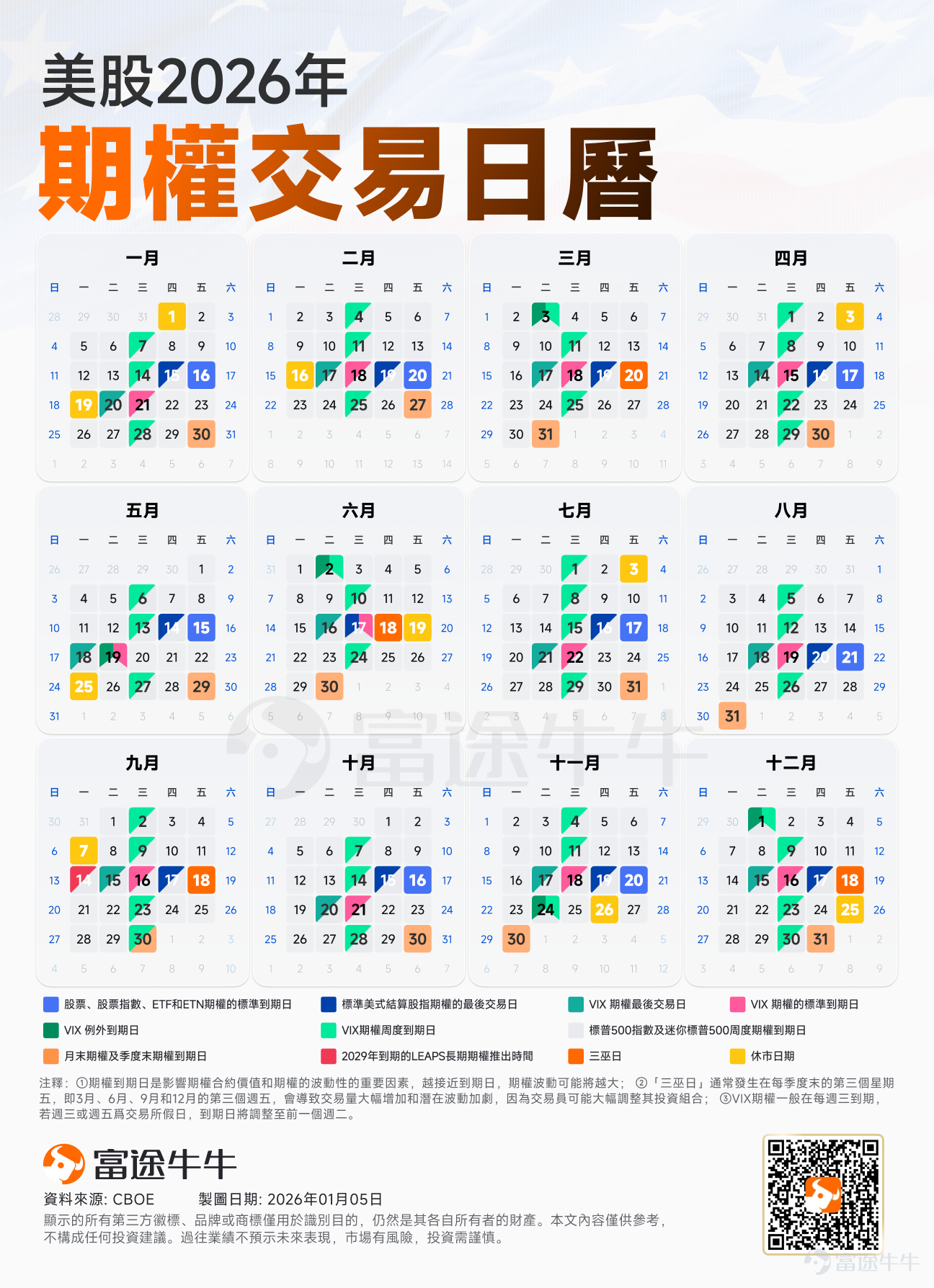
Below is the 2026 options calendar compiled by Futubull based on Cboe data, with different colors marking standard expiration dates, $CBOE Volatility S&P 500 Index (.VIX.US)$ options expiration dates, Triple Witching days, and US stock market holidays, provided for fellow investors' reference:
The trading curtain for 2026 has risen, and the US stock options trading market will welcome several important expiration dates. Options are entirely different from stocks. Stocks can be held long-term awaiting value recovery, whereas options are assets with time value decay. For American-style options, the final expiration date is the last day the option contract can be exercised. Therefore,The expiration date is a crucial factor affecting the value and volatility of options. The closer to the expiration date, the greater the potential fluctuations in the option. Time is both a friend and an enemy to options traders. In the hands of seasoned players, the options expiration calendar serves as a 'mine-clearing map' for option buyers and a 'rent-collection timetable' for option sellers. Understanding the options calendar and pairing it with the right options strategy can help experts precisely control position timing while assisting newcomers in avoiding potential sharp volatility. Below is the 2026 options calendar compiled by Futubull based on Cboe data, with different colors marking standard expiration dates, $CBOE Volatility S&P 500 Index (.VIX.US)$ options expiration dates, Triple Witching days, and US stock market holidays, provided for fellow investors' reference: Monthly Expiration Date: The Dojo of Gamma Risk The light blue squares on the calendar mark the monthly standard expiration dates for stocks, stock indices, ETFs, and ETNs (Standard Expiration), which form the most fundamental rhythm of the US options market, typically falling on the third Friday of each month. As the monthly expiration date approaches, the market will experience a...
Monthly Expiration Date: The Dojo of Gamma Risk
The light blue squares on the calendar mark the monthly standard expiration dates for stocks, stock indices, ETFs, and ETNs (Standard Expiration), which form the most fundamental rhythm of the US options market, typically falling on the third Friday of each month.
The trading curtain for 2026 has risen, and the US stock options trading market will welcome several important expiration dates. Options are entirely different from stocks. Stocks can be held long-term awaiting value recovery, whereas options are assets with time value decay. For American-style options, the final expiration date is the last day the option contract can be exercised. Therefore,The expiration date is a crucial factor affecting the value and volatility of options. The closer to the expiration date, the greater the potential fluctuations in the option. Time is both a friend and an enemy to options traders. In the hands of seasoned players, the options expiration calendar serves as a 'mine-clearing map' for option buyers and a 'rent-collection timetable' for option sellers. Understanding the options calendar and pairing it with the right options strategy can help experts precisely control position timing while assisting newcomers in avoiding potential sharp volatility. Below is the 2026 options calendar compiled by Futubull based on Cboe data, with different colors marking standard expiration dates, $CBOE Volatility S&P 500 Index (.VIX.US)$ options expiration dates, Triple Witching days, and US stock market holidays, provided for fellow investors' reference: Monthly Expiration Date: The Dojo of Gamma Risk The light blue squares on the calendar mark the monthly standard expiration dates for stocks, stock indices, ETFs, and ETNs (Standard Expiration), which form the most fundamental rhythm of the US options market, typically falling on the third Friday of each month. As the monthly expiration date approaches, the market will experience a...
As the monthly expiration date approaches, a phenomenon known as "Gamma risk explosion" occurs. The Gamma value of at-the-money (ATM) option contracts rises sharply during this period.This means that even a slight fluctuation in the underlying stock price can lead to significant volatility in the option price.
Option buyers need to be especially cautious, as what appears to be an opportunity for huge profits is actually a major trap. If the price of the underlying asset deviates from the strike price by just a few cents at the last minute before closing, an originally profitable option may instantly become worthless, or an originally out-of-the-money option could suddenly turn into an in-the-money one, leaving traders facing the financial pressure of passive exercise.
Institutional investors have rigid operational needs on this day. Large funds need to carry out massive close-out, exercise, or rollover operations on this Friday. This concentrated and enormous flow of funds can easily trigger mid-session plunges or violent rallies in the final hours, with the price movement of the underlying asset being driven by the open interest in the options market.
Novices should avoid holding end-of-day (0DTE) or short-term options that are about to expire worthless on the monthly expiration date, or simply stay out of the market to observe, to prevent 'zeroing risk' and margin call risks brought by passive exercise.
Triple Witching Day: The Quarterly Drama of Extreme Volatility
The 2026 calendar has four special orange nodes: March 20, June 18, September 18, and December 18. These days are called 'Triple Witching,' typically occurring on the third Friday of March, June, September, and December.The 'Triple Witching' day in June 2026 is not on a Friday,because June 19 (Friday) is the Juneteenth holiday when U.S. stocks are closed, so it is moved up one day to June 18 (Thursday).
The trading curtain for 2026 has risen, and the US stock options trading market will welcome several important expiration dates. Options are entirely different from stocks. Stocks can be held long-term awaiting value recovery, whereas options are assets with time value decay. For American-style options, the final expiration date is the last day the option contract can be exercised. Therefore,The expiration date is a crucial factor affecting the value and volatility of options. The closer to the expiration date, the greater the potential fluctuations in the option. Time is both a friend and an enemy to options traders. In the hands of seasoned players, the options expiration calendar serves as a 'mine-clearing map' for option buyers and a 'rent-collection timetable' for option sellers. Understanding the options calendar and pairing it with the right options strategy can help experts precisely control position timing while assisting newcomers in avoiding potential sharp volatility. Below is the 2026 options calendar compiled by Futubull based on Cboe data, with different colors marking standard expiration dates, $CBOE Volatility S&P 500 Index (.VIX.US)$ options expiration dates, Triple Witching days, and US stock market holidays, provided for fellow investors' reference: Monthly Expiration Date: The Dojo of Gamma Risk The light blue squares on the calendar mark the monthly standard expiration dates for stocks, stock indices, ETFs, and ETNs (Standard Expiration), which form the most fundamental rhythm of the US options market, typically falling on the third Friday of each month. As the monthly expiration date approaches, the market will experience a...
On Triple Witching Day, index futures, index options, and single-stock options all expire simultaneously, making it the day with the highest trading volume and most extreme volatility of the year.Trillions of dollars worth of derivatives contracts will be settled on this day, with bulls and bears engaging in fierce battles at specific price levels, trying to push the settlement price in their favor. Markets often see sudden trend reversals or sharp accelerations of existing trends on this day.
For volatility traders, 'Triple Witching Day' is a rare feast. The massive trading volume implies better liquidity and instant high premiums, but it’s also the riskiest time.
Traders who are accustomed to implementing wide strangle strategies aiming for 'two-way rent collection' need to stay highly vigilant a week before 'Triple Witching Day.' At this time, implied volatility (IV) often rises abnormally, but it’s not always an ideal moment to sell because the subsequent realized volatility could be large enough to break through the breakeven point.
The trading curtain for 2026 has risen, and the US stock options trading market will welcome several important expiration dates. Options are entirely different from stocks. Stocks can be held long-term awaiting value recovery, whereas options are assets with time value decay. For American-style options, the final expiration date is the last day the option contract can be exercised. Therefore,The expiration date is a crucial factor affecting the value and volatility of options. The closer to the expiration date, the greater the potential fluctuations in the option. Time is both a friend and an enemy to options traders. In the hands of seasoned players, the options expiration calendar serves as a 'mine-clearing map' for option buyers and a 'rent-collection timetable' for option sellers. Understanding the options calendar and pairing it with the right options strategy can help experts precisely control position timing while assisting newcomers in avoiding potential sharp volatility. Below is the 2026 options calendar compiled by Futubull based on Cboe data, with different colors marking standard expiration dates, $CBOE Volatility S&P 500 Index (.VIX.US)$ options expiration dates, Triple Witching days, and US stock market holidays, provided for fellow investors' reference: Monthly Expiration Date: The Dojo of Gamma Risk The light blue squares on the calendar mark the monthly standard expiration dates for stocks, stock indices, ETFs, and ETNs (Standard Expiration), which form the most fundamental rhythm of the US options market, typically falling on the third Friday of each month. As the monthly expiration date approaches, the market will experience a...
Looking back at the 'Triple Witching Day' on June 20, 2025, similar adjustments in timing once brought significant volatility. This special Thursday settlement day on June 18, 2026, will likely repeat history, requiring early preparation of risk management strategies.
Note: On June 20, 2025, the 'Triple Witching Day,' the intraday volatility of the S&P 500 Index was relatively high.
Holidays and Half Trading Days: The 'Harvesting' Time for Time Value
The yellow squares on the calendar represent market holidays, which are excellent 'time arbitrage' opportunities for option sellers.
The trading curtain for 2026 has risen, and the US stock options trading market will welcome several important expiration dates. Options are entirely different from stocks. Stocks can be held long-term awaiting value recovery, whereas options are assets with time value decay. For American-style options, the final expiration date is the last day the option contract can be exercised. Therefore,The expiration date is a crucial factor affecting the value and volatility of options. The closer to the expiration date, the greater the potential fluctuations in the option. Time is both a friend and an enemy to options traders. In the hands of seasoned players, the options expiration calendar serves as a 'mine-clearing map' for option buyers and a 'rent-collection timetable' for option sellers. Understanding the options calendar and pairing it with the right options strategy can help experts precisely control position timing while assisting newcomers in avoiding potential sharp volatility. Below is the 2026 options calendar compiled by Futubull based on Cboe data, with different colors marking standard expiration dates, $CBOE Volatility S&P 500 Index (.VIX.US)$ options expiration dates, Triple Witching days, and US stock market holidays, provided for fellow investors' reference: Monthly Expiration Date: The Dojo of Gamma Risk The light blue squares on the calendar mark the monthly standard expiration dates for stocks, stock indices, ETFs, and ETNs (Standard Expiration), which form the most fundamental rhythm of the US options market, typically falling on the third Friday of each month. As the monthly expiration date approaches, the market will experience a...
Theta (time decay) in the option pricing formula refers to physical time, not trading time. This means that even though the stock market is closed on weekends and holidays, the time value of options continues to decay as usual.When the market is closed, yet option prices continue to decline – this is the natural advantage of option sellers.
In practice, many seasoned traders leverage this for 'Holiday Theta Arbitrage': On the last trading day before a long holiday, they establish a calendar spread strategy or sell short-term options. Throughout the holiday period, the options contracts they sold continue to depreciate, and when the market reopens after the holiday, they can often directly harvest the Theta gains accumulated during those days.
It’s important to note that this strategy is not without risks. Although markets are closed during holidays, unexpected macroeconomic news or geopolitical events may ferment over the break, leading to significant price gaps when trading resumes. Price gaps are the nemesis of option sellers, potentially causing short-term options to be instantly blown up upon opening, resulting in losses.
Therefore, it is appropriate to use options reasonably as a hedging tool or to control position size. Despite the 'time arbitrage' opportunities, one should not take on the risk of liquidation just to earn a few days' worth of Theta, which would be like picking up sesame seeds but losing watermelons.
Advanced Strategy: The Artful Application of Calendar Spreads
By understanding the structure of a calendar spread, we can apply a strategy closely related to it — the Calendar Spread.
The core logic of a calendar spread is very straightforward: profit from the difference in time value decay rates of options with different expiration dates. The time value decay of options is non-linear; the closer to expiration, the faster the decay (higher absolute Theta); for longer-term options, the decay rate is slower.
The specific construction of a calendar spread involves selling a near-term option (capitalizing on its rapid decay) while simultaneously buying an option with the same strike price but a longer expiration (utilizing its preservation characteristics).
As long as the underlying asset price oscillates around the strike price, the near-term option will quickly approach zero, turning into pure profit; whereas the longer-term option, due to its extended duration, suffers minimal value loss and may even appreciate due to a rise in implied volatility.
Note: The demonstration of building a calendar strategy using Tesla options is for investment education purposes only and does not constitute any investment advice.
In 2026 trading, combining this strategy with a calendar offers two excellent scenarios:
The first is during earnings season. When you see on the calendar that a stock is about to release earnings, the implied volatility (IV) of near-term options is often pushed artificially high by the market. At this point, sell the near-term option and buy a longer-term option expiring after the earnings announcement. After the earnings are released, the IV of the near-term option will instantly 'collapse' (IV Crush), causing a sharp price drop, resulting in a big win for the seller; whereas the longer-term option is less affected, serving as a hedge.
The second scenario is major macro events, such as the Fed FOMC meeting dates marked on the calendar. On the eve of the meeting, market risk aversion rises, causing IV to soar and making option prices excessively expensive. By constructing a calendar spread, one can profit from shorting near-term volatility while locking in downside risk with longer-term contracts. This is a high-probability and risk-controlled 'rent collection' strategy, especially suitable for use in volatile markets or event-driven conditions.
Conclusion
Trading is not just about watching the price movements on the candlestick chart; it’s also about learning to find certainty within the squares of a calendar. For options trading, it's crucial to complete your setup before volatility strikes, leveraging the time structure advantage offered by the calendar to let probability work in your favor.
Whether avoiding the massive turbulence of Triple Witching Day or capitalizing on time decay over holidays, or even building calendar spreads to arbitrage from volatility differences, the core lies in a profound understanding of the element of 'time'.
Wishing all fellow investors a fruitful 2026, where you not only understand price movements but also master the art of reading time, steadily navigating the chessboard of options trading, and enjoying your investment journey.
Finally, Options Sir brings a small perk for fellow investors. Welcome to claim it!Beginner's Options Package
This event is exclusive to invited HK users. Click to learn more.Detailed rules of the event >>
Market conditions are complex and volatile,Options strategyOverwhelmed by choices? Futubull helps you build a portfolio in three steps.Options strategy, making investment simple and efficient!
The trading curtain for 2026 has risen, and the US stock options trading market will welcome several important expiration dates. Options are entirely different from stocks. Stocks can be held long-term awaiting value recovery, whereas options are assets with time value decay. For American-style options, the final expiration date is the last day the option contract can be exercised. Therefore,The expiration date is a crucial factor affecting the value and volatility of options. The closer to the expiration date, the greater the potential fluctuations in the option. Time is both a friend and an enemy to options traders. In the hands of seasoned players, the options expiration calendar serves as a 'mine-clearing map' for option buyers and a 'rent-collection timetable' for option sellers. Understanding the options calendar and pairing it with the right options strategy can help experts precisely control position timing while assisting newcomers in avoiding potential sharp volatility. Below is the 2026 options calendar compiled by Futubull based on Cboe data, with different colors marking standard expiration dates, $CBOE Volatility S&P 500 Index (.VIX.US)$ options expiration dates, Triple Witching days, and US stock market holidays, provided for fellow investors' reference: Monthly Expiration Date: The Dojo of Gamma Risk The light blue squares on the calendar mark the monthly standard expiration dates for stocks, stock indices, ETFs, and ETNs (Standard Expiration), which form the most fundamental rhythm of the US options market, typically falling on the third Friday of each month. As the monthly expiration date approaches, the market will experience a...
Risk Warning
An option is a contract that grants the holder the right, but not the obligation, to buy or sell an asset at a fixed price on a specific date or at any time before that date. The price of an option is influenced by various factors, including the current price of the underlying asset, the strike price, the time to expiration, andimplied volatility
implied volatilityreflects the market's expectation of volatility in the option over a future period. It is data derived inversely from the Black-Scholes option pricing model and is generally considered an indicator of market sentiment. When investors anticipate higher volatility, they may be more willing to pay a higher price for options to help hedge risks, thereby leading to a higherimplied volatility
Traders and investors useimplied volatilityto evaluateoption pricesthe attractiveness, identify potential mispricing, and manage risk exposure.
Disclaimer
This content does not constitute any offer, solicitation, recommendation, opinion, or guarantee regarding securities, financial products, or tools. The risk of loss in trading options can be substantial. In certain circumstances, the losses you incur may exceed the initial margin amount deposited. Even if you set contingent orders, such as “stop-loss” or “limit” orders, they may not prevent losses. Market conditions may render such orders unexecutable. You may be required to deposit additional margin within a short period. If you fail to provide the required amount within the specified time, your open positions may be liquidated. However, you will remain responsible for any shortfall in your account resulting from such liquidation. Therefore, before engaging in trading, you should study and understand options and carefully consider whether such trading is suitable for you based on your financial situation and investment objectives. If you trade options, you should familiarize yourself with the procedures upon option exercise and expiration, as well as your rights and obligations upon option exercise and expiration.
Risk Disclaimer: The above content only represents the author's view. It does not represent any position or investment advice of Futu. Futu makes no representation or warranty.Read more
Thumbs Up
205
Heart
14
Sob
1
Respect
1
Emm
1
227K Views
Report
Comments (14)
Write a Comment...
14
222
389