
English
Back
Open Account
跟聰明錢學投資!分享你的心水潛力股
牛牛名人追蹤
joined discussion · ·

Tracking Cathie Wood: Is a 9% plunge a buying opportunity? Cathie Wood increases her stake in Robinhood against the market trend, with Goldman Sachs elaborating on the underlying logic.

On Thursday Eastern Time, the three major U.S. stock indices closed mixed, with both the S&P 500 and the Dow Jones Industrial Average reaching new all-time closing highs. Due to Oracle's earnings report raising investor concerns about the outlook for artificial intelligence (AI) investments, the tech-heavy Nasdaq underperformed.
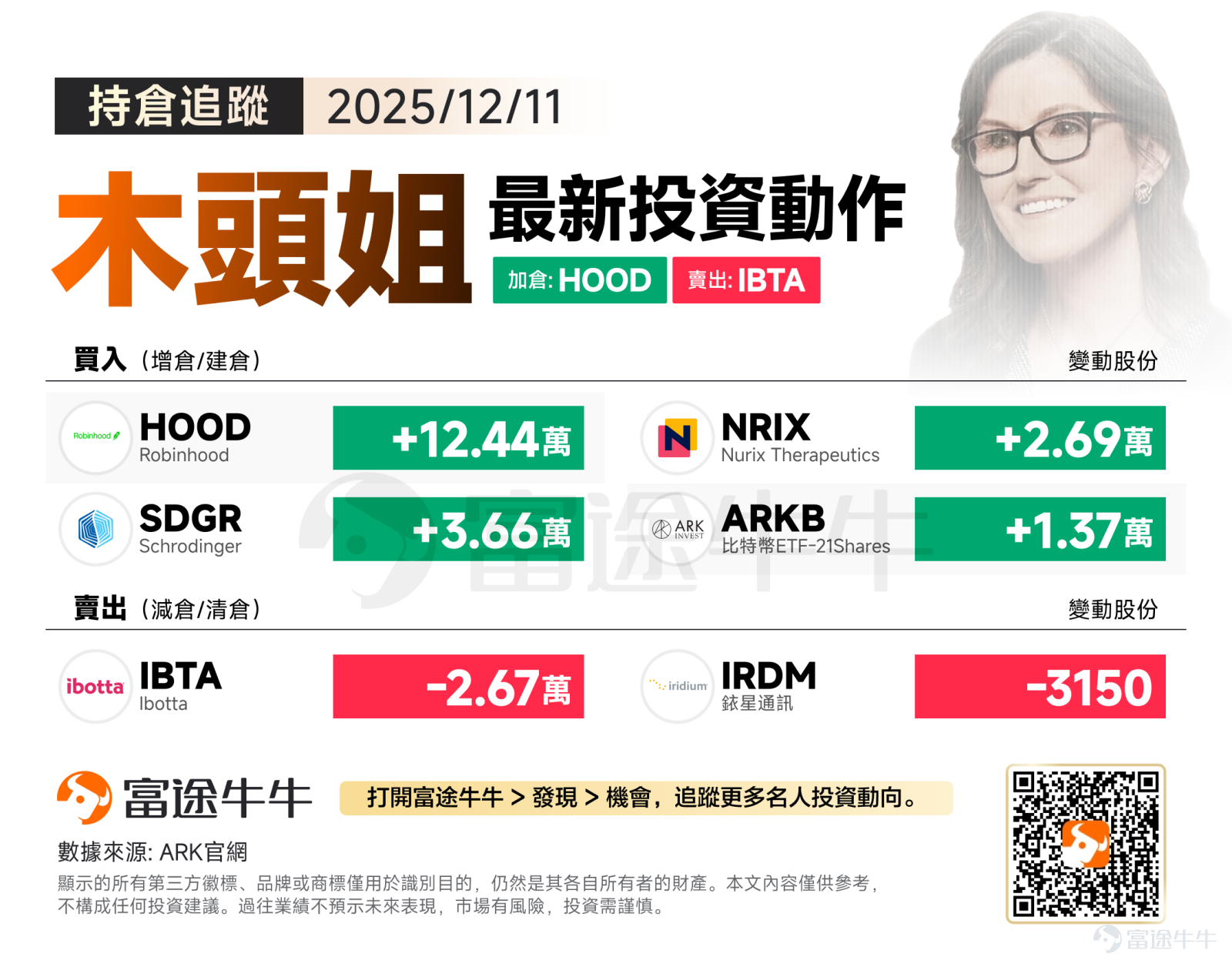
Market capital is rotating from high-valuation tech stocks to cyclical stocks.However, Cathie Wood has not followed this trend to adjust her investment style. Instead, she continues to increase her stakes in the two core sectors of crypto finance and AI-driven drug development.She further reduced holdings in satellite communications and financial technology, making her portfolio more concentrated and positioning herself as a steadfast 'long-term flag-bearer' of disruptive innovation.
On Thursday Eastern Time, the three major U.S. stock indices closed mixed, with both the S&P 500 and the Dow Jones Industrial Average reaching new all-time closing highs. Due to Oracle's earnings report raising investor concerns about the outlook for artificial intelligence (AI) investments, the tech-heavy Nasdaq underperformed. Market capital is rotating from high-valuation tech stocks to cyclical stocks.However, Cathie Wood has not followed this trend to adjust her investment style. Instead, she continues to increase her stakes in the two core sectors of crypto finance and AI-driven drug development.She further reduced holdings in satellite communications and financial technology, making her portfolio more concentrated and positioning herself as a steadfast 'long-term flag-bearer' of disruptive innovation. Among these moves, the most noteworthy trade overnight was Cathie Wood’s substantial purchase of $Robinhood (HOOD.US)$ , and this article will also focus on analyzing for fellow investors why Robinhood plummeted overnight and why Cathie Wood chose to buy the dip. Why did Robinhood plummet overnight? Overnight, Robinhood plunged over 9%. The main reason, in terms of news, was the release of its November operational data.The trading volumes of stocks, options, and cryptocurrencies all decreased on a month-over-month basis. Specifically: StockThe transaction volume amounted to USD 201.5 billion, representing a 37% decrease quarter-over-quarter and a 37% increase year-over-year. OptionsThe trading volume reached 193 million units, marking a 28% decline quarter-over-quarter and a 24% increase year-over-year. CryptocurrencyThe transaction volume amounted to USD 28.6 billion,...
Among these moves, the most noteworthy trade overnight was Cathie Wood’s substantial purchase of $Robinhood (HOOD.US)$ , and this article will also focus on analyzing for fellow investors why Robinhood plummeted overnight and why Cathie Wood chose to buy the dip.
Why did Robinhood plummet overnight?
Overnight, Robinhood plunged over 9%. The main reason, in terms of news, was the release of its November operational data.The trading volumes of stocks, options, and cryptocurrencies all decreased on a month-over-month basis.
On Thursday Eastern Time, the three major U.S. stock indices closed mixed, with both the S&P 500 and the Dow Jones Industrial Average reaching new all-time closing highs. Due to Oracle's earnings report raising investor concerns about the outlook for artificial intelligence (AI) investments, the tech-heavy Nasdaq underperformed. Market capital is rotating from high-valuation tech stocks to cyclical stocks.However, Cathie Wood has not followed this trend to adjust her investment style. Instead, she continues to increase her stakes in the two core sectors of crypto finance and AI-driven drug development.She further reduced holdings in satellite communications and financial technology, making her portfolio more concentrated and positioning herself as a steadfast 'long-term flag-bearer' of disruptive innovation. Among these moves, the most noteworthy trade overnight was Cathie Wood’s substantial purchase of $Robinhood (HOOD.US)$ , and this article will also focus on analyzing for fellow investors why Robinhood plummeted overnight and why Cathie Wood chose to buy the dip. Why did Robinhood plummet overnight? Overnight, Robinhood plunged over 9%. The main reason, in terms of news, was the release of its November operational data.The trading volumes of stocks, options, and cryptocurrencies all decreased on a month-over-month basis. Specifically: StockThe transaction volume amounted to USD 201.5 billion, representing a 37% decrease quarter-over-quarter and a 37% increase year-over-year. OptionsThe trading volume reached 193 million units, marking a 28% decline quarter-over-quarter and a 24% increase year-over-year. CryptocurrencyThe transaction volume amounted to USD 28.6 billion,...
Specifically:
StockThe transaction volume amounted to USD 201.5 billion, representing a 37% decrease quarter-over-quarter and a 37% increase year-over-year.
OptionsThe trading volume reached 193 million units, marking a 28% decline quarter-over-quarter and a 24% increase year-over-year.
CryptocurrencyThe transaction volume amounted to USD 28.6 billion, reflecting a 12% decrease quarter-over-quarter and a 19% decline year-over-year. Notably, the nominal transaction volume on the Robinhood App was USD 12 billion (a 14% decrease compared to October and a 66% drop year-over-year), while Bitstamp's transaction volume stood at USD 16.6 billion (an 11% decline compared to October).
Event contractsThe trading volume reached 3 billion units, showing a 20% increase quarter-over-quarter.
On Thursday Eastern Time, the three major U.S. stock indices closed mixed, with both the S&P 500 and the Dow Jones Industrial Average reaching new all-time closing highs. Due to Oracle's earnings report raising investor concerns about the outlook for artificial intelligence (AI) investments, the tech-heavy Nasdaq underperformed. Market capital is rotating from high-valuation tech stocks to cyclical stocks.However, Cathie Wood has not followed this trend to adjust her investment style. Instead, she continues to increase her stakes in the two core sectors of crypto finance and AI-driven drug development.She further reduced holdings in satellite communications and financial technology, making her portfolio more concentrated and positioning herself as a steadfast 'long-term flag-bearer' of disruptive innovation. Among these moves, the most noteworthy trade overnight was Cathie Wood’s substantial purchase of $Robinhood (HOOD.US)$ , and this article will also focus on analyzing for fellow investors why Robinhood plummeted overnight and why Cathie Wood chose to buy the dip. Why did Robinhood plummet overnight? Overnight, Robinhood plunged over 9%. The main reason, in terms of news, was the release of its November operational data.The trading volumes of stocks, options, and cryptocurrencies all decreased on a month-over-month basis. Specifically: StockThe transaction volume amounted to USD 201.5 billion, representing a 37% decrease quarter-over-quarter and a 37% increase year-over-year. OptionsThe trading volume reached 193 million units, marking a 28% decline quarter-over-quarter and a 24% increase year-over-year. CryptocurrencyThe transaction volume amounted to USD 28.6 billion,...
Changes in user accounts:The number of funded accounts decreased by 130,000, primarily due to the cleanup of approximately 280,000 low-balance accounts. Excluding this factor,the actual number of new funded customers grew by 150,000.
On Thursday Eastern Time, the three major U.S. stock indices closed mixed, with both the S&P 500 and the Dow Jones Industrial Average reaching new all-time closing highs. Due to Oracle's earnings report raising investor concerns about the outlook for artificial intelligence (AI) investments, the tech-heavy Nasdaq underperformed. Market capital is rotating from high-valuation tech stocks to cyclical stocks.However, Cathie Wood has not followed this trend to adjust her investment style. Instead, she continues to increase her stakes in the two core sectors of crypto finance and AI-driven drug development.She further reduced holdings in satellite communications and financial technology, making her portfolio more concentrated and positioning herself as a steadfast 'long-term flag-bearer' of disruptive innovation. Among these moves, the most noteworthy trade overnight was Cathie Wood’s substantial purchase of $Robinhood (HOOD.US)$ , and this article will also focus on analyzing for fellow investors why Robinhood plummeted overnight and why Cathie Wood chose to buy the dip. Why did Robinhood plummet overnight? Overnight, Robinhood plunged over 9%. The main reason, in terms of news, was the release of its November operational data.The trading volumes of stocks, options, and cryptocurrencies all decreased on a month-over-month basis. Specifically: StockThe transaction volume amounted to USD 201.5 billion, representing a 37% decrease quarter-over-quarter and a 37% increase year-over-year. OptionsThe trading volume reached 193 million units, marking a 28% decline quarter-over-quarter and a 24% increase year-over-year. CryptocurrencyThe transaction volume amounted to USD 28.6 billion,...
What are the key details in this monthly report worth noting?
Based on this month’s data, Goldman Sachs also analyzed that:
In November, Robinhood's core trading categories exhibited notable characteristics of 'sequential cooling but strong year-over-year performance.' Specifically,stocks and optionstrading volumes both declined sequentially. This cooling in activity is also reflected in the daily average revenue trades (DARTs), with DARTs for stocks and options falling by 13% and 7%, respectively, compared to the previous month. However,from the perspective of monetization efficiency, the options business has shown positive signs.The fee per contract increased year over year from $0.50 to $0.54, partially offsetting the impact of the decline in monthly trading volume.
In terms of cryptocurrency operations, there are also indications of short-term pressure.However, more noteworthy is thatits monetization efficiency has declined.The blended trading fee rate dropped significantly from 0.53% a year ago to 0.32%, indicating that revenue generated per trade is facing contractionary pressure.
However, while traditional trading categories faced short-term pressure, prediction markets (event contracts) stood out as a clear growth highlight within the business. Trading volume surged by 20% month-over-month in November, reaching 30 billion contracts.
On Thursday Eastern Time, the three major U.S. stock indices closed mixed, with both the S&P 500 and the Dow Jones Industrial Average reaching new all-time closing highs. Due to Oracle's earnings report raising investor concerns about the outlook for artificial intelligence (AI) investments, the tech-heavy Nasdaq underperformed. Market capital is rotating from high-valuation tech stocks to cyclical stocks.However, Cathie Wood has not followed this trend to adjust her investment style. Instead, she continues to increase her stakes in the two core sectors of crypto finance and AI-driven drug development.She further reduced holdings in satellite communications and financial technology, making her portfolio more concentrated and positioning herself as a steadfast 'long-term flag-bearer' of disruptive innovation. Among these moves, the most noteworthy trade overnight was Cathie Wood’s substantial purchase of $Robinhood (HOOD.US)$ , and this article will also focus on analyzing for fellow investors why Robinhood plummeted overnight and why Cathie Wood chose to buy the dip. Why did Robinhood plummet overnight? Overnight, Robinhood plunged over 9%. The main reason, in terms of news, was the release of its November operational data.The trading volumes of stocks, options, and cryptocurrencies all decreased on a month-over-month basis. Specifically: StockThe transaction volume amounted to USD 201.5 billion, representing a 37% decrease quarter-over-quarter and a 37% increase year-over-year. OptionsThe trading volume reached 193 million units, marking a 28% decline quarter-over-quarter and a 24% increase year-over-year. CryptocurrencyThe transaction volume amounted to USD 28.6 billion,...
Additionally, the company's margin balance is noteworthy. This metric reached $16.8 billion at the end of the reporting period, up 2% month-over-month and a significant 147% year-over-year increase.This robust year-over-year growth not only directly contributed to substantial net interest income but also vividly demonstrated the increasing depth of active trader participation and heightened trading intent on the platform.
In addition,Goldman Sachs also released key highlights from its discussions with Robinhood management earlier this month.Overall, management emphasizedprediction markets and business diversificationare enhancing the company’s resilience and are expected to mitigate historical seasonal fluctuations. Specific details are as follows:
1. Core growth engine: Prediction markets
Management views prediction markets as central to their long-term strategic vision, aiming to build a comprehensive financial "super app."
2. Cryptocurrency and tokenization
The company aims to capture market share through more flexible pricing strategies and new product offerings.
Pricing Strategy: Adopt tiered pricing for high-frequency traders.While this may reduce the blended monetization rate, a significant increase in trading volume is expected to offset the impact.
Tokenization Progress:
Europe: Tokenized stocks have been launched to address local trading frictions.
United States: Focused on tokenizing private equity, enabling individual investors to access high-growth private companies. However, comprehensive implementation requires regulatory reform.
Bitstamp: Continues to invest in enhancing liquidity and institutional business capabilities.
3. Long-Term Strategy and Technology
AI: The company positions itself as an AI-native enterprise, utilizing AI for software development (where the majority of code is written by AI), operational automation, and client-facing products.
Precision marketing: Leveraging machine learning for highly personalized marketing (as opposed to broad-based marketing), which offers a better return on investment compared to traditional marketing methods.
Robinhood Social: Plans to establish a verified financial social network, potentially integrated with prediction markets, enabling users to interact while discussing financial topics.
Institutional Business Objective: The long-term goal is to achieve a 50% share of institutional business, with the acquisition of TradePMR being the first step into the investment advisory market.
4. Capital Allocation and Internationalization
International Expansion: Adoption rates in the UK market have exceeded expectations. The goal is to eventually offer all products (brokerage, cryptocurrency, tokenized stocks) in the US, Europe, and Asia.
Three Pillars of Capital Allocation: 1) Active Traders (generating cash flow), 2) Wallet Share, 3) Global Financial Ecosystem.
Based on the latest data,The Goldman Sachs analyst team has refined its financial forecast model for Robinhood, with an overall outlook trending towards optimism.
Upward revision of financial forecasts
Revenue forecast:Expected revenues for 2026 and 2027 have been revised upward by 2% and 1%, respectively.
Earnings per share (EPS) forecast:Forecasted earnings per share for the same period have been increased by 4% and 3%, respectively.
Goldman Sachs noted that this upward revision is primarily driven by robust growth in the predictive markets business, with its positive contributions offsetting pressures from a short-term decline in volumes of traditional trading activities.
Adjustment to valuation methodology
At the valuation level, Goldman Sachs has implemented technical updates to reflect changes in the overall market environment. Price-to-earnings (P/E) ratio: The expected P/E multiple for the fifth to eighth quarters ahead has been reduced from 62x to 60x, primarily based on a downward adjustment in the market's valuation benchmark.
Target share price remains unchanged
Despite adjustments to revenue, earnings forecasts, and valuation multiples, the various revisions have offset each other. Consequently, Goldman Sachs has decided to maintain its 12-month target share price at $167.
On Thursday Eastern Time, the three major U.S. stock indices closed mixed, with both the S&P 500 and the Dow Jones Industrial Average reaching new all-time closing highs. Due to Oracle's earnings report raising investor concerns about the outlook for artificial intelligence (AI) investments, the tech-heavy Nasdaq underperformed. Market capital is rotating from high-valuation tech stocks to cyclical stocks.However, Cathie Wood has not followed this trend to adjust her investment style. Instead, she continues to increase her stakes in the two core sectors of crypto finance and AI-driven drug development.She further reduced holdings in satellite communications and financial technology, making her portfolio more concentrated and positioning herself as a steadfast 'long-term flag-bearer' of disruptive innovation. Among these moves, the most noteworthy trade overnight was Cathie Wood’s substantial purchase of $Robinhood (HOOD.US)$ , and this article will also focus on analyzing for fellow investors why Robinhood plummeted overnight and why Cathie Wood chose to buy the dip. Why did Robinhood plummet overnight? Overnight, Robinhood plunged over 9%. The main reason, in terms of news, was the release of its November operational data.The trading volumes of stocks, options, and cryptocurrencies all decreased on a month-over-month basis. Specifically: StockThe transaction volume amounted to USD 201.5 billion, representing a 37% decrease quarter-over-quarter and a 37% increase year-over-year. OptionsThe trading volume reached 193 million units, marking a 28% decline quarter-over-quarter and a 24% increase year-over-year. CryptocurrencyThe transaction volume amounted to USD 28.6 billion,...
Despite short-term trading volume fluctuations and clear risks, Robinhood's platform continues to exhibit strong growth momentum and sustained innovation. In the long term, the company demonstrates significant investment value, warranting that investors look beyond near-term uncertainties and focus on its long-term development potential.This may also explain why 'Wood' firmly increased her position overnight.
Futubull's [Opportunities Page] has launched tracking for celebrity portfolio opportunities! Choose from multiple celebrity portfolios, follow the masters' strategies with one click, precisely lock onto high-quality targets, and invest with greater confidence!
On Thursday Eastern Time, the three major U.S. stock indices closed mixed, with both the S&P 500 and the Dow Jones Industrial Average reaching new all-time closing highs. Due to Oracle's earnings report raising investor concerns about the outlook for artificial intelligence (AI) investments, the tech-heavy Nasdaq underperformed. Market capital is rotating from high-valuation tech stocks to cyclical stocks.However, Cathie Wood has not followed this trend to adjust her investment style. Instead, she continues to increase her stakes in the two core sectors of crypto finance and AI-driven drug development.She further reduced holdings in satellite communications and financial technology, making her portfolio more concentrated and positioning herself as a steadfast 'long-term flag-bearer' of disruptive innovation. Among these moves, the most noteworthy trade overnight was Cathie Wood’s substantial purchase of $Robinhood (HOOD.US)$ , and this article will also focus on analyzing for fellow investors why Robinhood plummeted overnight and why Cathie Wood chose to buy the dip. Why did Robinhood plummet overnight? Overnight, Robinhood plunged over 9%. The main reason, in terms of news, was the release of its November operational data.The trading volumes of stocks, options, and cryptocurrencies all decreased on a month-over-month basis. Specifically: StockThe transaction volume amounted to USD 201.5 billion, representing a 37% decrease quarter-over-quarter and a 37% increase year-over-year. OptionsThe trading volume reached 193 million units, marking a 28% decline quarter-over-quarter and a 24% increase year-over-year. CryptocurrencyThe transaction volume amounted to USD 28.6 billion,...
Risk Disclaimer: The above content only represents the author's view. It does not represent any position or investment advice of Futu. Futu makes no representation or warranty.Read more
Thumbs Up
53
Emm
2
Heart
2
166K Views
Report
Comments (4)
Write a Comment...
4
57
60