

Focus on the Super Macro Week! Japan raises interest rates by 25 basis points

The prospect of a Fed rate cut in December heated up overnight! With hawks and doves pulling in opposite directions, who will dominate market direction?
Divergences within the Federal Reserve have intensified ahead of the December policy meeting, amid silence from Chair Powell,with notable divisions emerging among voting committee members.
Last Friday, after John Williams, the “third-ranking official” at the Fed and president of the New York Federal Reserve, hinted that the Fed might cut rates again in December, U.S. stocks rebounded, with all three major indices closing higher.

According to the CME FedWatch Tool, following Williams’ speech on Friday, traders in the interest rate futures market sharply increased their expectations for a Federal Reserve rate cut in December to about 70%, nearly doubling from less than 40% previously.
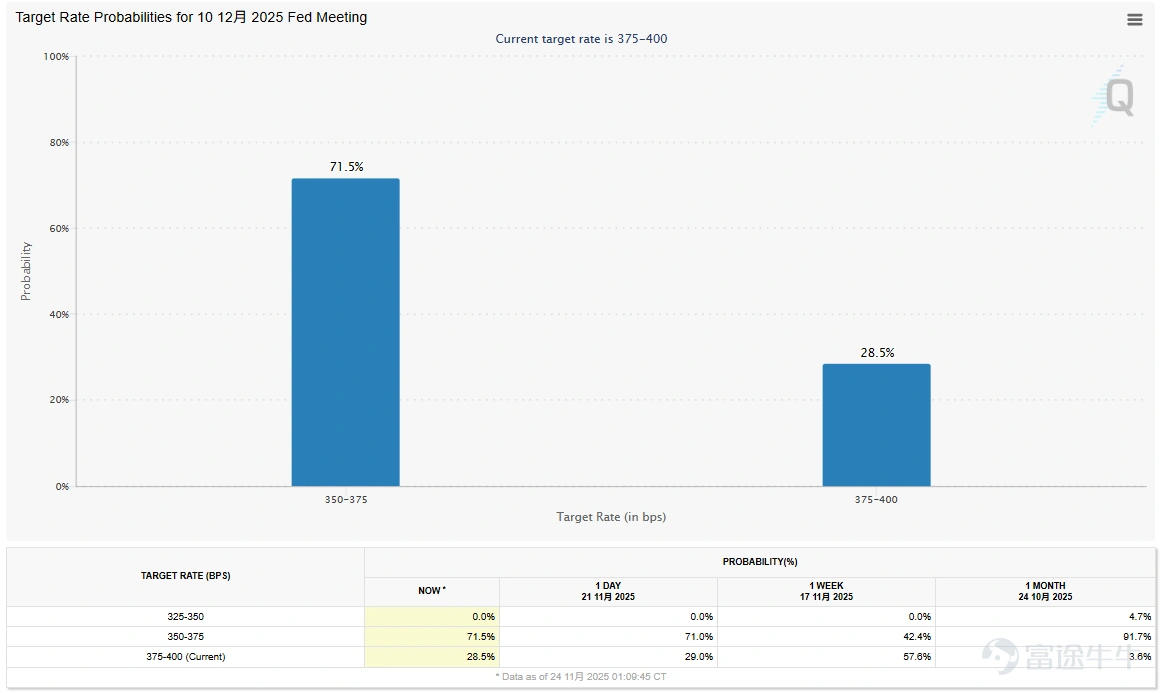
In fact, communication from the Federal Reserve, especially at the highest levels, is rarely accidental. Public statements by senior Fed officials, particularly the 'troika' consisting of the Chair, Vice Chair, and President of the New York Fed, are seldom made impulsively.These remarks are often carefully planned and meticulously considered, aiming to convey clear policy intentions while avoiding unnecessary market volatility.
Recently, statements by Federal Reserve officials have repeatedly impacted the markets. Many fellow investors want to understand whose words carry the most weight, who is hawkish or dovish, and what the Fed's recent stance is. The following analysis will address these questions one by one for our fellow investors.
Who speaks with the most authority? Who is hawkish and who is dovish?
As is well known, although the Federal Reserve’s interest rate decisions are led by the Chair, they must be approved by the 12-member Federal Open Market Committee (FOMC). This committee consists of seven governors appointed by the President, the President of the Federal Reserve Bank of New York, who has permanent voting rights, and four regional Federal Reserve Bank presidents who rotate voting privileges annually.
We have also compiled a chart showing which current Fed officials have voting rights and their respective hawkish or dovish stances for reference by fellow investors.
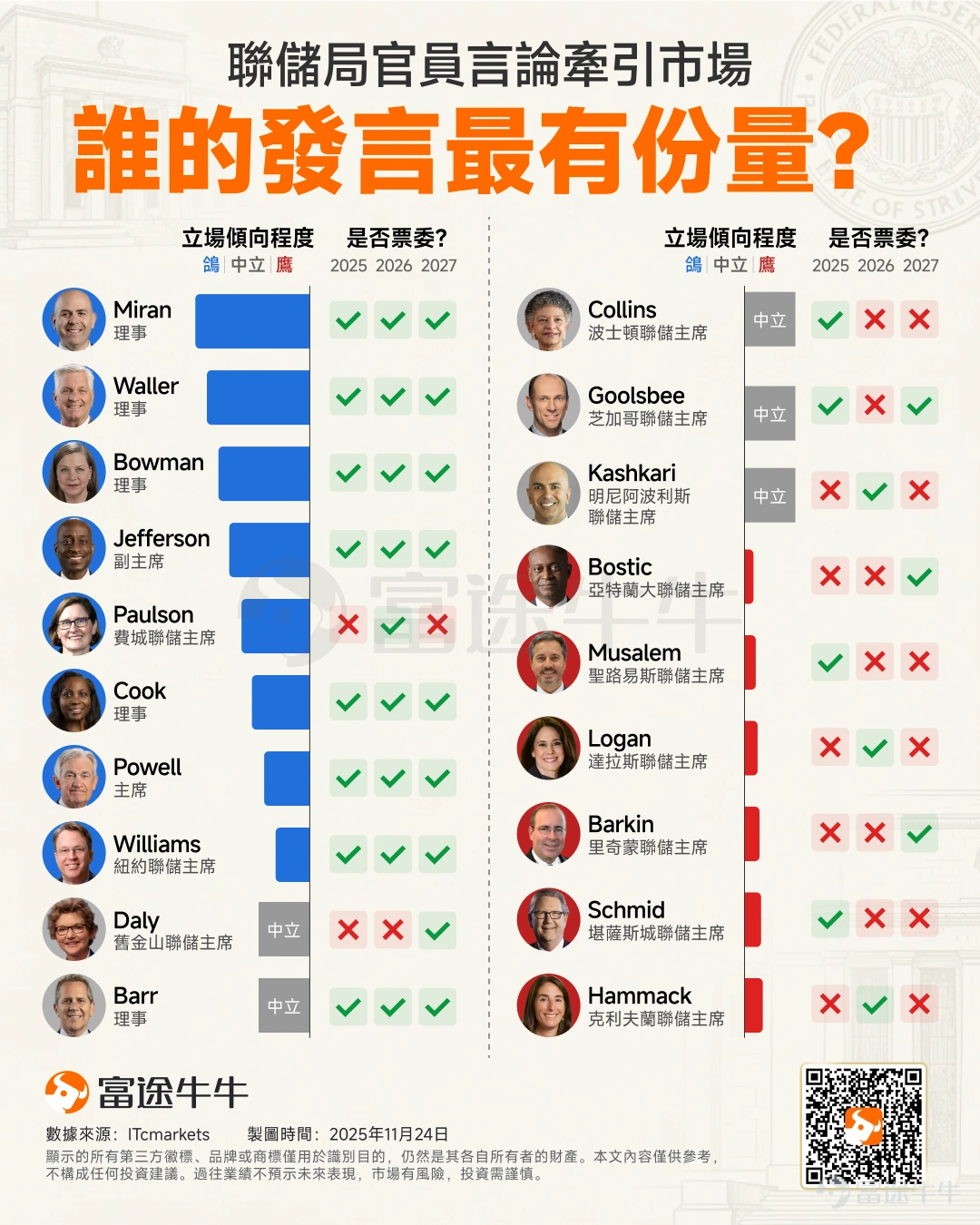
Last Friday, New York Fed President Williams stated that as the labor market cools,the Federal Reserve has room for further rate cuts in the near term,to adjust its policy stance closer to a neutral level.
Commentary noted that the sharp decline in U.S. stocks on Thursday reflected investors' concerns about an artificial intelligence (AI) bubble, geopolitical risks, and uncertainty regarding the Federal Reserve's policy outlook. The market remained volatile in early trading on Friday until it turned firmer following Williams’ remarks.Williams’ statement was seen as a policy signal from the highest leadership of the Federal Reserve, injecting key confidence into the market and timely preventing a potential renewed plunge.
Krishna Guha, Head of Global Policy and Central Bank Strategy at Evercore ISI, noted in a research report that
“The phrase ‘in the near term’ carries some ambiguity, but the most obvious interpretation refers to the next (i.e., December) meeting.Although Williams may have been expressing his personal view, signals on key policy issues by the Fed’s top three leaders are almost always approved by the Chair. It would be a serious professional misstep to issue such a signal without Powell’s endorsement.”
Williams’ remarks came at a sensitive time when the Federal Reserve faced an unusually divided stance. On one hand, some officials believed that policy was still restraining growth and there was room for adjustment; on the other hand, some officials were concerned about inflation, believing that economic growth was robust and no further rate cuts were necessary.
What are the recent views within the Federal Reserve?
In the eyes of many insiders, the December meeting could become one of the most unusual Federal Reserve interest rate decision meetings in recent years.Officials not only disagree on how to address the risks of weak job growth and stubborn inflation, but they also lack the data typically used to reconcile forecast differences. The recent federal government shutdown has delayed the release of employment and inflation data for two consecutive months.
Based on the latest statements from Federal Reserve members, four regional Federal Reserve Presidents on the FOMC—Boston Fed President Collins, Chicago Fed President Goolsbee, St. Louis Fed President Mosser, and Kansas City Fed President Schmid—are skeptical or even explicitly opposed to the idea of a rate cut next month. Fed Governor Barr has also signaled caution.
Among the dovish camp, the three Federal Reserve governors appointed by Trump—Michelle Bowman, Stephen Miller, and Christopher Waller—have been advocating for interest rate cuts. Williams’ statement last Friday indicates that he might join this group.
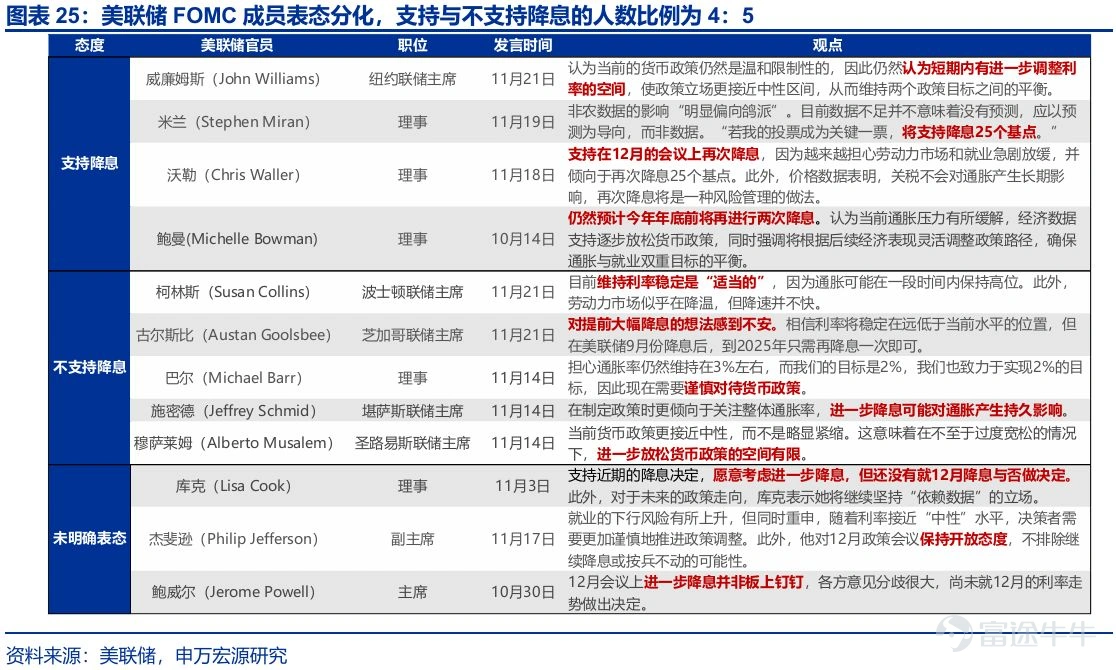
Such a significant divergenceactually implies that the stance of the Fed's "troika"—Powell, Jefferson, and Williams (whose views can be regarded as aligned)—will likely determine whether the doves or hawks prevail in December’s interest rate decision.
Shenwan Hongyuan Research believes that how Powell builds and guides consensus within the Fed is crucial—However, since the October meeting, Powell has not yet made a definitive statement on his position.
Claudia Sahm, Chief Economist at New Century Advisors and former Fed economist, stated:By staying out of the spotlight, Powell is giving every member of the Open Market Committee an opportunity to voice their opinions and be heard.He is allowing space for this divergence, which is actually positive because it is challenging, and these debates should take place.
However, some market observers currently believe that the Fed, traditionally consensus-driven, is experiencing increasing internal divisions, potentially leading to a historic deadlock in the December interest rate decision.The FOMC vote could result in a six-to-six tie.The Federal Reserve has never experienced a tie in its voting history, and the rules and procedures of the FOMC do not explicitly address such a scenario.
Hodge, who previously served as the chief economist at the New York Fed, stated that the chair of the Federal Reserve holds significant power in presiding over meetings and guiding decision-making. Moreover, the FOMC, as an autonomous committee, has the authority to amend its own rules.
In the absence of clear rules for breaking a deadlock, the chair is generally considered to have the ability to cast a decisive vote or guide the committee toward consensus—a practice commonly observed in other deliberative bodies with a chairperson. None of the documents I reviewed explicitly address this point, which is more a matter of convention than an established rule.
Amid Chairman Powell's continued silence, voting members are sharply divided into two major camps with nearly equal representation—regardless of the decision made on December 10, it is certain to be met with an unusually high level of dissenting votes.
Risk Disclaimer: The above content only represents the author's view. It does not represent any position or investment advice of Futu. Futu makes no representation or warranty.Read more


Comments (5)
to post a comment
26
32