
Earnings Showdown in the AI Sector

The AI computing power wave is sweeping the globe! Optical communication emerges as the new protagonist in AI infrastructure, and these ten companies are worth watching!
Global tech giants are sparking an unprecedented wave of investment in AI computing power.
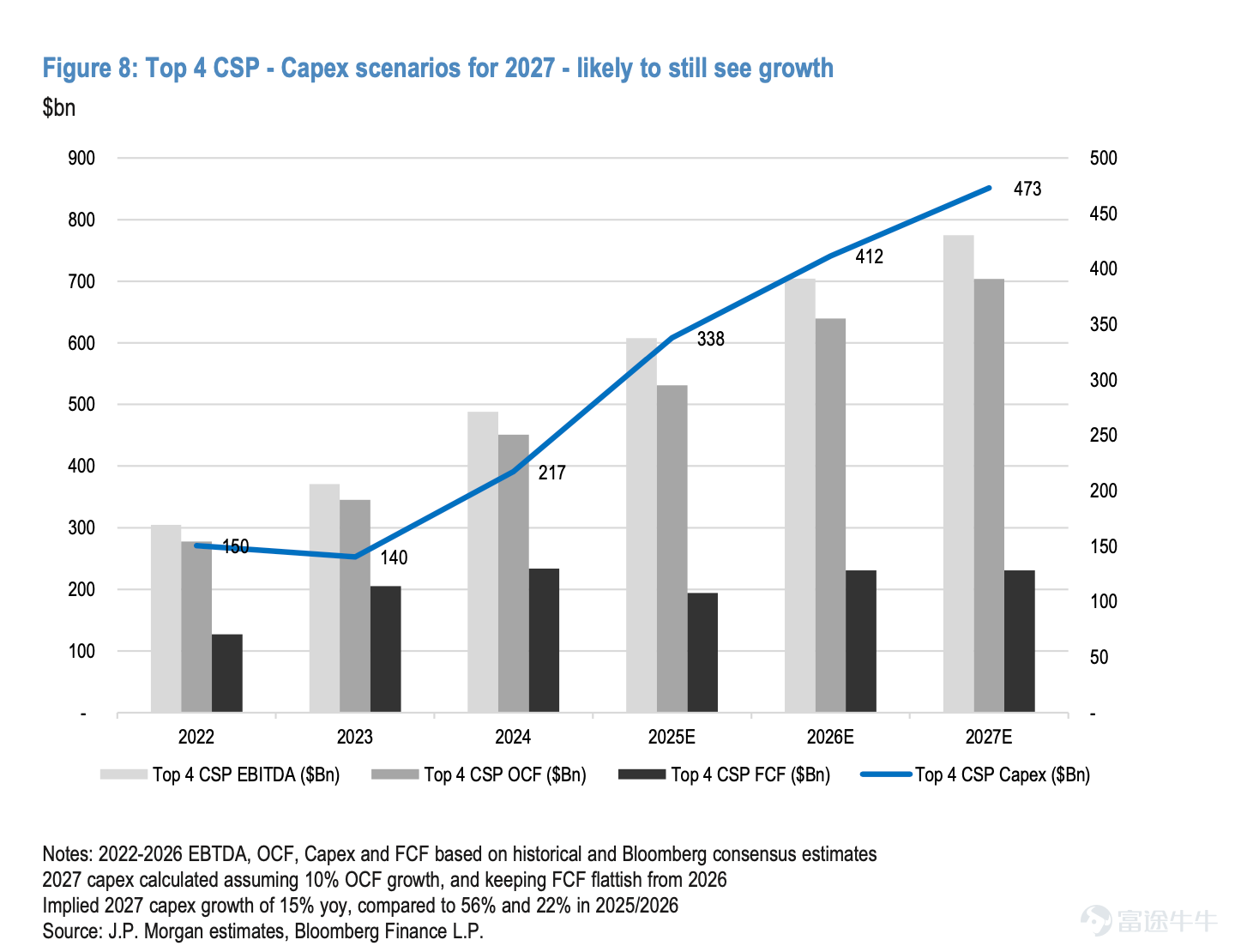
Recently, the four major U.S. cloud giants (Amazon, Google, Microsoft, Meta) successively released their Q3 2025 earnings reports. Data shows that the wave of capital expenditure driven by AI remains strong. In 2025 Q3, the combined capital expenditures of four North American CSPs reached $113.3 billion, marking a 75% increase year-over-year and an 18% increase quarter-over-quarter.
Capital expenditures by North American CSPs are still in a phase of rapid growth, with an optimistic outlook. According to JPMorgan forecasts, by 2027, the capital expenditures of these four CSPs are expected to reach $473 billion.

Source: JPMorgan
Amid explosive growth in computational demand, traditional network architectures are increasingly unable to meet the high bandwidth and low latency requirements of AI workloads. With the demand for high-speed interconnections between data centers rising rapidly,optical communication technology has become a critical enabler.
Notably, NVIDIA announced at its latest GTC conference a $1 billion investment in Nokia. The two parties will collaborate to develop AI networking solutions,and explore the possibility of integrating Nokia's data center switching and optical technologies into NVIDIA's future AI infrastructure architecture.At the same time, this collaboration will jointly target next-generation 6G technology, indicating that the integration of AI and communications will deepen further.
NVIDIA’s investment highlights an increasingly clear trend: in the AI race, the importance of networking is becoming as crucial as computational power itself. As AI participants seek to move data more quickly both within and outside chip clusters, the demand for connectivity solutions continues to grow.
What is optical communication? Why is it the most critical component in the era of AI infrastructure?
Optical communication is a method of transmitting information using light signals. It uses light as a carrier, modulating various properties of light to encode information, and transmits these information-carrying light signals through a transmission medium. At the receiving end, the light signals are then converted back into electrical signals or other forms of signals to achieve information transfer.
Optical communication has become the most critical link in the entire process of AI training, inference, and data scheduling, which is essentially a process of data flow and computation. Optical communication serves as the 'digital blood vessel' that supports this process, and its performance directly determines the efficiency, scale, and cost ceiling of AI infrastructure.Without the support of optical communication’s 'high capacity, low latency, wide connectivity, and low cost,' the training of large AI models would encounter bottlenecks where 'data clogs the pipeline,' real-time AI inference would be unattainable, and distributed AI infrastructure could not be implemented.
According to Huibo’s research, the optical communication industry chain is divided into upstream, midstream, and downstream segments. The upstream segment mainly involves core components such as optical chips, optical components, and electrical chips. The midstream includes optical devices, optical modules, and optical communication equipment, while the downstream is segmented by application scenarios into telecom markets and data communication markets.

1. Upstream Components
(1) Optical Chips: Active optical chips (laser chips, detector chips, etc.) and passive optical chips (wavelength division multiplexing chips, etc.);
Major manufacturers: $Coherent (COHR.US)$ 、 $Broadcom (AVGO.US)$ 、 $Lumentum (LITE.US)$ 、 $Applied Optoelectronics (AAOI.US)$ among others.
(2) Optical components: ceramic sleeves/ferrules, optical transceiver interface components, etc.;
(3) Electrical chips: mainly imported from overseas, including LD driver, TIA, LA, CDR, DSP, etc.;
2. Midstream device module equipment
(1) Optical devices: optical devices are divided into active and passive devices based on whether a power supply is required; passive devices are used to fulfill other functions in the optical transmission process.
Active optical devices - lasers (DFB/FP/VCSEL), detectors (PIN/APD), optical amplifiers, optical modulators (DML/EML), optical sub-assembly modules (TOSA/ROSA/BOSA), etc.
Passive optical devices—optical isolators, optical splitters, optical switches, fiber optic connectors, wavelength division multiplexers/demultiplexers, optical splitters, optical attenuators, FA fiber arrays, optical couplers, etc.;
Key manufacturers: $Suzhou TFC Optical Communication (300394.SZ)$ 、 $Coherent (COHR.US)$ 、 $Lumentum (LITE.US)$ 、 $Applied Optoelectronics (AAOI.US)$ among others.
(2) Optical modules: 100G/200G/400G/800G/1.6T/3.2T, etc.;
Key manufacturers: $Zhongji Innolight (300308.SZ)$ 、 $Eoptolink Technology Inc., (300502.SZ)$ 、 $CIG (06166.HK)$ 、 $Coherent (COHR.US)$ 、 $Lumentum (LITE.US)$ 、 $Applied Optoelectronics (AAOI.US)$ among others.
(3) Optical communication equipment: routers, switches, base stations, etc.;
3. Downstream application scenarios
Telecom market: communication equipment providers— $ZTE (00763.HK)$ 、 $Nokia Oyj (NOK.US)$ 、 $Cisco (CSCO.US)$ ; Terminal telecom operators— $CHINA MOBILE (00941.HK)$ 、 $CHINA TELECOM (00728.HK)$ 、 $CHINA UNICOM (00762.HK)$ 、 $Verizon (VZ.US)$ 、 $AT&T (T.US)$ among others.
Data communication market: Cloud vendors—Alibaba Cloud, Tencent Cloud, Baidu Cloud, AWS, Microsoft, Google, Meta, etc.; Servers—Lenovo, Dell, HPE, Cisco, etc.
Optical communications emerge as the new protagonist in AI infrastructure! Which companies are worth watching?
As early as October, Jordan Klein, an analyst at Mizuho Securities' trading division, noted in a report that compared to memory, power, and semiconductor-related stocks,Optical communication stocks are 'the least well-known and possibly the least held by individual investors.'
Klein stated that although optical communication stocks have significant growth potential, they are difficult to value due to higher volatility and more inconsistent performance, which also implies greater risk. Based on this, he listed ten companies in the sector worth watching: $Astera Labs (ALAB.US)$ 、 $Credo Technology (CRDO.US)$ 、 $Lumentum (LITE.US)$ 、 $Arista Networks (ANET.US)$ 、 $Fabrinet (FN.US)$ 、 $Amphenol (APH.US)$ 、 $Ciena (CIEN.US)$ 、 $MACOM Technology Solutions (MTSI.US)$ 、 $Coherent (COHR.US)$ 、 $Semtech (SMTC.US)$ 。
The following is an analysis of consensus estimates from analysts surveyed by the London Stock Exchange Group (LSEG), listing ten companies ranked by their expected compound annual growth rate (CAGR) from 2025 to 2027:

These companies play diverse roles, covering key areas across the entire supply chain. For instance, Astera Labs, Credo, Macom, and Semtech specialize in producing semiconductors that enable high-speed data transmission via optical fibers. Meanwhile, companies like Lumentum and Coherent manufacture optical modules—components responsible for generating and receiving optical signals in fiber-optic communications. These modules are critical because optical fibers transmit signals faster than copper wires. Fabrinet handles the assembly and packaging of these optical components, enabling their integration into Arista and Ciena's high-performance routing and switching equipment, which is designed to manage network data transmission and traffic.
Specifically:
Astera Labs – “The Mini NVIDIA”
$Astera Labs (ALAB.US)$ Dubbed “The Mini NVIDIA,” Astera Labs is a fabless semiconductor company focused on providing connectivity solutions for AI and cloud infrastructure. Founded in 2017 by three veteran engineers from Texas Instruments, the company has quickly made its mark in the industry.
The company’s core technology focuses on interconnects for high-performance computing and data centers, aiming to optimize data transmission efficiency within data centers and address the “memory wall” challenge in high-performance computing. Currently, Astera Labs offers comprehensive solutions covering the full protocol stack of PCIe, Ethernet, and CXL. Its three mature product lines target bottlenecks in data (Aries), networking (Taurus), and memory (Leo). Additionally, Astera provides the COSMOS software suite and Interop Lab support and plans to launch a series of intelligent switch products.
In terms of market coverage, Astera Labs' core customer base spans three main areas: first, hyperscale cloud service providers (such as AWS and Google Cloud), which have ongoing demand for scalable and efficient data center connectivity solutions; second, AI hardware manufacturers (such as NVIDIA and AMD), whose technological advancements rely on high-speed interconnect solutions; and third, enterprise-level data centers, where the company serves large organizations seeking to optimize the efficiency of AI and high-performance computing applications.
However, Astera Labs' stock price previously experienced a significant correction, triggered primarily by the OCP Conference on September 24. At the event, tech giants such as NVIDIA, AMD, Broadcom, Meta, Microsoft, and OpenAI jointly announced support for a new interconnect standard called ESUN. Notably, Astera Labs and its key customer Amazon were absent from this alliance. This development raised strong market concerns that Astera Labs’ role in the UAI Link Alliance might face risks of diminished influence or even marginalization within the industry.

During the Q3 2025 earnings call, management positively addressed market concerns regarding the potential replacement of UALink by Ethernet or other standards. During the Q&A session, when asked by analysts about the competitive relationship between UALink and ESUN (Ethernet-based), which is led by OCP, CEO Jitendra Mohan emphasized the company's 'protocol-neutral' strategy. He further noted that even if OCP Ethernet becomes mainstream in the future,Astera Labs’ core products are designed with forward-looking compatibility, enabling seamless integration into that ecosystem.
Credo – a leader in high-speed data connectivity for AI data centers
$Credo Technology (CRDO.US)$ specializing in high-speed interconnect solutions,is a key provider of ‘high-speed channels’ between servers and network switches in the AI era.Its customers include global cloud giants such as Amazon AWS and Microsoft.

Credo’s core technology is primarily focused on three major areas:
1. AEC Active Optical Cables
These demonstrate outstanding performance in terms of reliability, energy efficiency, and flexibility:The failure rate is significantly lower than fiber optics, greatly reducing the risk of disconnection in large-scale clusters; power consumption is only about half that of fiber optics, better meeting green energy-saving requirements for data centers; and they support transmission rates ranging from 100G to 800G, adapting to diverse application scenarios.
Currently, Credo has captured over 70% of the global AEC market, establishing a near-monopolistic competitive advantage. As GPU cluster sizes continue to expand (e.g., NVIDIA's GB200 NVL72), AEC is emerging as the new mainstream solution for data center interconnects.
Notably, in July this year, Elon Musk posted an internal photo of xAI’s Colossus 2 data center on X. One image prominently displayed thousands of neatly arranged purple cables—these are Credo’s signature product: Active Electrical Cables (AEC).

2. Optical DSP Chips
This chip, manufactured using Taiwan Semiconductor’s 3nm process technology, primarily targets the 800G and 1.6T optical module markets, offering dual advantages of low power consumption and cost efficiency. Credo has already launched products such as Dove850 and is gradually penetrating the 800G market.In the future, as 1.6T technology matures and commercial adoption progresses, Credo’s growth potential in the high-speed optical interconnect field is highly anticipated.
3. SerDes IP Technology
Credo holds a leading position in high-speed SerDes technologies such as PAM4. Through an IP licensing model, it integrates its technology into more data center and communication chip designs, building a robust technological moat.
At present, foreign media speculate that Amazon, xAI, and Meta are likely on Credo’s client list. However, this raises investor concerns as Credo’s revenue is overly reliant on a few ultra-large clients. Any reduction in AI infrastructure investment by these companies could impact Credo in the future.
Lumentum – The Architect of AI ‘Data Highways’
Lumentum is a globally leading designer and manufacturer of optical and photonic products, widely applied in telecom, enterprise, and data center networks, with primary supply to NVIDIA. Its core business is divided into two main segments:
Cloud & Networking Business: Includes data center interconnect (DCI), long-haul transmission products, and optical components such as EML laser chips, accounting for 88% of the company's revenue. This segment has benefited from the surge in AI computing power demand, particularly the need for high-speed optical chips in hyperscale data centers.
Industrial Technology Business:Covers 3D sensing and industrial lasers, contributing 12% of total revenue. This division has been impacted by macroeconomic weakness, resulting in a sequential decline in revenue; however, ultra-high-power lasers have maintained stable demand in areas such as solar cell manufacturing.
Technical Advantages:
EML Laser Chips: Record shipments achieved for 100G and 200G products, with 200G products expected to account for 10% of total shipments by early 2026.
Indium Phosphide (InP) Wafer Capacity: Utilization rate has reached 100%, with all production capacity for the next six quarters already sold out. The supply gap has widened from 20% to 25-30%.
Innovative Products: Progress on optical circuit switches (OCS) and co-packaged optics (CPO) solutions has exceeded expectations. OCS products are priced at $75,000-$90,000 per unit, and even small shipments can significantly contribute to revenue.
Notably, the company's latest financial results surpassed expectations for both revenue and profit. The company also raised its Q2 revenue guidance to the upper limit of market consensus. During the earnings call, the company explicitly stated that the supply-demand gap for EML optical chips had widened from 20% in the previous quarter to 25-30%, and the company has initiated a 'targeted pricing mechanism.' Driven by these results, the company’s stock surged over 23% overnight post-earnings.

Arista Networks – The Invisible Champion Behind AI Ethernet
$Arista Networks (ANET.US)$ Founded in 2008 and headquartered in Santa Clara, California, the company's core business is providing data center-grade Ethernet switches and cloud networking solutions.Its products act as the "nervous system" of data centers, responsible for high-speed connectivity between servers, storage devices, and GPUs.The company’s technological moat is built on three core pillars:
EOS Operating System:An intelligent software platform that runs a unified image across all devices, enabling automated network management.
High-speed switch hardware:Products supporting 400G/800G account for over 60% of its portfolio, strongly supporting the high-speed transmission demands of AI computing power.
White-box + commercial chip strategy:Standardized hardware is used to reduce costs, while software enables differentiated competitive advantages.
In terms of customer ecosystems, the company has formed deep partnerships with tech giants.The North American market contributed 75% of revenue, with Microsoft and Meta collectively accounting for nearly half of the income by providing high-speed switching equipment for their Azure cloud platform and Meta AI clusters.
The relationship with NVIDIA reflects both competition and cooperation:While collaborating on the development of EOSAIAgent, NVIDIA's internally developed InfiniBand technology also poses a potential substitution threat. Additionally, the company indirectly taps into the AI hardware supply chain through its contract manufacturer, Gongjin Electronics, supplying 800G optical communication switches to NVIDIA.
From the latest quarterly performance, network equipment manufacturer Arista Networks exceeded expectations for both revenue and profit in Q3. However, the lack of a significant upward revision to guidance led to a sharp decline in its stock price.

Arista provided Q4 revenue guidance in the range of $2.3 billion to $2.4 billion, with a midpoint of $2.35 billion, only slightly above analysts' expectations of $2.33 billion. Moreover, the company decided to maintain its long-term forecast of 20% sales growth by 2026.This was seen as underwhelming by investors who look for 'earnings beats accompanied by upward revisions to guidance.'
In stark contrast to the market's short-term pessimism, the company's management expressed strong confidence in the future. Arista CEO Jayshree Ullal stated during the earnings call,The company is at the heart of an 'undeniable and explosive AI megatrend,' which she described as 'the golden age of networking.'She noted that the rise of AI will drive the networking industry’s total addressable market (TAM) to exceed $100 billion in the coming years.
Fabrinet – Leading contract manufacturer of optical components and modules in North America
$Fabrinet (FN.US)$ Fabrinet is a leading provider of advanced optical packaging and precision optical, electromechanical, and electronic manufacturing services, offering complex products to original equipment manufacturers such as optical communication components, modules and subsystems, automotive components, medical devices, industrial lasers, and sensors. Notably,Fabrinet is also one of NVIDIA's optical module suppliers.
Although Fabrinet operates as a single business unit, its revenue is divided into two major segments based on end markets:
Optical Communication:The company's core and largest revenue source, accounting for 76.6% of total revenue in fiscal year 2025. This segment provides precision manufacturing services to optical communication equipment manufacturers (OEMs), with products including optical modules, transceivers, optical amplifiers, active optical cables (AOCs), etc., used in data centers and telecommunication networks. This segment is further divided into two subcategories: data communications and telecommunications, benefiting from the rapid growth in global network bandwidth and data center infrastructure demand.
Non-optical communications:The company’s diversified growth engine, this segment primarily includes:
Automotive: Precision manufacturing of automotive components, such as pressure, micro-gyroscope, fuel, and other types of sensors used in automobiles.
Industrial Lasers: Manufacturing services for industrial lasers used in semiconductor processing, biotechnology, metrology, and materials processing.
Others: Including medical devices, sensors, and other products requiring complex precision manufacturing capabilities.

Amphenol – The ‘Connector Titan’ in the AI Revolution
$Amphenol (APH.US)$is a globally leading manufacturer of connectors and interconnect systems,with business operations spanning communication solutions, interconnect and sensor systems, and harsh environment solutions. The company provides customers with high-speed, highly reliable connection solutions. Its core value lies in supplying essential components for critical sectors such as data centers, communication networks, automotive electronics, aerospace, and industrial applications, ensuring efficient and stable transmission of data and power.
The company recently delivered its strongest quarterly earnings report in history: total revenue for the third quarter of 2025 reached $6.194 billion, with an operating profit margin of 27.5%,setting a new all-time high for the company.
From the perspective of the three major business segments, Amphenol demonstrates a clear structural growth logic: the Communication Solutions segment served as the core growth driver for this quarter; while the Harsh Environment Solutions and Interconnect and Sensor Systems segments maintained steady growth.

The Communication Solutions segment was the primary growth driver for this quarter.Revenue from this segment amounted to approximately $3.310 billion, representing a year-on-year increase of 96%, with operating profit reaching $1.081 billion, accounting for 32.7% of sales.
Driven by the wave of server upgrades spurred by generative AI, global data centers are accelerating the adoption of 48V power architectures and high-density GPU nodes, placing higher demands on high-speed interconnects, power modules, and signal integrity. Leveraging its technological expertise in high-speed backplanes, PwrBlade+ high-power connection systems, and cable assemblies, Amphenol has emerged as a key beneficiary of this wave of AI infrastructure investment.
Harsh Environment Solutions segmentThe automotive, industrial, and defense markets maintained robust growth, with revenue reaching USD 1.516 billion, representing a year-over-year increase of approximately 27%.
Interconnect and Sensor Systems DivisionRevenue amounted to USD 1.367 billion, marking an annual increase of 17.8%. The acquisition of Rochester Sensors made a significant contribution, strengthening the division's presence in the industrial sensor sector.
Amphenol’s record-breaking quarterly report confirms that, driven by AI and energy transformation, connectors have evolved from basic components to strategic core elements of systems. Companies capable of providing high-speed, high-power, and highly reliable system interconnection solutions are continuously reaping technological premiums and market dividends.
Ciena – A Leading Enterprise in High-Speed Optical Fiber Network Technology
$Ciena (CIEN.US)$ A globally leading provider of optical communication network solutions, Ciena focuses on delivering optical transmission systems, packet networking platforms, and software-defined networking solutions to communication service providers, cloud service providers (such as Meta and Microsoft), and enterprise customers.Its core products include the WaveLogic series of coherent optical modems, the 6500 Packet-Optical Platform, and Data Center Interconnect (DCI) solutions.
Technological Leadership:As the only supplier in the industry offering 1.6Tbps coherent optical modems, Ciena maintains an 18- to 24-month technological lead in the high-speed optical communication field. The WaveLogic 6 Nano, set for release in 2025, supports 800Gbps speeds optimized for short-distance transmission in AI data centers and is expected to enter mass production in 2026.

MACOM Technology Solutions – A Leading Supplier of High-Performance Analog RF, Microwave, Millimeter-Wave, and Photonic Semiconductor Products
$MACOM Technology Solutions (MTSI.US)$ is a U.S.-based semiconductor company specializing in high-performance analog RF, microwave, millimeter-wave, and photonic semiconductor solutions, serving the communications, industrial, defense, and data center markets extensively.In recent years, its performance has been stable, with a strategic focus on optical communications and 5G/6G infrastructure.
MACOM operates in multiple core semiconductor segments, primarily divided into three major product areas:
RF & Microwave:
Power amplifiers, low-noise amplifiers, switches, mixers, attenuators, phase shifters, etc.
Downstream applications: radar systems, avionics, satellite communications, wireless base stations, electronic warfare
Photonics/Optical components:
Lasers (DFB/EML), modulator driver ICs, TIAs (transimpedance amplifiers), photodetectors, silicon photonics-related components
Key customers: data centers, metropolitan area networks, core network equipment manufacturers
Semiconductor materials and supporting components (diodes, GaN/GaAs components, etc.):
Offers a wide range of wide-bandgap semiconductor support products, with particular advantages in equipment manufacturing support for GaN (Gallium Nitride) and GaAs (Gallium Arsenide).
Core Competencies:
Deep expertise in analog RF and photonics technologies:
Possesses decades of IP accumulation in the design and manufacturing of high-frequency/high-linearity devices, particularly relied upon in defense (radar, jamming) and industrial RF applications.
Comprehensive product portfolio and system-level solution capabilities:
Able to provide customers with an end-to-end combination of RF/photonics components, reducing customer development complexity and supply chain challenges.
"Fab-lite" manufacturing model:
The company owns part of its production lines but outsources a significant portion of manufacturing to external wafer foundries and packaging resources, enhancing asset turnover, reducing costs, while maintaining core competencies in design and testing.
High-reliability certifications:
MACOM products are widely certified to aerospace and military high standards, serving as a critical threshold for long-term supply to defense and aerospace customers.
Coherent——A Global Leader in Photonics
$Coherent (COHR.US)$ is a leading global provider of laser technology and optoelectronic solutions,and a key player in the field of global optical communications and laser subsystems.
The company's latest earnings report shows that its third-quarter revenue reached $1.58 billion, a year-over-year increase of 17%, surpassing market expectations of $1.54 billion. Earnings per share were $1.16, exceeding the Wall Street consensus estimate of $1.04. This marks the fourth consecutive quarter in which the company has surpassed market profit expectations. The better-than-expected performance is primarily attributed to strong demand from AI data centers and the communications sector.

In response to robust demand for AI data center business, Coherent is actively expanding its indium phosphide laser production capacity. Anderson stated that the company plans to double its indium phosphide production capacity over the next 12 months, with simultaneous capacity increases at two production sites: Sherman, Texas, and Jarfalla, Sweden.
The company is constructing the world’s first 6-inch indium phosphide production line, a technological breakthrough expected to significantly improve production efficiency while reducing costs. Anderson revealed that the initial yield of the 6-inch production line exceeds that of the existing 3-inch production line.
This quarter, the company recorded record-breaking order volumes in its data center business, with order timelines extending longer than usual, providing good visibility for future planning. The strong orders span 800G and 1.6T transceiver products, as well as data center interconnects and traditional telecom sectors. With customer demand forecasts extending to 2028, the company plans to continue expanding capacity 12 months from now.
Astera Labs——A Well-Known Enterprise in Optical Communications
$Semtech (SMTC.US)$ is a well-known enterprise in the field of optical communications. The company offers signal integrity products, including a portfolio of optical data communication and video transmission products for various infrastructure and industrial applications; an integrated circuit portfolio for data centers, enterprise networks, passive optical networks, wireless base station optical transceivers, and high-speed interface applications; and video products for broadcasting applications, as well as Video over IP technology for professional audiovisual applications.
Overall, investment in AI computing power is driving the global optical communications industry into a high-growth cycle. Although some market forecasts indicate that spending growth by hyperscale vendors may slow after 2026, the long-term construction of AI infrastructure is just beginning. Under the grand vision of $3-4 trillion in investments, optical communications, as the cornerstone supporting and connecting global computing power, are expected to enjoy a prolonged high-growth cycle. A new era defined by AI computing power and supported by optical communications has begun.
Risk Disclaimer: The above content only represents the author's view. It does not represent any position or investment advice of Futu. Futu makes no representation or warranty.Read more


Comments
to post a comment
201
612