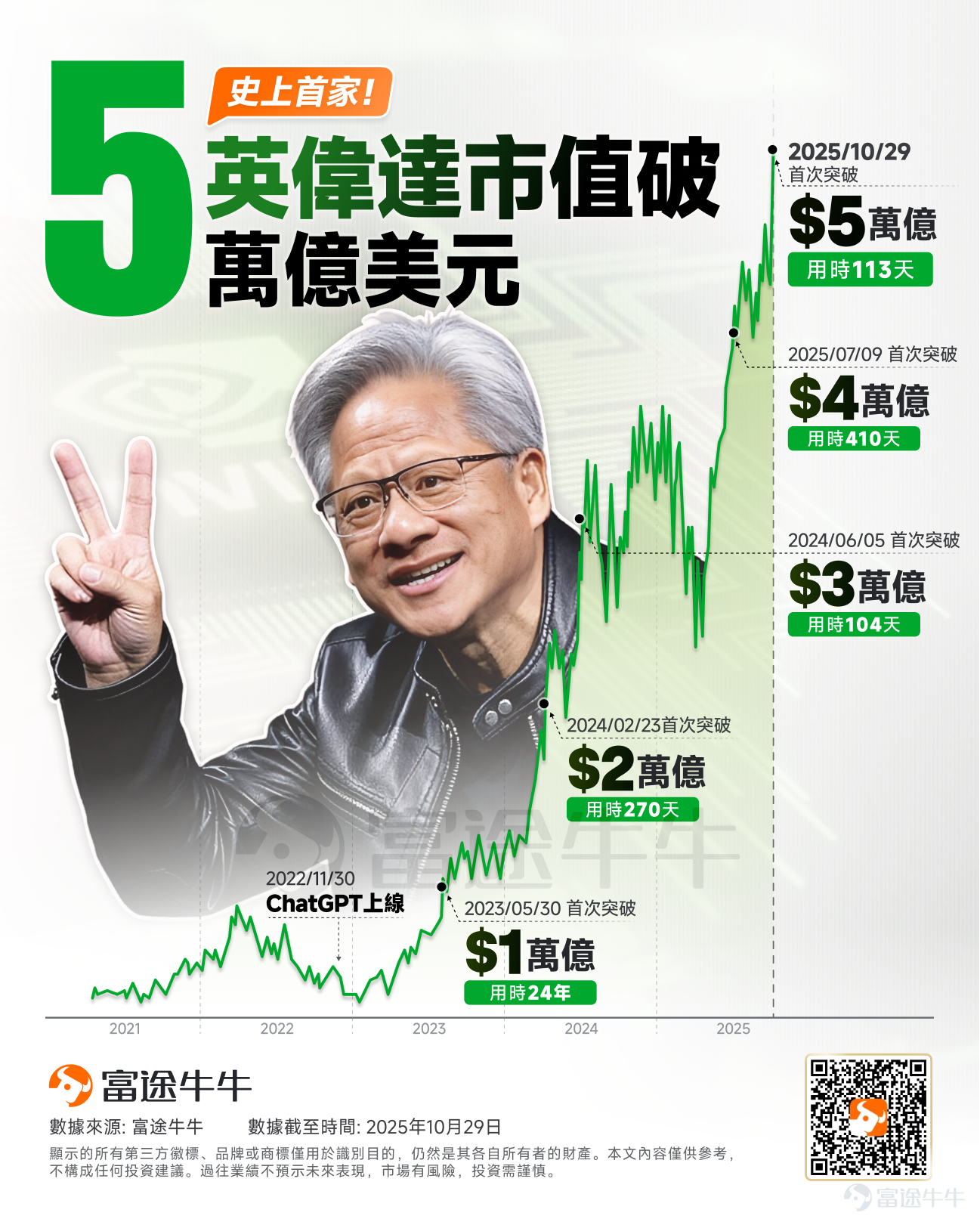
GTC Ignites AI Enthusiasm! NVIDIA’s Market Cap Surpasses $5 Trillion!
On October 29, 2025, the technology industry witnessed a historic milestone — $NVIDIA (NVDA.US)$ with a market capitalization breaking through the $5 trillion mark, becoming the world's first company to achieve this milestone.

Since the release of ChatGPT in November 2022 (when NVIDIA’s market cap was just $400 billion), NVIDIA’s market value has surged by $4.5 trillion.
The figure of $5 trillion exceeds the combined market capitalizations of its competitors AMD, Arm, ASML, Broadcom, Intel, Lam Research, Qualcomm, and Taiwan Semiconductor. It even surpasses the aggregate value of entire sectors such as utilities, industrials, and consumer staples within the S&P 500 index. Morestaggering is the fact that NVIDIA’s current size now surpasses the combined market capitalization of Germany, France, and Italy's major stock indices.
As NVIDIA reaches the pinnacle of a five-trillion-dollar market capitalization, investors are faced with two core questions:Does its upward momentum still have sustainability? And what strategy should be adopted to position for the future market?This article will conduct an in-depth analysis of these questions.
Wall Street Debate: Can the Rally Continue?
Based on the current consensus on Wall Street,analysts generally affirm its fundamentals and growth prospects, maintaining a positive outlook on the future trajectory.
Matt Britzman, Senior Equity Analyst at Hargreaves Lansdown, a prominent UK financial services provider, stated:NVIDIA's market capitalization reaching $5 trillion is not only a milestone but also a declaration—NVIDIA has transformed from a chip manufacturer into an industry pioneer.
For investors who believe they have missed the best entry point, even at a $5 trillion market cap, this stock does not appear overvalued. The market continues to underestimate the immense opportunities within the artificial intelligence sector, andNVIDIA remains one of the best options for participating in the AI theme.
Kim Forrest, Chief Investment Officer at Bokeh Capital Partners, a U.S.-based financial advisory firm, stated:NVIDIA truly deserves its success.At present, the AI bubble is far from bursting. As a result, we are witnessing this outcome: a company with a $5 trillion market cap that has created products driving the AI cycle.Demand for data center construction appears exceptionally robust, consistently pointing back to NVIDIA.
Michael Brown, Senior Research Strategist at Pepperstone, a globally renowned financial services provider, stated: The company has made progress in many areas within the past 24 hours. A series of strategic partnerships were announced yesterday, and CEO Jensen Huang provided very clear earnings guidance.He indicated that the business scale over the next five quarters is expected to reach $500 billion.
One of the key drivers for whether NVIDIA can sustain its upward momentum depends on the capital expenditure forecasts of some large technology companies. If, as seen in the second quarter,capital expenditures increase significantly again, with a substantial portion evidently directed toward NVIDIA chips, then there is absolutely no reason why this rally should lose steam.
Arthur R. Hogan III, Chief Market Strategist of B. RILEY Financial Services in the United States, stated:
This milestone further solidifies the dominant position of chip manufacturers in the current phase of the AI revolution. Importantly,NVIDIA's market capitalization surge is accompanied by reasonable valuations. The company’s stock is trading at 35 times its projected earnings for the next 12 months, with a gross margin as high as 70%.
While a $5 trillion milestone may seem unimaginable from a historical perspective, it reflects the achievements of a company excelling across all metrics, while securing strategic agreements with all key industry players and successfully navigating a challenging political environment.
A senior market analyst at Spain’s Capital.com noted: On one hand, the driving force behind NVIDIA’s share price increase stems from overall market optimism. Not only has NVIDIA’s stock price surged, but major indices have also repeatedly hit new highs, which I believe is no coincidence. This is the result of multiple fundamental factors working together: easing inflationary pressures and the prospect of accommodative monetary policy.
At the same time, an AI-driven capital expenditure boom is sweeping in—particularly in the fields of chips, hardware, and cloud infrastructure. Consequently, the structural growth momentum exhibited in the market far exceeds a cyclical rebound.To a certain extent, what people refer to as the AI bubble is not a real bubble because it is supported by fundamentals and, frankly, also by profit growth.
How should investors position themselves?
From a technical perspective, NVIDIA's stock price broke through the resistance level of $200, ending a three-month consolidation phase, signaling that its multi-quarter upward trend will continue.

NVIDIA's strong breakout confirms that the company has not only regained dominance in AI infrastructure and networking but is also seeing margin expansion. Record-breaking performance for the next quarter is almost guaranteed. Considering the accelerating mass production of Blackwell architecture products, growing synergies from the networking business, and limited impact from trade barriers, NVIDIA remains the market's most unequivocally high-conviction investment target, continuing to benefit from the accelerated growth of AI-driven computing demand.
As investors, in addition to investing in individual stocks, there are many ETFs available for investment in the U.S. stock market, such as $GraniteShares 2x Long NVDA Daily ETF (NVDL.US)$ 、 $YieldMax NVDA Option Income Strategy ETF (NVDY.US)$ etc. Fellow investors who are interested can click on NVIDIA's stock page > ETF for more information.
In terms of options strategies, investors can refer to the following three options strategies:
Strategy One: Bull Call Spread
Applicable Scenarios:Expectation of moderate stock price increase
Core logic:
– Capitalize on NVIDIA's upcoming quarterly earnings release and anticipated growth in AI chip demand to capture potential upside in the stock price.
– Construct a spread strategy to reduce premium costs while capping potential losses.
Operational recommendation (for illustrative purposes only):
– Buy 1 call option with a strike price of $200.
– Sell 1 call option with a strike price of $220.
Net cost: $925.
Break-even point: $209.25 (near the current stock price).
Maximum profit: $1,075, achieved if NVIDIA rises to $220.

Advantages:
– Reduce premium costs and improve the risk-reward ratio.
– Controllable risk (maximum loss of $925).
Risk Warning:If the stock price does not exceed the break-even point, there may be a loss of the premium.
Strategy Two: Protective Put
Applicable Scenarios:Holding stocks while wishing to hedge against short-term pullback risks
Core logic:
– NVIDIA is currently at a historical high, raising concerns over potential short-term pullbacks.
– By purchasing put options, downside risk can be locked in while retaining upside profit potential.
Operational recommendation (for illustrative purposes only):
Holding 100 shares of NVIDIA stock (current market value approximately $20,704).
Buying one put option with a strike price of $195.
Maximum loss: $867.50
Maximum profit: $18,632.50 (referring only to the profit from the options, excluding gains from the underlying stock).

Advantages:Effectively hedges against black swan events (e.g., earnings below expectations, geopolitical risks).
Risk Warning:Requires payment of a premium, reducing overall returns.
Strategy Three: Cash-Secured Put
Applicable Scenarios:Neutral to slightly bullish, hoping to establish a position or enhance returns at a discounted price.
Core logic:Institutional forecasts predict NVIDIA's data center business revenue could reach $500 billion by 2026, with a clear long-term bullish outlook.
Generate premium income by selling put options while reserving cash to handle potential exercise.
Operational recommendations:
Reserved Cash: 185 × 100 = $18,500 (exercise price based on the lower limit of recent institutional target prices).
Sell one put option with an exercise price of $185.
Break-even point: $179.475
Maximum profit: $552.5 (if the stock price ≥ $185).
Maximum loss: $17,947

Advantages:
Stably earn premium income.
If exercised, a position can be established at the target price.
Risk Warning:Ensure the account has sufficient cash to avoid liquidity risk.
Brian Wong 黃梓政
Futu Investment Strategy Expert
CE: BBH085
(The author is a licensed person under the Securities and Futures Commission and neither they nor their associates hold any financial interest in the recommended stock issuer.)
Risk Disclaimer: The above content only represents the author's view. It does not represent any position or investment advice of Futu. Futu makes no representation or warranty.Read more
Comments (5)
to post a comment
30
55