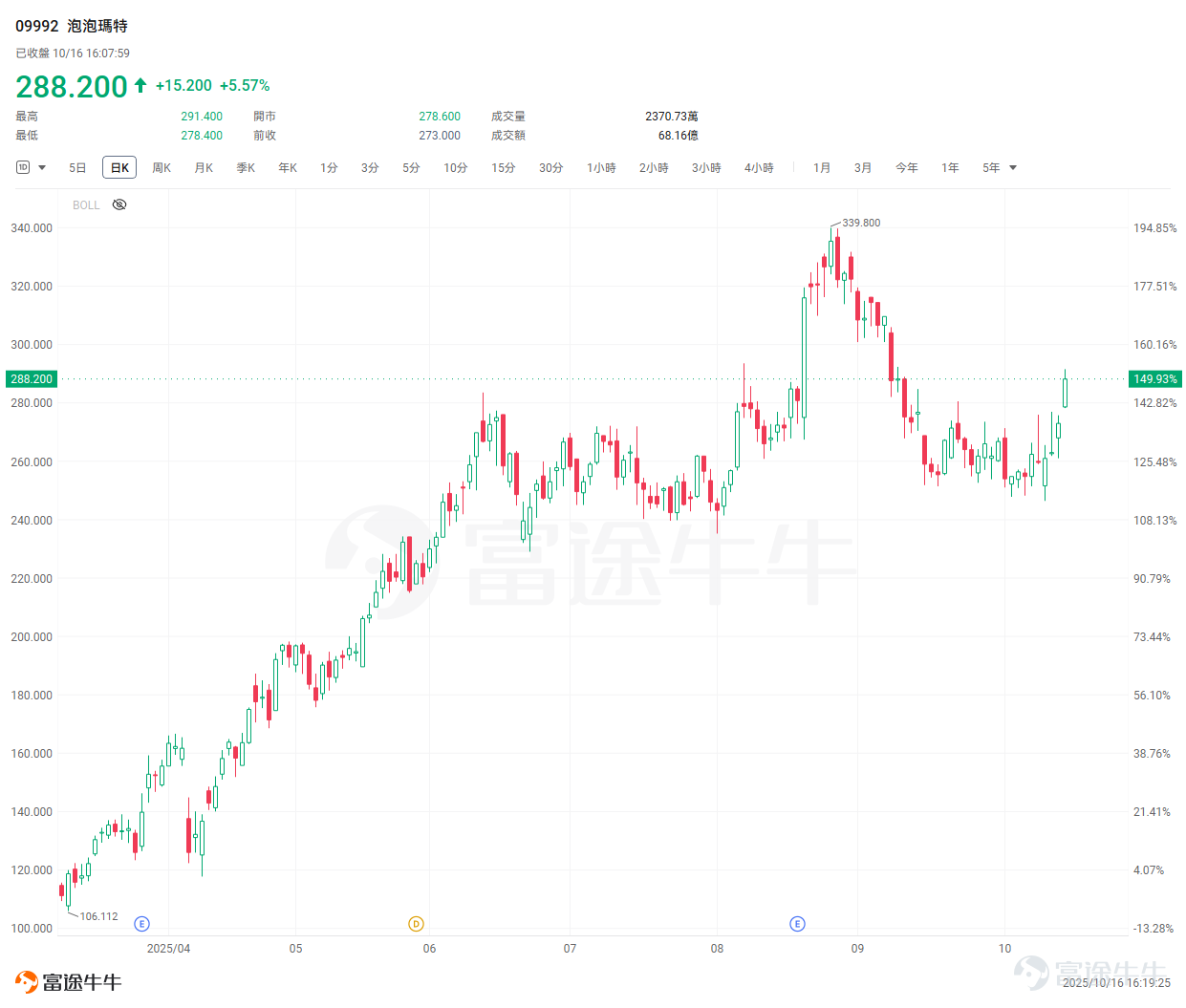

The new consumer sector in Hong Kong's stock market has risen strongly.

Pop Mart regains upward momentum! Is it time to deploy again?
Introduction
On the afternoon of October 13, Apple CEO Tim Cook appeared at the THEMONSTERS 10th Anniversary Tour in Shanghai, marking the first stop of his visit to China. He was presented with a Labubu doll holding an iPhone, further showcasing the global influence of this China-originated IP.
After experiencing a stock price correction over the past month, falling 24% from a recent high of HKD 335.40 to as low as HKD 254, voices questioning whether 'Pop Mart is starting to cool down' have emerged.Recently, Hong Kong-listed new consumer concept stocks have rebounded amid a tug-of-war between sentiment and fundamentals. $POP MART (09992.HK)$ Is this the right time for allocation once again? This article will be divided into the following sections:
1. Based on the essence of the business, deconstruct the growth logic of Pop Mart.
2. Is it merely a coincidence that Pop Mart is the only company in this sector to achieve tremendous success?
3. What are the impacts of tariffs on Pop Mart?
4. Conduct specific calculations: how much growth potential does Pop Mart have in the future?

An analysis of Pop Mart's growth logic based on the essence of its business
The core of Pop Mart’s business is IP, which is indisputable. However, as investors, we need a more analyzable and trackable growth model.
If expressed in a formula, it can be written as:Revenue = Number of paying users × Revenue per user (ARPU)
However, in practical analysis,As shown in the figure below, Pop Mart adopts a DTC + omnichannel model, which can be divided by channel into stores, online e-commerce, vending machines, and wholesale.Since Pop Mart does not directly disclose the number of purchasing users, we can use the 'number of stores' as a proxy indicator.
The logic behind this is:Stores are not only sales terminals but also core nodes for brand display, user experience, and customer acquisition, followed by repurchase conversion through channels such as vending machines, mini-programs, and e-commerce. Therefore, there is a strong correlation between the number of stores and user scale.

The adjusted formula is:
Revenue ≈ Number of stores × Revenue per store
Revenue per store ≈ Number of IPs sold per store × Number of product categories covered by each IP
1. ‘The world’s Pop Mart’ – Where is the ceiling for store expansion?
According to the H1 2025 financial report, Pop Mart has 571 stores globally, including 443 in mainland China and 128 overseas. The accelerated expansion is attributed to LABUBU driving breakthrough growth in overseas markets.In the first half of the year, the company significantly increased its store presence in overseas regions.As of the first half of 2025, 28 new stores were added overseas, with North America being the primary region of expansion (19 stores opened).
The number of stores directly correlates to the user base; how much room for growth remains?
We can compare this with the global store count of LEGO,LEGO expanded gradually from Europe to the Americas and Asia, with over 1,000 branded retail stores worldwide, including nearly 480 stores across more than 120 cities in China. Pop Mart, on the other hand, started by targeting culturally proximate regions such as Asia and Southeast Asia before slowly penetrating higher IP premium markets like Australia, Europe, and North America.
Currently, Pop Mart has surpassed LEGO in the number of stores in Thailand and the Hong Kong, Macao, and Taiwan regions of China, while maintaining a store density in Singapore comparable to that of LEGO.Pop Mart has significantly fewer stores in the United States, Europe, and Australia compared to LEGO, indicating substantial room for future expansion.The company's management noted during the earnings call, 'The disproportionately high online sales in the Americas suggest that the offline store network is still underdeveloped, offering considerable potential for further expansion of physical outlets.'In line with the company’s target of opening more than 100 new overseas stores in 2025, it is expected that the pace of store openings in Europe and the US will accelerate in the second half of the year.

2. How can per-store revenue be increased?
In my view, growth in per-store revenue will primarily rely on two key drivers: an increase in the number of popular IPs and the expansion of product categories.
This bears a striking resemblance to the business model of gaming companies.IPs are like games, with lifecycles and fluctuations in popularity; while product categories are akin to in-game monetization points—greater diversity leads to increased consumer spending depth.
From the data spanning 2021 to 2025, several positive trends emerge:
– The number of popular IPs is increasing: From the early 'Big Three'—Molly, Skull Panda, and Dimoo—to the addition in 2024 of The Monsters, CryBaby, and Hirono, eight IPs are now contributing significant revenue. Pop Mart's new IP, 'Twinkle Twinkle' (星星人), is quickly emerging as a new growth driver. In the Halloween series released on October 9, products featuring five IPs (Labubu, Twinkle Twinkle, Molly, Dimoo, and Hacipupu) were sold out within minutes on mainstream online platforms.
– No internal cannibalization has occurred: While new IPs are rising, the revenue from older IPs such as Molly has not declined but has even rebounded. This suggests that different IPs may appeal to distinct consumer groups with varying aesthetics and emotional preferences, forming a complementary rather than competitive dynamic.
– Significant expansion effects across categories: The success of plush products has demonstrated the explosive potential of this category. Leveraging China’s mature supply chain and Pop Mart’s strong consumer insights, the path to expanding into new categories is clear and feasible. In H1 2025, revenue from plush products surged by 1276.2% year-on-year, with its revenue share skyrocketing from 9.8% to 44.2%, making it the largest category. This directly drove the sales of related IPs (e.g., Labubu, CryBaby), highlighting the impact of category innovation on per-store revenue.

Is it merely a coincidence that only Pop Mart has achieved tremendous success in this space?
Although we previously discussed the emotional value that Pop Mart creates for users,But this naturally raises a deeper question: In the fiercely competitive designer toy market, why has Pop Mart remained the dominant player?
Looking across the market, challengers have never been absent.Whether it's the growing number of designer toy stores in large shopping malls or certain players leveraging unique resources—such as 'Wakuku,' an IP developed by Yuehua Entertainment based on celebrity resources—they are all attempting to replicate the success model. However, judging from the current market landscape, Pop Mart’s leading position in the designer toy sector appears unshakable both domestically and in overseas markets.
In my view, the key lies in Pop Mart's platform characteristics, which have helped build barriers akin to those seen in platform economies.
1. Supply Side: A ‘Magnet’ for Top Artists
Pop Mart's emotional connection with users is rooted in its IPs, whose origin is outstanding artists. As its global influence expands, Pop Mart has become the primary and most successful channel for artists to commercialize the value of their IPs.This leading position means that top-tier artists, when seeking collaborations, will prioritize Pop Mart based on considerations of exposure opportunities, monetization capabilities, and long-term benefits (a form of 'loss aversion').This creates a virtuous cycle: The larger the platform, the more it attracts top IPs; the more top IPs it has, the further it strengthens the platform’s appeal.
2. Demand Side: Capturing the Consumer Mindset as the Epitome of 'Trendy Toys'
On the other hand, the barriers of platform economies are also reflected in the capture of consumer mindsets. Despite the multitude of trendy toy brands, 'Pop Mart' has almost become synonymous with trendy toys in the minds of many consumers.When consumers seek to establish emotional connections with IPs to gain companionship and emotional value, a brand with a strong reputation, a large user community, and a long-term operational track record is undoubtedly a more reliable choice.
What impact do tariffs have on Pop Mart?
The ongoing uncertainty surrounding Trump's new round of tariff threats raises questions about the potential adverse impact on Pop Mart’s overseas expansion. If tariffs increase further, they may erode gross margins to some extent, but perhaps not to an alarming degree.
1. On one hand, high gross margins and the ability to pass on costs have been validated in the market.
The gross margin in overseas markets is approximately 10% higher than in domestic markets. Taking the North American market as an example, Pop Mart’s gross margin exceeds 75%.
On April 24 this year, the new Labubu series was released in the United States at a price of $27.99, representing a direct increase of $6 compared to the previous generation—a rise of about 27%. This price adjustment effectively covered the increased per-unit cost brought by an estimated comprehensive tax rate of around 45% (approximately RMB 10). Despite the significant price hike, the series still triggered a buying frenzy in the U.S., with premiums emerging in the secondary market, demonstrating strong brand premium and consumer acceptance.
2. On the other hand, it continues to optimize its cost structure and actively promotes localized production to mitigate risks.
According to information from its mid-term press conference, the level of automation in the production process is continuously increasing, significantly reducing the labor required per production line and decreasing reliance on worker experience, which directly lowers unit production costs.
Pop Mart's factory in Vietnam (with a monthly capacity of 10 million units) combines with a bonded warehouse in Mexico for 'last-mile' assembly, effectively reducing direct tariff risks in the North American market.
What is Pop Mart’s potential growth space moving forward based on specific calculations?
In fact, there is no doubt that Pop Mart is a good business; the key question is how to purchase shares in this excellent company at an attractive price.
From the perspective of earnings forecasts, we can roughly estimate as follows:
1. Revenue: In H1 2025, revenue was $13.88 billion, with 40 new stores opened. The company's target for 2025 is to open over 100 new overseas stores. Considering seasonality factors, the second half of the year is generally the peak season, contributing around 60% of annual performance under neutral assumptions. Assuming the number of stores increases by 127 to 658 by the end of 2025 and by another 100 to 758 in 2026, and given category expansion driving up per-store revenue, if per-store revenue grows by 10% in 2026, 2025 revenue is expected to reach RMB 29.8 billion and 2026 revenue is projected to hit RMB 37.8 billion, representing a year-over-year increase of 27%.
2. Gross margin: The gross margin in H1 2025 reached 70.3%, hitting a record high, mainly due to the rising proportion of high-margin overseas business and optimized product mix. Considering the expectation that overseas business will continue to account for a larger share of revenue but with uncertainties related to tariffs, we neutrally estimate that the gross margin will remain largely unchanged.
3. Expense ratio: Sales expenses in H1 2025 decreased significantly, primarily because the company intensified its efforts on overseas online platforms (e.g., Instagram, TikTok), where customer acquisition costs are much lower than traditional channels. Management expenses also declined significantly. Combined, these two expense ratios amounted to approximately 29%. Under neutral assumptions, the expense ratio is expected to remain unchanged in 2026.
Subsequent event-driven opportunities include:The operating data for the third quarter will be released at the end of October, coinciding with the peak consumption season of Halloween and Christmas, which could act as a short-term volatility trigger.
Based on the above assumptions, the author estimates that Pop Mart's net profit in 2026 will reach RMB 15.5 billion.At the current market capitalization of HKD 387 billion (RMB 354.7 billion), this corresponds to approximately 22 times the estimated net profit for 2026. In comparison with industry peers, the author believes that this valuation level, as a leader in new consumer trends, is not high compared to the median of the discretionary consumption-leisure goods sector (the median in Hong Kong stocks is around 15x, while in A-shares it is around 27x).This demonstrates a more favorable risk-return profile.
From a technical analysis perspective,The moving averages are forming a bullish arrangement, with net inflows from major investors for 15 consecutive days. Trading volume has increased alongside the rise in stock price, with the trading value reaching a monthly high on October 16. Market participation remains high. The resistance level is near HKD 290-300; if the stock price stabilizes above HKD 290, it may test the psychological threshold of HKD 300.There is strong upward momentum in the short term, but attention should also be paid to the possibility of a technical pullback triggered by overbought conditions.
In terms of option strategies,Investors who are strongly optimistic about the future performance can consider purchasing call options,as Pop Mart options were only officially launched on October 13. It is advisable to select actively traded options with good liquidity for transactions.

Given that the premium for single-leg options may be relatively high, if investors wish to maintain a bullish position while committing less capital, they can consider employing a call option spread strategy across different expiration dates.For example, one could purchase a call option with a strike price of HKD 300 while simultaneously selling a call option with a strike price of HKD 320. Due to the premium received from selling the option, the upfront cost of this strategy will be significantly lower compared to purchasing a single-leg call option. Upon expiration, if the stock price rises above the higher strike price (i.e., HKD 320), the maximum profit achievable is HKD 2,858; in the worst-case scenario, where the stock price fails to rise above HKD 300 by expiration, the loss incurred would be HKD 1,142.

Risk Warning: Potential escalation of Sino-US trade tensions and underperformance of intellectual property development.
That concludes today’s discussion. If you have any specific content suggestions, feel free to share them!
Among the new consumer concept stocks in Hong Kong, which company do you favor the most?
Futu Securities Analyst Wei Wenbo
CE:BUI890
(The author is a licensed person of the Securities and Futures Commission, and neither he nor his associates have any financial interests in the recommended issuers of shares.)
 Finally, here is a small benefit for fellow investors; we welcome fellow investors to claim it.Options Beginner's Package
*This event is exclusive to HK invited users. Click to learn moreEvent details >>
With the market conditions being complex and ever-changing,Options StrategyToo many options and not sure how to choose? Futubull helps you build in three steps.Options Strategy, making investment simple and efficient!
Risk Warning: An option is a contract that grants the holder the right, but not the obligation, to buy or sell an asset at a fixed price on or before a specified date. The price of an option is influenced by various factors, including the current price of the underlying asset, the strike price, time to expiration, andimplied volatility。implied volatilityIt reflects the market's expectation of volatility over a future period, derived from the Black-Scholes (BS) option pricing model. It is generally considered an indicator of market sentiment. When investors expect higher volatility, they may be willing to pay more for options to help hedge risks, leading to higher implied volatility.implied volatilityTraders and investors useimplied volatilityto evaluateOption Priceto enhance its attractiveness, identify potential mispricings, and manage risk exposure.
Disclaimer: This content does not constitute an offer, solicitation, recommendation, opinion, or any guarantee regarding any securities, financial products, or instruments. The risks of trading options can be substantial. In certain circumstances, the losses you incur may exceed the initial margin amount deposited. Even if you set stop-loss or limit orders, such instructions may not necessarily prevent losses. Market conditions may prevent the execution of such orders. You may be required to deposit additional margin on short notice. Failure to meet the required amount by the specified time may result in the closure of your open contracts. However, you will still be responsible for any shortfall in your account resulting from this. Therefore, you should research and understand options before trading and carefully consider whether such trading is suitable for you based on your financial situation and investment objectives. If you trade options, you should familiarize yourself with the procedures for exercising options and the rights and obligations you have when exercising options and at the expiration of options.
Risk Disclaimer: The above content only represents the author's view. It does not represent any position or investment advice of Futu. Futu makes no representation or warranty.Read more

Comments (3)
to post a comment
26
49