
Tech giants are emerging as AI infrastructure powerhouses, ramping up investments in data center construction.
Recently, $NVIDIA (NVDA.US)$ Recently announced plans to invest up to $100 billion in OpenAI to support its large-scale data center expansion.
OpenAI, $Oracle (ORCL.US)$ along with SoftBank, which is providing funding for the project, announced thatfive new 'Stargate' program sites will be added in Texas, New Mexico, Ohio, and an undisclosed location in the Midwest.Within the next three years,the total scale of the plan is expected to reach nearly 7 gigawatts of power capacity, with investments exceeding $400 billion,including a $300 billion agreement between OpenAI and Oracle.
Microsoft announced last week that its $3.3 billion AI data center in Wisconsin, touted as the 'world’s most powerful,'will be operational by early 2026, with plans for an additional $4 billion investment.to build a second data center of the same scale in the same state, bringingthe total investment in the state to over $7 billion.
Elon Musk’s "Giant Hard Plan" has officially unveiled its new developments:A computing cluster was built from scratch in just six months, with a completed power supply scale of 200MW, sufficient to support 110,000 NVIDIA GB200 GPUs in NVL72 configuration.This achievement was accomplished in only six months, compared to the 15 months taken by OpenAI and Oracle collaborations, setting a new record once again.
However, this raises a common issue:How can the power supply problem be resolved?
This also implies that,whoever can solve the power supply problem is likely to emerge as one of the major winners amidst the current AI boom.Besides the previously discussedelectric utility stocks and nuclear energy stocks,this article will analyze for investorsanother hidden winner—Bitcoin miners.
Who can immediately provide power to AI?
The explosive growth of artificial intelligence is driving unprecedented demand for electricity, yet existing supply is struggling to keep pace immediately.
According to the latest research report by Morgan Stanley, between 2025 and 2028,the United States alone faces a data center electricity shortfall of up to 45 gigawatts (GW).Even when considering alternative innovative energy solutions such as natural gas and nuclear power,this gap remains significant.
Unlike new construction projects that require years to connect to the grid, Bitcoin mining companies possess large-scale sites with readily available grid-connected power capacity. The report highlights thatU.S.-based Bitcoin miners currently operate large-scale facilities with an aggregate capacity of approximately 6.3 gigawatts, with another 2.5 gigawatts under construction, positioning them as the 'fastest and lowest execution risk' option for AI companies seeking power.
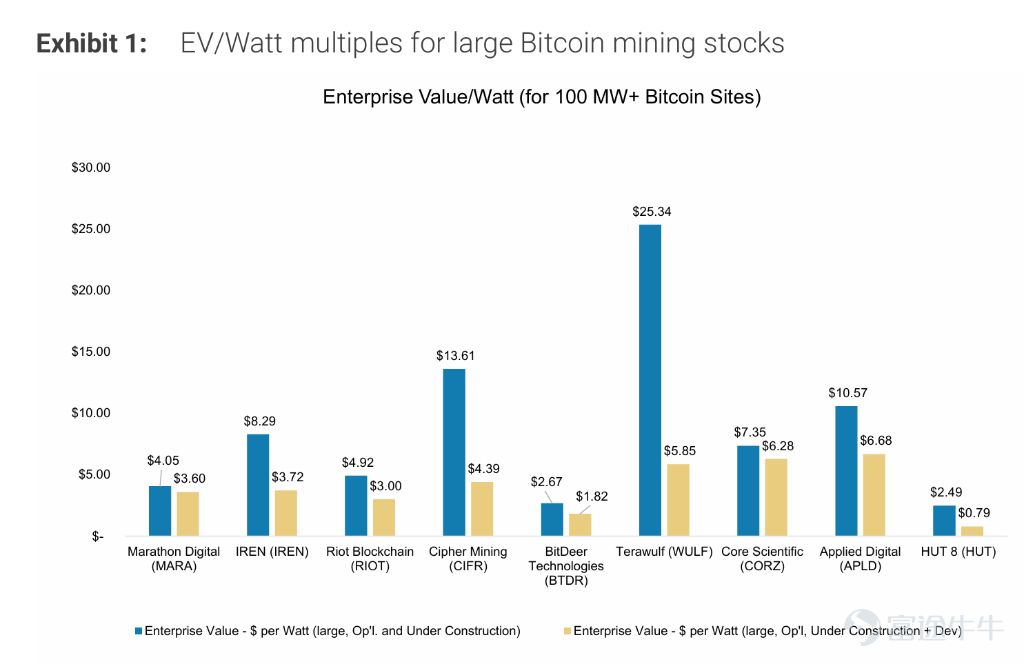
Currently, the stock valuations of many Bitcoin mining firms remain tied to mining logic, with their 'Enterprise Value per Watt' (EV/Watt) metrics at extremely low levels. The report estimates that if these mining operations were repurposed into data centers, the equity value generated could reach $5 to $8 per watt, far exceeding their current trading levels.For investors, this may indicate a significant valuation mismatch, along with a potential opportunity for excess returns.

Source: Morgan Stanley
In fact, mining companies transitioning to AI data centers have unique advantages, specifically:
1. Cost advantage of electricity
The power supply systems of mining operations can be directly reused, and the electricity purchase prices for mining companies are significantly lower than market procurement prices for data centers.
2. Ready-made infrastructure
High Efficiency:Building new HPC data centers typically takes 3-5 years, with grid connection wait times extending up to 6 years; in contrast, mining companies’ existing facilities can be deployed immediately.
Low cost:The construction cost of AI data centers exceeds 10 million USD per megawatt, whereas retrofitting mining facilities costs only 300,000 to 500,000 USD per megawatt. Mining companies in regions like Texas and North Dakota have secured low-cost electricity agreements and possess energy expansion capabilities.
The 'AI data center boom' extends to Bitcoin miners!
This year, driven by the wave of AI,Bitcoin miners, equipped with substantial power and computing resources, are becoming highly sought-after assets in the eyes of technology giants.
Futubull AI has compiled a list of Bitcoin mining enterprises currently listed on the U.S. stock market for fellow investors' reference.

Previously,The cryptocurrency mining industry is igniting a computational power revolution! Who has the potential to become the next CoreWeave?A previous article introduced fellow investors to the opportunities within crypto mining firms, and based on their performance over the past 20 trading sessions, they have delivered strong results, with some share prices doubling.

Specifically:
Applied Digital, a cryptocurrency mining and AI infrastructure company, announced that it has spent approximately $674 million purchasing high-end GPUs from NVIDIA and AMD, two leading chipmakers, to accelerate the expansion of its AI cloud business. This procurement includes 7,100 NVIDIA B300 GPUs, 4,200 NVIDIA B200 GPUs, and 1,100 AMD MI350X units. Upon completion of this order, Applied Digital's total GPU installation will significantly increase to around 23,000 units. The company’s stock has surged over 300% year-to-date.

In a statement, the company said that the new equipment would be delivered in phases to its facility in Prince George.This is expected to strongly support the company's goal of achieving an annual recurring revenue (ARR) of over $500 million from its AI cloud business by the end of the first quarter of 2026.

Daniel Roberts, Co-founder and CEO of Applied Digital, stated: "As global computing demand accelerates, customers are increasingly seeking partners capable of delivering at scale quickly. Within just a few months, our GPU count has doubled to over 23,000, highlighting the strength of our vertically integrated platform and our ability to meet urgent, long-term demands. This pre-contracting model before delivery further supports our growth trajectory."
It is worth noting that, on August 28, 2025,IREN entered into a strategic partnership with NVIDIA, becoming its preferred partner.
In addition, IREN's core strengths are reflected in its securedsubstantial power capacity and robust infrastructure deployment:
Power advantage: It has secured a total power capacity of 2.9GW, exceeding current contractual customer demand.
Infrastructure: It owns six built or under-construction data center campuses across five locations.

Current operations and near-term plans:
Ongoing operations:The Prince George data center in British Columbia, with a capacity of 50MW, is already operational with its GPU cluster; once all NVIDIA GPUs are installed, the power consumption will reach 30MW.
Projects under construction:
Horizon 1: Located within the Childress campus, with a scale of 50 megawatts and an investment of $350 million, it is scheduled to go online in Q4 2025.
Sweetwater 1: A hyperscale data center with a capacity of 1,400 megawatts, planned to be operational by April 2026.
Sweetwater 2: Under development, with a scale of 600 megawatts, expected to be operational by 2028.
Applied Digital is a company that many are familiar with, as it is one of NVIDIA’s portfolio holdings.Applied Digital was among the first miners to pivot towards constructing HPC data centers.This company's stock has risen more than two-fold this year.

APLD initially focused on cryptocurrency mining infrastructure, but since 2022, they have shifted their focus to AI and high-performance computing (HPC), primarily building large-scale data centers to provide computational power for companies engaged in AI and cloud computing.
Previously, APLD announced two contracts worth up to $7 billion with CoreWeave, with lease terms extending 15 years. This marks the largest transaction in APLD's history and represents one of the rarest large-scale long-term contracts in the AI data center industry.
In August 2025, Google acquired an 8% stake in the Bitcoin mining firm TeraWulf for $1.8 billion in funding and $3.7 billion in contract guarantees, securing 41 million warrants. This marked a landmark event in the convergence of cryptocurrencies and AI. Since receiving Google's backing, the company's stock has surged 93% year-to-date.

TeraWulf is a crypto mining company that has transitioned from Bitcoin mining to becoming an HPC service provider, leveraging its Lake Mariner data center in New York State (equipped with a 345kV transmission grid, closed-loop water cooling system, and ultra-low latency fiber optic network). The company signed a ten-year agreement with the AI cloud platform Fluidstack.The agreement provides 200 megawatts (200MW) of AI computing power. If renewed, the total contract value will reach $8.7 billion.
Google's entry not only provides capital support to TeraWulf but also validates the strategic value of its "zero-carbon energy-driven AI infrastructure," marking a fundamental shift in the mining business model from reliance on cryptocurrency price volatility to stable computing power services.
Earlier this year, the CEO of Cipher Mining outlined the company’s strategic transition from Bitcoin mining to data center development. This company has surged over 190% cumulatively this year.
Notably, Cipher Mining secured a $50 million investment from SoftBank, which will purchase approximately 10.4 million shares of the Bitcoin miner’s common stock. This financing was conducted through a public equity investment method.The funds will be used to support the construction of Cipher’s high-performance computing (HPC) and AI data center infrastructure.

CLSK’s new CEO recently mentioned entering the HPC field in an interview. Additionally, the company has increased its Bitcoin-backed credit line by $100 million via Coinbase. This $100 million financing will be used for strategic capital expenditures, including expanding CleanSpark’s energy portfolio, scaling its Bitcoin mining operations, andInvesting in high-performance computing (HPC) capabilities.Notably, The company has 1GW of reserve power.
Core Scientific was once one of the top Bitcoin miners but went bankrupt during the cryptocurrency market crash. With the recovery of Bitcoin prices and a successful transition to AI infrastructure business, the company officially emerged from bankruptcy last January.
Despite its origins in cryptocurrency mining, Core Scientific boasts a robust infrastructure advantage and has transformed into one of the key data center contractors for AI cloud computing company CoreWeave.Leveraging its abundant power resources, it has successfully transitioned from being a miner to a provider of computational infrastructure.
CoreWeave has signed a 12-year long-term agreement with Core Scientific to lease its 200-megawatt data center resources and expressed an acquisition interest of approximately $1 billion last year.
Riot began exploring AI and high-performance computing (HPC) businesses in early 2025.It officially initiated an evaluation to transform its Corsicana, Texas facility, which has a capacity of up to 600 megawatts, into high-performance infrastructure. This strategic shift also led to the temporary suspension of further expansion plans for its Bitcoin mining operations at the site. Although Riot has not yet secured any significant AI contracts, its Corsicana campus spans 355 acres and has the potential to support up to 1 gigawatt of power, making it attractive to hyperscale customers.
CEO Jason Les stated, "We will continue to expand our land reserves to ensure that the Corsicana facility can meet the demands of AI data centers."
Notably, in early June, the company announced the appointment of Jonathan Gibbs as its Chief Data Center Officer. With over 15 years of experience in designing and constructing large-scale data centers, Jonathan Gibbs’ portfolio includes more than 1,000 megawatts of capacity across North America, Europe, and Asia.
Hut 8's AI strategy entered a substantive phase in September 2024, when the company launched its GPU-as-a-Service business through a newly established subsidiary, Highrise AI.
Following this transformation, Hut 8 deployed over 1,000 NVIDIA H100 GPUs — specialized chips widely used for AI model training and inference, enhancing its cloud-based AI computational services. The project is supported by a five-year agreement that includes fixed payments and revenue-sharing provisions.
In March 2024, MARA released the MARA 2PIC700.This is an immersion cooling system specifically designed for high-density computing power, including AI and cryptocurrency mining.By mid-2024, the company will reposition its overall strategy towards an 'edge computing' layout.
In early 2025,MARA launched two high-performance computing pilot sites,each equipped with a 2PIC700 cooling system, with a single site power capacity of approximately 30 megawatts.
Galaxy Digital signed a 15-year lease agreement with cloud computing company CoreWeave for its Helios data center located in Texas,providing 133 megawatts of electricity,expected to generate approximately $4.5 billion in revenue through this lease agreement. This move not only demonstrates Galaxy Digital's strong capabilities in the digital asset space but also lays a solid foundation for its future market expansion.
Analysts noted that Galaxy’s acquisition of the Helios data center was originally an emergency response during the crypto winter; however, following the surge in AI demand, this asset has become a key growth engine. Rittenhouse estimates that Helios will contribute $1.7 billion in EBITDA and $32 billion in equity value, far exceeding the volatility and high investment associated with mining operations.
Since mid-2023, Hive officially transitioned to focus on NVIDIA-powered computing clusters and rebranded from Hive Blockchain, marking its strategic shift towards AI.
After conducting small-scale pilot projects, Hive invested $30 million in December 2024 to deploy GPUs in Quebec, Canada. By mid-2025, over 5,000 units have been deployed.
In the fiscal year 2025, Hive achieved total revenue of $115.3 million, with its AI and high-performance computing (HPC) hosting business contributing $10.1 million—triple the amount from the same period last year, now accounting for nearly 9% of total revenue.Hive aims to achieve $100 million in AI revenue by 2026.
HIVE recently announced the acquisition of a 7.2-megawatt data center located in Toronto, Canada. HIVE plans to convert it into a Tier 3 data center for its subsidiary BUZZ HPC, capable of accommodating up to 5,000 next-generation liquid-cooled GPUs.This move is clearly aimed at meeting the demands of AI model training and inference.
Craig Tavares, President of BUZZ HPC, emphasized the strategic importance of establishing a 'sovereign AI data center' to ensure data residency and security in Canada. This aligns with the global trend of countries competing to build domestic AI infrastructure.
For HIVE, which originated from a cryptocurrency mining enterprise, this represents a significant step towards its evolution into a diversified AI and cloud service provider, creating a new narrative for investors that is less reliant on the daily fluctuations of cryptocurrency prices.
At the beginning of the year, Bitfarms announced a strategic partnership with Appleby Strategy Group (ASG) and World Wide Technology (WWT). According to GlobeNewswire, this collaboration aims to conduct a comprehensive feasibility analysis of Bitfarms' high-performance computing (HPC) and artificial intelligence (AI) applications across North America.
On November 10, 2023, Bitdeer entered into a cooperation agreement with NVIDIA, becoming the first Cloud Service Provider (CSP) partner in Asia to offer DGX H100 SuperPOD cloud services.
Bitdeer will enjoy priority supply rights from NVIDIA, providing GPU cloud services for the development and training of AI models. This announcement was made at a press conference held at NVIDIA's Singapore office, highlighting Bitdeer's emphasis on the title of 'NVIDIA Partner.'
Bitdeer's AI development roadmap encompasses infrastructure construction, cloud platforms, software support, and application API services. Through its collaboration with NVIDIA, Bitdeer will continuously invest in infrastructure such as GPUs, DGX, and SuperPod, while launching cloud computing platforms, artificial intelligence training and inference platforms, AI software tools, and application programming interfaces to provide comprehensive support for AI development.
Overall, the core rationale for mining companies transitioning to AI/HPC lies in achieving diversified revenue streams.However, whether infrastructure advantages can translate into sustained profitability will become the key differentiator for companies navigating industry cycles. Therefore, investors need to exercise prudent judgment.

Risk Disclaimer: The above content only represents the author's view. It does not represent any position or investment advice of Futu. Futu makes no representation or warranty.Read more
Comments (19)
to post a comment
174
767
