
English
Back
Open Account
牛牛課堂
wrote a column · ·

Electricity is the hard currency of AI! Morgan Stanley targets four core investment tracks; who is likely to take the lead?

While the spotlight of the global technology sector remains focused on NVIDIA, a more disruptive industrial revolution has been quietly brewing beneath the surface.
Morgan Stanley's latest in-depth report, "Powering AI in the US," clearly indicates that AI is no longer merely a "storytelling" phenomenon; AI-driven infrastructure investments have progressed from proof of concept to the stage of large-scale implementation.Electricity is becoming the most critical resource determining the pace of AI development.
Is electricity the bottleneck for AI?
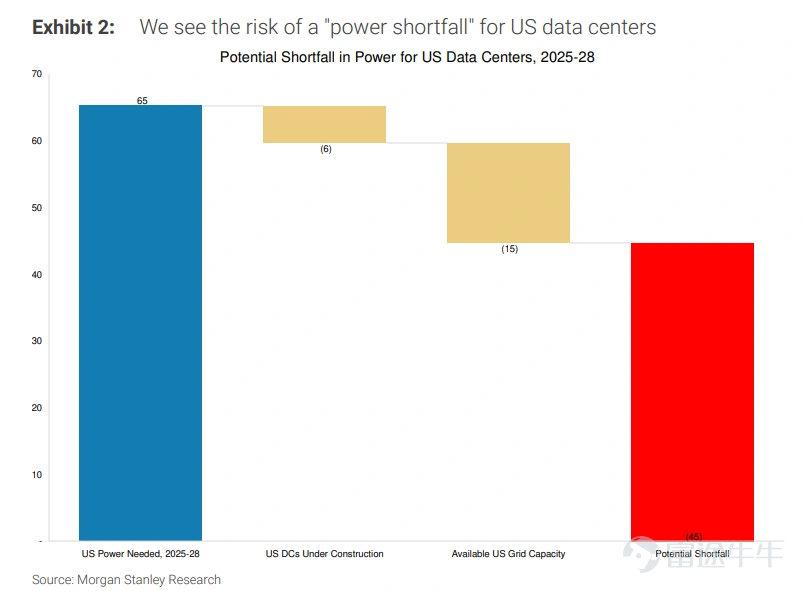
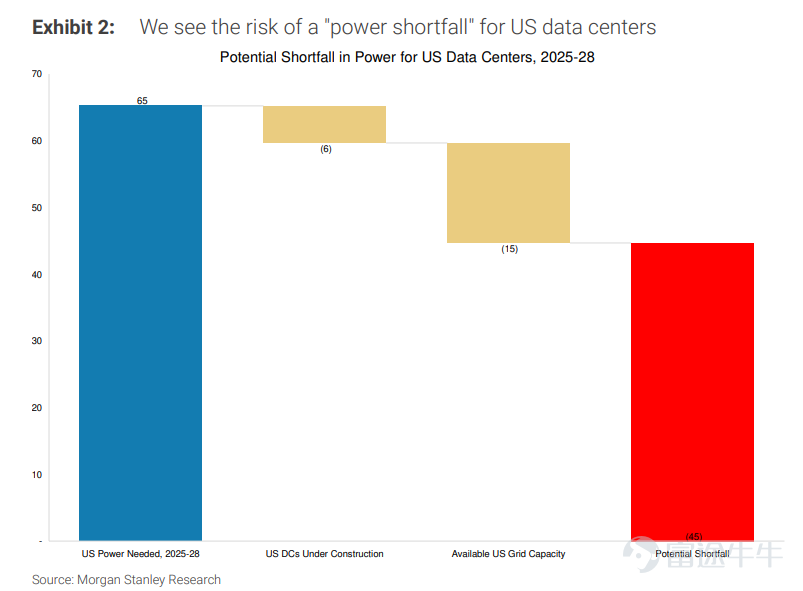
According to Morgan Stanley's estimates, from 2025 to 2028,the additional electricity demand from AI data centers in the United States will reach an astonishing 65 GW.However, the reality is that the incremental electricity that can be provided by the national grid in the short term is only 21 GW (15 GW can be accessed immediately + 6 GW under construction).This means that there will be a power shortfall of nearly 45 GW in the United States over the next 3-4 years.
Source: Morgan Stanley
According to a report from Morgan Stanley, the firm believes that there are currently four possible solutions:1) Retrofit existing Bitcoin mining facilities; 2) Establish new data centers relying on large nuclear power plants; 3) Build new natural gas power plants; 4) Utilize distributed fuel cells.
Notably, Morgan Stanley indicated that even if all four methods are employed, the U.S. power grid would only barely maintain a state of "rough balance," and risks to the power system would still exist.
To address this,Morgan Stanley has proposed a groundbreaking valuation concept called "time-based power supply."Anticipating the immense value of future power solutions: pioneers are expected to achieve a value reassessment of $500 billion within 3-5 years; by 2030, overall value creation is projected to rise to $1.1 trillion.
While the global technology sector remains focused on NVIDIA, a more disruptive industrial revolution has quietly been brewing beneath the surface. Morgan Stanley's latest in-depth report, "Powering AI in the US," clearly states: AI is no longer just "telling stories"; AI-driven infrastructure investment has moved from proof of concept to the stage of scaling.Electricity is becoming the most critical resource determining the pace of AI. Is electricity the bottleneck for AI? According to estimates from Morgan Stanley, from 2025 to 2028,the additional power demand from AI data centers in the United States will reach an astonishing 65 GW.However, the reality is that the incremental power that can be supplied by the U.S. power grid in the short term is only 21 GW (15 GW can be accessed immediately + 6 GW under construction),which means that there will be a nearly 45 GW power gap in the United States over the next 3 to 4 years. According to Morgan Stanley's research report, the firm believes that there are currently four methods:1) Transforming the existing Bitcoin mining facilities; 2) Establishing data centers relying on large nuclear power plants; 3) Constructing new natural gas power plants; 4) Utilizing distributed fuel cells. It is noteworthy that Morgan Stanley has indicated that even with the implementation of these four methods, the U.S. power grid would only barely maintain a state of 'rough balance,' and risks within the power system would still persist. To this end,Morgan Stanley has prominently introduced a new valuation concept of 'time-based power supply.',Anticipating the immense value of future power solutions: early movers are expected to...
In other words, In the next 3-5 years, the industry that successfully addresses the electricity consumption challenges of AI will occupy a crucial position in the industrial chain.
Among the four major industries, which one will emerge as the leader?
Based on Morgan Stanley's aforementioned report,Bitcoin mining companies, nuclear power plants, natural gas power plants, and distributed fuel cells are expected to become the next investment avenues.So, what is the current status of these industries? Which companies are worth paying attention to? We will analyze them one by one for fellow investors.
1. The repurposing of Bitcoin mining sites
Morgan Stanley utilized a metric, namely"Enterprise Value/Watt (EV/Watt)" – which compares Bitcoin mining operations with high-performance computing (HPC) data centers.
While the global technology sector remains focused on NVIDIA, a more disruptive industrial revolution has quietly been brewing beneath the surface. Morgan Stanley's latest in-depth report, "Powering AI in the US," clearly states: AI is no longer just "telling stories"; AI-driven infrastructure investment has moved from proof of concept to the stage of scaling.Electricity is becoming the most critical resource determining the pace of AI. Is electricity the bottleneck for AI? According to estimates from Morgan Stanley, from 2025 to 2028,the additional power demand from AI data centers in the United States will reach an astonishing 65 GW.However, the reality is that the incremental power that can be supplied by the U.S. power grid in the short term is only 21 GW (15 GW can be accessed immediately + 6 GW under construction),which means that there will be a nearly 45 GW power gap in the United States over the next 3 to 4 years. According to Morgan Stanley's research report, the firm believes that there are currently four methods:1) Transforming the existing Bitcoin mining facilities; 2) Establishing data centers relying on large nuclear power plants; 3) Constructing new natural gas power plants; 4) Utilizing distributed fuel cells. It is noteworthy that Morgan Stanley has indicated that even with the implementation of these four methods, the U.S. power grid would only barely maintain a state of 'rough balance,' and risks within the power system would still persist. To this end,Morgan Stanley has prominently introduced a new valuation concept of 'time-based power supply.',Anticipating the immense value of future power solutions: early movers are expected to...
Morgan Stanley found that Bitcoin investors generally overlook the intrinsic value of electricity resources,yet the firm still considers converting Bitcoin mining facilities into high-performance computing (HPC) data centers to be a viable "de-bottlenecking" solution,although rising Bitcoin prices may reduce operational capacity and increase conversion costs.
While the global technology sector remains focused on NVIDIA, a more disruptive industrial revolution has quietly been brewing beneath the surface. Morgan Stanley's latest in-depth report, "Powering AI in the US," clearly states: AI is no longer just "telling stories"; AI-driven infrastructure investment has moved from proof of concept to the stage of scaling.Electricity is becoming the most critical resource determining the pace of AI. Is electricity the bottleneck for AI? According to estimates from Morgan Stanley, from 2025 to 2028,the additional power demand from AI data centers in the United States will reach an astonishing 65 GW.However, the reality is that the incremental power that can be supplied by the U.S. power grid in the short term is only 21 GW (15 GW can be accessed immediately + 6 GW under construction),which means that there will be a nearly 45 GW power gap in the United States over the next 3 to 4 years. According to Morgan Stanley's research report, the firm believes that there are currently four methods:1) Transforming the existing Bitcoin mining facilities; 2) Establishing data centers relying on large nuclear power plants; 3) Constructing new natural gas power plants; 4) Utilizing distributed fuel cells. It is noteworthy that Morgan Stanley has indicated that even with the implementation of these four methods, the U.S. power grid would only barely maintain a state of 'rough balance,' and risks within the power system would still persist. To this end,Morgan Stanley has prominently introduced a new valuation concept of 'time-based power supply.',Anticipating the immense value of future power solutions: early movers are expected to...
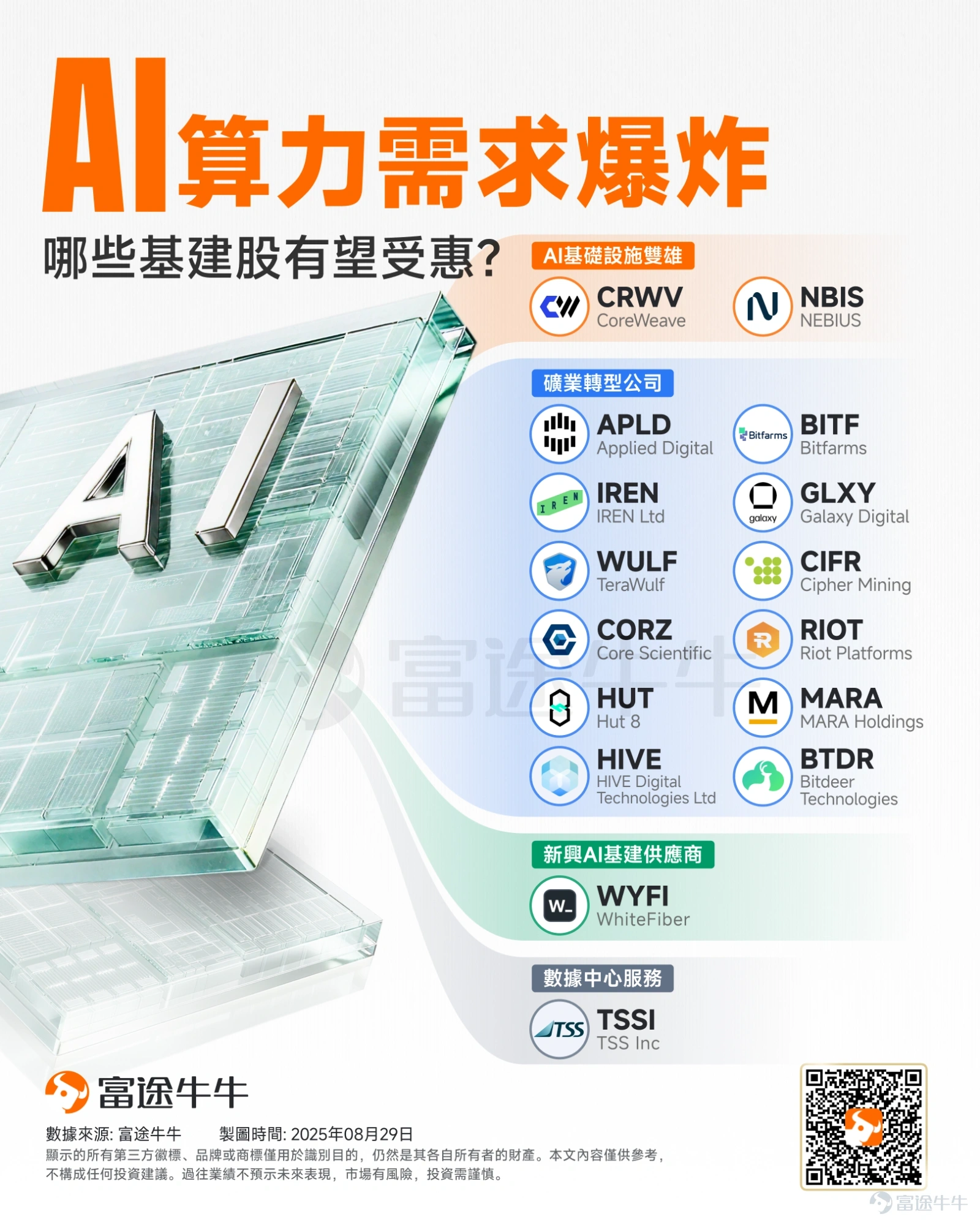
Among them, IREN will implement a key strategic transformation starting in 2024, expanding from a single cryptocurrency mining business to encompass artificial intelligence (AI), high-performance computing (HPC), and the provision of data center solutions and cloud services.
The company anticipates that its annual revenue from Bitcoin mining will reach $1 billion, while its AI cloud business's annual revenue is nearing $250 million. IREN has replaced ASICs used for Bitcoin mining with GPUs in several mining centers to support its AI cloud business.Additionally, it is investing in the construction of a liquid-cooled AI data center named "Horizon."It is expected to go live in the fourth quarter of 2025.Another facility, named Sweetwater, is expected to be operational by the end of 2027.
According to a research report from Morgan Stanley, the company is more optimistic about: $Riot Platforms (RIOT.US)$$Cipher Digital (CIFR.US)$$Hut 8 (HUT.US)$$Bitdeer Technologies Group (BTDR.US)$ and $IREN Ltd (IREN.US)$
Overall, Bitcoin mining sites typically possess substantial power infrastructure, which can be repurposed to support the operations of data centers, particularly in the energy-intensive fields of AI and big data processing.
With the advancement of AI technology, the demand for electricity has surged dramatically, and the energy infrastructure originally used for Bitcoin mining can be transformed into a valuable asset for supporting AI data centers.This conversion not only enhances the economic efficiency of these sites but also reduces the time and costs associated with constructing new data centers.
2. Natural gas is the bridge of the present, while nuclear power is the cornerstone of the future.
As demand for gas from AI data centers increases, Morgan Stanley points out thatthe natural gas supply chain (including upstream suppliers and midstream pipeline companies) will benefit from the signing of long-term premium contracts.
The analysis by the firm indicates that if a 20-year supply agreement is signed, the enterprise value/EBITDA of the natural gas supply business segment will exceed 10 times, indicating that the value of these assets will undergo a significant revaluation.
In addition, Morgan Stanley believes thatmajor technology companies (such as Microsoft, Amazon, Google, etc.) are achieving three goals through investments in nuclear power:meeting regulatory requirements for 'additional' power sources, supporting emissions reduction commitments, and obtaining stable and controllable baseload power.
This year,"Tech Giants Compete for Deployment! Nuclear Power Stocks Expected to Break Through by 2025, Potentially Becoming the Next Battlefield for AI?""Is Nuclear Energy the New Solution Amid the AI Wave? This Industry Has Emerged as an 'Invisible Winner,' Having Surged Over 220% This Year"As indicated by multiple articles,AI data centers are set to become the next generation 'electric tigers,' with the proportion of power consumption by data centers expected to further increase, positioning nuclear power as the next battlefield for AI.
While the global technology sector remains focused on NVIDIA, a more disruptive industrial revolution has quietly been brewing beneath the surface. Morgan Stanley's latest in-depth report, "Powering AI in the US," clearly states: AI is no longer just "telling stories"; AI-driven infrastructure investment has moved from proof of concept to the stage of scaling.Electricity is becoming the most critical resource determining the pace of AI. Is electricity the bottleneck for AI? According to estimates from Morgan Stanley, from 2025 to 2028,the additional power demand from AI data centers in the United States will reach an astonishing 65 GW.However, the reality is that the incremental power that can be supplied by the U.S. power grid in the short term is only 21 GW (15 GW can be accessed immediately + 6 GW under construction),which means that there will be a nearly 45 GW power gap in the United States over the next 3 to 4 years. According to Morgan Stanley's research report, the firm believes that there are currently four methods:1) Transforming the existing Bitcoin mining facilities; 2) Establishing data centers relying on large nuclear power plants; 3) Constructing new natural gas power plants; 4) Utilizing distributed fuel cells. It is noteworthy that Morgan Stanley has indicated that even with the implementation of these four methods, the U.S. power grid would only barely maintain a state of 'rough balance,' and risks within the power system would still persist. To this end,Morgan Stanley has prominently introduced a new valuation concept of 'time-based power supply.',Anticipating the immense value of future power solutions: early movers are expected to...
In contrast, upstream design and manufacturing have higher thresholds for expertise and technical barriers, granting upstream manufacturers greater bargaining power. The downstream operations and maintenance segment, due to its long and stable operational cycle, can generate long-term cash flow and is also more profitable. However, the profit margins in the midstream project construction segment are constrained by construction costs, project cycles, and engineering risks, leading to less stability in profit margins compared to the upstream or downstream.
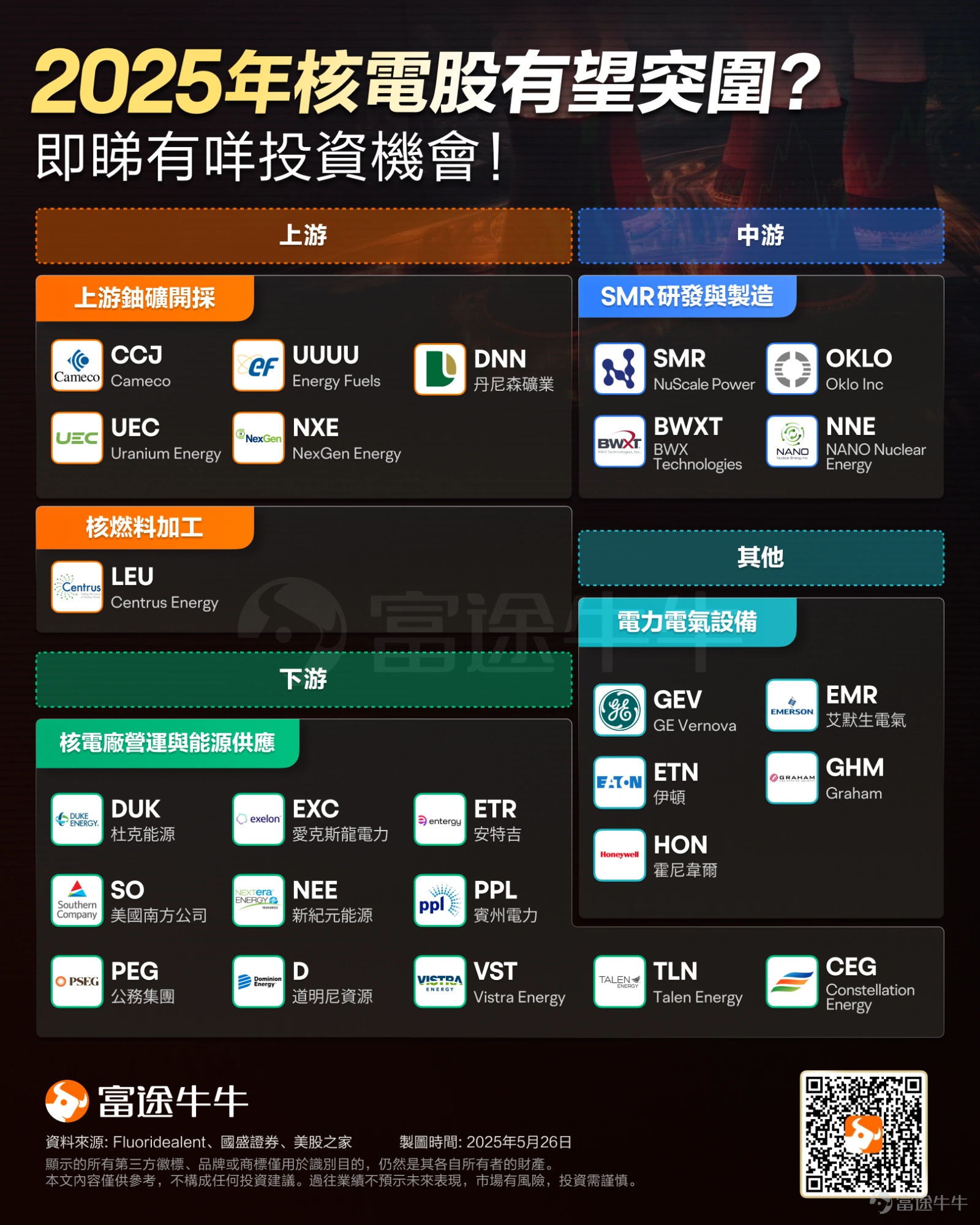
Upstream: Raw Materials and Processing
The upstream supply chain primarily involves the essential raw materials, key equipment, and nuclear fuel required for nuclear energy development, which mainly includes uranium mining and uranium enrichment.
Midstream: Design, Research and Development, and Construction
The midstream includes design, research and development, and construction. Among these,
$NuScale Power (SMR.US)$ is the first publicly listed SMR nuclear power company, with its core product being the SMR power module.
$Oklo Inc (OKLO.US)$ focuses on the development of small modular reactors (SMRs). The company has received investment from Sam Altman, the 'father of ChatGPT';
$NANO Nuclear Energy (NNE.US)$ Focused on the development of small modular reactors, the main business covers four areas related to SMRs, encompassing multiple stages such as manufacturing, fuel, and transportation, with the aim of building a diversified vertically integrated industrial chain;
$BWX Technologies (BWXT.US)$ focuses on the manufacturing of nuclear reactor components and nuclear energy technology. The main difference between BWXT and SMR/Oklo is that BWXT is a major supplier of large equipment and technical services, primarily providing nuclear reactor components, nuclear fuel, and defense-related nuclear technologies to the government and commercial sectors, with clients including the U.S. government (such as providing nuclear reactors for naval submarines).
Downstream: Operations, Sales, and Waste Management
The downstream primarily involves the operation of nuclear power plants and energy supply, with participants including $Constellation Energy (CEG.US)$$Vistra Energy (VST.US)$$American Electric Power (AEP.US)$$Southern (SO.US)$$Exelon (EXC.US)$$Duke Energy (DUK.US)$$Entergy (ETR.US)$$Public Service Enterprise Group (PEG.US)$ and so on.
Furthermore, electrical equipment includes $GE Vernova (GEV.US)$$Eaton (ETN.US)$$Honeywell (HON.US)$$Emerson Electric (EMR.US)$$Graham (GHM.US)$ and so on.
More noteworthy is that analysts have pointed out thatthe Trump administration in the United States is promoting equity stakes in businesses across various industries, with the next potential target likely being the nuclear energy sector.
Analysts from Compass Point indicate that the U.S. Department of Energy has recently established a new nuclear fuel alliance, paving the way for Trump administration investments in enterprises aimed at establishing a domestic enriched uranium supply system, which is a key fuel required for nuclear power generation.
Furthermore, recent reports indicate that in response to the substantial electricity demand from AI data centers, the largest renewable energy developer in the United States, NextEra Energy (NEE.US) has recently obtained approval from the Federal Energy Regulatory Commission to reconnect the Duane Arnold Nuclear Power Plant in Iowa to the grid.This marks the third nuclear power plant to enter the restart process, following the Palisades Nuclear Power Plant in Michigan (expected to come back online this year) and the Three Mile Island Nuclear Power Plant in Pennsylvania (2027), and it could potentially be the last decommissioned reactor to meet the criteria for restart.
However, investors looking to bet on "AI + nuclear power plant restart" should also be aware that this path will not be straightforward. NextEra has indicated to regulators thatthe project to restart nuclear power plants is a "highly capital-intensive process"with plans to invest up to $100 million in this project by 2025.
Morgan Stanley also reminds that,While SMR is highly anticipated, its widespread implementation may still have to wait for the next decade.
3. Seeking new paradigms to address power shortages: microgrids, mobile power sources
Microgrids
Morgan Stanley states that, in the context of the ongoing development of data centers, businesses and investors should pay closer attention to"microgrids". Among them, $Bloom Energy (BE.US)$Considered by Morgan Stanley as a core beneficiary capable of providing microgrid-type power solutions.
Microgrid providers, leveraging high power density, flexible deployment, and high stability advantages, have become a vital supplement for reliable power supply to data centers. They allow critical loads, facilities, and even entire communities to continue operating when the surrounding grid is unavailable.
Morgan Stanley believes that Bloom Energy's Always On fuel cell microgrid solution has several key advantages: (i) high-quality power; (ii) high equipment reliability; (iii) relatively small unit size, providing high redundancy even in the event of a single unit failure; (iv) high power density; and (v) highly flexible output power, accommodating changes in Bloom's power demand.
While the global technology sector remains focused on NVIDIA, a more disruptive industrial revolution has quietly been brewing beneath the surface. Morgan Stanley's latest in-depth report, "Powering AI in the US," clearly states: AI is no longer just "telling stories"; AI-driven infrastructure investment has moved from proof of concept to the stage of scaling.Electricity is becoming the most critical resource determining the pace of AI. Is electricity the bottleneck for AI? According to estimates from Morgan Stanley, from 2025 to 2028,the additional power demand from AI data centers in the United States will reach an astonishing 65 GW.However, the reality is that the incremental power that can be supplied by the U.S. power grid in the short term is only 21 GW (15 GW can be accessed immediately + 6 GW under construction),which means that there will be a nearly 45 GW power gap in the United States over the next 3 to 4 years. According to Morgan Stanley's research report, the firm believes that there are currently four methods:1) Transforming the existing Bitcoin mining facilities; 2) Establishing data centers relying on large nuclear power plants; 3) Constructing new natural gas power plants; 4) Utilizing distributed fuel cells. It is noteworthy that Morgan Stanley has indicated that even with the implementation of these four methods, the U.S. power grid would only barely maintain a state of 'rough balance,' and risks within the power system would still persist. To this end,Morgan Stanley has prominently introduced a new valuation concept of 'time-based power supply.',Anticipating the immense value of future power solutions: early movers are expected to...
Moreover, according to China Merchants Securities, AI has led to rapid growth in global data center electricity consumption. In regions with lower power system redundancy, such as North America, power supply issues are becoming increasingly urgent, with new power access in areas like PJM in the United States typically requiring a wait of 3 to 5 years. The traditional reliance on grid power supply models is struggling to meet the demands of newly constructed data centers.
Additionally, there is a tight supply of power generation equipment such as gas turbine generators, with GE Vernova's delivery cycle extending to 3-5 years.In this context, solid oxide fuel cells (SOFCs) have emerged as an alternative power source for overseas data centers due to their modular rapid deployment, high efficiency, high reliability, and low emissions.The rapid deployment capability of SOFCs is a core advantage. Although the initial capital expenditure is high and the replacement cost of core components is significant due to their relatively short lifespan, considering the ITC subsidies and the potential for future cost reductions, their long-term economics may warrant attention.
Bloom Energy is a global leader in SOFC technology.In the fixed fuel cell sector, it has a market share of approximately 40%, securing substantial orders for data center power supply systems from industry giants such as Oracle, Equinix, and AEP, thanks to its groundbreaking applications in the U.S. power grid and data center fields.
As of Q2 2025, the company has accumulated over 1 GW of SOFC orders pending delivery, covering data centers, utilities, and industrial customers. In July 2025, the company announced a collaboration with Oracle to provide power for its AI data center, promising a 90-day delivery; in 2024, it partnered with CoreWeave, with operations scheduled to commence in Q3 2025 in Illinois, marking a rapid entry of SOFC into the AI computational power scenario. That same year, Bloom signed a 1 GW order with AEP (with the first 100 MW to be delivered), establishing the largest procurement in the history of fuel cells, and the collaboration with Equinix also exceeds 100 MW, covering 19 data centers, highlighting the replicability and scalability potential of SOFC among top-tier IDC clients.
Bloom currently has a production capacity of 1 GW, which is expected to double to 2 GW by 2026 to meet the rapidly growing IDC market. In the future, as economies of scale become evident, system costs are anticipated to continue to decline. The company emphasizes the advantages of fuel flexibility and modular deployment, believing that SOFC is likely to gradually replace traditional diesel engines and gas turbines in the coming years.It aims to become the core power choice for data centers.
Mobile power sources.
In response to stringent regulatory requirements regarding 'Additionality' in certain regions, Morgan Stanley has proposed a 'bridging development' strategy.
This strategy suggests initially deploying mobile power sources (such as natural gas generators or fuel cells), and gradually expanding the data center scale after obtaining formal grid connection permits.In the long term, this approach allows for a stepwise expansion while also providing transitional assurance for final grid connection.
In regions such as Texas, where strict 'additionality' policies are enforced, data center developers will not be permitted to connect to the grid unless they simultaneously construct new power generation facilities. This regulatory trend is primarily based on two considerations:
To prevent the electricity demand from data centers from driving up residential electricity prices;
To ensure the overall safety and redundancy of the grid's operation.
Against this backdrop, companies capable of providing mobile power sources or rapidly deployable generation equipment—such as GE Vernova and Caterpillar—are expected to benefit significantly.
Summary
Morgan Stanley points out thatAI investments are gradually entering the 'monetization phase.'In the coming years, the AI industry chain in the United States will face a critical turning point: the bottleneck in power supply will become a core factor in reshaping the industry's valuation structure.
During this window period, thoseenergy and computing infrastructure companies that possess the capabilities of 'early power supply,' 'rapid deployment,' and 'high added value' are expected to be the first to achieve an increase in valuation.
🔥Futu's strategy meeting is making a significant impact!
From September 1 to September 14, Futu will host15 investment summits, where top expert institutions will gather to discussinvestment opportunities in the era of Hong Kong and US stocks.At that timeOnline and offlinewill be broadcasted simultaneously, with real-time interactive Q&A, and even morea thousand giftsWaiting for you to claimLimited spots available, register now >>>
While the global technology sector remains focused on NVIDIA, a more disruptive industrial revolution has quietly been brewing beneath the surface. Morgan Stanley's latest in-depth report, "Powering AI in the US," clearly states: AI is no longer just "telling stories"; AI-driven infrastructure investment has moved from proof of concept to the stage of scaling.Electricity is becoming the most critical resource determining the pace of AI. Is electricity the bottleneck for AI? According to estimates from Morgan Stanley, from 2025 to 2028,the additional power demand from AI data centers in the United States will reach an astonishing 65 GW.However, the reality is that the incremental power that can be supplied by the U.S. power grid in the short term is only 21 GW (15 GW can be accessed immediately + 6 GW under construction),which means that there will be a nearly 45 GW power gap in the United States over the next 3 to 4 years. According to Morgan Stanley's research report, the firm believes that there are currently four methods:1) Transforming the existing Bitcoin mining facilities; 2) Establishing data centers relying on large nuclear power plants; 3) Constructing new natural gas power plants; 4) Utilizing distributed fuel cells. It is noteworthy that Morgan Stanley has indicated that even with the implementation of these four methods, the U.S. power grid would only barely maintain a state of 'rough balance,' and risks within the power system would still persist. To this end,Morgan Stanley has prominently introduced a new valuation concept of 'time-based power supply.',Anticipating the immense value of future power solutions: early movers are expected to...
Risk Disclaimer: The above content only represents the author's view. It does not represent any position or investment advice of Futu. Futu makes no representation or warranty.Read more
Thumbs Up
193
Respect
4
Heart
10
Emm
1
Lol
2
Thumbs Up
1
1.1M Views
Report
Comments (10)
Write a Comment...
10
211
649