
English
Back
Open Account
Introductory knowledge and strategies of Warrants & Callable Bull/Bear Contract (CBBC)
富途投教導師大乾
joined discussion · ·

Bull and bear certificate beginner lazy person's guide

Hi, everyone. Lately, I have been frequently onGroupFrom mooer friends in the group, for beginner friends, we know that bull and bear certificates can skyrocket and plummet, but are unsure about the corresponding risks. For example, under what circumstances will bull and bear certificates be forcibly redeemed? After redemption, are they worthless or do they retain some residual value? How is the residual value calculated? There are even fundamental questions, such as: what do the long strings of names on bull and bear certificates mean?
So, today we will focus on the basic issues above, and sort out relevant knowledge points for everyone. >>
I. What are Bull and Bear Certificates
1. Definition of Bull and Bear Certificates
Bull and bear certificates are leveraged investment tools suitable for short-term trading. Each bull and bear certificate is linked to the same underlying asset, which can be stocks or indices. If you are bullish on an asset's rise, you can buy bull certificates; conversely, you can buy bear certificates.
Due to the redemption mechanism of bull and bear certificates, once the price of the underlying asset falls below (bull certificates) or rises above (bear certificates) the redemption price, the product will be forcibly redeemed and trading will be stopped. Therefore, before trading bull and bear certificates, it is essential to clearly understand the associated risks.
2. Identifying the names of Bull and Bear Certificates
Mooers can determine bull and bear certificates from the listed numbers. Currently, bull and bear certificates in the market are uniformly assigned listing numbers starting with '5' and '6'.
At the same time, both the Chinese and English names convey a lot of product information.
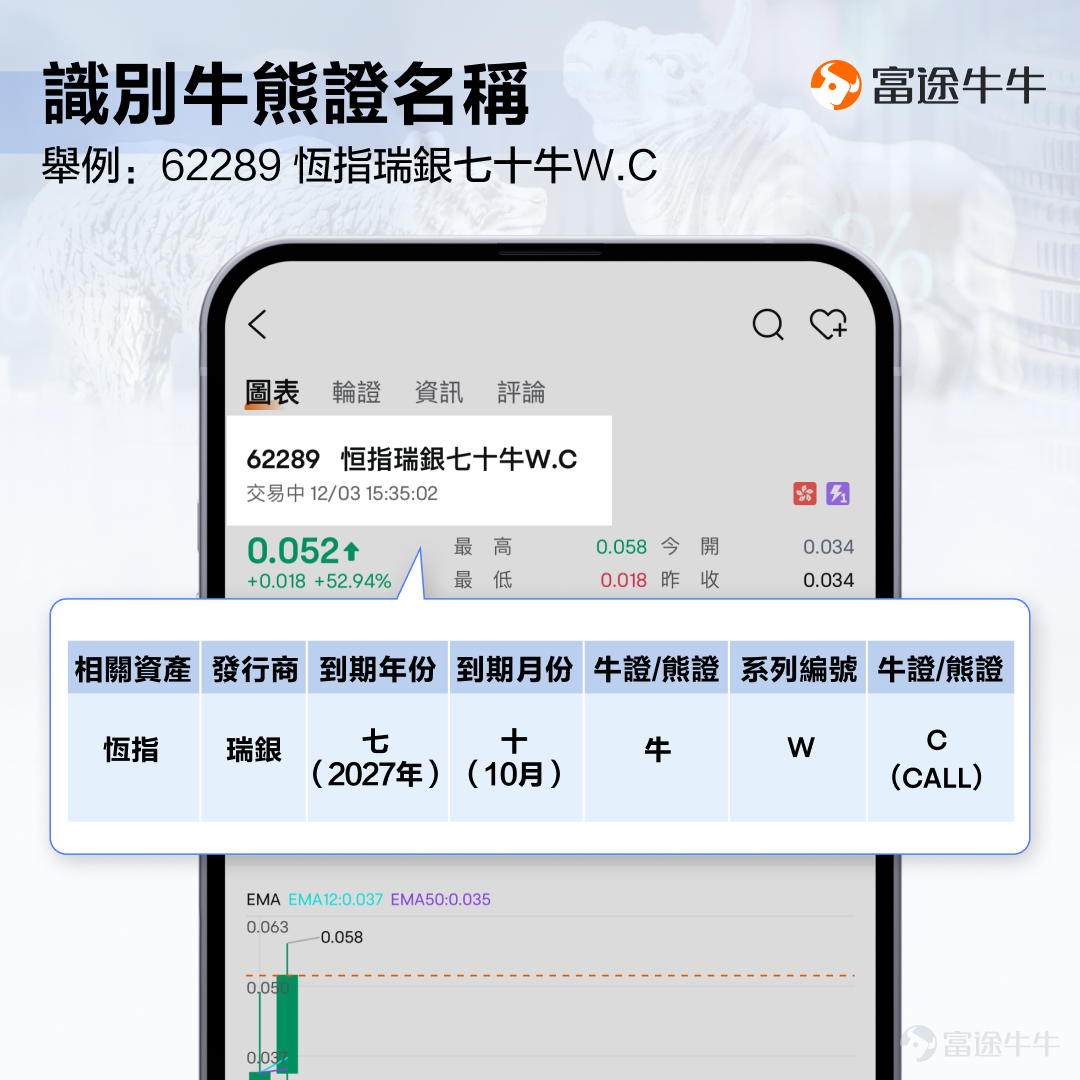
Example: 62289 Hang Seng UBS Bull 70 W.C
Hi, everyone. Lately, I have been frequently on[Share Link: Group]From mooer friends in the group[Shocked], For novice friends, we know that bull and bear certificates can skyrocket and plummet, but are unclear about the corresponding risks. For example: Under what circumstances would bull and bear certificates be forcibly redeemed? After redemption, are they worthless or still have residual value? How is the residual value calculated? There are even basic questions like: What do the long string of names of bull and bear certificates mean? So today, we will focus on the basic questions above and sort out the relevant key points for everyone. >>[Grin] First, what are Bull and Bear Certificates? 1. Definition of Bull and Bear Certificates Bull and bear certificates are leveraged investment tools suitable for short-term trading. Each bull and bear certificate is linked to the same underlying asset, which can be stocks or indices. If you are bullish on an asset's rise, you can buy bull certificates; conversely, you can buy bear certificates. Due to the redemption mechanism of bull and bear certificates, once the price of the underlying asset falls below (bull certificates) or rises above (bear certificates) the redemption price, the product will be forcibly redeemed and trading will be stopped. Therefore, before trading bull and bear certificates, it is essential to clearly understand the associated risks. 2. Identify the names of bull and bear certificates Mooers can determine bull and bear certificates from the listed numbers. Currently, bull and bear certificates in the market are uniformly assigned listing numbers starting with '5' and '6'. At the same time, both the Chinese and English names also convey a lot of product information. Example: 62289 Hang Seng UBS Bull 70 W.C 1. The first two characters are the name of the underlying assets. For example, Hang Seng represents that this bull and bear certificate tracks the trend of the Hang Seng Index.  2. The third and fourth characters refer to the abbreviation of the issuer of futubull certificates, such as UBS Group, representing this...
1. The first two characters are the name of the underlying assets. For example, Hang Seng represents that this bull and bear certificate tracks the trend of the Hang Seng Index.
2. The third and fourth characters are the abbreviation of the issuer of the bull and bear certificate. For example, UBS Group represents that the issuer of this bull and bear certificate is UBS Group.
The fifth and sixth characters represent the expiration year/month. For example, seventy represents October 2027; there are also special cases, such as 'seven甲' or 'seven乙', where '甲' represents November and '乙' represents December. Therefore, 'seven甲' is November 2027, and 'seven乙' represents December 2027.
The last Chinese character, Bullish or Bearish, represents Bullish or Bearish certificates.
The first letter at the end, for example ABCDE..., represents the issuer issuing multiple bull and bear certificates with the same exercise time but different exercise conditions (e.g. different exercise prices), so letters are used for distinction.
The last letter C or P is the abbreviation of call and put, representing Bullish and Bearish certificates respectively.
In summary, based on the information in the picture, we understand:This is a bull certificate tracking the Hang Seng Index issued by UBS Group, with an exercise time of October 2027.Is it super simple? 😎
2. Characteristics of Bull and Bear Certificates
Bull and Bear Certificates have two important characteristicsLeverage and Forced Redemption Mechanism
1. Leverage
FutuBear warrants have the characteristic of small bets for big gains. Theoretically, when the price of the underlying asset rises by 1%, a bull warrant with a leverage ratio of 10 times will increase by 10%.
For example: We are Bullish on the price of Tencent stocks, buying one lot of actual stocks requires 40,440 Hong Kong dollars (as shown in the figure below), while buying a Tencent Bull certificate with a leverage ratio of 19.73, the cost of one lot is only 2050 yuan. In other words, we only need to spend about one twentieth of the capital to obtain the same return as investing in actual stocks.
Of course, leverage can amplify returns as well as losses, so it is necessary to strictly manage positions to control risks.
Hi, everyone. Lately, I have been frequently on[Share Link: Group]From mooer friends in the group[Shocked], For novice friends, we know that bull and bear certificates can skyrocket and plummet, but are unclear about the corresponding risks. For example: Under what circumstances would bull and bear certificates be forcibly redeemed? After redemption, are they worthless or still have residual value? How is the residual value calculated? There are even basic questions like: What do the long string of names of bull and bear certificates mean? So today, we will focus on the basic questions above and sort out the relevant key points for everyone. >>[Grin] First, what are Bull and Bear Certificates? 1. Definition of Bull and Bear Certificates Bull and bear certificates are leveraged investment tools suitable for short-term trading. Each bull and bear certificate is linked to the same underlying asset, which can be stocks or indices. If you are bullish on an asset's rise, you can buy bull certificates; conversely, you can buy bear certificates. Due to the redemption mechanism of bull and bear certificates, once the price of the underlying asset falls below (bull certificates) or rises above (bear certificates) the redemption price, the product will be forcibly redeemed and trading will be stopped. Therefore, before trading bull and bear certificates, it is essential to clearly understand the associated risks. 2. Identify the names of bull and bear certificates Mooers can determine bull and bear certificates from the listed numbers. Currently, bull and bear certificates in the market are uniformly assigned listing numbers starting with '5' and '6'. At the same time, both the Chinese and English names also convey a lot of product information. Example: 62289 Hang Seng UBS Bull 70 W.C 1. The first two characters are the name of the underlying assets. For example, Hang Seng represents that this bull and bear certificate tracks the trend of the Hang Seng Index.  2. The third and fourth characters refer to the abbreviation of the issuer of futubull certificates, such as UBS Group, representing this...
Just a little addition,Leverage ratioThe ratio of the price of bull/bear warrants to the price of the underlying asset is calculated as: Leverage ratio of bull/bear warrants = Price of underlying asset / (Price of bull/bear warrants x Conversion ratio).
mentioned here,Exchange ratio, refers to the number of bull and bear warrant shares needed for one share of the underlying stock. For example, the conversion ratio of Tencent bull warrants in the chart is 500, meaning that 500 bull warrants correspond to one share of Tencent's equity. When the bull warrant expires without being forcibly redeemed, cash will be paid to the holder based on the conversion ratio.
However, all the above key indicators can be viewed intuitively on the Futubull app details page, without the need for Mooers to calculate each one.
2. Forced Redemption Mechanism
On any trading day before expiry, if the price of the underlying stock corresponding to the bull and bear warrant touches the redemption price in the warrant during trading hours, the bull and bear warrant will be immediately forcibly redeemed during trading hours, terminating the trade. This means that the subsequent price movement is basically unrelated to mooers!
Example: This is a Tencent Futu Stock with a redemption price of 388, and the current price is 404.4 yuan.
Hi, everyone. Lately, I have been frequently on[Share Link: Group]From mooer friends in the group[Shocked], For novice friends, we know that bull and bear certificates can skyrocket and plummet, but are unclear about the corresponding risks. For example: Under what circumstances would bull and bear certificates be forcibly redeemed? After redemption, are they worthless or still have residual value? How is the residual value calculated? There are even basic questions like: What do the long string of names of bull and bear certificates mean? So today, we will focus on the basic questions above and sort out the relevant key points for everyone. >>[Grin] First, what are Bull and Bear Certificates? 1. Definition of Bull and Bear Certificates Bull and bear certificates are leveraged investment tools suitable for short-term trading. Each bull and bear certificate is linked to the same underlying asset, which can be stocks or indices. If you are bullish on an asset's rise, you can buy bull certificates; conversely, you can buy bear certificates. Due to the redemption mechanism of bull and bear certificates, once the price of the underlying asset falls below (bull certificates) or rises above (bear certificates) the redemption price, the product will be forcibly redeemed and trading will be stopped. Therefore, before trading bull and bear certificates, it is essential to clearly understand the associated risks. 2. Identify the names of bull and bear certificates Mooers can determine bull and bear certificates from the listed numbers. Currently, bull and bear certificates in the market are uniformly assigned listing numbers starting with '5' and '6'. At the same time, both the Chinese and English names also convey a lot of product information. Example: 62289 Hang Seng UBS Bull 70 W.C 1. The first two characters are the name of the underlying assets. For example, Hang Seng represents that this bull and bear certificate tracks the trend of the Hang Seng Index.  2. The third and fourth characters refer to the abbreviation of the issuer of futubull certificates, such as UBS Group, representing this...
Under what circumstances will bull and bear certificates be forcibly redeemed:
Bull certificateThe related asset price reaches or falls below the expiration dateTouching or falling belowThe redemption price of the bull certificate, immediately subject to forced redemption
Bear certificatesThe related asset price reaches or falls below the expiration dateTouch or rise throughThe bear certificate redemption price will be forcibly redeemed immediately.
Hi, everyone. Lately, I have been frequently on[Share Link: Group]From mooer friends in the group[Shocked], For novice friends, we know that bull and bear certificates can skyrocket and plummet, but are unclear about the corresponding risks. For example: Under what circumstances would bull and bear certificates be forcibly redeemed? After redemption, are they worthless or still have residual value? How is the residual value calculated? There are even basic questions like: What do the long string of names of bull and bear certificates mean? So today, we will focus on the basic questions above and sort out the relevant key points for everyone. >>[Grin] First, what are Bull and Bear Certificates? 1. Definition of Bull and Bear Certificates Bull and bear certificates are leveraged investment tools suitable for short-term trading. Each bull and bear certificate is linked to the same underlying asset, which can be stocks or indices. If you are bullish on an asset's rise, you can buy bull certificates; conversely, you can buy bear certificates. Due to the redemption mechanism of bull and bear certificates, once the price of the underlying asset falls below (bull certificates) or rises above (bear certificates) the redemption price, the product will be forcibly redeemed and trading will be stopped. Therefore, before trading bull and bear certificates, it is essential to clearly understand the associated risks. 2. Identify the names of bull and bear certificates Mooers can determine bull and bear certificates from the listed numbers. Currently, bull and bear certificates in the market are uniformly assigned listing numbers starting with '5' and '6'. At the same time, both the Chinese and English names also convey a lot of product information. Example: 62289 Hang Seng UBS Bull 70 W.C 1. The first two characters are the name of the underlying assets. For example, Hang Seng represents that this bull and bear certificate tracks the trend of the Hang Seng Index.  2. The third and fourth characters refer to the abbreviation of the issuer of futubull certificates, such as UBS Group, representing this...
Account Performance:  
After triggering the redemption price, the holding market value of the bull and bear certificates in the account will become 0, and the initial investment amount of purchasing the bull and bear certificates will be completely lost. However, based on the subsequent performance of the underlying stock price, there may still be a small amount of residual value.
III. Remaining Value of Bull and Bear Certificates
1. Classification and differentiation of Bull and Bear Certificates
Bull and Bear Certificates are divided into N type and R type. N type has no remaining value.R type may retain some remaining value depending on the situation.Currently, the main Bull and Bear Certificates in the Hong Kong market are of R type.
2. Calculation of remaining value of Bull and Bear Certificates
When Bull and Bear Certificates trigger for early redemption before maturity, they will be immediately recalled. At this point, what we are most concerned about is: Is there still a remaining value in the account, or is it a total loss? 😭
Futubull remaining value = (settlement price - exercise price) / conversion ratio
If the related asset price reaches or falls below the exercise price during the observation period, the remaining value becomes 0.
Note: The settlement price is the lowest mark of the related asset price during the observation period.
Hi, everyone. Lately, I have been frequently on[Share Link: Group]From mooer friends in the group[Shocked], For novice friends, we know that bull and bear certificates can skyrocket and plummet, but are unclear about the corresponding risks. For example: Under what circumstances would bull and bear certificates be forcibly redeemed? After redemption, are they worthless or still have residual value? How is the residual value calculated? There are even basic questions like: What do the long string of names of bull and bear certificates mean? So today, we will focus on the basic questions above and sort out the relevant key points for everyone. >>[Grin] First, what are Bull and Bear Certificates? 1. Definition of Bull and Bear Certificates Bull and bear certificates are leveraged investment tools suitable for short-term trading. Each bull and bear certificate is linked to the same underlying asset, which can be stocks or indices. If you are bullish on an asset's rise, you can buy bull certificates; conversely, you can buy bear certificates. Due to the redemption mechanism of bull and bear certificates, once the price of the underlying asset falls below (bull certificates) or rises above (bear certificates) the redemption price, the product will be forcibly redeemed and trading will be stopped. Therefore, before trading bull and bear certificates, it is essential to clearly understand the associated risks. 2. Identify the names of bull and bear certificates Mooers can determine bull and bear certificates from the listed numbers. Currently, bull and bear certificates in the market are uniformly assigned listing numbers starting with '5' and '6'. At the same time, both the Chinese and English names also convey a lot of product information. Example: 62289 Hang Seng UBS Bull 70 W.C 1. The first two characters are the name of the underlying assets. For example, Hang Seng represents that this bull and bear certificate tracks the trend of the Hang Seng Index.  2. The third and fourth characters refer to the abbreviation of the issuer of futubull certificates, such as UBS Group, representing this...
Bearish remaining value = (exercise price - settlement price) / conversion ratio
If the settlement price of the relevant assets reaches or exceeds the exercise price during the observation period, the remaining value will be zero.
Note: The settlement price is the highest price of the relevant assets during the observation period.
Hi, everyone. Lately, I have been frequently on[Share Link: Group]From mooer friends in the group[Shocked], For novice friends, we know that bull and bear certificates can skyrocket and plummet, but are unclear about the corresponding risks. For example: Under what circumstances would bull and bear certificates be forcibly redeemed? After redemption, are they worthless or still have residual value? How is the residual value calculated? There are even basic questions like: What do the long string of names of bull and bear certificates mean? So today, we will focus on the basic questions above and sort out the relevant key points for everyone. >>[Grin] First, what are Bull and Bear Certificates? 1. Definition of Bull and Bear Certificates Bull and bear certificates are leveraged investment tools suitable for short-term trading. Each bull and bear certificate is linked to the same underlying asset, which can be stocks or indices. If you are bullish on an asset's rise, you can buy bull certificates; conversely, you can buy bear certificates. Due to the redemption mechanism of bull and bear certificates, once the price of the underlying asset falls below (bull certificates) or rises above (bear certificates) the redemption price, the product will be forcibly redeemed and trading will be stopped. Therefore, before trading bull and bear certificates, it is essential to clearly understand the associated risks. 2. Identify the names of bull and bear certificates Mooers can determine bull and bear certificates from the listed numbers. Currently, bull and bear certificates in the market are uniformly assigned listing numbers starting with '5' and '6'. At the same time, both the Chinese and English names also convey a lot of product information. Example: 62289 Hang Seng UBS Bull 70 W.C 1. The first two characters are the name of the underlying assets. For example, Hang Seng represents that this bull and bear certificate tracks the trend of the Hang Seng Index.  2. The third and fourth characters refer to the abbreviation of the issuer of futubull certificates, such as UBS Group, representing this...
3. Determine the settlement price of bull and bear certificates
The settlement price of bull and bear certificates needs to be defined based on the actual values of the prices of relevant assets during the observation period. The settlement price of bull certificates is the lowest price of the relevant assets during the observation period, and the settlement price of bear certificates is the highest price of the relevant assets during the observation period.
Smart mooers may ask: what exactly is the observation period?
The remaining value observation period includes bull and bear certificates.The remaining time of the trading session when forced liquidation occurs + the following complete trading session immediately after
Remembering this picture below makes it much simpler👇
Hi, everyone. Lately, I have been frequently on[Share Link: Group]From mooer friends in the group[Shocked], For novice friends, we know that bull and bear certificates can skyrocket and plummet, but are unclear about the corresponding risks. For example: Under what circumstances would bull and bear certificates be forcibly redeemed? After redemption, are they worthless or still have residual value? How is the residual value calculated? There are even basic questions like: What do the long string of names of bull and bear certificates mean? So today, we will focus on the basic questions above and sort out the relevant key points for everyone. >>[Grin] First, what are Bull and Bear Certificates? 1. Definition of Bull and Bear Certificates Bull and bear certificates are leveraged investment tools suitable for short-term trading. Each bull and bear certificate is linked to the same underlying asset, which can be stocks or indices. If you are bullish on an asset's rise, you can buy bull certificates; conversely, you can buy bear certificates. Due to the redemption mechanism of bull and bear certificates, once the price of the underlying asset falls below (bull certificates) or rises above (bear certificates) the redemption price, the product will be forcibly redeemed and trading will be stopped. Therefore, before trading bull and bear certificates, it is essential to clearly understand the associated risks. 2. Identify the names of bull and bear certificates Mooers can determine bull and bear certificates from the listed numbers. Currently, bull and bear certificates in the market are uniformly assigned listing numbers starting with '5' and '6'. At the same time, both the Chinese and English names also convey a lot of product information. Example: 62289 Hang Seng UBS Bull 70 W.C 1. The first two characters are the name of the underlying assets. For example, Hang Seng represents that this bull and bear certificate tracks the trend of the Hang Seng Index.  2. The third and fourth characters refer to the abbreviation of the issuer of futubull certificates, such as UBS Group, representing this...
Futubull Operation:  
In general, within a week after redemption, any remaining value will be automatically credited to the mooer's securities account without any other action required. The corresponding bull and bear certificates are expected to disappear from the positions, and subsequent attention can be paid to viewing the next day's statement details.
Futubull Feature:  
If a mooer wants to understand the remaining value of warrants, they can first go through"App - Warrant Bull and Bear Quote Details Page - News - Announcements"Check the issuer of the warrant, then check the remaining value through the issuer's website.
Hi, everyone. Lately, I have been frequently on[Share Link: Group]From mooer friends in the group[Shocked], For novice friends, we know that bull and bear certificates can skyrocket and plummet, but are unclear about the corresponding risks. For example: Under what circumstances would bull and bear certificates be forcibly redeemed? After redemption, are they worthless or still have residual value? How is the residual value calculated? There are even basic questions like: What do the long string of names of bull and bear certificates mean? So today, we will focus on the basic questions above and sort out the relevant key points for everyone. >>[Grin] First, what are Bull and Bear Certificates? 1. Definition of Bull and Bear Certificates Bull and bear certificates are leveraged investment tools suitable for short-term trading. Each bull and bear certificate is linked to the same underlying asset, which can be stocks or indices. If you are bullish on an asset's rise, you can buy bull certificates; conversely, you can buy bear certificates. Due to the redemption mechanism of bull and bear certificates, once the price of the underlying asset falls below (bull certificates) or rises above (bear certificates) the redemption price, the product will be forcibly redeemed and trading will be stopped. Therefore, before trading bull and bear certificates, it is essential to clearly understand the associated risks. 2. Identify the names of bull and bear certificates Mooers can determine bull and bear certificates from the listed numbers. Currently, bull and bear certificates in the market are uniformly assigned listing numbers starting with '5' and '6'. At the same time, both the Chinese and English names also convey a lot of product information. Example: 62289 Hang Seng UBS Bull 70 W.C 1. The first two characters are the name of the underlying assets. For example, Hang Seng represents that this bull and bear certificate tracks the trend of the Hang Seng Index.  2. The third and fourth characters refer to the abbreviation of the issuer of futubull certificates, such as UBS Group, representing this...
4. Calculation method after the expiration of bull and bear certificates
1. Last trading day
Each Bull & Bear Warrant has a predetermined expiration date. If the Bull & Bear Warrant is not forcibly redeemed before expiration, it will continue to trade on the market until the last trading day, which is the trading day before the expiration date of the Bull & Bear Warrant.
2. Settlement procedure
In general, when Bull & Bear Warrants expire, the issuer will calculate the cash settlement amount for the Warrants. Currently, Bull & Bear Warrants in the market are settled in cash, without involving stock delivery. The relevant settlement amount will be automatically credited to the holder's securities account, and no other actions are required by Bull & Bear aficionados.
The following is the calculation method for the settlement after the expiration of bull and bear certificates:
- The settlement value of bull certificates = (Settlement price - Exercise price) / Conversion ratio
- The settlement value of bear certificates = (Exercise price - Settlement price) / Conversion ratio
The above teachings are all the content of bull and bear certificates for this issue. If you still have any other unclear areas, you can leave a comment in the feedback section, and we will share it in the next course! Finally, a reminder to everyone, bull and bear certificates are leveraged investment tools, prone to sharp rises and falls, so be sure to fully understand the risks and methods before operating, to avoid unnecessary losses.
Risk Disclaimer: The above content only represents the author's view. It does not represent any position or investment advice of Futu. Futu makes no representation or warranty.Read more
Thumbs Up
42
Heart
4
Respect
1
72K Views
Report
Comments (12)
Write a Comment...
12
47
116