
English
Back
Open Account
業績全面超預期!台積電後市你點睇?
富途研究
joined discussion · ·

Futu Research | taiwan semiconductor Financial Report Review: Gross Margin Significantly Exceeds Expectations, Strong Demand for AI.

On Thursday, October 17, global chip manufacturing giant Taiwan Semiconductor released its third-quarter financial report for 2024. The performance in the third quarter was strong, with revenue, net income, and gross margin all surpassing expectations.Especially with the gross margin returning to around 58%, significantly higher than the market expectation (54.8%).The guidance for the next quarter on both revenue and gross margin significantly exceeded market expectations, demonstrating continued strong demand for AI.
1. Demand for AI remains strong, while smart phone demand is recovering.
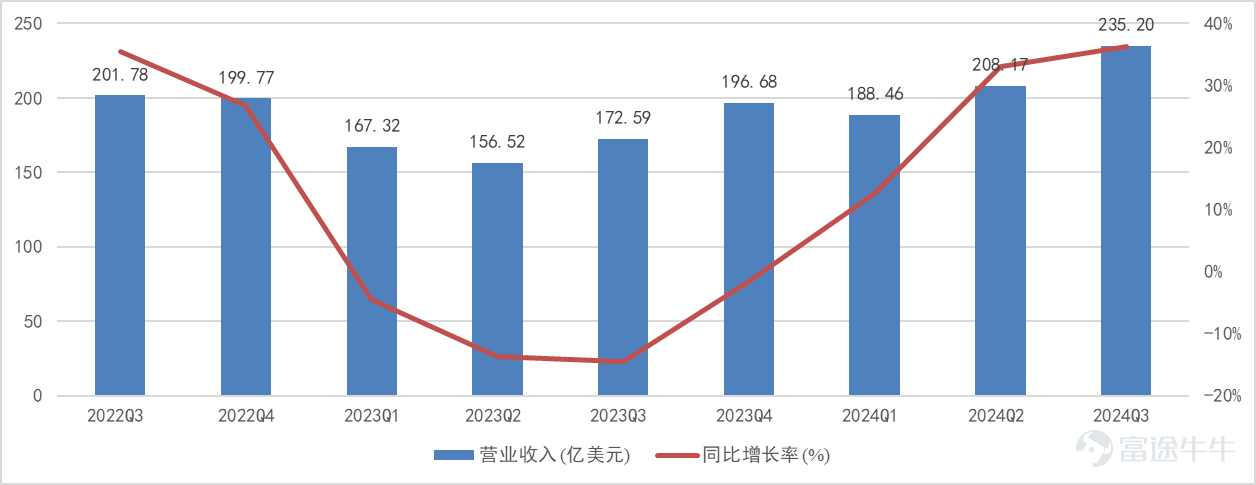
Q3 net revenue was 759.69 billion New Taiwan dollars, approximately 23.5 billion US dollars, a year-on-year increase of 39%, exceeding the estimated 751.06 billion New Taiwan dollars; however, the revenue surprise was actually lagging behind, as the monthly sales figures for taiwan semiconductor were already well anticipated by the market.Of particular interest is the breakdown of the revenue side, including the demand drivers for revenue and the increase in average selling price.
Chart: Revenue situation of taiwan semiconductor
On Thursday, October 17, global chip manufacturing giant Taiwan Semiconductor released its third-quarter financial report for 2024. The performance in the third quarter was strong, with revenue, net income, and gross margin all surpassing expectations.Especially with the gross margin returning to around 58%, significantly higher than the market expectation (54.8%).The guidance for the next quarter on both revenue and gross margin significantly exceeded market expectations, demonstrating continued strong demand for AI. 1. Demand for AI remains strong, while smart phone demand is recovering. Q3 net revenue was 759.69 billion New Taiwan dollars, approximately 23.5 billion US dollars, a year-on-year increase of 39%, exceeding the estimated 751.06 billion New Taiwan dollars; however, the revenue surprise was actually lagging behind, as the monthly sales figures for taiwan semiconductor were already well anticipated by the market.Of particular interest is the breakdown of the revenue side, including the demand drivers for revenue and the increase in average selling price. Chart: Revenue situation of taiwan semiconductor Source of Information: Company Announcement, Compilation of Futu Securities Looking at the breakdown of the revenue side, high-performance computing platforms account for 51%, while smart phone revenue accounts for 34%. Compared to the previous quarter, demand for AI remains very strong, with a quarter-on-quarter growth of 11%; while the quarter-on-quarter growth of smart phones reached 16% (compared to -1% in the previous quarter), with a 1% increase in share.Indicating that the demand for smart phones is gradually recovering season by season. Chart: Sales revenue situation of Taiwan Semiconductor by platform. Source of Information: Company Announcement, Compilation of Futu Securities Given the Apple Intelligent...
Source of Information: Company Announcement, Compilation of Futu Securities
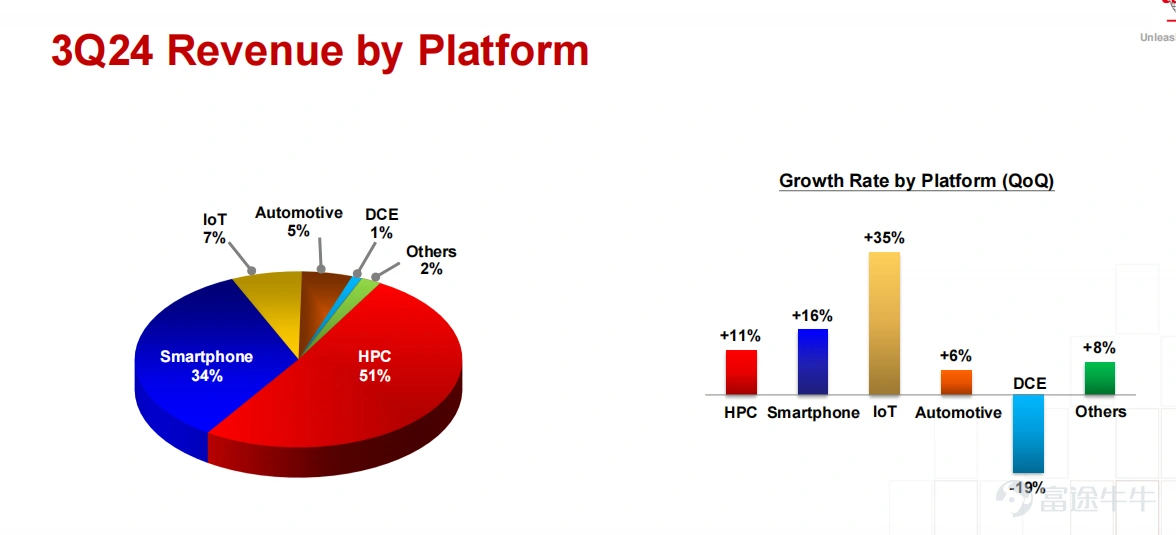
Looking at the breakdown of the revenue side, high-performance computing platforms account for 51%, while smart phone revenue accounts for 34%. Compared to the previous quarter, demand for AI remains very strong, with a quarter-on-quarter growth of 11%; while the quarter-on-quarter growth of smart phones reached 16% (compared to -1% in the previous quarter), with a 1% increase in share.Indicating that the demand for smart phones is gradually recovering season by season.
Chart: Sales revenue situation of Taiwan Semiconductor by platform.
On Thursday, October 17, global chip manufacturing giant Taiwan Semiconductor released its third-quarter financial report for 2024. The performance in the third quarter was strong, with revenue, net income, and gross margin all surpassing expectations.Especially with the gross margin returning to around 58%, significantly higher than the market expectation (54.8%).The guidance for the next quarter on both revenue and gross margin significantly exceeded market expectations, demonstrating continued strong demand for AI. 1. Demand for AI remains strong, while smart phone demand is recovering. Q3 net revenue was 759.69 billion New Taiwan dollars, approximately 23.5 billion US dollars, a year-on-year increase of 39%, exceeding the estimated 751.06 billion New Taiwan dollars; however, the revenue surprise was actually lagging behind, as the monthly sales figures for taiwan semiconductor were already well anticipated by the market.Of particular interest is the breakdown of the revenue side, including the demand drivers for revenue and the increase in average selling price. Chart: Revenue situation of taiwan semiconductor Source of Information: Company Announcement, Compilation of Futu Securities Looking at the breakdown of the revenue side, high-performance computing platforms account for 51%, while smart phone revenue accounts for 34%. Compared to the previous quarter, demand for AI remains very strong, with a quarter-on-quarter growth of 11%; while the quarter-on-quarter growth of smart phones reached 16% (compared to -1% in the previous quarter), with a 1% increase in share.Indicating that the demand for smart phones is gradually recovering season by season. Chart: Sales revenue situation of Taiwan Semiconductor by platform. Source of Information: Company Announcement, Compilation of Futu Securities Given the Apple Intelligent...
Source of Information: Company Announcement, Compilation of Futu Securities
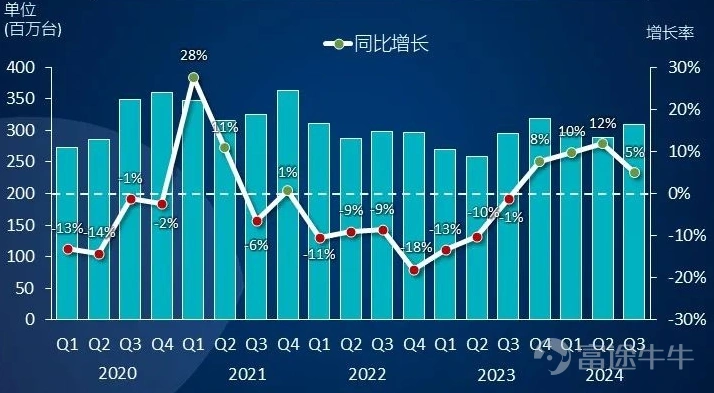
Given that Apple Intelligence is phased in its main iPhone products, buyers remain cautious, and the release of the iPhone 16 by Apple did not trigger a recent uptrend in AI smart phones. However, the global softness in smart phone sales is gradually diminishing, with Canalys reporting a 5% year-on-year growth in global smart phone shipments in the third quarter, achieving growth for four consecutive quarters.
Image: Statistics on smart phone shipments
On Thursday, October 17, global chip manufacturing giant Taiwan Semiconductor released its third-quarter financial report for 2024. The performance in the third quarter was strong, with revenue, net income, and gross margin all surpassing expectations.Especially with the gross margin returning to around 58%, significantly higher than the market expectation (54.8%).The guidance for the next quarter on both revenue and gross margin significantly exceeded market expectations, demonstrating continued strong demand for AI. 1. Demand for AI remains strong, while smart phone demand is recovering. Q3 net revenue was 759.69 billion New Taiwan dollars, approximately 23.5 billion US dollars, a year-on-year increase of 39%, exceeding the estimated 751.06 billion New Taiwan dollars; however, the revenue surprise was actually lagging behind, as the monthly sales figures for taiwan semiconductor were already well anticipated by the market.Of particular interest is the breakdown of the revenue side, including the demand drivers for revenue and the increase in average selling price. Chart: Revenue situation of taiwan semiconductor Source of Information: Company Announcement, Compilation of Futu Securities Looking at the breakdown of the revenue side, high-performance computing platforms account for 51%, while smart phone revenue accounts for 34%. Compared to the previous quarter, demand for AI remains very strong, with a quarter-on-quarter growth of 11%; while the quarter-on-quarter growth of smart phones reached 16% (compared to -1% in the previous quarter), with a 1% increase in share.Indicating that the demand for smart phones is gradually recovering season by season. Chart: Sales revenue situation of Taiwan Semiconductor by platform. Source of Information: Company Announcement, Compilation of Futu Securities Given the Apple Intelligent...
Source: Canalys, compiled by Futubull Securities
The company guided a revenue range of $26.1-26.9 billion for the fourth quarter of 2024, exceeding the market's expectations of $24.9 billion. In the high-performance computing field, NVIDIA's Blackwell will begin mass production, and with market expectations for Blackwell chips to begin shipping in volume, it is expected to enhance the clarity of Taiwan Semiconductor's forward guidance. AMD also released a new 3nm product, driving continued growth in high-performance computing revenue for Taiwan Semiconductor in the next quarter.
On the basis of strong demand for AI, the previously sluggish smart phone demand in the past quarter has passed its trough, starting to generate positive effects. This makes the revenue prospects for Taiwan Semiconductor in the fourth quarter remain positive.
Second, advanced processes are driving gross margin far beyond expectations.
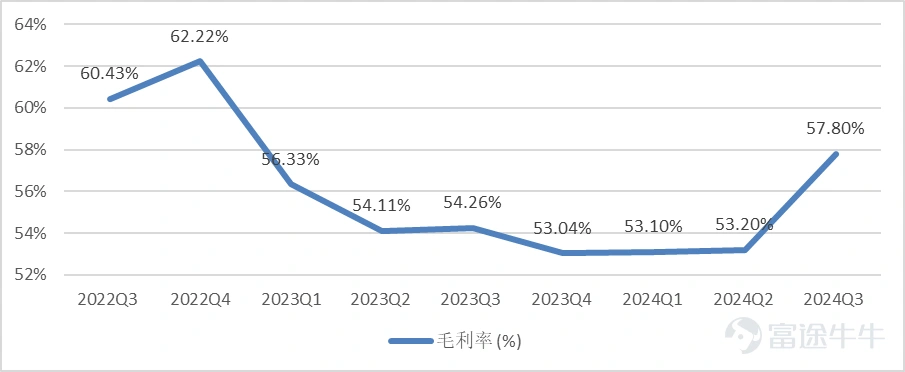
In the third quarter, the gross margin returned to around 58%, much higher than the market expectations (54.8%), a 4.6% increase from the previous quarter. This is mainly due to the continued increase in the company's 3nm production, driving the increase in the company's average selling price and gross margin, as well as the improved capacity utilization.
Chart: Quarterly gross margin situation
On Thursday, October 17, global chip manufacturing giant Taiwan Semiconductor released its third-quarter financial report for 2024. The performance in the third quarter was strong, with revenue, net income, and gross margin all surpassing expectations.Especially with the gross margin returning to around 58%, significantly higher than the market expectation (54.8%).The guidance for the next quarter on both revenue and gross margin significantly exceeded market expectations, demonstrating continued strong demand for AI. 1. Demand for AI remains strong, while smart phone demand is recovering. Q3 net revenue was 759.69 billion New Taiwan dollars, approximately 23.5 billion US dollars, a year-on-year increase of 39%, exceeding the estimated 751.06 billion New Taiwan dollars; however, the revenue surprise was actually lagging behind, as the monthly sales figures for taiwan semiconductor were already well anticipated by the market.Of particular interest is the breakdown of the revenue side, including the demand drivers for revenue and the increase in average selling price. Chart: Revenue situation of taiwan semiconductor Source of Information: Company Announcement, Compilation of Futu Securities Looking at the breakdown of the revenue side, high-performance computing platforms account for 51%, while smart phone revenue accounts for 34%. Compared to the previous quarter, demand for AI remains very strong, with a quarter-on-quarter growth of 11%; while the quarter-on-quarter growth of smart phones reached 16% (compared to -1% in the previous quarter), with a 1% increase in share.Indicating that the demand for smart phones is gradually recovering season by season. Chart: Sales revenue situation of Taiwan Semiconductor by platform. Source of Information: Company Announcement, Compilation of Futu Securities Given the Apple Intelligent...
Source of Information: Company Announcement, Compilation of Futu Securities
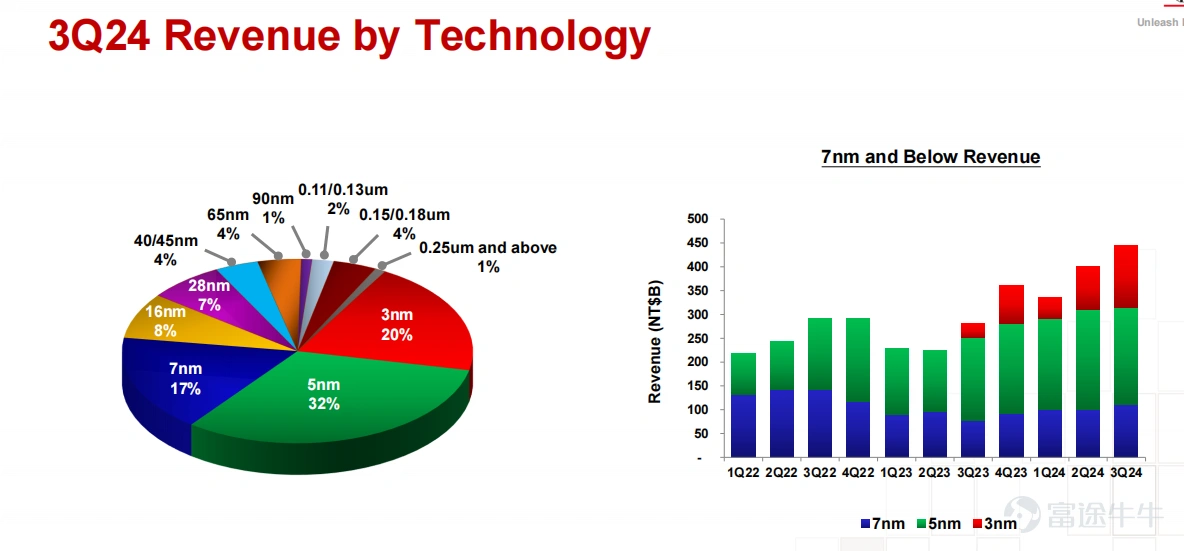
The proportion of high-priced advanced processes (defined as 7 nanometers and more advanced technologies) continues to increase, with advanced processes accounting for 69% of wafer revenue in the third quarter, up from 67% in the previous quarter.Whereas the shipment volume of 3 nanometers accounts for 20% of the wafer revenue, a significant increase of 5%, especially noteworthy. The entire iPhone16 series will adopt the 3nm node, while NVIDIA's data center GPUs mainly use 7nm and 5nm processes and are gradually evolving to the 3nm process,meaning that the revenue share of advanced processes will continue to increase.
Chart: Quarterly revenue distribution by technology
On Thursday, October 17, global chip manufacturing giant Taiwan Semiconductor released its third-quarter financial report for 2024. The performance in the third quarter was strong, with revenue, net income, and gross margin all surpassing expectations.Especially with the gross margin returning to around 58%, significantly higher than the market expectation (54.8%).The guidance for the next quarter on both revenue and gross margin significantly exceeded market expectations, demonstrating continued strong demand for AI. 1. Demand for AI remains strong, while smart phone demand is recovering. Q3 net revenue was 759.69 billion New Taiwan dollars, approximately 23.5 billion US dollars, a year-on-year increase of 39%, exceeding the estimated 751.06 billion New Taiwan dollars; however, the revenue surprise was actually lagging behind, as the monthly sales figures for taiwan semiconductor were already well anticipated by the market.Of particular interest is the breakdown of the revenue side, including the demand drivers for revenue and the increase in average selling price. Chart: Revenue situation of taiwan semiconductor Source of Information: Company Announcement, Compilation of Futu Securities Looking at the breakdown of the revenue side, high-performance computing platforms account for 51%, while smart phone revenue accounts for 34%. Compared to the previous quarter, demand for AI remains very strong, with a quarter-on-quarter growth of 11%; while the quarter-on-quarter growth of smart phones reached 16% (compared to -1% in the previous quarter), with a 1% increase in share.Indicating that the demand for smart phones is gradually recovering season by season. Chart: Sales revenue situation of Taiwan Semiconductor by platform. Source of Information: Company Announcement, Compilation of Futu Securities Given the Apple Intelligent...
Source of Information: Company Announcement, Compilation of Futu Securities
The company's gross margin in the next quarter is also significantly higher than market expectations. The company expects a gross margin of 57-59% in the fourth quarter of 2024 (market expectation 54.7%), mainly due to the high production capacity utilization rate in Q4 offsetting the cost of N3 ramp-up to N5, as well as the adverse impact of the rising electricity prices in Taiwan.
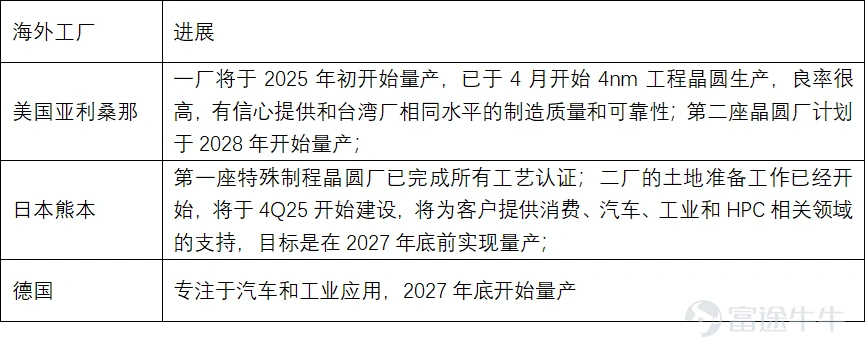
However, the long-term judgment of the 25-year gross margin is somewhat more complex, with multiple positive and negative factors intertwined. Overall, we remain optimistic about the gross margin in 2025.Considering the relatively small contribution of overseas factory revenue, it is unlikely that it will pose a significant burden on Taiwan Semiconductor in 2025. The specific factors are as follows.
Positive factors include:
1)The average selling price (ASP) of advanced technologies (N3, N5, and CoWoS packaging) is increasing.According to TrendForce, TSMC plans to raise prices of its 3nm chips by more than 5%, and prices of advanced packaging are expected to rise by 10% to 20% next year. As 3nm accounts for 20% of its revenue in the third quarter of its 2024 fiscal year, the continued mass production of 3nm will drive the increase in the company's product average selling price, positively affecting the company's gross margin.
2) The improvement of process yield and production capacity utilization.
3) With the end of semiconductor inventory adjustments, the utilization rate of N7 and mature nodes is expected to rebound.
Potential unfavorable factors include:
1) Overseas factories ramping up production capacity next year will negatively impact the gross margin, diluting the gross margin by 2-3 percentage points each year over the next three years.
On Thursday, October 17, global chip manufacturing giant Taiwan Semiconductor released its third-quarter financial report for 2024. The performance in the third quarter was strong, with revenue, net income, and gross margin all surpassing expectations.Especially with the gross margin returning to around 58%, significantly higher than the market expectation (54.8%).The guidance for the next quarter on both revenue and gross margin significantly exceeded market expectations, demonstrating continued strong demand for AI. 1. Demand for AI remains strong, while smart phone demand is recovering. Q3 net revenue was 759.69 billion New Taiwan dollars, approximately 23.5 billion US dollars, a year-on-year increase of 39%, exceeding the estimated 751.06 billion New Taiwan dollars; however, the revenue surprise was actually lagging behind, as the monthly sales figures for taiwan semiconductor were already well anticipated by the market.Of particular interest is the breakdown of the revenue side, including the demand drivers for revenue and the increase in average selling price. Chart: Revenue situation of taiwan semiconductor Source of Information: Company Announcement, Compilation of Futu Securities Looking at the breakdown of the revenue side, high-performance computing platforms account for 51%, while smart phone revenue accounts for 34%. Compared to the previous quarter, demand for AI remains very strong, with a quarter-on-quarter growth of 11%; while the quarter-on-quarter growth of smart phones reached 16% (compared to -1% in the previous quarter), with a 1% increase in share.Indicating that the demand for smart phones is gradually recovering season by season. Chart: Sales revenue situation of Taiwan Semiconductor by platform. Source of Information: Company Announcement, Compilation of Futu Securities Given the Apple Intelligent...
2) Cost inflation, especially the continuous increase in electricity tariffs in Taiwan. Higher electricity costs and inflation costs will dilute TSMC's gross margin by at least 1%.
3) Given the high demand for N3, there may be further conversion of N5 production capacity to N3.
III. TSMC has basically achieved a de facto monopoly
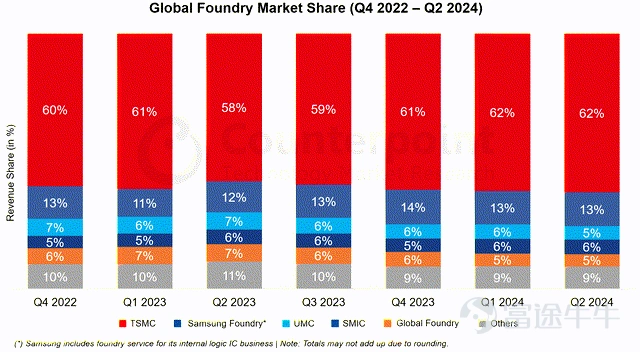
Currently, TSMC has basically achieved a de facto monopoly, and the challenges faced by Intel and Samsung have strengthened TSMC's position as the preferred AI foundry. In the foundry field, TSMC occupies a leading position in competition and holds a favorable position in negotiations with suppliers and customers.After all, chip companies that want the best chips have almost no chance of avoiding Taiwan Semiconductor.
According to Counterpoint Research's data, Taiwan Semiconductor's market share in the global foundry market in the second quarter was 62%. In the long term, as chip processes enter the '5-nanometer' and even '3-nanometer' era, Samsung has lost market share and Intel's performance is below expectations. Undoubtedly, Taiwan Semiconductor is likely to continue to maintain a significant market leadership position.
The current issue facing Taiwan Semiconductor is still insufficient capacity for advanced processes. In the context of a 'seller's market,' Taiwan Semiconductor may be able to maintain the current high profit margin for a considerable period of time.
Figure: Global Foundry Market Share Situation
On Thursday, October 17, global chip manufacturing giant Taiwan Semiconductor released its third-quarter financial report for 2024. The performance in the third quarter was strong, with revenue, net income, and gross margin all surpassing expectations.Especially with the gross margin returning to around 58%, significantly higher than the market expectation (54.8%).The guidance for the next quarter on both revenue and gross margin significantly exceeded market expectations, demonstrating continued strong demand for AI. 1. Demand for AI remains strong, while smart phone demand is recovering. Q3 net revenue was 759.69 billion New Taiwan dollars, approximately 23.5 billion US dollars, a year-on-year increase of 39%, exceeding the estimated 751.06 billion New Taiwan dollars; however, the revenue surprise was actually lagging behind, as the monthly sales figures for taiwan semiconductor were already well anticipated by the market.Of particular interest is the breakdown of the revenue side, including the demand drivers for revenue and the increase in average selling price. Chart: Revenue situation of taiwan semiconductor Source of Information: Company Announcement, Compilation of Futu Securities Looking at the breakdown of the revenue side, high-performance computing platforms account for 51%, while smart phone revenue accounts for 34%. Compared to the previous quarter, demand for AI remains very strong, with a quarter-on-quarter growth of 11%; while the quarter-on-quarter growth of smart phones reached 16% (compared to -1% in the previous quarter), with a 1% increase in share.Indicating that the demand for smart phones is gradually recovering season by season. Chart: Sales revenue situation of Taiwan Semiconductor by platform. Source of Information: Company Announcement, Compilation of Futu Securities Given the Apple Intelligent...
Data Source: Counterpoint Research, Futu Securities compilation
Summary
Taiwan Semiconductor's financial performance this time is very good, not only indicating strong prospects for AI demand, but also with smart phone demand picking up and gross margin rebounding far beyond expectations. As a manufacturing enterprise, Taiwan Semiconductor's net profit margin in the third quarter reached 42.8%, establishing a monopoly position with strong evidence of high profits.
Given this background, we believe that 2025 will continue to see high revenue growth, with room for gross margin improvement. It is expected that revenues for 2024/2025/2026 will increase by 30%, 25%, and 20% year-on-year, corresponding to revenues of $89.68 billion, $112.10 billion, and $134.52 billion, respectively, with net profits of $36.2 billion, $49.3 billion, and $57.8 billion. Current valuation is $1.07 trillion, corresponding to 22 times 2025 net profit.
From the perspective of comparing with semiconductor peers listed on the US stock market, the valuation of Taiwan Semiconductor remains relatively inexpensive. However, considering the potential adverse impact of geopolitical risks, especially with the current US presidential election underway, the increasing risk factors are expected to discount the valuation and investment sentiment of Taiwan Semiconductor in the near term. If the valuation falls to a trading range below 20 times in the past 25 years, the safety margin will be stronger. Therefore, for shareholders skilled in trading, actively seizing opportunities to sell high and buy low is advisable.
Risk Disclaimer: The above content only represents the author's view. It does not represent any position or investment advice of Futu. Futu makes no representation or warranty.Read more
Thumbs Up
13
362K Views
Report
Comments
Write a Comment...
13
21