
Futu Research | Australian REITs Investment Guide: Product Features and Selection Tips
introduction
In the global capital wave seeking diversification of assets and stable returns, real estate investment trusts (REITs) have become a popular option sought after by investors. As an innovative financial instrument, REITs enable investors to enter the originally high-cost, high-threshold commercial real estate sector with a lower threshold and share stable rental income and capital appreciation from office buildings, shopping centers, industrial real estate, and even infrastructure projects.
As globalization continues to deepen, the REITs market in various countries competes to blossom. Among them, the Australian REITs market has become a shining jewel in this investment torrent with its transparent regulatory environment, mature market mechanism, and preferential tax policies.
1. What are REITS?
Real Estate Investment Trusts (English name Real Estate Investment Trusts, REITs for short)It is a type established in accordance with legal procedures to collect investors' funds by issuing shares or fund units, and a professional organization carries out the operation and management of real estate, andA trust fund that allocates more than 90% of net after-tax income to investors. Essentially speaking, REITs are an institutionalized arrangement for real estate investment.
Unlike other types of investment funds, the investment target of REITs is limited to real estate assets; compared to direct real estate purchases, REITs provide investors with smaller capital investment opportunities to get involved in the rise and fall of diverse real estate — most REITs are publicly traded on stock exchanges to diversify their investments in different real estate projects, and have product characteristics such as strong liquidity, high transparency, low investment threshold, and diversified investment.
Classification by organizational structure, REITs can be divided into the following two types:
Trust type (Trust): This is the most common structure. Investors buy trust units to become unit holders and indirectly hold real estate assets through trusts.
Company type: Although rare, there are also REITs organized in the form of companies where investors participate as shareholders.
Currently, investors can directly participate in real estate investment through REITs products on Futubull Niuniu/MooMoo, so how should they choose among the many REITs products?
2. How to choose REITS products
As mentioned at the beginning of the article, REITs are fund products that invest in real estate after pooling capital in the form of a trust. Then, when choosing REITs products, we can consider the two levels of securities and underlying assets:
Examining the quality of REITs' underlying assets is a critical step in evaluating the value of their investments, as it directly affects REITs' income stability, growth potential, and ability to withstand economic cycle fluctuations. The following isExamine several important aspects of the quality of underlying assets:
Property Type and Location:
Property types: Different types of properties (such as office, retail, industrial, residential, etc.) have different market needs and risk characteristics. Understanding current market trends for each type of property and how they are performing during the economic cycle can help assess the attractiveness of an asset.
Location: Premium locations often mean stronger rental demand, higher rents, and lower vacancy rates. Check whether the property is located in a commercial center, an easily accessible area, or an area with a growing population.
Property utilization rate and vacancy rate:
Current occupancy: A high occupancy rate means a steady cash flow. The low vacancy rate indicates the popularity of the property in the market.
Rental history and trends: Examine the property's past rental rate and rent trends to predict future income stability.
Market supply and demand analysis:
Regional market trends: Analyze the economic conditions, job market, population growth, and real estate supply in the area where the property is located to assess future demand.
Overall, examining the quality of REITs underlying assets is a detailed and multi-dimensional process aimed at evaluating their stability and growth potential, so as to make more clear investment decisions for selecting REITs products.
Securities-level selection criteriaMuch the same as other products, such as:
Financial health: Analyze REITs' financial statements and focus on their debt levels, cash flow status, dividend history, and dividend payout rates. A healthy cash flow is key to maintaining dividends, and a reasonable debt ratio helps reduce risk.
Management team experience: Study the background of REITs management teams, including their experience and past performance in the real estate sector. An excellent management team can effectively enhance asset value and develop appropriate growth strategies.
Market Positioning and Growth Potential: Understand the current situation and future trends in the market segment where REITs are located. Sectors such as industrial logistics and data centers may have good growth prospects due to the rise of e-commerce and cloud computing.
3. Performance and characteristics of A-REITS
Australia was one of the first countries in the world to establish REITs, and REITs listed on the Australian Stock Exchange (ASX) are known asA-reits. After more than 30 years of exploration and practice, A-REITs have formed a certain scale and gradually matured. Currently, Australia is the second-largest REITs market in the world, after the US.
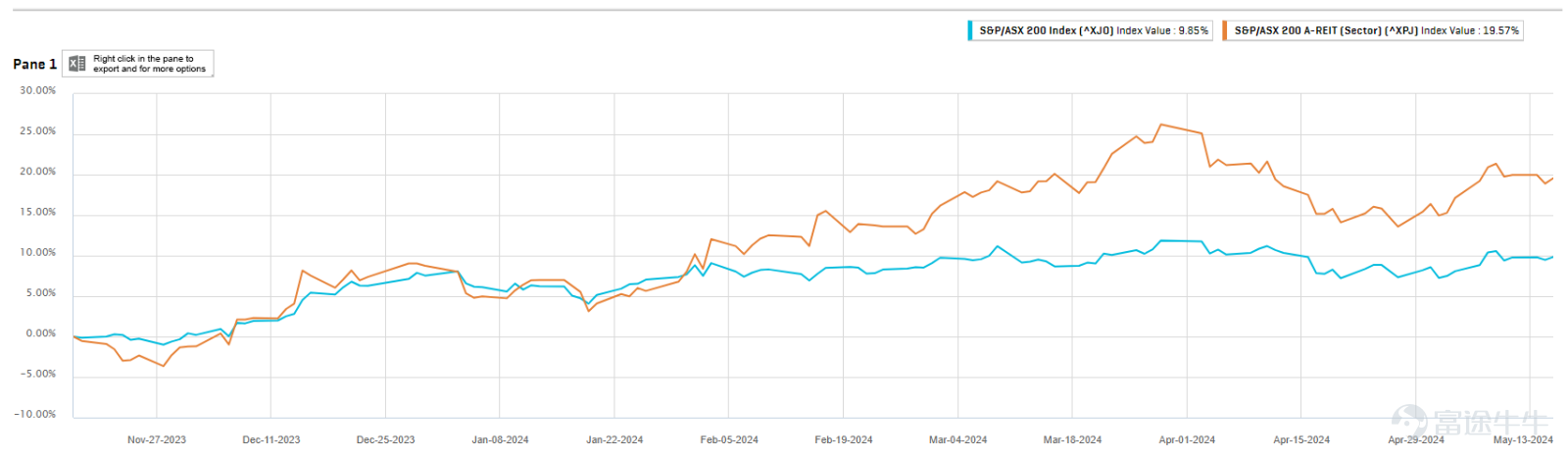
S&P/ASX 200 A-REITIt is an industry sub-index focusing on Australian A-REITs and mortgage REITs to track the performance of the Australian real estate investment trust market. Since the beginning of 2024, the Australian Stock Exchange 200a-REITs Index has continued to outperform the market and has remained in a high position.
Figure: ASX200 compared to ASX200 A-REIT

Source: Capital IQ
According to the latest statistics released by ASX in April 2024, the current total market value of A-REITs in Australia is about 162.44 billion Australian dollars, an increase of 13.3% over the previous year. There are 44 registered companies, with an average daily trading volume of 118,900 transactions. As shown in the April trading situation in the following figure, A-REITs are one of the most active fund product categories in the Australian market.
Figure: Comparison of the conditions of various fund products in the Australian market in April 2024

Source: Australian Securities Exchange Investment Product Summary, compiled by Futu Securities
According to investment targets, A-REITs can be divided into six types: diversified (diversified), industry (industrial), miscellaneous (miscellaneous), residential (residential), retail (commercial retail), and specialised (specialized). Among them, industry accounts for the largest share and fluctuates more clearly, followed by retail and diversified investment, and the smallest share is residential housing.
Figure: Comparison of A-REITS product conditions in the Australian market in April 2024

Source: Australian Securities Exchange Investment Product Summary, compiled by Futu Securities
In addition to the characteristics of REITs mentioned above, which are common to strong liquidity and high transparency, Australian A-REITs also have the following characteristics:
Tax benefits: Australian government policies are extremely supportive of the development of A-REITs. Australian tax law provides tax benefits for eligible REITs, which are reflected in corporate income tax, capital gains tax, and dividend tax.
High dividend rate: A-REITs usually provide a relatively high dividend rate, generally around 5%, which is much higher than many traditional fixed income investment instruments. This is very attractive for Australia, a less liquid market where most investors prefer stable cash flow.
Economic growth and stability: The Australian economy has maintained steady growth for a long time, and the population has continued to increase, especially in major cities such as Sydney and Melbourne. Demand for commercial and residential properties continues to rise, and the Australian real estate market is generally stable and rich in high-quality property assets, providing REITs with stable rental income and asset appreciation potential.
4. Introduction of representative A-REITS products
So, in the Australian market, what specific A-REITs can we choose to invest in?
Below, we select the top five in the Australian market ranked by market capitalizationListed trust companies associated with REITs transactions:
It is a leading global real estate group focused onindustrial propertyThe investment, development and management of is Australia's largest industrial real estate company. It has 434 properties in 14 countries, with a total asset management volume of 80 billion Australian dollars. It has established long-term partnerships with major logistics and retail companies such as Amazon, JD, and DHL. It is one of the largest real estate groups in the world.
As of May 14, 2024, the total market value of the company was approximately 63.566 billion Australian dollars. The share price has increased 14.56% from the beginning of 2024 to date, the company's interest-bearing debt ratio is 13.99%, dividend ratio is 0.9%, and WALE (weighted average rental period) is 5.1 years.
Advantages: The real estate fund portfolio is large, and the lockdown period is long, and it is less affected by large-scale customer redemptions when the market declines; it is committed to developing data centers, which has become a new upward momentum for the company.
Disadvantage: Large investment in data centers may have an impact on the company's cash flow. At the same time, GMG is selling some high-quality real estate projects on the market to invest in data center development, and the scale of managed assets has declined slightly; the dividend ratio is lower than that of similar products.

This is a company focused onRetail and commercial real estate sectorThe Australian company is particularly known for its shopping center investment, development and management business. As a leading company in the industry, Scentre Group has an extensive network of shopping malls. As of May 2024, it operates 42 shopping malls, mainly in various urban centers in Australia and New Zealand.
As of May 14, 2024, the company had a total market capitalization of approximately $16.209 billion, a dividend ratio of 5.29%, an interest-bearing debt ratio of 44%, WALE (weighted average rental period) of 6.8 years, and the share price increase of 4.04% since the beginning of 2024.
Advantages: High brand awareness and market share help attract tenants and customers and maintain stable rental income; moreover, most shopping centers are located in the city center, with excellent location, convenient transportation, and good asset maintenance, which can attract high-end brands to settle in and enhance the overall shopping experience.
Disadvantages: Factors such as global economic fluctuations, declining consumer confidence, and e-commerce shocks may affect the performance of the physical retail industry, thereby affecting the company's rental income and asset value; high-end shopping centers require continuous renewal and expansion, which may affect the company's cash flow and short-term profits.

This is a familyComprehensiveThe real estate group's main business involves residential community development, retail properties, commercial office parks, retirement living communities, and logistics real estate. The company is committed to creating high quality living, working and relaxing spaces to serve communities across Australia.
As of May 14, 2024, the company had a total market capitalization of approximately $10.838 billion, a dividend ratio of 4.93%, an interest-bearing debt ratio of 23.48%, WALE (weighted average rental period) of 5.4 years, and a 1.1% increase in stock prices since the beginning of 2024.
Advantages: The diversification of the company's business is conducive to risk diversification in different real estate market cycles, and the company has strong brand influence and market awareness, which is conducive to attracting partners, investors and tenants.
Disadvantage: Performance is affected by the overall state of the Australian real estate market. A recession or downturn in the real estate market will affect sales, occupancy rates and asset values. The stock price has fluctuated greatly in the past year, and the company's profitability is average.

This is an Australian leadingComprehensiveReal estate group focusing on real estate investment, development, asset management and property management. The company has an important position in the Australian real estate market. Its business covers various fields such as housing, commercial offices, retail and industry, and also provides asset management services to third party customers. The company currently has a total asset management volume of about 43 billion Australian dollars.
As of May 14, 2024, the company had a total market capitalization of approximately $8.168 billion, a dividend ratio of 4.73%, an interest-bearing debt ratio of 26.89%, WALE (weighted average rental period) of 5.2 years, and its share price decreased by 0.35% since the beginning of 2024.
Advantages: Known for developing high-quality and innovative design projects, it has established a strong brand reputation, while diversifying operations, which is conducive to risk diversification and reducing the impact of single market fluctuations on the company's overall performance.
Disadvantage: Most of the income comes from residential and office properties, which are greatly affected by the macroeconomy. Under high interest rates, debt costs are higher, and there is a greater downside risk.

This is an Australian leadingretail real estateThe Group, which focuses on the ownership, management and development of shopping centers, has a broad portfolio of shopping malls across the country, including some landmark shopping malls, such as Melbourne's Chadstone Shopping Centre (Chadstone Shopping Centre), which is one of the largest shopping centers in the Southern Hemisphere. The company focuses on creating a high-quality retail environment to meet consumer needs by providing a diverse and attractive retail mix.
As of May 14, 2024, the company had a total market capitalization of approximately $8.695 billion, a dividend ratio of 6.28%, an interest-bearing debt ratio of 28.63%, WALE (weighted average rental period) of 4.5 years, and the stock price declined 1.96% from the beginning of 2024 to date.
Advantages: The company has some iconic shopping centers. These high-end properties usually attract large traffic and are relatively less affected by e-commerce. They have a stable tenant base and high rental returns, which enhances its market position and brand value.
Disadvantage: Affected by the macroeconomic environment and consumer confidence, the retail industry is vulnerable to economic cycle fluctuations, which may affect shopping center traffic, sales, and rental income.

5. Risk Alerts
However, it should be noted that in addition to the above advantages, investing in A-REITs also has the following risks:
Concentration issues: Some REITs focus too much on a specific type or region of property and are vulnerable to changes in economic conditions in the sector. For example, if a REIT mainly owns an office building and the local job market suddenly declines, tenants may not be able to pay rent, causing the REIT's income to drop;
Property cycle: The real estate market usually experiences a cycle of boom and decline. During economic expansion, housing prices and rents may rise, while during economic contraction, prices may fall and vacancy rates rise. Therefore, in the case of an unfavorable market environment, the performance of REITs may be affected;
Leverage: Some A-reits may use borrowed funds to buy or develop property portfolios, creating a high percentage of leverage. Although leverage can amplify capital gains, it can also amplify losses when the value of assets falls, and may lead to higher interest costs;
Interest rates: Rising interest rates may have a negative impact on A-REIT's performance, both by increasing interest expenses and by making fixed-income investments more attractive to income-seeking investors, which may reduce overall demand.
Volatility: A-REITs may also be sensitive to broader stock market movements, leading to higher volatility than direct real estate investments.
Risk Disclaimer: The above content only represents the author's view. It does not represent any position or investment advice of Futu. Futu makes no representation or warranty.Read more

Comments
to post a comment
5
10