
The Nvidia Shareholders' Meeting is approaching, how will it be deployed in the near future?

Futu Research | Nvidia's earnings report astonishes the market. Has AI reached a tipping point?
At a time when global AI technology is rapidly iterating and penetrating deeply into all walks of life, Nvidia has written a new commercial legend with its outstanding innovation and market leadership in the field of artificial intelligence chips, and once again handed over a market-shocking report card in the fourth quarter of fiscal year 2024.

Not only did the quarter's earnings report hit a record high of revenue — reaching an astonishing 22.1 billion US dollars, a year-on-year growth rate of 265%, but net profit also achieved an equally impressive increase, rising 769% year over year to 12.285 billion US dollars. This outstanding performance far surpassed Wall Street analysts' expectations, fully demonstrating Nvidia's strong strength and market leadership in global data centers, gaming, professional visualization, and generative AI.
As the AI wave sweeps the world, from cloud to edge computing, from large cloud service providers to vertical industry applications, Nvidia's data center products have gained a broad market space. The data center business unit became a key engine driving the company's overall rapid performance, accounting for 83% of revenue, with revenue of 18.4 billion US dollars in a single quarter, up 409% year over year, demonstrating Nvidia's dominance in the field of accelerated computing and AI infrastructure. The data center business is therefore the key to analyzing Nvidia's performance.
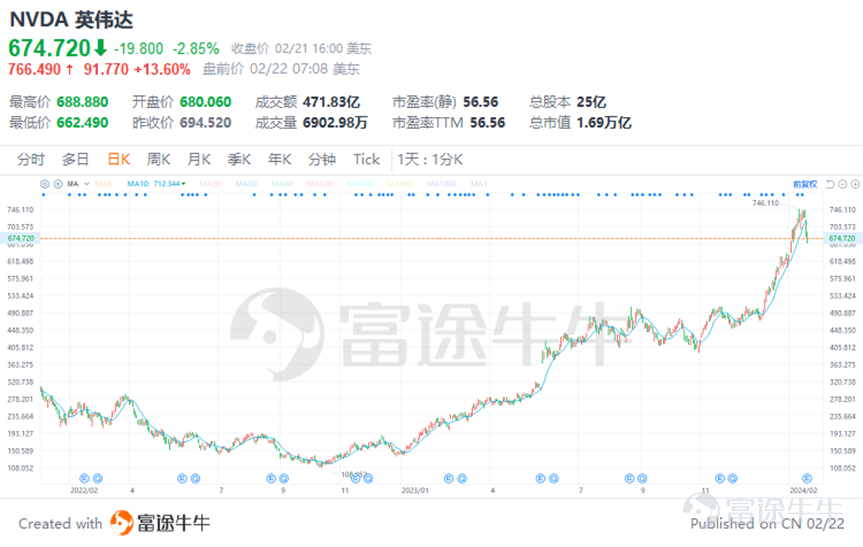
Supported by strong performance, Nvidia continues to set new stock price records. Since the beginning of the year, Nvidia's stock price has risen by 36.25%, and the stock price once broke through to $746.11. After the release of this financial report, the stock price once rose by more than 10%. Next, we will thoroughly analyze the specific performance of each business sector and the growth driving force behind it, and discuss the evolution direction of subsequent companies' stock prices.
Figure: Composition of Nvidia's revenue

Source: Bloomberg, compiled by Futu Securities
1. The data center business is driving the company's rapid performance. Can growth continue?
As Nvidia's main growth engine, the data center division reached a record high of 18.4 billion US dollars in Q4, up 409% year over year. The growth was mainly driven by the surge in demand for data processing, training, and inference from cloud computing service providers, dedicated GPU providers, enterprise software providers, and consumer internet companies. Additionally, applications in vertical industries such as automotive, financial services, and healthcare are also accelerating business development.
Figure: Data center business revenue (million dollars)

Source: Bloomberg, compiled by Futu Securities
The product structure of Nvidia's data center business covers multiple levels. Its core products include but are not limited to GPU chips designed based on Ampere and Hopper architectures, NVIDIA DGX systems, high-speed network technology and solutions, and software ecosystems including CUDA programming environments, TensorRT inference optimization libraries, and RAPIDS data analysis libraries. Nvidia's competitive advantage is not only reflected in hardware performance, but also in the fact that it has built a complete software and hardware ecosystem, which enables it to meet the rapid response and customized services of enterprises of different industries and sizes to complex computing needs.
Although competition for AI chips is becoming more intense, Nvidia still occupies a prominent position in the AI field with far leading hardware technology and rich software ecosystem. According to Garner's latest research data, Nvidia's global market share of artificial intelligence chips reached 90% by the end of 2023, leaving other competitors such as AMD and Intel far behind.
So can Nvidia's data center business continue to grow strongly? In the words of Nvidia founder and CEO Hwang In-hoon, “Accelerated computing and generative AI have reached a tipping point.”
1. Strong demand
(1) As the global digital transformation process accelerates, downstream customer demand for cloud computing, big data analysis, machine learning, and deep learning applications surges, and Nvidia's data center platform is expected to be driven by more and more diversified demand.
(2) The world is undergoing transformation and upgrading from general computing to accelerated computing, and capital expenditure in data centers is gradually focusing on accelerated computing and generative AI. At present, the world has installed data centers worth 1 trillion US dollars, distributed in the cloud, enterprises and other fields. It is expected that investment in the general server market will gradually decline, investment in AI servers will continue to grow, and Nvidia's AI products will usher in huge market space, driving the continuous growth of the data center business.
(3) Considering that enterprises need customized AI services, Nvidia will create customized artificial intelligence for the company by providing software and hardware services (including DGX Cloud, etc.) and deploy it on Nvidia DGX Cloud. Currently, it has cooperated with companies such as SAP, ServiceNow, Dropbox, Getty, etc., and the profit model uses authorized subscriptions, similar to cloud computing vendors.
(4) The NVIDIA AI Enterprise software stack service is expected to be successful. The company will manage, optimize, patch, adjust, and install basic optimization of all software stacks required for AI to accelerate computation, and charge 4,500 US dollars per year for each GPU.
(5) Japan, Canada, France and many other regions are building sovereign artificial intelligence infrastructure. In the next few years, it is expected that there will be multi-billion dollar demand to serve the artificial infrastructure market of sovereign countries, mainly supercomputers built based on the Grace Hopper product line.
(6) The company's inventory remained at a low level in the fourth quarter, indicating that the company's products were in short supply. The number of days the company's inventory turnover in the fourth quarter was 90.49, which continued to decline from the previous quarter (92.14).
Figure: Inventory turnover days

Source: Bloomberg, compiled by Futu Securities
2. Supply improvement
(1) Nvidia's continued technological innovation and new product launches have also stimulated market demand. In order to cope with market competition, the H200 chip introduced by Nvidia last year is expected to be launched in the second quarter of '24. With a first-mover advantage, Nvidia is expected to stay ahead in ongoing technology iterations.
(2) The supply chain continues to improve, and demand is expected to continue to be stronger than supply throughout the year.
Looking ahead, given the long-term growth trend of the AI and high-performance computing market, as well as Nvidia's increasing competitive barriers to the market and plans to launch new products, its data center business is expected to continue to grow rapidly
2. Other businesses: The gaming business is growing steadily, and the professional visualization business benefits from strong RTX ADA GPU demand
1. The gaming business continues to grow steadily, and AI PCs are expected to drive performance growth
The gaming business has maintained a steady growth trend. Game business revenue for the fourth quarter was 2.9 billion US dollars, up 56% compared with the same period last year, and game business revenue increased 15% to 10.4 billion US dollars for the whole year. The introduction of new products, such as the GeForce RTX 40 SUPER series GPU, as well as the enhancement of large-scale language models and generative AI capabilities of the existing RTX AI PC user base, continue to drive the development of the gaming business.
Figure: Gaming business revenue (million dollars)

Source: Bloomberg, compiled by Futu Securities
The future development trend of the PC industry is that the powerful AI computing power of AI PCs, NVIDIA AI Tensor cores, and GPUs is expected to continue to improve PC product performance and drive a new round of product upgrade demand. Currently, there are more than 0.1 billion RTX PCs worldwide, and more than 500 AI-enabled PC applications and games, which shows NVIDIA's broad user base and strong market penetration rate in the field of gaming and AI. As NVIDIA continues to advance next-generation generative AI applications into the PC market, it is expected to further drive the long-term growth of its gaming and related businesses.
2. Significant growth in professional visualization business reflects strong market demand for RTX ADA GPUs
The professional visualization business achieved significant growth in the quarter, with revenue reaching $0.463 billion, up 11% month-on-month and 105% year-on-year growth, reflecting strong market demand for RTX ADA GPUs. This growth is mainly due to increased demand for powerful computing power to support generative AI workloads, particularly in industries such as manufacturing, automotive, and robotics.
Figure: Professional Visualization Business Revenue (in millions of dollars)

Source: Bloomberg, compiled by Futu Securities
As generative artificial intelligence applications continue to expand and iterate technology, it is expected that professional visualization businesses will continue to benefit from the updated needs of the high-end workstation market, especially those focused on using AI for innovative design and simulation work. As more businesses and industries adopt NVIDIA's technology solutions, such as the Omniverse platform, this business segment is expected to maintain a steady upward trend.
Furthermore, the automotive business recorded revenue of 0.281 billion US dollars in the quarter, up 8% from the previous quarter, but down 4% year over year. Recently, several automotive customers announced the adoption of NVIDIA's solutions in their new models, Ideal Auto announced the adoption of the next-generation centralized in-vehicle computing platform NVIDIA DRIVE Thor, and Great Wall Motors, ZEEKR, and Xiaomi Electric Vehicles announced that they will be equipped with the NVIDIA DRIVE Orin platform. The automotive business is expected to usher in a new growth point in the short term.
Figure: Automotive business

Source: Bloomberg, compiled by Futu Securities
3. Significant increase in profit and strong growth in free cash flow
Gross margin increased significantly.The company's GAAP gross margin continued to expand to 76% during the quarter, and the non-GAAP gross margin even reached 76.7%, mainly due to the removal of upstream component product costs and the company's success in cost control and product pricing strategies. High gross margins reflect the strong market competitiveness of Nvidia products and the effectiveness of supply chain management.
Figure: Profit margin situation

Source: Bloomberg, compiled by Futu Securities
Net profit was released at an accelerated pace.GAAP diluted earnings per share for the quarter were $4.93, up 33% from the previous quarter, up 765% year-on-year; non-GAAP diluted earnings per share were $5.16, up 28% from the previous quarter and 486% from the same period last year. Throughout the year, GAAP and non-GAAP diluted earnings per share showed significant growth, showing that Nvidia has effectively improved profit efficiency while maintaining revenue growth.
The increase in operating expenses is manageable.Although GAAP and non-GAAP operating expenses increased by 6% and 9%, respectively, in the current quarter, due to the sharp increase in operating income, the increase in operating expenses did not affect the company's overall profitability, and the R&D expenses rate and sales management expenses ratio declined significantly. Looking at the whole year, the company's R&D expenses rate fell from 27.2% to 14.2%, and the sales management expenses rate fell from 9.1% to 4.4%. Furthermore, the company extended the depreciation period, which further reduced depreciation expenses.
Figure: Total operating expenses (in millions of dollars)

Source: Bloomberg, compiled by Futu Securities
Strong growth in free cash flow.As the company's net profit grew rapidly, the company's free cash flow multiplied from $3.75 billion in fiscal 2023 to $26.947 billion in fiscal 2024. As of fiscal year 2024, the company's cash and cash equivalents were $25.984 billion. Strong cash reserves support the company's shareholder returns.
Figure: Free cash flow (millions of dollars)

Source: Bloomberg, compiled by Futu Securities
The company has already repurchased 9.7 billion US dollars of shares in fiscal year 2024. Currently, there is still a repurchase amount of about 22.5 billion US dollars. Currently, the company's cash reserves can fully support large-scale repurchases.
4. What is Nvidia's current investment value?
Overall, Nvidia has shown significant growth in all business areas, particularly in the data center business. Thanks to the boom in artificial intelligence, big data processing, and the emerging generative AI market, its business scale and profitability have increased as never before. With its first-mover advantage in hardware, a mature supply chain, and CUDA ecosystem, Nvidia is expected to maintain an absolute leading market position in the fierce competition.
1. Performance aspects
The company's future performance growth will still be driven by rapid growth in the data center business, and the increase in capital expenditure on AI by cloud service vendors and large consumer internet giants will be the main driving force for the company's performance. According to Bloomberg's forecast, the combined capital expenditure of Microsoft, Google, META, and Amazon is expected to increase 27% year over year in 24, which is expected to clearly drive Nvidia's data center performance growth. The data center business is driven by diverse needs, including but not limited to general computing upgrades to accelerated computing platforms, customized artificial intelligence enterprise services, NVIDIA AI Enterprise software stack services, and sovereign AI clouds. These demands will all become growth points for the data center business.
Furthermore, with the innovation and upgrading of virtual reality, augmented reality, the game industry, and the development of professional design and rendering technology, gaming and professional visualization businesses are expected to benefit from the increase in demand for high-performance GPUs.
The company's performance guidance for the first quarter remains strong. The company expects the median revenue of FY25Q1 to be 24 billion US dollars, fluctuating 2% up and down, and is expected to achieve a year-on-year increase of about 234%. In terms of profit, the median non-GAAP gross margin for the first quarter is expected to be 77%, fluctuating 0.5% up and down, continuing to reach new highs. Non-GAAP operating expenses for the first quarter are expected to be 2.5 billion US dollars, and non-GAAP operating profit increased 424% year over year.
However, as FY24Q2's performance has entered a stage of explosive growth, it is expected that FY25Q2's performance growth rate will slow significantly. Judging from the month-on-month growth rate, FY25Q1's revenue forecast has fallen back to a single-digit increase of 9%.
As a result, under the high base for FY24, Nvidia's revenue growth rate for FY25 is expected to be about 65% year over year, while the company's revenue growth rate will continue to fall back to around 20% in FY26 and FY27.
Currently, the company's performance risks are mainly due to the negative impact on revenue in the Chinese market brought about by the AI chip ban, the challenges brought about by the intensification of AI chip competition, insufficient demand for subsequent chips due to the cyclical nature of semiconductors, and supply chain restrictions.
2. Shareholder returns
The current market value of the company is about 1.69 trillion US dollars, and the company still has a repurchase amount of about 22.5 billion US dollars. If the repurchase is completed within a year, the yield is 1.33%. In terms of dividends, the company's annualized dividend ratio is approximately 0.02%. As a result, the company's return to shareholders is around 1.35%.
Due to the rapid growth in the company's stock price, returns to the company's shareholders are relatively low.
Judging from Nvidia's current performance and valuation conditions, it is currently in a period of rapid growth, and valuations have also been widely recognized by the market. However, in terms of historical growth stock research, instead of focusing on whether performance is growing, we should pay more attention to whether performance is growing rapidly. This growth rate will have a direct impact on Nvidia's valuation.
Therefore, investors should pay more attention to whether more cutting-edge technology has emerged in the AI field, as well as the emergence of a wider range of needs, driving Nvidia towards double high and double digit performance growth.
If Nvidia's growth rate slows down, it will have a negative impact on the valuation.
Therefore, shareholders who invest in Nvidia are more like investing in a global AI feast. In this feast, rational investors need to pay attention to the growth rate of the entire industry, which will have a real impact on valuation.
Risk Disclaimer: The above content only represents the author's view. It does not represent any position or investment advice of Futu. Futu makes no representation or warranty.Read more


Comments (2)
to post a comment
21
93