
With every performance period, market volatility intensifies, and investors want to catch the edge of this sentiment.
However, on this fast-paced trading circuit, you need not only calm down, but also some efficient trading tools to cope.
Today, Asir is here to talk about ordering things — order types and additional orders.
Looking at Zhang Futubull's trading world, isn't it a sight to behold?

There are a lot of order types. What's the point of adding orders? What are all these things doing?
Don't panic, Sir has a trick that freaks you out isn't their complexity, but your ignorance of them.
Order Type:
It can be used both for opening and closing positions, which determines the basic execution of an opening/closing trade. There are 8 order types, some that will help you trade quickly and some will help you to trade at the best price.
Additional order:
A total of 3 types. When you open a position, the additional order automatically executes the closing under specific conditions, providing additional conditions or orders for the position to ease you in a complex market.
1. Order type
First, let's talk about the order type. The different order types are designed to adapt to the order requirements of different scenarios, enabling investors to better implement trading strategies and manage risk.
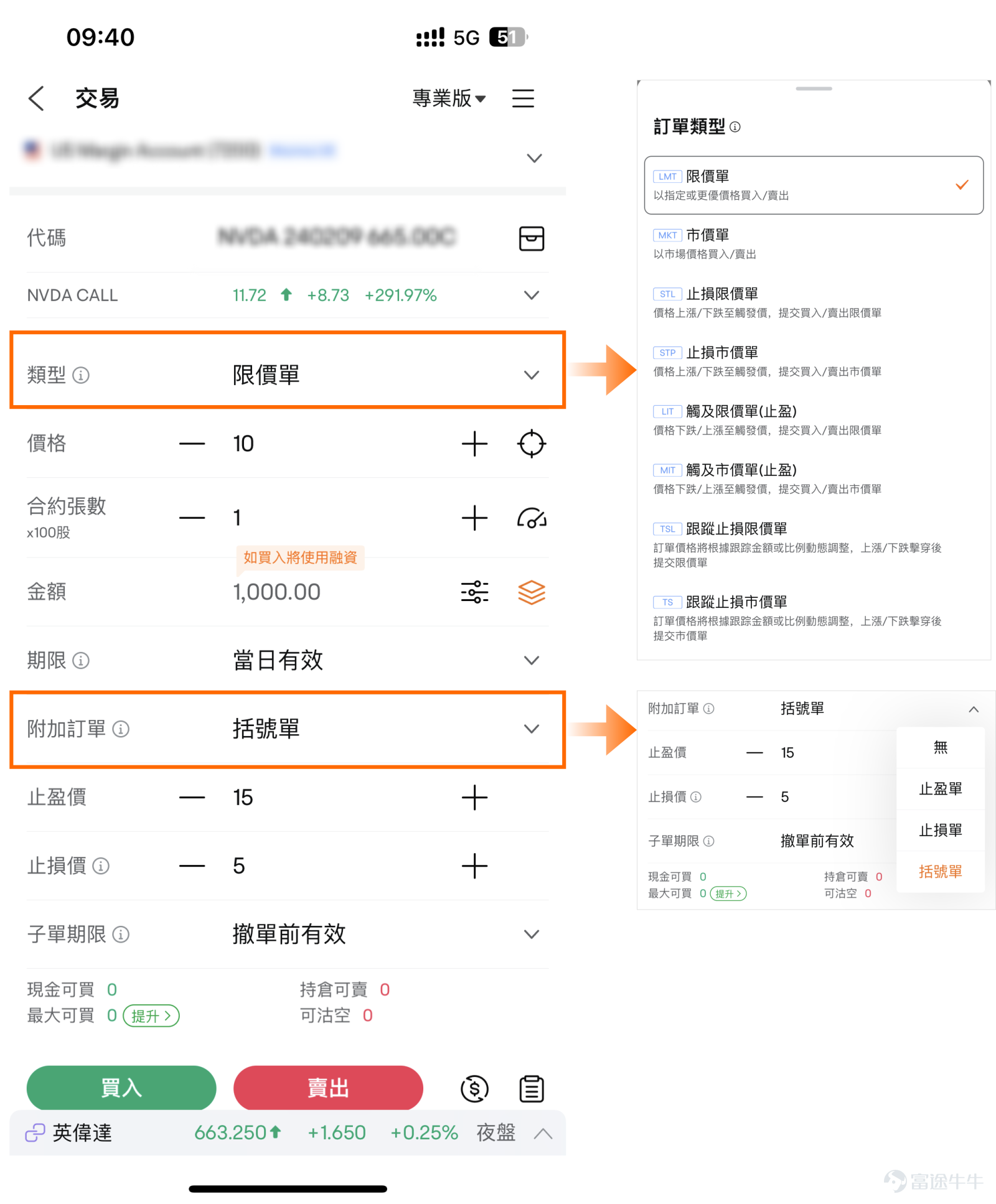
8 types of orders are supported in US equity trading:
Limit order, market price, stop loss order, stop loss market price, hit limit order (stop profit), hit limit order (stop loss), track stop loss price, track stop loss market price.
But in most options trading scenarios, limit orders and market orders are already meeting the demand.
If you are interested in other order types, you can find more information by clicking on the “i” symbol on the trading page.

What is a limit order?
A limit order refers to the execution of a buy or sell order at a specified price or better price.
If you want to buy an NVDA call option for $10, the total spend cannot exceed $1000.
You can place a limit order for the next order with a price of $10, so your order will not be traded for more than $10.
The advantage of a limited price list is that the price is controllable, can be traded at the price you set or at a better price.
However,The downside is that it may be necessary to wait for upstream summation syndication, there is a certain waiting period for the transaction, and there may also be a situation where the deal cannot be reached.
What is Market Price List?
The market price alone does not require a price to be specified, but a buy or sell order is executed at the market price.
If you want to quickly open a position and buy a call option on an NVDA, you can place the next market price, then the system will quickly match the price of the market to trade at the market price of the counter and trade immediately.
The advantage of market quotes is fast trading, but the disadvantage is that the price is not very manageableEspecially when the option price fluctuates a lot, it is necessary to use market quotes with extreme caution.
Since the transaction price of the market price is not guaranteed, it means that the order can be traded at any price.
Second, additional orders
Today, we focus on additional orders.
In options trading, placing orders is a key step in the implementation of a trading strategy, and it is not allowed to anyone who does not already know [Additional Orders].
Additional order refers to:
A closing order (additional order) placed on top of an open order (parent order). Once the parent order has been placed and the option price reaches the trigger price, additional orders are automatically submitted for automatic closing.
There are 3 types of additional orders:
Stop Profit Orders, Stop Loss Orders, Parentheses.
Mobile side path:
Options Trading Page - Click on the top right corner to toggle Pro - Attach Orders - Click the down arrow on the right - Select the desired Additional Order Type
PC-side path:
Optional - Selected Stocks - Below [Related Options] - Selected Options to Trade - Top Right【Quick Trading】- Lower Right Trading Block - Additional Orders
What are parentheses, stop profit and loss orders?
If you have a definite stop and stop loss strategy when you open an option. Then you can.Drop-down Options, Quickly add an additional order, so you can automate the stop profit and stop loss and complete the opening and closing two-step operation with one click.

In the above example, you bought an NVDA call option at $10 for a total of $1000.
Since you expect the performance of NVDA, you set a stop price of $15 and a stop loss of $5 at the same time as you open a position.
This way you can go about other things with peace of mind without staring at the screen all the time, because your profit and loss limit is secured.
The parentheses consist of a stop profit and a stop loss order:
After the parent order has been placed, the first order that reaches the trigger price will be submitted, and the other order will be automatically withdrawn by the system.
A stop-loss order is a special limit order:
Its code and quantity are consistent with the parent order, the buying and selling direction is the opposite of the parent order, and the order price is profitable until the price.
If the price of the call first hits $15,Then [Stop Profit Order] is triggered, the system automatically submits a limit order with a transaction price of $15,Automatically sell calls for $15, achieve your full purpose and make you smile in your dreams too.
A stop loss order is a special stop loss market price:
Its code and quantity are consistent with the parent order, the buy and sell direction is the opposite of the parent order, and the order triggers the price until it loses price.
If the price of the call first hits $5,The Stop Loss Order will be triggered., the system automatically submits a market price quote for the market price,Automatically sell calls at market price, achieve the purpose of stopping losses and avoiding greater losses.
It should be noted that the stop price here represents both the trigger price and the order price (limit order).
A stop-loss price means only a trigger price for the order, which, once triggered, will be submitted to the market at the stop-loss market price.
The above is today's share, and welcome all Cow friends to forward three series with one click.
Whether you're a beginner or a seasoned veteran, understanding the various order types and their uses is a must-have lesson on the trading circuit.
By using precise entry of limit orders, fast market price trades, and smart stop-loss gains on additional orders, we can more calmly respond to market fluctuations and capture investment opportunities for performance.
Risk Disclosure
This article is for reference and educational purposes only and does not recommend any specific investment strategy. The content is general and strictly for educational purposes and may not be suitable for all investors. The foregoing does not take into account an individual investor's financial situation, investment objectives, investment timeframes or risk tolerance. You should consider your personal situation and the risks involved before making any investment decisions.
Any examples provided in this article are for illustrative purposes only and are not intended to reflect the investment results any investor can expect. Options trading involves significant risk and may not be suitable for all investors. Before participating in any options trading and implementing any options trading strategy, investors must consider the characteristics and risks of options trading and consult a professional investment advisor if necessary.
Risk Disclaimer: The above content only represents the author's view. It does not represent any position or investment advice of Futu. Futu makes no representation or warranty.Read more
Comments (19)
to post a comment
85
44
