English
Back
Open Account
漲勢延續,國際油價能否「破百」?
躺平指数
joined discussion · Sep 19, 2023 13:29 ·

The crisis is here again, and the oil market is already in turmoil

But... well, our previous predictions for oil prices were a bit conservative. Currently, the oil market trend is rising a bit rapidly, and there are very few signs of stagnation.
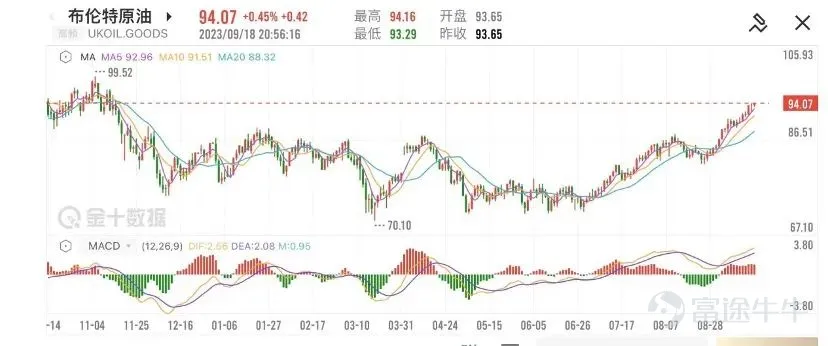
This past weekend, Brent and WTI oil prices have risen one after another. Currently, they are all above 90 US dollars/barrel. This is also the highest level in the past 10 months. If we take the time a little further, from 70 US dollars/barrel at the end of June and the beginning of July to now, international oil prices have risen by nearly one-third in two months or so.
But... well, our previous predictions for oil prices were a bit conservative. Currently, the oil market trend is rising a bit rapidly, and there are very few signs of stagnation. This past weekend, Brent and WTI oil prices have risen one after another. Currently, they are all above 90 US dollars/barrel. This is also the highest level in the past 10 months. If we take the time a little further, from 70 US dollars/barrel at the end of June and the beginning of July to now, international oil prices have risen by nearly one-third in two months or so. Source: Jinten data As shown in the chart above, oil prices have experienced a deep and large fluctuation this year. They have completely left the trend of rising and falling in the first half of the year, and have maintained an upward trend since the end of June. As oil prices continue to rise, it is basically possible to make the next judgment, which we have emphasized before: The peak of this round of the international crude oil cycle, which was jointly driven by “masks” and the Russian-Ukrainian conflict, is not over yet, and high prices will continue. However, there is one expectation that might need to be adjusted. As can be clearly seen from the trend in recent months, the “bottom line” of oil prices acceptable to oil-producing countries has changed — 70 US dollars/barrel. In the past, this could be considered a moderately high price. You can almost think of it as the bottom line of oil prices acceptable to oil-producing countries for a long time to come. Once the drop breaks through this bottom line, they will take tough measures to bolster the price. At the same time, what haunts the international oil market is not only the willingness of oil-producing countries to control; factors such as current inventories and the price of refined oil products all play a strong role in supporting oil prices...
Source: Jinten data
As shown in the chart above, oil prices have experienced a deep and large fluctuation this year. They have completely left the trend of rising and falling in the first half of the year, and have maintained an upward trend since the end of June. As oil prices continue to rise, it is basically possible to make the next judgment, which we have emphasized before:
The peak of this round of the international crude oil cycle, which was jointly driven by “masks” and the Russian-Ukrainian conflict, is not over yet, and high prices will continue.
However, there is one expectation that might need to be adjusted. As can be clearly seen from the trend in recent months, the “bottom line” of oil prices acceptable to oil-producing countries has changed — 70 US dollars/barrel. In the past, this could be considered a moderately high price. You can almost think of it as the bottom line of oil prices acceptable to oil-producing countries for a long time to come. Once the drop breaks through this bottom line, they will take tough measures to bolster the price.
At the same time, what haunts the international oil market is not only the willingness of oil-producing countries to control; factors such as current inventories and refined oil prices all have a strong supporting effect on oil prices; in contrast, the interest rate hike expectations of the Federal Reserve and the central banks of various Western countries are constrained by the possibility of an economic recession, making it difficult to further hinder oil prices.
Next, we will once again sort out the fundamentals of the current international oil market and clarify some new changes that may occur in the future.
01  Demand, or demand.
For conventional energy, it's hard to avoid the fact that demand for fossil fuels such as coal, oil, and gas may permanently decline in the future. Of course, this judgment has been heard for a long time, but as the prices of these energy sources hit new highs one after another, it is easy to refute these claims that they will enter a recession.
But the truth is the truth. As China's economy moves towards high-quality development, this engine of global oil demand in the past 20 years is shifting to a more efficient and cleaner economic structure; photovoltaics, wind power, and electric vehicles that are becoming popular are gradually replacing the traditional energy supply and demand structure around the world. This evolution may not be as fast, but it's already an established trend.
According to predictions from the International Energy Agency (IEA), even if governments around the world do not introduce any clean energy policies or carry out additional energy consumption control starting this year, a peak in demand for fossil energy will occur within ten years. It can be said that the world's demand for energy is getting closer to a historic turning point, which will bring the peak of global greenhouse gas emissions ahead of schedule.
To really understand this is an answer that explains many of the current situations and helps to analyze the many phenomena in the crude oil market. Why is it that Saudi Arabia and Russia have to push back production under the already tight supply and demand situation this year; another example is investment in exploration and development of coal, natural gas, and oil, even with prices soaring in the past two years, there is still no sign of a sharp expansion, etc.
Precisely because the market has reached a consensus that the peak in demand for fossil energy is accelerating, many things have become traceable.
Of course, the decline in demand will not be rapid, let alone linear, but slow and volatile. For example, energy shortages within a short period of time may increase demand for fossil energy; for example, rapid economic development in some countries has greatly increased energy demand, leading to fluctuations in global aggregate demand, etc.
At the same time, it is precisely because such demand expectations have been established that energy security has also become more challenging, and the way countries respond is not the same. As the largest global consumer of fossil energy, China is not slowing down the pace of fossil energy development; oil, natural gas, and coal production is increasing year by year. In particular, for the first two types of energy, under the strategy of increasing storage and production that began a few years ago, all Chinese petroleum companies are increasing investment in the development of both domestic and international resources, striving to guarantee domestic energy supply as much as possible in a future where uncertainty about the global energy supply pattern increases.
It is also for this reason that it is wrong to simply equate poor demand expectations with falling oil prices and reduced investment. Every country in the world, especially the largest economies, will respond to the same expectations differently, and some even the opposite. As an investor, you should make a comprehensive judgment based on factors such as the country's resource endowment, geographical location, and international influence in order to make the most scientific decisions.
02 Supply, the “steel pact” between the two major countries
Precisely based on the weakening of irrefutable and extremely certain long-term demand expectations, the two major powers, Saudi Arabia and Russia, began to work together to bail out the market.
Don't get me wrong. We are definitely not implying the collaboration between Saudi Arabia and Russia on oil price control as collusion between Nazi Germany and Italy; we just feel that this “steel-like cooperation” is particularly appropriate for Saudi Arabia and Russia today.
Of course, in the context of Western media, the current state of collaboration between these two countries really does mean something like that.
First, let's take a look at some data. This is a chart of oil price trends over the past ten years.
But... well, our previous predictions for oil prices were a bit conservative. Currently, the oil market trend is rising a bit rapidly, and there are very few signs of stagnation. This past weekend, Brent and WTI oil prices have risen one after another. Currently, they are all above 90 US dollars/barrel. This is also the highest level in the past 10 months. If we take the time a little further, from 70 US dollars/barrel at the end of June and the beginning of July to now, international oil prices have risen by nearly one-third in two months or so. Source: Jinten data As shown in the chart above, oil prices have experienced a deep and large fluctuation this year. They have completely left the trend of rising and falling in the first half of the year, and have maintained an upward trend since the end of June. As oil prices continue to rise, it is basically possible to make the next judgment, which we have emphasized before: The peak of this round of the international crude oil cycle, which was jointly driven by “masks” and the Russian-Ukrainian conflict, is not over yet, and high prices will continue. However, there is one expectation that might need to be adjusted. As can be clearly seen from the trend in recent months, the “bottom line” of oil prices acceptable to oil-producing countries has changed — 70 US dollars/barrel. In the past, this could be considered a moderately high price. You can almost think of it as the bottom line of oil prices acceptable to oil-producing countries for a long time to come. Once the drop breaks through this bottom line, they will take tough measures to bolster the price. At the same time, what haunts the international oil market is not only the willingness of oil-producing countries to control; factors such as current inventories and the price of refined oil products all play a strong role in supporting oil prices...
Source: Bloomberg
As can be clearly seen from this chart, the period before 2015 and after 2022 is the last two rounds of peak oil prices. What is mixed in the middle is that two collaborations between Saudi-led OPEC and Russia have broken down. In 2015, in order to regain lost share in the hands of rising US shale oil producers, Saudi Arabia drastically increased production and launched a price war; in 2020, soon after the “mask” occurred, Saudi Arabia once again launched a crude oil price war, and this time the target was aimed directly at Russia.
Time passed, and soon after the war between Czarist and Russia, the two countries discovered that things were not right. They clearly had a very broad base of interests — oil prices, yet they were all very upset because of minor issues. In 2022, the Russia-Ukraine conflict broke out, and Western countries began imposing energy sanctions on Russia. As Saudi Arabia became more and more autonomous from US control, the two major crude oil countries began to form a collaboration.
This synergy of energy production strategies allows Russia to still have a good crude oil revenue in the face of Western sanctions, and continues to be a source of impetus between this country and Ukraine; it has also given Saudi Arabia more capital, invested in other domestic industries, and cultivated economic growth points other than crude oil.
Saudi Arabia, in particular, has not hesitated to invest in these highly influential sporting events, from establishing events that rival the US Professional Golf Tour, to sending Neymar and Ronaldo to join their domestic professional soccer leagues; it has reached various industrial and investment cooperation with China, while at the same time putting aside previous differences with Iran and striving to play a greater role in geopolitics.
Everything revolves around one central point: even without the US, Saudi Arabia will still be able to survive very well. Of course, a good life must be based on having money. For this reason, Saudi Arabia and Russia have pushed the bottom line of international oil prices above 70 US dollars. In the past, it was less than 50 US dollars/barrel, so it's hard to say that this oil price is “low.”
Now, the pressure is on America. Last year, in order to cope with the sharp rise in energy prices brought about by the Russia-Ukraine conflict, the US reduced its crude oil inventories to the level of 40 years ago; this year, as oil prices continue to rise, how many options are left?
03  Raising interest rates or not, a dilemma
Since 2022, in addition to releasing crude oil reserves in stock, there is another way to deal with rising oil prices — raising interest rates. However, interest rate hikes are not expected to effectively curb inflation, let alone have effective control over oil prices.
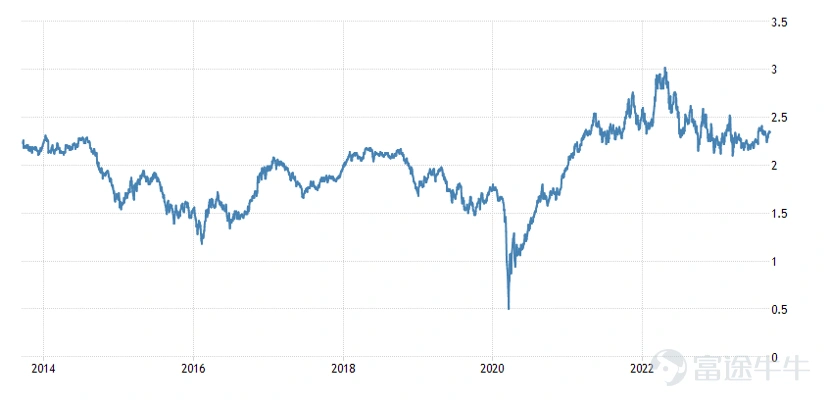
(US break-even inflation rate for the past 10 years)
But... well, our previous predictions for oil prices were a bit conservative. Currently, the oil market trend is rising a bit rapidly, and there are very few signs of stagnation. This past weekend, Brent and WTI oil prices have risen one after another. Currently, they are all above 90 US dollars/barrel. This is also the highest level in the past 10 months. If we take the time a little further, from 70 US dollars/barrel at the end of June and the beginning of July to now, international oil prices have risen by nearly one-third in two months or so. Source: Jinten data As shown in the chart above, oil prices have experienced a deep and large fluctuation this year. They have completely left the trend of rising and falling in the first half of the year, and have maintained an upward trend since the end of June. As oil prices continue to rise, it is basically possible to make the next judgment, which we have emphasized before: The peak of this round of the international crude oil cycle, which was jointly driven by “masks” and the Russian-Ukrainian conflict, is not over yet, and high prices will continue. However, there is one expectation that might need to be adjusted. As can be clearly seen from the trend in recent months, the “bottom line” of oil prices acceptable to oil-producing countries has changed — 70 US dollars/barrel. In the past, this could be considered a moderately high price. You can almost think of it as the bottom line of oil prices acceptable to oil-producing countries for a long time to come. Once the drop breaks through this bottom line, they will take tough measures to bolster the price. At the same time, what haunts the international oil market is not only the willingness of oil-producing countries to control; factors such as current inventories and the price of refined oil products all play a strong role in supporting oil prices...
Source: BEA
(Changes in Brent oil prices over the past ten years)
But... well, our previous predictions for oil prices were a bit conservative. Currently, the oil market trend is rising a bit rapidly, and there are very few signs of stagnation. This past weekend, Brent and WTI oil prices have risen one after another. Currently, they are all above 90 US dollars/barrel. This is also the highest level in the past 10 months. If we take the time a little further, from 70 US dollars/barrel at the end of June and the beginning of July to now, international oil prices have risen by nearly one-third in two months or so. Source: Jinten data As shown in the chart above, oil prices have experienced a deep and large fluctuation this year. They have completely left the trend of rising and falling in the first half of the year, and have maintained an upward trend since the end of June. As oil prices continue to rise, it is basically possible to make the next judgment, which we have emphasized before: The peak of this round of the international crude oil cycle, which was jointly driven by “masks” and the Russian-Ukrainian conflict, is not over yet, and high prices will continue. However, there is one expectation that might need to be adjusted. As can be clearly seen from the trend in recent months, the “bottom line” of oil prices acceptable to oil-producing countries has changed — 70 US dollars/barrel. In the past, this could be considered a moderately high price. You can almost think of it as the bottom line of oil prices acceptable to oil-producing countries for a long time to come. Once the drop breaks through this bottom line, they will take tough measures to bolster the price. At the same time, what haunts the international oil market is not only the willingness of oil-producing countries to control; factors such as current inventories and the price of refined oil products all play a strong role in supporting oil prices...
As you can see, the trends in these two pictures are almost completely correlated. According to the base effect, we know that the current rise in oil prices means a decline in future inflation expectations, but the opposite is true. Even with interest rate increases one after another, the 10-year US break-even inflation rate is 2.35%. This level is not that low.
On September 13, local time, the US Consumer Price Index (CPI) for August increased 0.6% month-on-month, up from 0.2% in the previous month. The year-on-year increase was 3.7%, an increase of 0.5 percentage points over the previous month, the biggest month-on-month increase in 14 months. However, if you look closely at this data, it is easy to see that after excluding volatile energy prices, the core CPI rose 0.3% month-on-month and 4.3% year-on-year. The sharp rise in energy prices became the main reason for the increase in CPI.
On the other side of the ocean, interest-rate booties have already landed. On September 14, the European Central Bank held a monetary policy meeting and decided to raise each of the Eurozone's three key interest rates by 25 basis points. This is the tenth time that the ECB has raised interest rates since July last year. After the rate hike, interest rates in the Eurozone have reached their highest point since the introduction of the euro in 1999.
However, oil prices, which continued to soar over the weekend, became the toughest response to interest rate hikes. On the basis of interest rates that are already high in Western countries, further interest rate hikes will bring huge risks to economic development. In particular, Europe. France and Germany's support for interest rate hikes is likely to damage the expanding fiscal situation in neighboring countries and further increase the possibility of economic recession.
What's worse is that raising interest rates cannot control Saudi Arabia and Russia's willingness to raise prices, let alone ease the current imbalance between supply and demand for refined oil products.
Refining has long been one of the more predictable areas of the oil market, but now it is in trouble because of climate policies. In the US, Europe, and emerging economies in particular, people's demand for fuel is rising, but the additional production capacity of oil refineries is declining.
But... well, our previous predictions for oil prices were a bit conservative. Currently, the oil market trend is rising a bit rapidly, and there are very few signs of stagnation. This past weekend, Brent and WTI oil prices have risen one after another. Currently, they are all above 90 US dollars/barrel. This is also the highest level in the past 10 months. If we take the time a little further, from 70 US dollars/barrel at the end of June and the beginning of July to now, international oil prices have risen by nearly one-third in two months or so. Source: Jinten data As shown in the chart above, oil prices have experienced a deep and large fluctuation this year. They have completely left the trend of rising and falling in the first half of the year, and have maintained an upward trend since the end of June. As oil prices continue to rise, it is basically possible to make the next judgment, which we have emphasized before: The peak of this round of the international crude oil cycle, which was jointly driven by “masks” and the Russian-Ukrainian conflict, is not over yet, and high prices will continue. However, there is one expectation that might need to be adjusted. As can be clearly seen from the trend in recent months, the “bottom line” of oil prices acceptable to oil-producing countries has changed — 70 US dollars/barrel. In the past, this could be considered a moderately high price. You can almost think of it as the bottom line of oil prices acceptable to oil-producing countries for a long time to come. Once the drop breaks through this bottom line, they will take tough measures to bolster the price. At the same time, what haunts the international oil market is not only the willingness of oil-producing countries to control; factors such as current inventories and the price of refined oil products all play a strong role in supporting oil prices...
Shortage of supply has become the main theme of oil refining and downstream processes. This means that supply shortages in refined oil products will continue for a long time.
Therefore, under the current circumstances, it is difficult for interest rate hikes to play a particularly critical role in curbing the rise in energy prices. Even if energy prices are high, whether to raise interest rates will be considered based on the overall macroeconomic situation. According to market expectations, the probability that the Fed will keep interest rates unchanged in September is close to 99%. Whether to raise interest rates further in the future also depends on economic expectations.
Finally, let's talk about some types of targets we should pay attention to in the current state of the oil market. The first category is oil development companies with high-quality large-scale oil fields in China, such as CNPC and CNOOC. Of course, CNPC is China's main supplier of Russian crude oil, and can also enjoy the latter's current oil price discounts; the other category is oil refiners that can export overseas or have refineries overseas, such as Sinopec and Hengyi Petrochemical.$CNOOC (00883.HK)$$PETROCHINA (00857.HK)$$SINOPEC CORP (00386.HK)$
Disclaimer: This article is for learning and communication only and does not constitute investment advice.
Risk Disclaimer: The above content only represents the author's view. It does not represent any position or investment advice of Futu. Futu makes no representation or warranty.Read more
Thumbs Up
11
Respect
1
Heart
1
82K Views
Report
Comment (1)
Write a Comment...
1
13
8