

How should I handle stocks that I’ve held for about two years?
Recently, several friends around me have been asking me:Should I sell the stock I've been holding for over two years?
In a prolonged, bottomless bear market, there are likely quite a few people who share this sentiment.
On one hand, the stocks you hold continue to stagnate; on the other, others' holdings are surging. Naturally, this stark contrast is all the more painful.
Since its peak, the Hang Seng Tech Index has still fallen by about 60%, a decline driven by the sharp drops of once-popular stocks. Waiting one year is manageable; waiting two is tough—especially now that we're in the third year of the bear market. As a widespread and deeply ingrained psychological instinct, loss aversion seems to be nearing the end of its effectiveness.
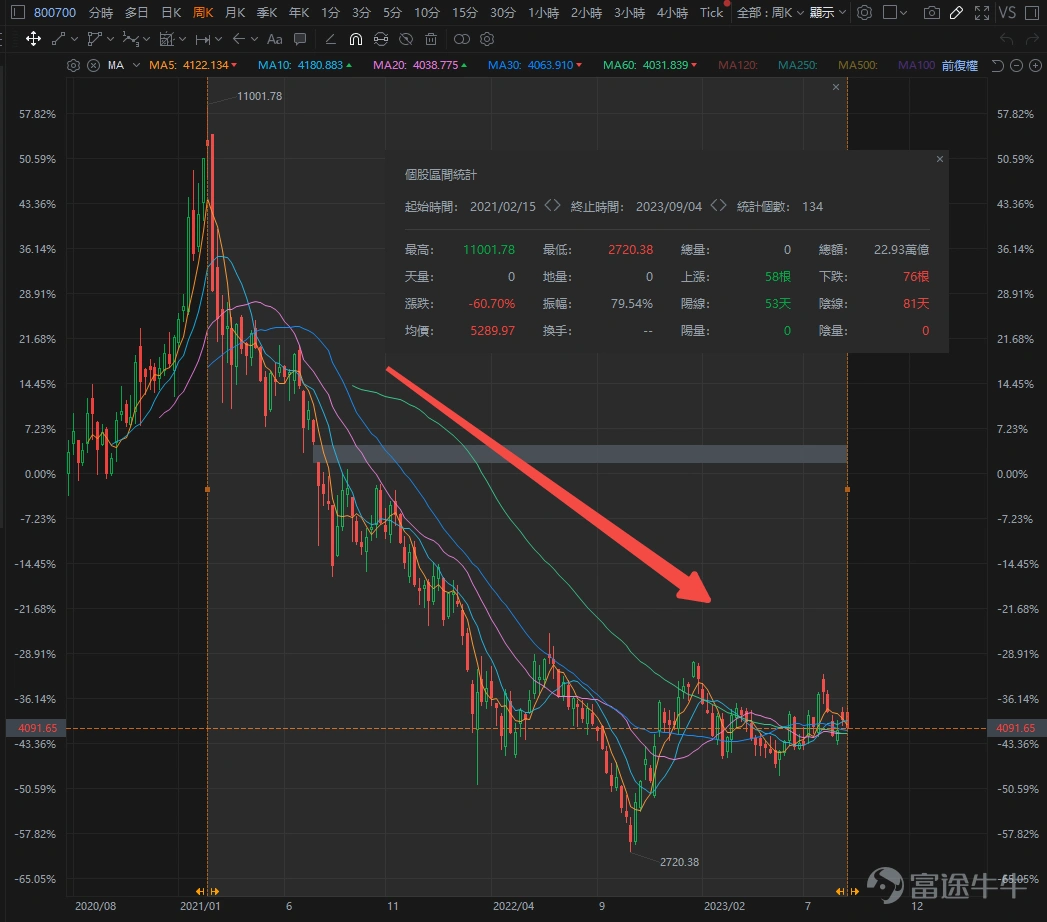
Source: Futubull
When the hope of breaking even turns into the despair of continuous losses,"Cutting ties with the past and starting anew" will then become an enticing new option.
![Recently, several friends around me have been asking me:Should I sell the stock I've been holding for over two years?[Sob] In a protracted, bottomless bear market, there are likely quite a few people who share this view. On the one hand, the stocks you hold continue to languish; on the other, others' holdings are soaring. Naturally, this stark contrast is all the more painful. Since its peak, the Hang Seng Tech Index has still fallen by about 60%, a decline driven by the precipitous declines of once-hot stocks. Waiting one year is easy; waiting two is hard—especially now that we're in the third year of the bear market. As a widespread and deeply ingrained physiological instinct, loss aversion appears to be nearing the end of its shelf life.[Shrunken] When the hope of breaking even turns into the despair of continuous losses,"Cutting ties with the past and starting anew" will then become a tantalizing new option. Besides, where on earth is there not fragrant grass? Over the past two years, energy stocks, gold stocks, and more recently "AI-themed" stocks have each sparked wave after wave of exhilarating rallies—some individual stocks have surged by 50% or even 100% in just six months. Of course, some of these waves have already receded, becoming nothing more than yesterday's surges, while others are still roaring and show no sign of abating anytime soon. This constant ebb and flow of new opportunities only makes investors who were once trapped all the more eager to jump back in.[Whimper] To cut or not to cut? To replace or not to replace?This is a problem. I. The First Step to Breaking Even: Forget the Cost A rational investor typically sells stocks for one of three main reasons: 1. Deteriorating fundamentals; 2. Or the price reaches the target price; 3. Or other, better investment opportunities. However, for most investors...](https://nnqimage.futunn.com/999986/editor_image/925f76ec781138d3b27b4a7cf1c3ccc3.png/big?imageMogr2/ignore-error/1/format/webp&imageMogr2/ignore-error/1/format/webp)
Besides, where isn't there green pastures?
Over the past two years, energy stocks, gold stocks, and more recently 'AI-themed' stocks have each sparked wave after wave of exhilarating rallies—some individual stocks have surged by 50% or even 100% in just six months. Of course, some of these waves have already subsided, becoming nothing more than yesterday's gains, while others are still roaring and show no sign of abating anytime soon. This constant ebb and flow of new opportunities only makes investors who were once trapped all the more eager to jump back in.
To cut or not to cut? To replace or not to replace?This is a problem.
I. The First Step to Breaking Even: Forget the Cost
A rational investor typically sells stocks for one of three main reasons:
1. Deteriorating fundamentals;
2. Or the price reaches the target price;
3. Or other, better investment opportunities.
However, for most investors,When selling stocks, the first thing to consider is the purchase cost.:
:1) On the cost side, lock in profits at the first sign of trouble; off the cost side, absolutely refuse to sell.
2) On the cost side, we're relentlessly aggressive—after all, losing the money we've earned doesn't hurt; on the capital preservation side, we're painstakingly conservative—because even a single penny of capital loss is painfully felt.
Especially after incurring losses, one is faced with two options:
A: Wait—there's an 80% chance of incurring greater losses, but a 20% chance of breaking even.
B: Cut losses and accept the loss.
Most people still opt for Option A, because in their view, selling guarantees a loss, whereas being "stuck" at a loss at least leaves open the possibility of recouping the investment—even if there's also a high probability that the loss will only widen.
An extreme example is the gambler:Once losses reach a certain point, players "lose all sense of reason" and recklessly ramp up their risk appetite, determined to recoup their losses.
According to some estimates, cutting losses when investment losses are between 5% and 10% is relatively easy; once the loss exceeds 10%, it becomes much harder to make the decision. Under such irrational sentiment, whether the stock's fundamentals have actually deteriorated and whether it is still worth holding onto ceases to be your primary concern.
Even worse, the marginal utility of losses also diminishes: after the initial unrealized loss, each additional segment of unrealized loss brings with it a progressively smaller increase in pain—Loss is a process of gradual numbness.。
Yet at the same time, you vividly remember your costs—though you dare not dwell on just how much you've already lost, comforting yourself with the thought that this is only a temporary paper loss.
Most people, once their losses reach a certain level, are reluctant to cut their losses; they'll hold onto a position for many years.Passively 'becoming friends with time'。
Those who fear loss often end up losing the most.
![Recently, several friends around me have been asking me:Should I sell the stock I've been holding for over two years?[Sob] In a protracted, bottomless bear market, there are likely quite a few people who share this view. On the one hand, the stocks you hold continue to languish; on the other, others' holdings are soaring. Naturally, this stark contrast is all the more painful. Since its peak, the Hang Seng Tech Index has still fallen by about 60%, a decline driven by the precipitous declines of once-hot stocks. Waiting one year is easy; waiting two is hard—especially now that we're in the third year of the bear market. As a widespread and deeply ingrained physiological instinct, loss aversion appears to be nearing the end of its shelf life.[Shrunken] When the hope of breaking even turns into the despair of continuous losses,"Cutting ties with the past and starting anew" will then become a tantalizing new option. Besides, where on earth is there not fragrant grass? Over the past two years, energy stocks, gold stocks, and more recently "AI-themed" stocks have each sparked wave after wave of exhilarating rallies—some individual stocks have surged by 50% or even 100% in just six months. Of course, some of these waves have already receded, becoming nothing more than yesterday's surges, while others are still roaring and show no sign of abating anytime soon. This constant ebb and flow of new opportunities only makes investors who were once trapped all the more eager to jump back in.[Whimper] To cut or not to cut? To replace or not to replace?This is a problem. I. The First Step to Breaking Even: Forget the Cost A rational investor typically sells stocks for one of three main reasons: 1. Deteriorating fundamentals; 2. Or the price reaches the target price; 3. Or other, better investment opportunities. However, for most investors...](https://nnqimage.futunn.com/999986/editor_image/461e118c87cd322b8c420665b4c74d3a.png/big?imageMogr2/ignore-error/1/format/webp&imageMogr2/ignore-error/1/format/webp)
So, what should you do if you're deeply trapped in a stock?
The first step is to forget about your costs.
Let's make a hypothetical: suppose you're lucky enough to hold no stocks at all right now—100% cash.Do you still want to buy this stock?
When you no longer dwell on this loss in your mindset, then compare it with other companies to assess its investment value. If you still find it reasonable, holding onto it won't be unbearable; otherwise, selling and rebalancing your portfolio may be the more rational choice.
II. Step Two in Escaping Losses: Understand Your Investment Style
The next question is: Is switching positions after a sell-off always the right move? Can you guarantee it won't turn into another "deeply trapped" scenario?
Therefore, before making a position change, you must first make sure you understand:Why did you get trapped in the last round, and how does that relate to your investment style?
In general, investors in the market can be broadly categorized into two types: trend followers and value investors.
If you are a trend investor
You may favor a momentum strategy, believing that "the strong get stronger"—at least for a certain period—so you should buy high and sell even higher. In that case, the rationale for your stock purchases is most likelyChasing a trending market upward。
Participating in the process of a strengthening trend tends to yield relatively quick results. Once an upward trend takes hold, a flood of follow-on buyers will propel the price higher in a near-vertical surge, potentially generating astonishing short-term gains.
However, profiting from trends is exceedingly difficult. On the one hand, most investors struggle to identify emerging trends at their inception and enter the market in a timely manner; on the other hand, they often find it hard to make rational assessments at trend peaks and exit decisively.
Therefore, if we liken the trend-accelerating phase to the most succulent part of a fish, most people, eager to savor that prime cut, often end up with a fishbone lodged in their throat.
The most common scenario is this: in the early stages, traders make only brief forays into certain trend movements—entering quickly and exiting just as fast, locking in profits at the right moment—and this approach repeatedly proves successful. As a result, their confidence soars, leading them to believe they have trend trading firmly under control. Consequently, they pour large sums into positions, only to suffer crushing losses and total defeat. This, too,This is why most trend investors get trapped.。
George Soros is also a successful trend trader. His theory of reflexivity teaches us that bubbles are inevitable—and that they will inevitably burst—but the precise timing of the burst is difficult to predict. Trend investors, therefore, prefer to ride the wave of the bubble.
![Recently, several friends around me have been asking me:Should I sell the stock I've been holding for over two years?[Sob] In a protracted, bottomless bear market, there are likely quite a few people who share this view. On the one hand, the stocks you hold continue to languish; on the other, others' holdings are soaring. Naturally, this stark contrast is all the more painful. Since its peak, the Hang Seng Tech Index has still fallen by about 60%, a decline driven by the precipitous declines of once-hot stocks. Waiting one year is easy; waiting two is hard—especially now that we're in the third year of the bear market. As a widespread and deeply ingrained physiological instinct, loss aversion appears to be nearing the end of its shelf life.[Shrunken] When the hope of breaking even turns into the despair of continuous losses,"Cutting ties with the past and starting anew" will then become a tantalizing new option. Besides, where on earth is there not fragrant grass? Over the past two years, energy stocks, gold stocks, and more recently "AI-themed" stocks have each sparked wave after wave of exhilarating rallies—some individual stocks have surged by 50% or even 100% in just six months. Of course, some of these waves have already receded, becoming nothing more than yesterday's surges, while others are still roaring and show no sign of abating anytime soon. This constant ebb and flow of new opportunities only makes investors who were once trapped all the more eager to jump back in.[Whimper] To cut or not to cut? To replace or not to replace?This is a problem. I. The First Step to Breaking Even: Forget the Cost A rational investor typically sells stocks for one of three main reasons: 1. Deteriorating fundamentals; 2. Or the price reaches the target price; 3. Or other, better investment opportunities. However, for most investors...](https://nnqimage.futunn.com/999986/editor_image/44da93c5e89d39a6850d8fb85fb113ff.png/big?imageMogr2/ignore-error/1/format/webp&imageMogr2/ignore-error/1/format/webp)
Yet Soros consistently emphasizes that the secret to his trading lies in setting strict stop-losses. Stanley Druckenmiller, Soros's most trusted protégé and chief investment officer of Quantum Fund, says: "I've learned a great deal from Soros, but perhaps what has inspired me the most is—"Trading is not about being right or wrong; it's about how much you profit when you're right and how much you lose when you're wrong.
Therefore, for trend investors, who frequently face the risk of buying at peak prices and getting trapped, trial and error and timely stop-losses should naturally be part of their strategy.
Set a stop-loss level and know when to cut your losses promptly.Otherwise, your next investment will very likely repeat the "deeply trapped" scenario you experienced before.
> Here's a recommended stop-loss tool:Didn’t check the market? Missed your stop loss? You’ll regret not knowing about this game-changing tool—【Stop-Loss Limit Orders】!
If you are a value investor
You may prefer a contrarian strategy,Faith in Mean ReversionIt is believed that if a stock has underperformed over the past few months, it is likely due to market mispricing. At such times, one should buy the stock at an undervalued price with a sufficient margin of safety and wait for its price to revert to its intrinsic value.
As Howard Marks puts it, the market is like a pendulum, with the intrinsic value of stocks serving as its fulcrum. Driven by market sentiment, stock prices swing from one extreme to the other; when they reach an extreme, we may not know exactly when the peak will be reached, but we can at least identify where they stand today—and we know that they will eventually revert.
![Recently, several friends around me have been asking me:Should I sell the stock I've been holding for over two years?[Sob] In a protracted, bottomless bear market, there are likely quite a few people who share this view. On the one hand, the stocks you hold continue to languish; on the other, others' holdings are soaring. Naturally, this stark contrast is all the more painful. Since its peak, the Hang Seng Tech Index has still fallen by about 60%, a decline driven by the precipitous declines of once-hot stocks. Waiting one year is easy; waiting two is hard—especially now that we're in the third year of the bear market. As a widespread and deeply ingrained physiological instinct, loss aversion appears to be nearing the end of its shelf life.[Shrunken] When the hope of breaking even turns into the despair of continuous losses,"Cutting ties with the past and starting anew" will then become a tantalizing new option. Besides, where on earth is there not fragrant grass? Over the past two years, energy stocks, gold stocks, and more recently "AI-themed" stocks have each sparked wave after wave of exhilarating rallies—some individual stocks have surged by 50% or even 100% in just six months. Of course, some of these waves have already receded, becoming nothing more than yesterday's surges, while others are still roaring and show no sign of abating anytime soon. This constant ebb and flow of new opportunities only makes investors who were once trapped all the more eager to jump back in.[Whimper] To cut or not to cut? To replace or not to replace?This is a problem. I. The First Step to Breaking Even: Forget the Cost A rational investor typically sells stocks for one of three main reasons: 1. Deteriorating fundamentals; 2. Or the price reaches the target price; 3. Or other, better investment opportunities. However, for most investors...](https://nnqimage.futunn.com/999986/editor_image/9b1713b92d7838c4abf59b5783418d59.png/big?imageMogr2/ignore-error/1/format/webp&imageMogr2/ignore-error/1/format/webp)
Of course, this cyclical mindset is rather counterintuitive in practice. After all, the time it takes for a stock to move from undervaluation to mean reversion is inherently unpredictable.Once you buy, you may have to endure losses—for a long time, even.
For example, as early as 1995, Max himself believed that U.S. internet stocks were overvalued; yet the bubble did not burst until 2001. For an investment manager whose performance is evaluated on relative returns, those six years would have been extremely painful. Nevertheless, Max does not seem intent on striking a balance in this regard; instead, he steadfastly advocates patience, trusting that time will create room for value to emerge.
Therefore, for value investors,What is needed is patience.Once a downtrend has taken hold, irrational forces can drive it just as relentlessly—and for just as long—as they do an uptrend. Under no circumstances should you rush to sell. And even once you do decide to act, don't go all in right away. It's perfectly fine to buy gradually in stages, since mean reversion is never a one-step process.
![Recently, several friends around me have been asking me:Should I sell the stock I've been holding for over two years?[Sob] In a protracted, bottomless bear market, there are likely quite a few people who share this view. On the one hand, the stocks you hold continue to languish; on the other, others' holdings are soaring. Naturally, this stark contrast is all the more painful. Since its peak, the Hang Seng Tech Index has still fallen by about 60%, a decline driven by the precipitous declines of once-hot stocks. Waiting one year is easy; waiting two is hard—especially now that we're in the third year of the bear market. As a widespread and deeply ingrained physiological instinct, loss aversion appears to be nearing the end of its shelf life.[Shrunken] When the hope of breaking even turns into the despair of continuous losses,"Cutting ties with the past and starting anew" will then become a tantalizing new option. Besides, where on earth is there not fragrant grass? Over the past two years, energy stocks, gold stocks, and more recently "AI-themed" stocks have each sparked wave after wave of exhilarating rallies—some individual stocks have surged by 50% or even 100% in just six months. Of course, some of these waves have already receded, becoming nothing more than yesterday's surges, while others are still roaring and show no sign of abating anytime soon. This constant ebb and flow of new opportunities only makes investors who were once trapped all the more eager to jump back in.[Whimper] To cut or not to cut? To replace or not to replace?This is a problem. I. The First Step to Breaking Even: Forget the Cost A rational investor typically sells stocks for one of three main reasons: 1. Deteriorating fundamentals; 2. Or the price reaches the target price; 3. Or other, better investment opportunities. However, for most investors...](https://nnqimage.futunn.com/999986/editor_image/9a12188c4c623e009834eee368cba0d7.png/big?imageMogr2/ignore-error/1/format/webp&imageMogr2/ignore-error/1/format/webp)
Prolonged "being stuck" in a position is often due to having bought at an excessively high price, leaving insufficient margin of safety, or because the mean-reversion cycle itself is simply very long. In such cases, continuing to hold remains a reasonable choice.
Of course, it is essential to guard against value traps—avoiding stocks whose deteriorating fundamentals cause their prices to rise rather than fall as they decline. Therefore, throughout the holding period, you must continuously monitor whether the company's fundamentals have encountered any irreversible and serious problems. If they have, you should decisively admit your mistake and cut your losses.
![Recently, several friends around me have been asking me:Should I sell the stock I've been holding for over two years?[Sob] In a protracted, bottomless bear market, there are likely quite a few people who share this view. On the one hand, the stocks you hold continue to languish; on the other, others' holdings are soaring. Naturally, this stark contrast is all the more painful. Since its peak, the Hang Seng Tech Index has still fallen by about 60%, a decline driven by the precipitous declines of once-hot stocks. Waiting one year is easy; waiting two is hard—especially now that we're in the third year of the bear market. As a widespread and deeply ingrained physiological instinct, loss aversion appears to be nearing the end of its shelf life.[Shrunken] When the hope of breaking even turns into the despair of continuous losses,"Cutting ties with the past and starting anew" will then become a tantalizing new option. Besides, where on earth is there not fragrant grass? Over the past two years, energy stocks, gold stocks, and more recently "AI-themed" stocks have each sparked wave after wave of exhilarating rallies—some individual stocks have surged by 50% or even 100% in just six months. Of course, some of these waves have already receded, becoming nothing more than yesterday's surges, while others are still roaring and show no sign of abating anytime soon. This constant ebb and flow of new opportunities only makes investors who were once trapped all the more eager to jump back in.[Whimper] To cut or not to cut? To replace or not to replace?This is a problem. I. The First Step to Breaking Even: Forget the Cost A rational investor typically sells stocks for one of three main reasons: 1. Deteriorating fundamentals; 2. Or the price reaches the target price; 3. Or other, better investment opportunities. However, for most investors...](https://nnqimage.futunn.com/999986/editor_image/0a4ce0f8a82c360da6694f5fe4157cf2.png/big?imageMogr2/ignore-error/1/format/webp&imageMogr2/ignore-error/1/format/webp)
In summary,
Facing stocks that have been held for more than two years,First, let's assume you currently hold no stocks and have 100% cash—would you still want to buy this stock?If you're not convinced, decisively switch your holdings and buy other stocks that you're more bullish on.
But to avoid making the same mistake again, youYou also need to clearly understand your investment style., if you are a trend investor,Set a stop-loss level and know when to cut your losses.It is a form of wisdom; if you are a value investor,First, don't rush to buy at the bottom; second, purchase in installments; and third, hold patiently., trade time for space, while also being vigilant against the emergence of value traps.
If fellow investors have any other views or questions about investment, feel free to leave a message in the comments; for the issues that fellow investors are most concerned about, we will write a separate article in the next issue to provide a detailed explanation~
Risk Disclaimer: The above content only represents the author's view. It does not represent any position or investment advice of Futu. Futu makes no representation or warranty.Read more

Comments
to post a comment
3
2