

京東百億補貼全面上線,電商價格戰再起?

It wasn't just price that made JD fall
“ Today's JD is like a tiger with its teeth removed — it doesn't hurt people.
On the evening of the 23rd, in the face of analysts' questions about price subsidies, Alibaba's board chairman Zhang Yong said this at the performance conference:
“Every once in a while, someone will take the initiative to make some price subsidies, hoping to reverse the situation and win a head start through subsidies. But looking back at history, no company has been able to change the situation through its own continuous price subsidies.”
If the so-called change in the situation meant shaking Taobao's position, Zhang Yong was right; however, his pattern is still a bit small, because several large-scale price wars that have occurred in history have actually changed the pattern of the Chinese retail industry. The losers, such as Suning, Gome, and Dangdang, have all gradually faded out of the ranks of mainstream retailers later.
However, without exception, these few price wars were either initiated by Liu Qiangdong on the initiative or strongly intervened by him. People were kind enough to judge who was the biggest winner, but JD could definitely be considered the one that persisted until the end. But what did an enterprise capable of fighting well, and an entrepreneur with a strong sense of fighting, gain after the release of the “10 billion subsidy” news?
First, stock prices have plummeted. For a total of four US stock trading days last week, JD (NASDAQ: JD) has been falling every day. On the day the news of the “10 billion subsidy” came out on the 21st, the decline reached 11%, along with the entire China Securities e-commerce stock market; furthermore, there was disdain from peers. Pinduoduo, the direct rival of the price war, did not respond to JD's determination, and Ali's Zhang Yong directly denied the role of subsidies at the performance conference.
So, just how critical was the situation that led Liu Qiangdong to start a price war? And where will this war take JD?
01 The competitive advantage is completely gone
In our opinion, the impact of the epidemic on JD in three years has been huge, because JD's true core strengths have been completely encroached upon in these three years, and there is very little left.
To understand this change in commercial competition, one simple question can be summed up:
How long has it been since you've seen a JD courier delivering to your home in the community you live in?
If you live in a first-tier city, then congratulations, you'll probably still be able to receive express delivery at home; however, in many second- and third-tier cities, door-to-door delivery by JD couriers is no longer “standard.”
Originally, JD's advantages could be summed up as”More, faster, better, less“The four words, this is JD's brand value proposition in the early days, and of course it is also their own advantage.
Through years of continuous construction of its own supply chain and express logistics, the complete system established by JD is indeed very convincing: the timeliness is first-class; goods purchased in the morning can be delivered home in the afternoon; packaging is complete and the after-sales service system is perfect, so there is no need to worry about goods being damaged during express delivery, and it is extremely convenient to return or exchange goods even if damaged. Buying products on JD is synonymous with being fast and good. In the eyes of investors, this impression is a competitive barrier established by JD; in the eyes of consumers, it is also an important basis for choosing JD as a purchasing channel.
But nowadays, the competitive advantage represented by “good” and “fast” has also been offset by a new type of business that has developed rapidly since the pandemic — express delivery stations.
What needs to be clarified is that this offset is not only a squeeze on JD's terminal caused by the rapid expansion of express delivery stations, but also appears to be JD's active choice to quickly enter the “outside of the 5th Ring Road” market:Through the convenience brought by express delivery stations, JD can guarantee express delivery timeliness and coverage in cities “outside the Fifth Ring Road” without drastically expanding personnel.
According to the “2022 Express Terminal Ecological Development Report” recently released by the research group of the Employment Promotion Professional Committee of the Society of Labor Economics, public service stations represented by community express delivery stations have become the main channel for terminal delivery of express delivery, and have also become the main force in the increase in the number of express delivery workers.
In the three years since the epidemic, the growth rate of public service stations across the country far exceeded that of previous years, and remained above 40%. By the end of 2022, there were 280,000 express delivery public service stations nationwide, with a year-on-year growth rate of 74%, serving an average of 5,000 people per public service station. If this is a rough calculation, the population covered by public service stations has reached 1.4 billion people. Even if the population repeatedly covered by each station is removed, they currently occupy the absolute mainstream of terminal express delivery services.
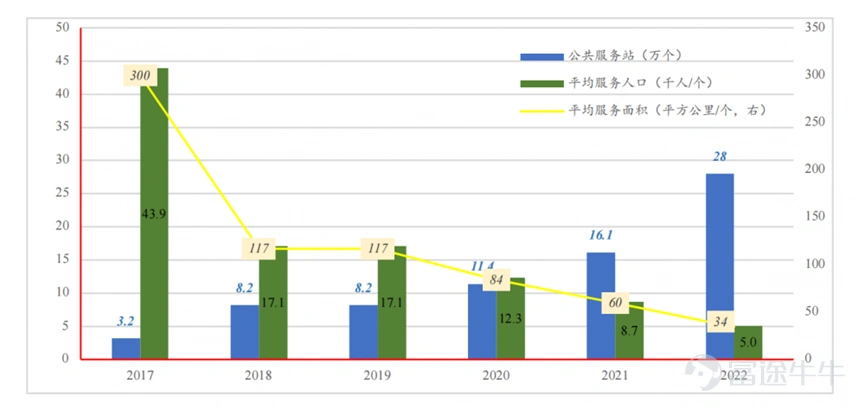
Data source: Labor Economics Association Employment Promotion Professional Committee “2022 Express Delivery Terminal Ecological Development Report”
Macro statistics are like this, and the actual consumer experience is more intuitive. Since the outbreak of the epidemic, including after it was liberalized in December last year, the author's family, located in a family home in a unit in a third-tier city, has never seen a JD courier delivering door-to-door delivery. Instead, they have been required to pick up their own goods at a courier station in the community.
We also noticed that it was from the second half of 2019 that JD's revenue continued to rise to a new level, and its market capitalization also began a new upward trend.However, behind the significant increase in transaction volume was actually the downgrade of services。
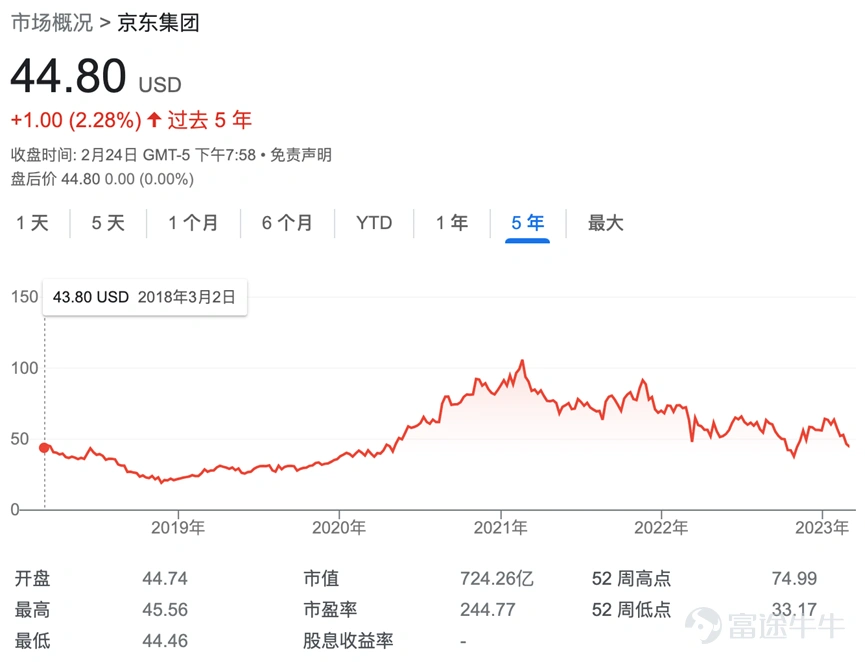
As a result, in addition to larger home appliances and household shopping, the service link between JD and consumers was completely cut off, and the terminal perception of JD's online shopping service also became the consumer's perception of the service at express delivery stations.
At the same time, when express delivery changes from direct door-to-door delivery to when consumers have time to pick them up, their perception of timeliness also changes: for items that are really not in a hurry, the consumer's pickup time will be adjusted according to their own circumstances. As a result,The timeliness of express delivery depends on when consumers are free, not how fast the courier is delivered。
They can't perceive “good” and can't enjoy “fast”. When consumers buy products, they think more about “more” and “saving.” However, from the consumer's point of view, when it comes to “many” of JD, the Jingdong Mall is definitely no match for the Taobao Mall; in terms of “provinces,” it is now no better than Pinduoduo.
In particular, when it comes to “province”, the gap between JD and Pinduoduo is currently huge.
Comparing this aspect, you can take Apple phones with more rigid prices on different channels as an example. On JD, the price of one of the latest iPhone 14 Pro Max black 256G memory phones in Apple's JD flagship store is 9099 yuan each after all subsidies are taken into account, while the Apple phone with Pinduoduo's official “10 billion dollar subsidy” is only 8,529 yuan. If you choose the gold one, the price can be even cheaper by 200 yuan.The extreme price difference reached as much as 700 yuan。
The price difference of 700 yuan is already close to 10% of the price of this phone. What's more, in the eyes of consumers, the price to buy a mobile phone through JD is over 9,000. On Pinduoduo, it only takes more than 8,000. In terms of 1,000 digits, there is a gap between 8 and 9, which immediately opens up the consumer's psychological acceptance when purchasing.
What's even more serious is that compared to Pinduoduo, JD's own advantageous categories, such as the 100 and 3C, have almost no advantage. The advantages of good service and fast timeliness have been eroded. There are many types, more money saving, and no match for others. JD is now facing the embarrassing situation where the “how fast is better and cheaper” line has completely collapsed.
If you want to remedy the situation, either improve service and force every order to be delivered to your door in all regions, especially low-tier cities, to close the gap with other express delivery services; or fight a price war, knock down the relatively high prices while maintaining the current state of service, and win back the hearts of consumers.
However, no matter which of these changes, it will inevitably erode JD's profits.
02 The price war is the only way
Judging from the dimension of quick results and good results, a price war is definitely the best approach. However, the “10 billion subsidy” was also the only way Liu Qiangdong could think of.
There is no traffic entry,JD, which sells all of its goods on its own, has fallen to its current situation. No one is to blame; no one can blame it; it can only blame itself for not being angry. In the three years since the epidemic, especially after 2022, middle-aged and elderly people in low-tier cities where e-commerce platforms did not have extensive coverage before have begun to use online shopping methods. This increase in traffic out of thin air (which is also the last traffic benefit of e-commerce) has not brought even the slightest benefit to JD.
According to financial reports, JD's product sales revenue for the third quarter of 2022 was 19.7 billion yuan, an increase of 5.9% over the previous year, lower than the market's unanimous forecast of 2.1%, and a decrease of 13% from the previous month. The reason the revenue growth rate fell short of expectations was the slowdown in revenue growth in the daily department stores and 3C home appliances categories, which are the driving forces of growth.
In the third quarter of 2022, JD's daily revenue was 77.74 billion yuan, up 3.5% year on year and down 13% from month on month; revenue from the 3C home appliance category in the third quarter was 119.28 billion yuan, up 7.5% year on year and down 12.6% month on month. Unlike Taobao and Pinduoduo, JD is a self-operated e-commerce company. The direct effect of the slowdown in product sales was the deterioration of JD's cash flow. Operating cash flow in the third quarter was only 9.15 billion yuan, down 36.7% from the previous year, and a sharp drop of 72.8% from the previous month.
However, the decline in free cash flow, which plays a key role in JD's valuation, is even more obvious.The third quarter was only 2,339 million yuan, down 44% year on year and 92% month on month. According to JD's current development situation, it is also likely that the above financial indicators will not improve significantly in the fourth quarter.
Meanwhile, JD's net profit in the third quarter turned a sharp loss into profit of 5.959 billion yuan over the same period last year. The vast majority was due to investment profit and loss calculated by the equity method and other non-operating income. This portion of revenue reached 4.43 billion yuan, accounting for about half of the total loss reversal. Judging simply from the progress of its main business, JD's results in the third quarter are hardly satisfactory.
Compared to JD's direct rival in initiating the price war, its high performance is a verdict. Pinduoduo achieved significant growth in the third quarter, with total revenue of 35.5 billion yuan, up 65% year on year and 13% month on month; net profit of 10.59 billion yuan, up 546% year on year, up 20% month on month; net operating cash flow was 11.65 billion yuan, up 33% year on year, and down 39% month on month.
As an e-commerce platform that still maintains rapid growth, Pinduoduo's performance has brought investors hope for growth, yet JD makes people feel that the future is bleak. If you look at a relatively long cycle,JD had a big problem with its brand positioning。
JD's brand value proposition changed from “just for quality of life” in 2016 to “living up to every love” now, and basically no longer emphasizes the previous brand impression of “how fast and economical” it used to be. The establishment of this impression led JD to embark on a completely different path from Taobao and Pinduoduo — high-end.
Frankly speaking, can high-end make up the competitiveness of a comprehensive e-commerce platform,It all depends on what consumers think, not on what JD itself says. When consumers can accept high premiums, that is competitiveness; in an age where consumers want value for money, they will abandon it.
In JD's revenue contribution, daily and 3C home appliances account for the absolute majority. For these two categories, even if consumers want to choose high-end, they value the product itself rather than the shopping platform. Also taking Apple phones as an example, prices over 9,000 are far less attractive to consumers than prices over 8,000.
And what consumers pay for value for money,It's just one more day of waiting。
We have mentioned in previous articles that mass consumer goods need to return to their primary principle — good quality and low price, which also applies here at JD. As a self-operated e-commerce platform, there are no drainage bonuses from social networking and short video platforms, leaving consumers with the impression that they value high-end and light value for money. The result is bound to be that when consumers value cost performance more, they will abandon such platforms.
Obviously, in the past two years, there have been more and more consumers who prefer cost performance. Instead of blindly paying for advertising premiums, shopping has become a new trend. One obvious example is that when the growth rate of retailers such as Amazon and Target slowed, Costco, the world's largest member discount retailer, achieved steady growth. In the fiscal year 2022 financial report, the company's total annual revenue was US$226.954 billion, up 15.8% year on year; net profit was US$5.844 billion, up 16.7% year on year.
If JD wants to adapt to this trend, it will inevitably have to pick up its own price war.“Low prices were the most important weapon for our success in the past, and the only basic weapon in the future.”This is what Liu Qiangdong once said, and it is also the path JD will take in the future.
However, choosing a price war will inevitably mean sacrificing net profit this year or even next year and the year after. At a time when Taobao is still strong and Pinduoduo is making great strides, JD's stock price continues to decline.It also seems like it will become inevitable。
03 epilogue
JD, once upon a time, was just like Pinduoduo now; it is a well-deserved price-performance king.
While I was writing this article, I looked through my purchase records on JD. According to records, the first item I bought on JD was an iPhone 6 with a gold color and 64G memory that I ordered in 2014/12, and its price was 6,088 yuan.
In my impression, iPhones back then were far less easy to get than they are now, and even more than two months after they were released, gold phones had to be purchased at a higher price. In those few days, I went to several offline mobile phone retail stores in Zhongguancun, and the prices were slightly higher than 6088, so I, who had never bought a mobile phone online, decided to try it out in Jingdong.
Needless to say about the consumer experience, the next day, JD delivered a brand new unremoved and unactivated phone to my door. After that, this phone accompanied me two years from graduation from my master's degree to entering society. Since then, my love for JD has soared, including buying items such as desktop computer accessories and laptops later, and I no longer chose offline stores, but placed orders directly from JD.
Eight years have passed, and JD has gone round and round, but now it has to rely on a low price strategy to win back consumers, but this time its rival also changed from a huge number of offline stores to Pinduoduo, which has strong strength and high traffic.Can JD win back the market?$JD.com (JD.US)$$PDD Holdings (PDD.US)$$BABA-W (09988.HK)$
Disclaimer: This article is for learning and communication only and does not constitute investment advice.
Risk Disclaimer: The above content only represents the author's view. It does not represent any position or investment advice of Futu. Futu makes no representation or warranty.Read more


Comments (18)
to post a comment
19
23