多隻新股齊上市,港股IPO市場演繹「年尾行情」?

Preface:
The business history of Chinese tea is much longer than that of liquor. In the long history of the Tea Horse Ancient Road and the Silk Road, tea has become one of the important commodities and has become a means for ancient literati to express their thoughts through tea.

Nowadays, tea has become an indispensable part of people's lives, and it has even become a spiritual sustenance for many people. Without a cup of tea every day, life feels a little bit less fun and flavor.
Currently, the Chinese tea market, like the Baijiu market, is a steady-growing hundred billion market. According to a report by Frost Sullivan, the size of the Chinese tea market in 2021 was RMB 304.9 billion.
However, in the Baijiu industry, there are already Guizhou Maotai with a market value of over one trillion, as well as Wuliangye, Shanxi Fenjiu, Luzhou Laojiao, and Jiangsu Yanghe Brewery, which are all Baijiu companies with a market value of over one hundred billion. In contrast, in the tea market, successful tea companies listed on the capital market are rare. The market value of tea companies that can successfully list is below one hundred billion. For example, in the Hong Kong stock market,$TENFU (06868.HK)$The total market value is only HKD 5.5 billion, while$Longrun Tea Group (02898.HK)$The total market value is a meager HKD 0.55 billion, and the attention of the capital market is very low.
Against this background, Chinese tea backed by central enterprises, Bama Tea Company founded on Tieguanyin tea, and Lancang Ancient Tea which tells the story of Pu'er tea, have all launched attacks on the A-share IPO market, striving to become the first tea company to list on the A-share market and fill the gap in the A-share market for tea companies.
Nowadays, Bama Tea Company has voluntarily withdrawn its application for listing on the GEM, Chinese Tea Company is still waiting patiently in the queue for A-share listing, Lancang Ancient Tea has withdrawn its application for listing on the Shenzhen Stock Exchange, turned its head to the nearby Hong Kong market, and submitted an IPO application.
So, under the background of the continuous downturn in the Hong Kong IPO market, how can Lancang ancient tea tell the story of Pu'er tea?
The story of Pu'er tea from Lancang ancient tea
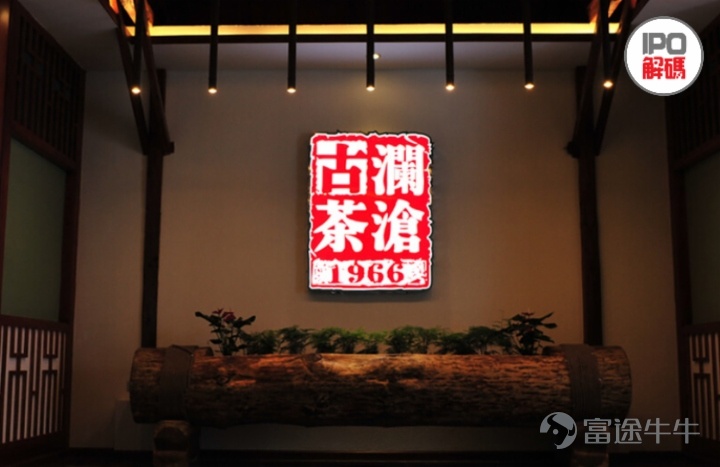
Lancang ancient tea can be traced back to 1966.
In 1966, in order to develop the tea industry in Lancang County, Pu'er City, Yunnan Province, the local government established a tea training class in Jingmai Mountain, which became the starting point of Lancang ancient tea and laid the foundation for the predecessor, Jingmai Tea Factory. Du Chunyi, the founder and executive director of Lancang ancient tea, was a student at that training class.
By 1975, the tea industry in Lancang County had developed, and the tea factory was relocated to the western outskirts of Lancang County, officially named Lancang County Tea Factory. Du Chunyi, step by step, became the deputy head of the tea factory. At the same time as the renaming of Lancang County Tea Factory, Du Chunyi was appointed as the deputy factory director in charge of production.
In 1998, with the transition from planned economy to market economy, coupled with poor management of the tea factory, Lancang County Tea Factory went bankrupt. In order to properly resettle the tea factory's employees, the Lancang County government agreed to approve the establishment of a new limited liability company by the on-the-job employees of the former Lancang County Tea Factory, and participate in the bankruptcy property auction of Lancang County Tea Factory.
Under this background, including Du Chunyi, Xu Weixian and other former employees of Lancang County Tea Factory, voluntarily participated in the establishment of the new company - Lancang County Ancient Tea Co., Ltd., and spent 2.2 million yuan to acquire the tea factory's machinery, plant and production workshops and other main assets.
Shortly after the establishment of the new company, Du Chunyi's team, relying on the mature tea fermentation technology they learned in Menghai in the previous two years, launched the iconic tea products "Ancient Tea Ripe Tea 0085" and "Ancient Tea Raw Tea 001".
By 2006, Lancang Ancient Tea Co., Ltd. was renamed "Lancang Ancient Tea Co., Ltd." Subsequently, Lancang Ancient Tea expanded its sales network through distribution models. The first stop was Guangzhou, the largest tea distribution center in Asia, where Lancang Ancient Tea established its marketing headquarters and set up sales outlets in the surrounding area. As a result, the Lancang Ancient Tea store and its Pu'er tea series gained popularity in Guangdong.
In order to pursue further scale development, Lancang Ancient Tea began to use capital tools. First, it underwent equity reform, and then it introduced institutional shareholders and individual shareholders such as Jingmai New Industry, Junquan Xinben, Zheng Wenping, and Wu Zhize (Chairman of Baoxiniao) through capital increase and equity transfer.
With the injection of capital, Lancang Ancient Tea, in order to quickly expand its distribution network and gain more market share, no longer focused solely on the story of ancient tree Pu'er tea. Instead, it began to diversify by exploring other fermented teas and convenient tea drinks.
Currently, in addition to its flagship brand 1966, Lancang Ancient Tea also launched a new brand called "Tea Mama" in 2014. Tea Mama has three main series: Chenpi Pu'er Tea series, Classic series (black tea, white tea, etc.), and Portable series (cupped tea and bagged tea).

In addition, in the prospectus, Lancang Ancient Tea emphasized that it is currently planning its third new product called "Yan Leng", which is expected to be launched in June 2022. Lancang Ancient Tea stated that the "Yan Leng" brand is mainly targeting the new middle-class consumers who have strong purchasing power and are seen as more fashionable and seeking enjoyment. This may mean that Lancang Ancient Tea is entering the high-end Pu'er tea market.
With the support of capital and the continuous launch of new products, Lancang Ancient Tea briefly rose to the second position in market share.
According to the Frost & Sullivan report, based on the revenue generated by Pu'er tea products in 2021, Lancang Ancient Tea ranks second with a market share of 2.8%, but there is still a long way to go to catch up with Da Yi, which holds the first place with a market share of 12.9%.
In addition, in the world of Pu'er tea, Lancang Ancient Tea is not short of competitors, and their overall strength is similar. According to the Frost & Sullivan report, they rank third and fourth in market share with 2.7% and 2.2% respectively.
The performance is average, with significant fluctuations in gross margin.
From the perspective of business model, Lancang Ancient Tea mainly sells products through online and offline channels.
Offline channels include self-operated stores, dealer-operated stores, and large chain supermarkets. Among them, the dealer model is the main profit model for Lancang Ancient Tea.
As of May 23, 2022, Lancang Ancient Tea has 534 offline stores, of which 26 are self-operated stores and the remaining 508 are dealer stores, accounting for a high percentage of 95.13%.
The online channel is selling through self-operated online stores on platforms such as Tmall, JD.com, WeChat, and Douyin. However, currently, the online channel for Lancang Ancient Tea is still in the investment period, with only 7.5% of the revenue in 2021, and the majority of the revenue is still contributed by offline dealers.
With the expansion of the channel scale and the continuous launch of new product combinations, Lancang Ancient Tea's business performance has steadily improved. According to the prospectus, from 2019 to 2021, Lancang Ancient Tea's total revenue was 0.377 billion yuan, 0.405 billion yuan, and 0.559 billion yuan, and net profit was 0.081 billion yuan, 0.123 billion yuan, and 129 million yuan, respectively, maintaining a steady growth trend. Among them, over 70% of the revenue comes from the 1966 product line, while the revenue from the new product Tea Mommy accounts for only 22.7%.

In contrast to the stable growth of revenue, Lancang Ancient Tea's gross margin has fluctuated greatly. From 2019 to 2021, Lancang Ancient Tea's gross margin was 58.7%, 70.4%, and 65.9% respectively.
According to the prospectus of Lincang Ancient Tea, the fluctuation of gross margin is explained by the differences in the product mix introduced in each specific year and the impact of the introduction of low-gross-margin new product combinations. This means that Lincang Ancient Tea's gross margin in the future may also be affected by factors such as the iteration cycle of the product mix and category differences.
As for inventory, due to Lincang Ancient Tea mainly engaging in the Pu'er tea industry, the inventory proportion is also relatively high. According to the prospectus, as of the end of 2021, Lincang Ancient Tea had over 3,600 tons of raw tea and processed tea collected from 15 different years, with inventory of 0.414 billion yuan, 0.47 billion yuan, and 0.636 billion yuan for the years 2019-2021 respectively, accounting for 77% of the current assets.
However, having high inventory does not necessarily mean it is better. It is a double-edged sword. When the Pu'er tea market is doing well, high inventory may bring considerable revenue. On the other hand, if the operating environment is poor and industry competition intensifies, high inventory may have a negative impact on the company's liquidity and operating performance.
Can going public in Hong Kong break the "large industry, small company" pattern?
Some investors believe that if Lincang Ancient Tea can successfully go public, it may create a market capitalization of hundreds of billions or even trillions, becoming a "tea giant".
In my opinion, although the tea market currently has a large increment, it is still challenging for Lincang Ancient Tea, which relies excessively on a single type of tea, to achieve this. Moreover, even if Lincang Ancient Tea goes public and obtains more refinancing tools and capital, the possibility of expanding into other tea sectors and achieving growth and strength is not high.
The tea industry has always been characterized by a "large industry, small company" pattern, with a large number of competitors and fierce competition in the segmented market.
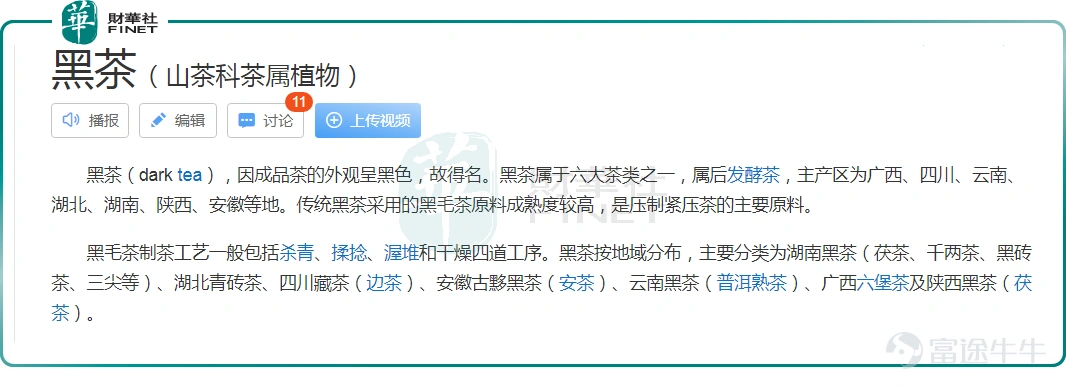
Taking the example of Lincang Ancient Tea's Pu'er ripe tea, Pu'er tea is just a small branch of the six major categories of black tea, green tea, oolong tea, yellow tea, dark tea, and white tea. By tea category, Pu'er tea is a type of dark tea, belonging to the same category as Anhua dark tea, Liubao tea, Bian tea, Qingzhuan tea, and black tea from Hunan and Shaanxi.

If you want to seek cross-category development in the tea industry, you will face fierce competition.
Currently, every segment of the tea market has local tea factories with a long history and overall strength. For example, in the pu'er tea field, there are Dayi and Zhongcha; in the oolong tea field, there are Tenfu and Bama; in the white tea field, there are Fujian Pinpinxiang and Tianhu Tea Industry; in the black tea field, there are Anhui Qimen Black Tea and Yunnan Dianhong Group; in the green tea field, there are Sichuan Zhuyeqing Tea Industry, Xie Yuda, and more.
Furthermore, the development of the tea industry faces many challenges. For example, the standards in each segment of the tea market are not unified, and the product quality is uneven, making it difficult for consumers to buy good quality tea. In addition, it is also challenging for brand enterprises to sell tea. Due to the growing demand for tea among consumers, there are higher requirements for brand tea companies in terms of operation and management.
It is due to these limitations that the development of the tea industry in terms of standardization and industrialization has been slow, resulting in relatively small-scale tea enterprises.
Therefore, even if Lancang Ancient Tea goes public in Hong Kong, it cannot break the pattern of a "big industry, small companies".
However, if Lancang Ancient Tea can successfully go public in Hong Kong, it will not only benefit its own development, but also draw attention from the capital market to the entire industry.
For the industry as a whole, the IPO of Lancang Ancient Tea does not represent the entire pu'er tea market. If Lancang Ancient Tea can gain recognition from capital markets in Hong Kong, it will set a good example. Other tea brands can follow Lancang Ancient Tea's lead and embark on a path of capitalization, thereby changing investors' past biases and misconceptions through stable and sustainable growth, and uncovering more investment value in the tea industry.
For Lancang Ancient Tea, a successful listing financing and deep cultivation of the Pu'er tea segment not only helps to widen the gap with later entrants and stabilize its market position, but also accelerates the shaping of brand influence on the international stage of the Hong Kong stock market, which is more beneficial than detrimental for the long-term development of the enterprise.
Lancang Ancient Tea's transition to the Hong Kong IPO market is not just a self-change, but also a new attempt in the tea industry. Whether Lancang Ancient Tea can successfully open the doors of the Hong Kong Stock Exchange remains to be seen.
Author: Yizhi
Risk Disclaimer: The above content only represents the author's view. It does not represent any position or investment advice of Futu. Futu makes no representation or warranty.Read more
Comment (1)
to post a comment
1
11