
This article is from "Bullet Finance," authored by Xingzhe and edited by Dan Zong.
The "Big Three" of the new EV manufacturers—NIO, Xpeng, and Li Auto—released their Q3 2021 financial results in November. From a data perspective, all three companies are showing signs of improvement: losses have narrowed, and vehicle deliveries are steadily increasing.
First, let's look at Li Auto.$Li Auto (LI.US)$According to its Q3 2021 financial report, total revenue for the quarter reached RMB 7.78 billion, up 209.7% from RMB 2.51 billion in the same period last year and up 54.3% from RMB 5.04 billion in the previous quarter. Notably, vehicle sales revenue in Q3 amounted to RMB 7.39 billion, representing a 199.7% increase from RMB 2.46 billion in the same period last year.
In addition to a significant increase in total revenue, the company posted a gross margin of 21.1% for vehicles in the third quarter, with overall gross margin reaching 23.3%, compared with 19.8% in the same period last year and 18.9% in the previous quarter.
Such a gross profit margin puts it in a leading position among the "Big Three" of the new EV forces, while Nio, which ranks second in gross profit margin,$NIO Inc (NIO.US)$, in the third quarter of 2021, the gross profit margin for complete vehicle sales was 18%, while Xpeng during the same period$XPeng (XPEV.US)$Its gross margin is only 14.4%, which is still below the average of 18.68% for these two new-energy vehicle manufacturers.
In addition, all three companies recorded record vehicle deliveries in the third quarter: Li Auto delivered 25,116 units, Nio delivered 24,439 units, and Xpeng delivered 25,666 units, marking the highest delivery volumes in recent quarters.
In addition, the losses of the three companies are also decreasing. In the Q3 2021 report, Li Auto's net loss was RMB 21.5 million, down 79.9% from the same period last year, whereas its net loss in the previous quarter was RMB 235 million, making it the best at reducing losses; Nio's net loss was RMB 835.3 million, down 20.2% from the same period last year; and XPeng's net loss was RMB 1.5948 billion, down 21.28% from the same period last year.
Accordingly, all companies have expressed strong optimism in their earnings reports, forecasting that fourth-quarter vehicle deliveries will exceed 35,000 units and that revenue will reach a record high.
The latest reports show that all three automakers have released their November delivery figures. Compared with the first ten months of 2021, each company delivered more than 10,000 vehicles in November, setting new monthly delivery records. If this pace continues, it is highly likely that they will meet the quarterly delivery targets outlined in their third-quarter reports for the fourth quarter.
Consequently, following the release of the third-quarter reports, the stock prices of all three companies rose in unison. Although on December 3 their shares experienced some volatility due to new SEC regulations and Didi's delisting, over the week and more leading up to late November, each stock generally reached its highest level for the year, successfully igniting investor enthusiasm.
As far as I know, many US stock institutional investors are now looking for a 'second Tesla' among these three new EV manufacturers.Moreover, top-tier investment-bank analysts have already been assigned to closely monitor the stocks of these three companies. If they can meet their vehicle-delivery targets in the fourth-quarter earnings reports, we can expect another round of institutional buying, which could push the share prices even higher. Wang Jing, a Chinese analyst at a US investment bank, told Bullet Finance. Now it all comes down to how these three companies perform in the market.
BYD bursts the bubble
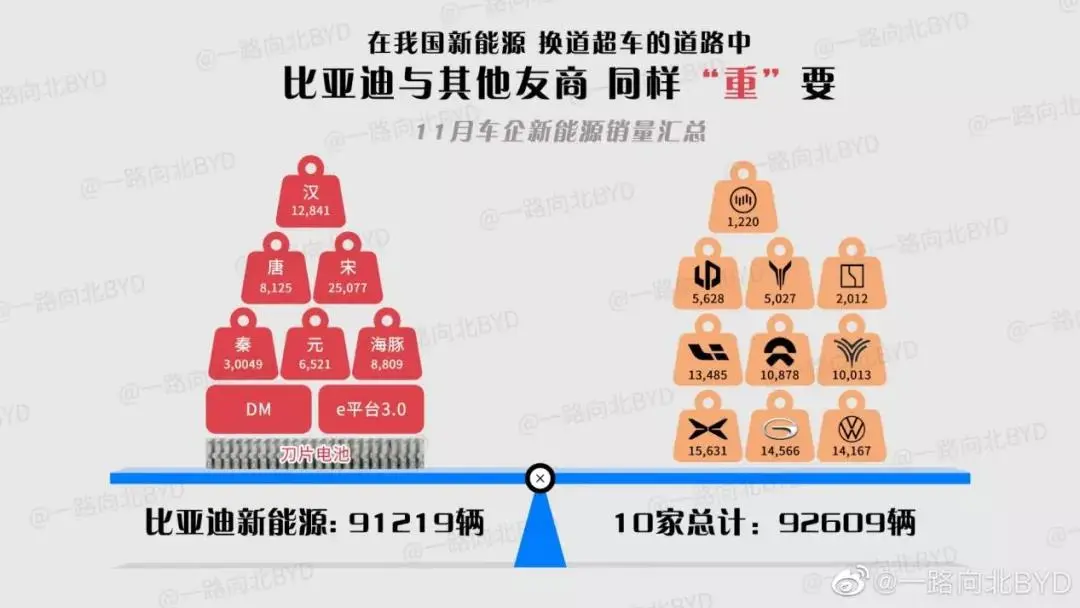
On December 1, a BYD$BYD Company Limited (002594.SZ)$An advertisement image suddenly circulated in WeChat Moments, stating that the total sales of domestically produced car models that can almost compete with BYD are roughly on par with BYD's sales alone.

(Photo / Weibo user "Heading North BYD")
Some media outlets were surprised by the figures in the chart, so they compiled statistics based on the relevant data disclosed on the official websites of NIO, Xpeng, and Li Auto—and found that the November sales figures for the three new EV makers shown in the chart are remarkably accurate.
According to the data in the chart, 'NIO, Xpeng, and Li Auto' are still far from challenging Tesla—first they need to surpass BYD.
After all, judging from the above pictures, BYD's sales are in a different league from most domestic new-energy vehicle manufacturers. Of course, this doesn't include the Wuling Hongguang MINI—this model sold 45,576 units in November, but due to its price, it's not a market benchmark for BYD.
Data shows that BYD's DM-i technology has boosted sales of DM models, with a total of 43,984 units sold, accounting for nearly 75% of the domestic market share for new-energy vehicles; EV models sold 46,137 units, while Tesla's November sales were 48,583 units, bringing the two companies very close in performance.
On the evening of October 28, BYD released its Q3 2021 report. The financial report shows that in the first three quarters of this year, BYD achieved a net profit of RMB 2.443 billion and operating revenue of RMB 145.192 billion, up 38.25% year on year. In the third quarter alone, BYD's revenue reached nearly RMB 55 billion, setting a new quarterly record.
The key is that BYD's share of new-energy vehicle sales has already exceeded 70%. According to the monthly sales data released earlier, BYD sold a total of 452,700 vehicles in the first three quarters of this year, up 68.32% year on year. Among them, nearly 337,600 were new-energy vehicles, a year-on-year increase of 204.29%. Based on these figures, new-energy vehicle sales account for more than 76% of BYD's total sales.
As a result, BYD's stock price has risen consecutively. By the close of trading on December 3, 2021, BYD's market capitalization had approached HK$900 billion, far surpassing other domestically listed automakers and even exceeding the combined market capitalization of FAW and SAIC, the two traditional state-owned automakers, by more than double.
Interestingly, in the third quarter of 2021, the gross profit margins of NIO, Xpeng, and Li Auto all increased and far exceeded BYD's 13%, while BYD posted a net profit of over RMB 2.4 billion, yet these three new EV makers were still operating at a loss.
This leaves many people puzzled—why can BYD, with a gross margin of 13% for new-energy vehicles, still achieve positive net profit, while NIO, Xpeng, and Li Auto, some of which have gross margins exceeding 20%, still report losses?
In fact, this is rooted in economic principles.
2. The "Magic" of the Marginal Effect
In fact, from 2019 to 2020, BYD recorded net losses in most quarters.
In the first quarter of this year, BYD's net profit excluding non-recurring items was RMB 80 million, which narrowed significantly year on year but still fell by 103% quarter on quarter; the net profit margin was 0.58%, down 1.0 percentage point from the fourth quarter of 2020.
In the first quarter of 2021, BYD Auto's cumulative sales reached 104,100 units, a decrease of 54,000 units, or 34.08%, compared with the fourth quarter of 2020, with new energy vehicles accounting for less than 60% of the total.
"In the first quarter of this year, BYD's pure electric vehicle sales should be around 50,000 to 60,000 units. At that time, BYD's overall situation was similar to that of NIO, Xpeng, and Li Auto today," said Zhang Xutu, a veteran in the automotive industry who worked at Beijing Benz for five years, to "Bullet Finance." He believes that analyzing BYD's rise is of great significance for the new forces in carmaking.
In his view, two factors have been crucial to BYD's rise: first, the launch of DMI technology has dramatically boosted its sales; second, the marginal effects of new-energy vehicle production are gradually becoming apparent.
For NIO, Xpeng, and Li Auto, the core "three-electric" technologies of their electric vehicles—batteries, electric motors, and electronic control systems—are all assembled from mature, off-the-shelf components sourced from market suppliers.
From the perspective of these companies that have entered traditional automaking with an internet mindset, hardware may be less important; what truly matters is treating the entire vehicle as a software platform, with the software running on it taking center stage. That's why NIO, Xpeng, and Li Auto are constantly upgrading their systems and investing heavily in areas such as autonomous driving, computer vision, and LiDAR guidance.

(Image / Shetu.com, based on the VRF protocol)
As long as mature, standardized "three-electric" components are available on the market, automakers will directly source them and assemble their own vehicles at competitive prices and with appropriate technical specifications.
It is precisely in this regard that BYD's understanding is completely different from theirs.
From an objective perspective, BYD is one of the few domestic new-energy vehicle manufacturers that currently possess core technologies in the "three electric" systems—be it batteries, motors, electronic control systems, or range-extending engines. BYD has proprietary technologies for all these components and can even complete the entire production process in its own factories.
That "internet mindset" of "outsourcing all product procurement and assembly to the supply chain while optimizing the software ourselves" may seem superior, but under the current circumstances of the raging pandemic and severe chip shortages, BYD's self-owned technology has actually boosted its production capacity and sales growth.
This is actually very easy to understand.
On the one hand, NIO, Xpeng, and Li Auto rely on supply-chain procurement for all core system hardware, making their ability to control the supply chain a critically important factor. Meanwhile, with quarterly shipments of more than 20,000 vehicles per company, it follows that the total number of system sets procured each month is fewer than 10,000.At this level of volume, it may be difficult to secure particularly favorable pricing from system integrators, nor is it guaranteed that a highly reliable supply can be secured.
At the same time, this approach of completely entrusting the "lifeline" of production to the supply chain has also driven up automobile production costs.
The latest Q3 report shows that as of September 30, Li Auto's cost of sales, which is the ratio of manufacturing costs to automobile sales revenue, was 78.94%; Nio's figure was 81.95%; and XPeng's was 86.42%.
Although the Q3 report did not disclose specific revenue data for automobiles, according to Zhang Xutu, "the ratio of BYD's new energy vehicle manufacturing costs to sales revenue will not exceed 70%."
On the other hand, BYD, which keeps the automobile production process in its own hands, conforms to the economic theory of marginal effect.
The so-called "marginal effect" generally refers to the phenomenon whereby, with all other inputs held constant, continuously increasing one particular input leads to progressively diminishing additional output or returns.
In other words, once the level of additional input exceeds a certain threshold, the output generated by each additional unit of input will decline. This can also be understood as follows: when production activities reach a certain cumulative scale, average costs fall and efficiency increases.
According to the theory of marginal effect, due to the increase in car sales, BYD's R&D expenditure in the three-electric field has been rapidly diluted, and there is even a surplus.
This is also an important reason why BYD has been able to achieve cost-controlled growth in vehicle sales since launching its DMI system this year. In contrast, NIO, Xpeng, and Li Auto source their core hardware from supply chain vendors, so they cannot reduce the proportion of intermediate costs through mass production, and their supply chain management capabilities are not as direct as BYD's fully in-house production.
The internet is not a panacea.
"In fact, when the new EV manufacturers first entered the automotive market and enthusiastically announced their intention to build cars, their underlying message seemed to be that they would leverage internet-based thinking to 'cross over and disrupt' the traditional auto industry," said Zhang Xutu. He added that this claim genuinely sent shockwaves through the established automakers at the time.
However, economics always has core principles, and traditional manufacturing firms also operate according to a set of production theories—"it's not something that can be solved simply by 'cross-industry disruption.'"
"Compared with NIO, Xpeng, and Li Auto, BYD is indeed a traditional automaker. However, the first domestically produced new-energy vehicle to be mass-produced and sold in China was manufactured by BYD," said Zhang Xutu.
Although NIO, Xpeng, and Li Auto invest substantial sums each year in R&D, the vast majority of these funds are directed toward soft infrastructure—such as autonomous-driving technologies—and vehicle-control systems. While this approach to development generally works well under normal circumstances, it reveals significant lags and limited control when supply-chain management faces crises.
In contrast, BYD, which keeps hardware production firmly in its own hands, has actually been procuring products from suppliers in these soft-tech areas. "It's well known in the industry that BYD's current L2-level autonomous driving technology is developed with Bosch's assistance," said Zhang Xutu.
In his view, the biggest difference between BYD and the new EV manufacturers is that BYD focuses on the R&D and production of vehicle systems and hardware, which actually aligns with the rules of automotive development.
"Because automobiles are mass-produced products, according to the law of diminishing marginal returns, the more cars sold, the greater the actual reduction in per-unit costs. To achieve this, however, it is unrealistic to rely solely on sourcing all hardware from the supply chain; instead, we must invest serious effort in every stage of automobile manufacturing," Zhang Xutu emphasized.

(Image / Shetu.com, based on the VRF protocol)
Amid the global chip supply crunch, BYD has been less adversely affected than other automakers because it owns automotive-grade semiconductors; moreover, compared with new EV manufacturers, BYD has stronger control over upstream key components, such as ESP and IPB intelligent integrated braking systems, for which it has made advance reserves and secured production capacity.
On the other hand, in recent times, the prices of upstream raw materials for lithium batteries have continued to soar, with spodumene ore prices nearly doubling in three months to reach a record high of US$2,350 per ton. However, power battery orders are typically signed on an annual basis, and the newly signed procurement agreements between Tesla and CATL both have a three-year term, meaning that the impact of the short-term rise in raw material prices on these two companies will be lagged.
BYD, on the other hand, uses its self-developed blade battery and has secured raw materials through mining partnerships, stockpiling supplies for more than several years. As a result, this round of raw material price fluctuations has not had a significant impact on BYD.
"This is actually what the new-wave EV manufacturers lack the most—not some groundbreaking technological breakthrough in areas like autonomous driving," said Zhang Xutu. He believes that these new entrants have taken a wrong turn: rather than first gaining a deep understanding of the automotive industry's true development patterns and underlying theoretical framework, they are trying to directly overhaul the sector by applying internet-based thinking.
"We're currently in a situation where raw-material prices are skyrocketing and supply chains are beyond control. If the new EV manufacturers don't take serious lessons from traditional automakers and build a solid foundation, they're likely to run into plenty of obstacles," said Zhang Xutu.
In a sense, BYD's comeback and rapid rise to the top—surpassing the combined sales of most domestic new-energy vehicle companies—have proven that it is impossible to succeed in the automotive manufacturing industry by simply applying internet-based thinking.
Only by staying grounded and thoroughly studying the industry's experiences and lessons can new entrants truly focus their efforts.
Without a solid foundation, you're bound to stumble no matter what you do
Note: This article does not constitute any investment advice
The featured image in this article is from SheTu.com, licensed under the VRF protocol
Risk Disclaimer: The above content only represents the author's view. It does not represent any position or investment advice of Futu. Futu makes no representation or warranty.Read more
Comments
to post a comment
3
1