
English
Back
Open Account
How do you view the recent WSB concept stock market?
格隆汇GuruClub
joined discussion · Jun 9, 2021 15:52

WSB's 'new favorites' emerge in endless numbers! Retail investors are waging guerrilla warfare, how does Wall Street respond to the enemy?

The drama of retail investors squeezing Wall Street short is far from over yet.
Last Wednesday, AMC rose by 95.5%, and in the following 4 trading days, the stock has cumulatively dropped by 12%. You might think that retail investors have lost again, but they have already shifted their positions.
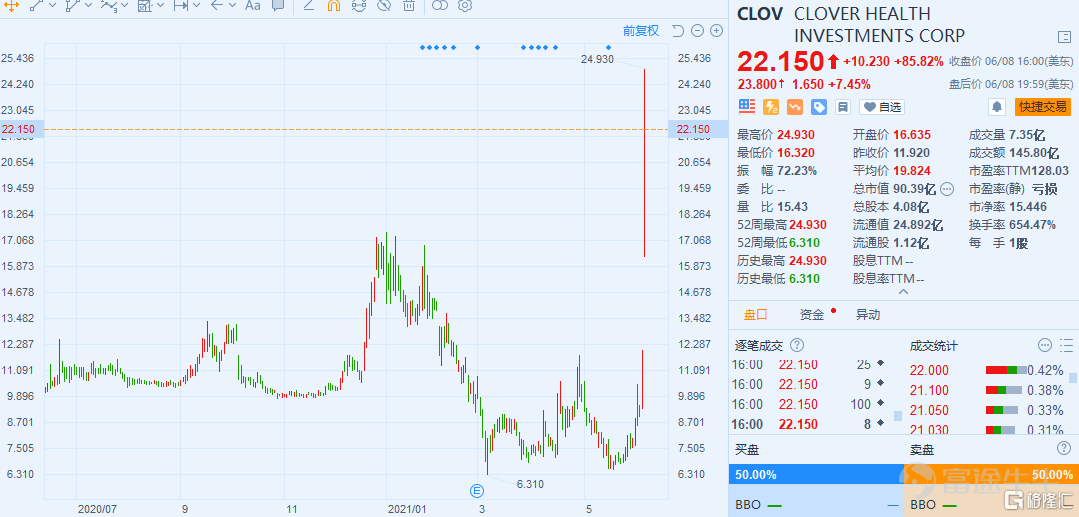
Last night, the 'darling of retail investors,' Clover Health, surged over 100% at one point, closing with an 85.8% increase at $22.15, and continued to rise by 7.5% after hours. FactSet data shows that the trading volume of the stock surpassed 0.65 billion shares by the closing, 30 times more than its 30-day average trading volume of 22 million shares. There were already over 0.715 billion shares exchanged by the closing.
The drama of retail investors forcing Wall Street into a short squeeze is far from over.  Last Wednesday, AMC closed up 95.5%, but in the following four trading days, the stock dropped by 12%. You might think that retail investors lost again, but they had already shifted their positions.  Last night, 'retail investors' new favorite' Clover Health surged more than 100% at one point, closing up 85.8% at $22.15, with a 7.5% additional increase in after-hours trading. FactSet data shows that at the close, the trading volume of the stock had exceeded 0.65 billion shares, 30 times more than the 30-day average trading volume of 22 million shares. At the close, over 0.715 billion shares had changed hands.  In addition to Clover Health, the parent company ContextLogicInc of the American version of PDD, Wish, surged 50%, and rose another 30% after hours. The fast food chain brand, Wendy's, also closed up by 25.8%. However, GameStop and AMC only rose by 7% and 0.1% respectively.  During the previous few large-scale retail investor short squeezes, Clover Health remained unheard of. What is the background of this company? 1. Retail investors' "new favorite": Clover Health Clover Health is a Medicare Advantage insurance company established in 2013. The so-called Medicare Advantage is a Medicare plan for people over 65 in the USA, with CMS transferring premium payments to commercial insurance companies for operation...
Apart from Clover Health, the parent company of the US version of pdd holdings, ContextLogicInc, surged by 50%, and rose another 30% after hours. Fast-food chain brand Wendy's also closed with a significant increase of 25.8%, while gamestop and AMC only rose by 7% and 0.1% respectively.
In the previous few large-scale retail short squeeze incidents, Clover Health was unheard of, so what is the background of this company?
1 Retail investors' 'new favorite': Clover Health
Clover Health is a Medicare Advantage insurance company established in 2013. Medicare Advantage is a Medicare plan for people over 65 in the United States, where CMS transfers premium payments to commercial insurance companies for operation.
In October 2020, Clover completed a reverse merger with a blank-check company under Chamath Palihapitiya for $3.7 billion, thereby becoming a publicly traded US stock company. Before going public, Clover had six rounds of financing between 2014 and 2019, with early star investors including First Round Capital, Sequoia Capital, and Greenoaks Capital.
Before going public, Clover had six rounds of financing between 2014 and 2019, with early star investors including First Round Capital, Sequoia Capital, and Greenoaks Capital.
In February,Clover Health faced allegations from the short-selling institution Hindenburg Research.In the short report, the institution claimed that Clover Health was a "broken company." Subsequently, the stock price of Clover Health dropped by more than 50% cumulatively within a month.
However, after reaching the low point in stock price, the stock started to show an upward trend. By last night, Clover Health had accumulated a rise of over 60% compared to the low point in March.
Clover HealthThe reason for the rise is still related to the WSB forum.
The short call on Clover Health by the Wall Street institution Hindenburg Research caught the attention of retail investors on Twitter and the WSB forum, making Clover Health a hot topic on the forum.
The drama of retail investors forcing Wall Street into a short squeeze is far from over.  Last Wednesday, AMC closed up 95.5%, but in the following four trading days, the stock dropped by 12%. You might think that retail investors lost again, but they had already shifted their positions.  Last night, 'retail investors' new favorite' Clover Health surged more than 100% at one point, closing up 85.8% at $22.15, with a 7.5% additional increase in after-hours trading. FactSet data shows that at the close, the trading volume of the stock had exceeded 0.65 billion shares, 30 times more than the 30-day average trading volume of 22 million shares. At the close, over 0.715 billion shares had changed hands.  In addition to Clover Health, the parent company ContextLogicInc of the American version of PDD, Wish, surged 50%, and rose another 30% after hours. The fast food chain brand, Wendy's, also closed up by 25.8%. However, GameStop and AMC only rose by 7% and 0.1% respectively.  During the previous few large-scale retail investor short squeezes, Clover Health remained unheard of. What is the background of this company? 1. Retail investors' "new favorite": Clover Health Clover Health is a Medicare Advantage insurance company established in 2013. The so-called Medicare Advantage is a Medicare plan for people over 65 in the USA, with CMS transferring premium payments to commercial insurance companies for operation...
According to S3 Partners' data,In the past month, the short interest ratio of this stock has increased by about 25%, leading to 43.5% of its outstanding shares being shorted.
In comparison, when AMC Entertainment surged last Wednesday, only over 20% of its outstanding shares were shorted.
Clover has become one of the most shorted stocks across various exchanges in the USA, making it a well-deserved star stock on the WSB forum. On Tuesday, discussions about Clover on the WSB forum attracted over 10 million participants, surpassing AMC, becoming the hottest topic on the forum.
The massive short positions have allowed retail investors to buy in fearlessly, hoping to drive up the stock price and force the hedge funds shorting Clover to buy back shares from the market.As the stock price rises further in this process, a group of shorts are forced to close positions, while early retail investors profit handsomely, achieving a complete victory. This is what is known as a short squeeze.
Data shows that just last night, shorts lost $0.5 billion on Clover.
From GameStop to Rocket Companies, to AMC Entertainment, and now to Clover and Wish. What should have been a battlefield between retail investors and shorts has been turned into a guerrilla warfare by the retail investors themselves.
Retail investors from the WSB forum post their thoughts, aiming to confuse the Wall Street big shots who rely on cutting leeks one by one, making them puzzled, and each of them becomes the ones being harvested. Is this reasonable?
Who has the final say on Wall Street?
In fact, it is reasonable. The reason why retail investors in the US stock market have such great power, enough to counterbalance the Wall Street tycoons who hold financial dominance, is multifaceted.
Firstly, credit must be given to the era of mobile internet, which has expanded the scale of retail investors, leading to an increase in their influence.The introduction of internet brokerages like Robinhood has brought a large number of young people into the stock market. This is because these stock trading software with stronger internet genes have lower or even free transaction fees, interfaces, and interactions that better fit the habits and aesthetics of the next generation.
Secondly, the lockdown and government subsidies caused by the epidemic have provided retail investors with ample time and ammunition.In 2020, during the epidemic, the degree of money oversupply by the Federal Reserve reached historic highs, extreme low borrowing costs, and excess liquidity pushed up the prices of various assets. The thousands of dollars in subsidies provided by the government to ordinary people mostly flowed into the stock market.
Lastly, young retail investors who are highly speculative and hostile to the old order gather through WSB forums and social media platforms. They have ample time, energy, and money, thus creating storms one after another.
In the past, on Wall Street, there was always one voice, but mobile internet has changed everything. The challenge of bitcoin to the traditional monetary system, and the challenge of retail investors to traditional financial infrastructure, have made Wall Street unable to act recklessly anymore.
Returning to last night's surging stock Clover, following the usual practice, stocks targeted by Wall Street short sellers usually don't end well. The stock price plummets, eventually delists, the company goes bankrupt, and the short sellers make a big profit in the process.
However, in reality, these companies are not beyond redemption.From a market perspective, Market Realist analyst Anuradha Garg predicts that the penetration rate of medical insurance will increase from 36% in 2020 to 50% in 2025.
In 2019, spending on Medicare Advantage insurance plans was 270 billion USD, and it is expected to increase to 590 billion USD by 2025, which will be a huge opportunity for Clover.
Moreover, Clover's market share growth rate is much faster than most peers. Data from 2019 shows that the company had a total of 41,143 members, expected to grow to 0.273 million in 2021, and double to 0.589 million in 2023.
Furthermore, venture capitalist Chamath Palihapitiya also expects Clover to achieve overall profitability in 2023. Clover estimates that company revenue will increase from 0.88 billion USD in 2021 to 1.7 billion USD in 2023.
As the United States gradually shifts from paper medical records to electronic medical records, Clover's web-based Clover Assistant application is also poised for success. In addition, Clover has established partnerships with several retail giants such as Walmart, CVS Health, Walgreens, Kroger, and Costco.
Wish, which soared last night, is no exception. This company relies on Chinese suppliers, known as the American version of pdd holdings, mainly selling various affordable and discounted commodities.
In 2020, Wish's revenue was $2.54 billion, a year-on-year increase of 33.67%. The net loss reached $0.745 billion, a significant increase from the $0.13 billion loss in 2019.
Wish's losses are mainly due to a significant 31% increase in market, sales, and administrative expenses, reaching $2 billion, coming from its advertising on platforms such as Facebook, boxing, and the Lakers.
The drama of retail investors forcing Wall Street into a short squeeze is far from over.  Last Wednesday, AMC closed up 95.5%, but in the following four trading days, the stock dropped by 12%. You might think that retail investors lost again, but they had already shifted their positions.  Last night, 'retail investors' new favorite' Clover Health surged more than 100% at one point, closing up 85.8% at $22.15, with a 7.5% additional increase in after-hours trading. FactSet data shows that at the close, the trading volume of the stock had exceeded 0.65 billion shares, 30 times more than the 30-day average trading volume of 22 million shares. At the close, over 0.715 billion shares had changed hands.  In addition to Clover Health, the parent company ContextLogicInc of the American version of PDD, Wish, surged 50%, and rose another 30% after hours. The fast food chain brand, Wendy's, also closed up by 25.8%. However, GameStop and AMC only rose by 7% and 0.1% respectively.  During the previous few large-scale retail investor short squeezes, Clover Health remained unheard of. What is the background of this company? 1. Retail investors' "new favorite": Clover Health Clover Health is a Medicare Advantage insurance company established in 2013. The so-called Medicare Advantage is a Medicare plan for people over 65 in the USA, with CMS transferring premium payments to commercial insurance companies for operation...
However, Wish has once become the most downloaded global shopping application, long ranking among the top ten in the North American e-commerce platform list, with a monthly active user base exceeding 0.1 billion, selling over 1.8 million items daily.
In the era of mobile internet, Wish is expected to carve out a new path behind super players like Walmart and Amazon, becoming another influential e-commerce giant.
Short selling such two potentially powerful companies, though unreasonable, used to be acceptable in the era when Wall Street had absolute dominance in the past.
However, it is obviously not wise to do so in today's context of the rise of retail investors.
3 Conclusion
Since the beginning of the year, Wall Street has suffered losses repeatedly, challenging the power of retail investors time and time again. Ultimately, it is not that they have not learned their lesson, but rather a question of the ownership of financial discourse, unable to make concessions.
Moreover, they are not willing to take the beating.On the one hand, hedge funds currently adopt an options strategy of selling covered call spreads.By selling short selling options of low-priced stocks and buying short selling options of high-priced stocks at the same time, they can not only achieve higher short-selling returns but also hedge against the risk of forced liquidation brought by retail investors.
On the other hand, although some Wall Street investment banks and brokerages have restricted short selling of MEME stocks, more and more hedge funds are joining the short-selling camp,which will result in lower and lower capital weight for retail investors.
On the other hand, the retail investors gathered through social media are not a tightly organized system, which leads to a very complex composition. Not only are institutions mixed in with the group to fish in troubled waters, but most are simply looking to profit and exit.
However, in terms of regulation, the statement from the SEC spokesperson yesterday pledging to protect retail investors undoubtedly bodes well for retail investors.
So, currently the two major camps are still in a standoff, and it's hard to say who will win.
Risk Disclaimer: The above content only represents the author's view. It does not represent any position or investment advice of Futu. Futu makes no representation or warranty.Read more
Thumbs Up
1
13K Views
Report
Comments
Write a Comment...
1
5