Countdown to Anthropic's IPO! Trading expected to begin on November 19

Anthropic's IPO receives 6x subscription! Is Jensen Huang's departure a bullish or bearish signal for Anthropic?
Jensen Huang suddenly steps down, and news emerges of further tightening in U.S. export restrictions on advanced AI chips. Just as the market reassesses the outlook for AI investments, another AI giant $Anthropic (ANT.US)$ is about to enjoy its own spotlight moment with its listing.
According to a Reuters report on November 13, Anthropic's IPO garnered approximately 2x subscription on the first day of roadshows. By the end of the roadshow on Thursday, November 12, 2026 (Eastern Time), institutional orders had reached about 6x the offering size. The company plans to list on Nasdaq under the ticker symbol ANT on November 19, with an indicative price range of $70–$78 per share, implying a maximum fully diluted valuation of approximately $1.4 trillion.
Anthropic's listing also falls within a very special time window. On November 17, $NVIDIA (NVDA.US)$ will announce its Q3 FY2027 earnings; Anthropic is expected to finalize pricing on November 18 and officially list on November 19. This means thatthere is only about a one-day gap between NVIDIA's latest earnings release and Anthropic's final IPO pricing.
To what extent will NVIDIA's crisis alter Anthropic's competitiveness? Is this highly anticipated IPO a new starting point for AI investment, or a concentrated test of high-valuation risks?
I. Escalating NVIDIA Crisis: Why Anthropic Could Be an Unexpected Winner?
On November 12, NVIDIA officially announced that Jensen Huang has resigned as CEO and Director, with former CFO Colette Kress taking over on an interim basis. Before Huang's departure, the company had already come under scrutiny due to his personal conduct and potential links to foreign intelligence, further drawing attention from U.S. policymakers to NVIDIA's China operations and chip export policies.
Huang had long advocated for maintaining commercial supply to the Chinese market, arguing that restricting chip exports could undermine the competitive advantage of U.S. firms. With his departure, NVIDIA's influence in Washington to push for relatively lenient export policies may weaken.
Meanwhile, according to a November 11 report by The Information, the U.S. Department of Commerce is drafting stricter export rules for AI chips, planning to extend related restrictions to seven countries including Singapore, Malaysia, and Thailand, while strengthening oversight of remote access to advanced chips from overseas data centers. The significance of this change lies in:The United States is attempting to expand chip controls from "restricting physical chip exports" to "restricting the cross-border use of advanced computing power."
These developments have collectively pushed the market to refocus on a key question: If it becomes increasingly difficult for Chinese AI companies to access advanced computing power, who will gain a relative competitive advantage?Anthropic could be among the beneficiaries.
Anthropic CEO Dario Amodei has long supported strict controls on the export of advanced AI chips. His core argument is that restricting competitors' access to the most advanced computing power helps U.S. AI firms maintain their technological lead.
If the new restrictions can truly slow down the iteration speed of Chinese open-source models, Anthropic may enjoy a longer window of competitive advantage.
2. Does Anthropic have an opportunity to maintain high pricing for its AI models?
On the surface, the AI industry is experiencing an explosion in demand; however, behind rapidly growing revenues, a more intense price war has already begun.
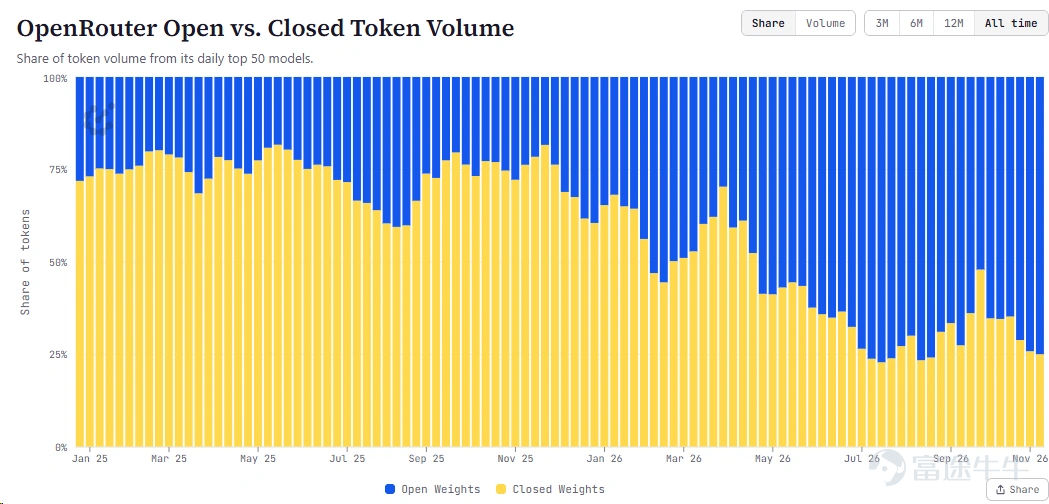
According to platform data from OpenRouter for September 2026, open-source weight models handled approximately 72% of token usage but accounted for only about 27% of spending; closed-source models handled about 28% of tokens but captured 73% of spending.
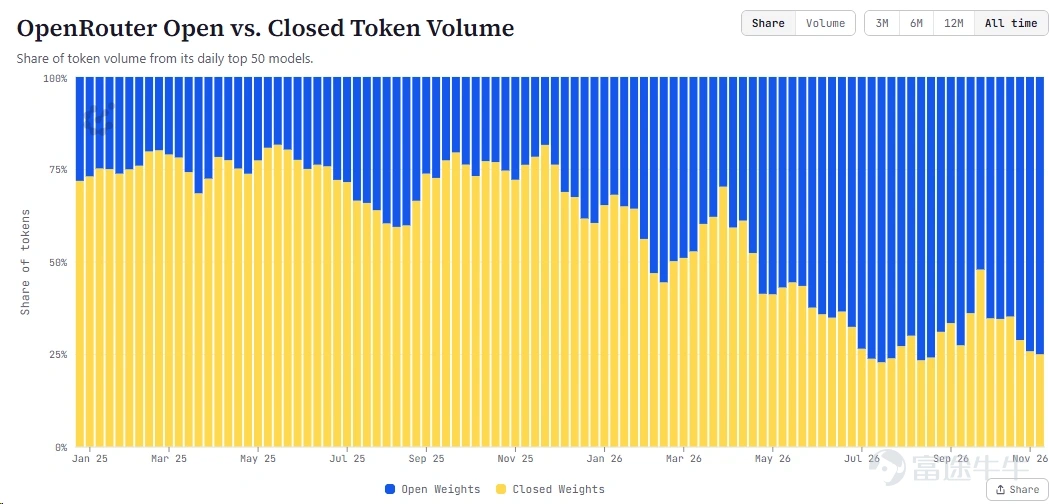
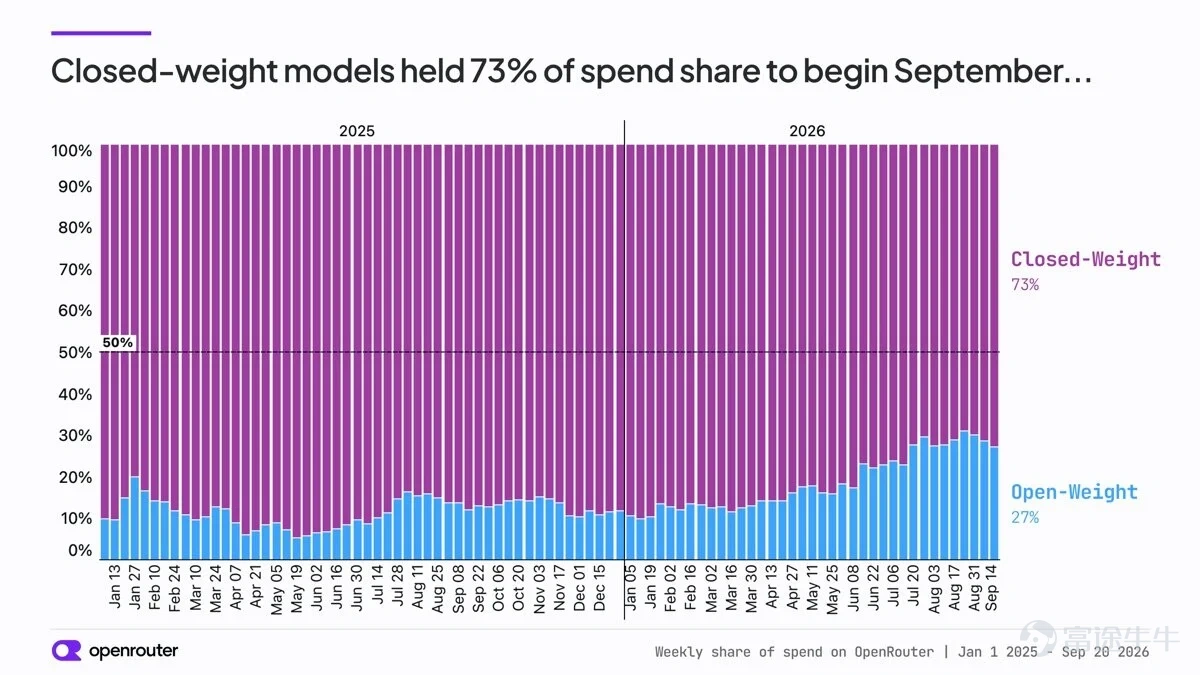
Note: The above data reflects only the traffic structure on the OpenRouter platform and does not represent the market share of the entire AI industry.
This implies that on this platform, the average cost per token for closed-source models is approximately seven times that of open-weight models.
Leading vendors of closed-source models, such as Anthropic and OpenAI, are still able to command a premium by targeting high-value use cases like complex reasoning, programming, and AI agents.
The question remains: how long can this premium persist?
The rapid progress of open-source models like DeepSeek has demonstrated that enterprises can acquire substantial AI capabilities at a lower cost. As the performance of open-source models continues to converge with that of closed-source counterparts, customers are naturally incentivized to shift some workloads to more affordable alternatives.
Anthropic's own financial data already reflects this pressure.
According to the prospectus updated on November 10:
– Q3 revenue reached $16.96 billion,representing a 46.7% quarter-on-quarter increase, indicating that demand expansion remains robust.
- Revenue growth in Q3 compared to the previous quarter was offset by approximately $600 million due to price cuts for new models and contract discounts.
- The adjusted operating margin declined from 19% in Q2 to 15% in Q3, primarily driven by a short-term rise in computing power procurement costs.
These figures reveal the real challenges facing Anthropic:User adoption can grow rapidly, but if model prices continue to fall while compute costs remain high, revenue growth may not ultimately translate fully into profit growth.
Anthropic’s profitability logic is heavily dependent on scale.
The company needs to procure and lock in compute resources 12–18 months in advance. Once substantial compute costs are committed, it must continuously expand customer demand and improve compute utilization to amortize unit costs.
Therefore, the biggest potential benefit of chip restrictions may be to delay the impact of low-priced alternative models on the high-end market, allowing Anthropic to retain stronger pricing power for a period in the future.
However,There remains significant uncertainty as to whether policy measures can truly slow down competition. Chinese model developers can enhance efficiency through algorithm optimization, domestic chips, and existing compute infrastructure, while US competitors such as Google and OpenAI will not cease their price cuts.
Thus, key metrics investors should monitor are Anthropic’s actual discount levels, revenue per unit of compute, and margin trends in the coming quarters, rather than simply betting on tighter US chip restrictions.
3. NVIDIA is also an investor in Anthropic; will its strategic investments become more cautious in the future?
NVIDIA itself is a major stakeholder behind Anthropic.
According to Anthropic's latest prospectus, NVIDIA plans to invest approximately $10 billion in a related private placement following the completion of its IPO. Other strategic investors participating in this $26 billion allocation include investment entities affiliated with Google, AMD, Broadcom, Microsoft, Micron, and Taiwan Semiconductor.
This transaction reflects a significant trend: the AI industry is forging increasingly tight capital and supply chain ties. Chip suppliers are investing in AI model companies, which in turn use the raised capital to expand their computing power procurement. Both sides are jointly driving the continuous expansion of AI infrastructure.
For Anthropic, both capital support and product supply from NVIDIA hold strategic value. Jensen Huang’s departure also brings two notable changes worth monitoring.
First, will NVIDIA’s future strategic investments become more cautious?
Jensen Huang has long championed expanding NVIDIA’s ecosystem by investing in AI enterprises, cloud computing providers, and infrastructure partners. Whether the new management continues this strategy could impact the pace of capital expansion across the entire AI industry chain.
There is currently no evidence that NVIDIA will withdraw its disclosed investment commitment to Anthropic, but the market will begin to reassess the continuity of its subsequent investments and collaborations.
Second, tightening chip export controls may increase the complexity of global computing resource allocation.
Even if some Chinese companies find it harder to obtain high-end chips, this does not mean Anthropic can immediately secure more low-cost computing power. Compliance requirements for overseas data centers, chip delivery, and supply chain adjustments may all incur additional costs.
Therefore, from an industry chain perspective, NVIDIA’s crisis presents two opposing effects on Anthropic:
On one hand, competitors may face greater difficulties in accessing advanced computing power; on the other hand, the chip supply and capital ecosystem that Anthropic relies on also faces new uncertainties.
4. A Clash of Two Major Events: NVIDIA's Earnings Report Could Set the Tone for Anthropic's IPO Debut
It is worth noting that NVIDIA's revenue for the third quarter, ending October 25, was primarily generated from operations during Jensen Huang's tenure.
Therefore, beyond the actual financial results, the significance of this earnings report lies in whether the interim management can stabilize market confidence, as well as its guidance on future order demand, Blackwell product supply, and computing power investments.
Perhaps the most noteworthy aspect of this IPO is the historical moment in which it takes place.
In recent years, NVIDIA has practically embodied the entire AI investment wave: capital first flowed into chips and data centers, subsequently driving improvements in model capabilities through increased computing power investment.
Anthropic's listing means investors can finally price the commercial value of frontier AI model companies more directly.
The market will begin to address a deeper question:With computing infrastructure already invested in and model capabilities continuously improving, who will ultimately succeed in transforming artificial intelligence into sustainable commercial profits?
For investors, the three key signals to watch right now are: whether NVIDIA's earnings can stabilize confidence in AI investments, whether Anthropic's final pricing continues to trend upward, and how much premium capital is willing to pay for its scarcity on the first day of trading.
While NVIDIA's challenges may create opportunities for Anthropic, whether Anthropic can become the leader in the next phase of the AI rally will ultimately depend on proving its growth quality and profitability.
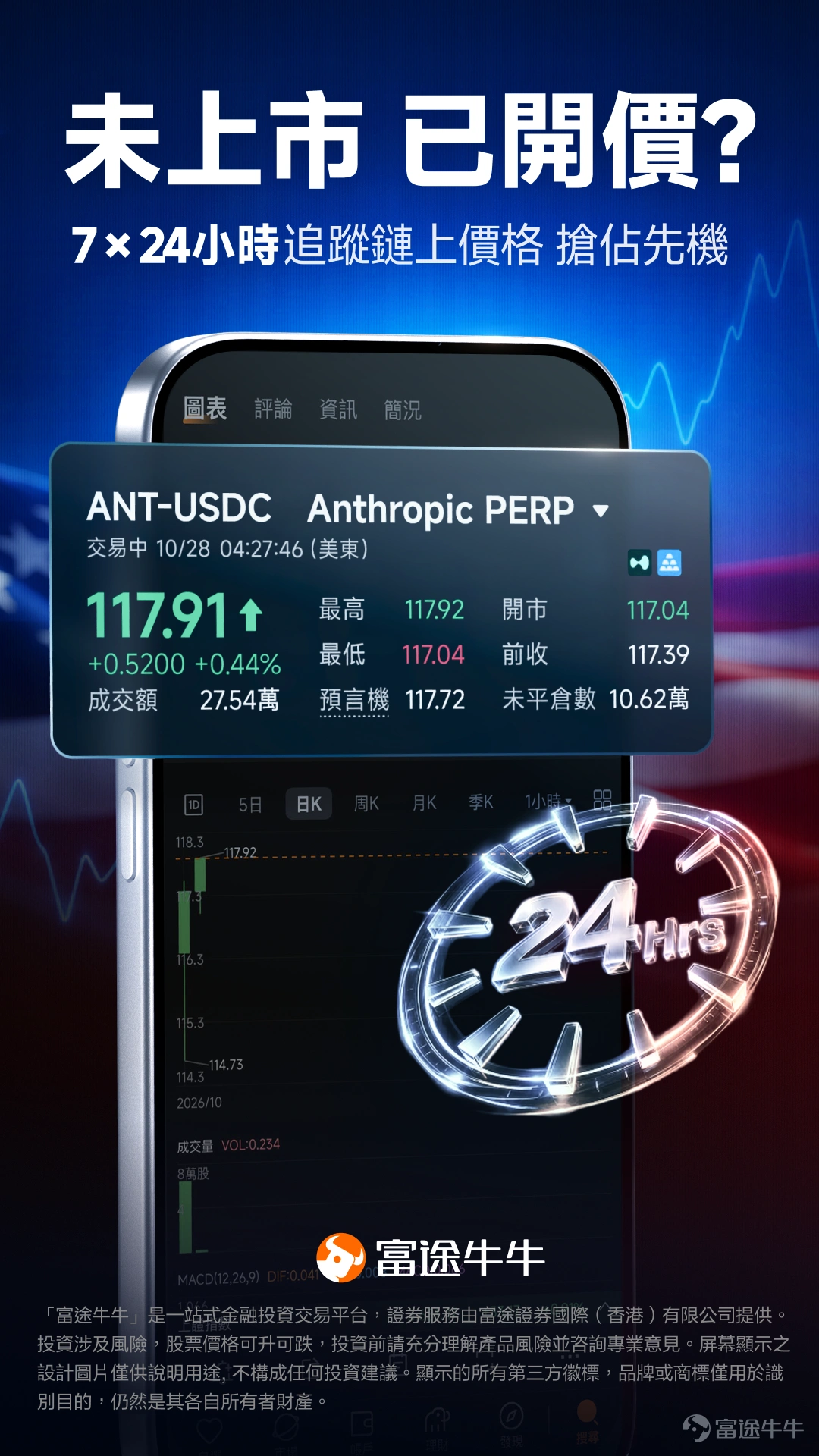
Not yet listed, but already priced? Track on-chain prices 24/7 to capture potential opportunities ahead of the curve
Monitor on-chain price fluctuations, market sentiment, and trading trends in real-time before listing, allowing you to capture signals earlier before market attention heats up.
Path:Go to the [Pre-IPO Company Quote Page, e.g., [ANT] > [Anthropic PERP]] or directly enter [ANT-USDC]
Risk Disclaimer: The above content only represents the author's view. It does not represent any position or investment advice of Futu. Futu makes no representation or warranty.Read more


Comments (8)
to post a comment
9
14