

US Data Center Construction Hits the Brakes: An AI Race Rewritten by Power and Votes
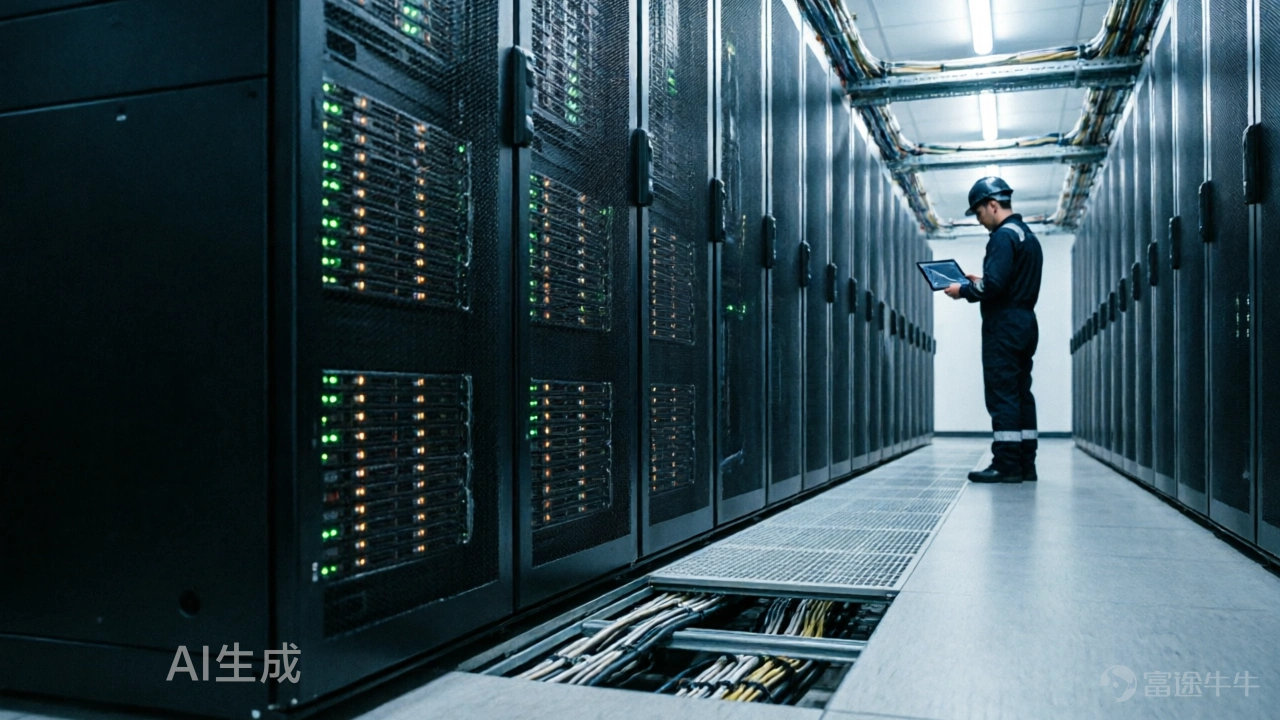
Over the past two years, the scarcest resource in the AI industry was chips; starting in the autumn of 2026, the answer has shifted to electricity and votes.
On the night of the US midterm elections in early November, a rare event occurred: for the first time, data centers became a major national campaign issue on a large scale. Of the 41 local ballot measures directly related to data centers, all 27 restrictive proposals were approved, while all 13 pro-development proposals were rejected. The industry secured only one victory in Harwood, North Dakota. The capital markets reacted swiftly and severely: on November 5, the Philadelphia Semiconductor Index plunged 12.25%, marking its largest single-day drop since March 2020. On the same day,NasdaqThe index fell 5.5%, with the market capitalization of the so-called "Magnificent Seven" evaporating by approximately $1 trillion in a single day.
The market's sharp reaction easily brings to mind the common narrative of an "AI bubble burst." However, taking a broader view reveals another thread: this is not merely a valuation correction, but the first time AI infrastructure expansion has simultaneously hit triple constraints from power supply, public sentiment, and cash flow.
AI rack power consumption is a full order of magnitude higher than traditional workloads: a single AI training rack consumes over 30 to 100 kilowatts, whereas traditional server racks typically consume only 5 to 15 kilowatts. The International Energy Agency (IEA) estimates that global data center electricity consumption will more than double by 2030, reaching approximately 945 terawatt-hours, slightly exceeding Japan's current annual electricity consumption. In the United States, data centers will account for nearly half of the growth in electricity demand over the same period.
The problem lies in the mismatch: the chip industry iterates at the pace of Moore's Law, while the power system expands at the pace of infrastructure development.Delivery lead times for critical grid components such as transformers and cables have doubled over the past three years.By 2026, delivery cycles for substation transformers are generally over three years, while building new transmission lines often takes several years.
This speed gap is directly reflected on project balance sheets:MicrosoftNadella confirmed during the earnings call that part of the $80 billion backlog in Azure orders is due to an inability to deliver caused by power shortages. The scale of the supply-demand gap is significant: industry estimates suggest US data center demand will reach 75 gigawatts by 2030, while committed supply stands at only 58 gigawatts, leaving a shortfall of 17 gigawatts. This indicates that the power issue is not a failure in any single link, but a systemic bottleneck spanning the entire chain of power generation, transmission, and distribution.
An easily overlooked detail is the efficiency paradox. Google disclosed that the median energy consumption per Gemini text prompt has dropped 33-fold compared to a year ago, to 0.24 watt-hours; meanwhile, its reported monthly token processing volume has surged from 480 trillion at the 2025 I/O conference to over 3,200 trillion at the 2026 I/O conference.The cost per inference has dropped, yet total demand has actually increased.This is a replay of Jevons paradox in the computing power sector.
Relying on technological progress to automatically resolve the electricity shortfall appears unrealistic at present. In fact, efficiency gains affect unit costs rather than the overall demand curve; as costs decline, previously uneconomical use cases are activated, accelerating demand release. The key to judging whether this expansion cycle has bottomed out lies not in energy efficiency metrics, but in the speed at which the supply-demand gap converges.
If the electricity shortfall is a technical issue, community opposition is turning it into a political one.
The reasons for opposition are clearly ranked: rising electricity bills, noise pollution, and strain on public infrastructure, with electricity costs being the primary concern.
Under current US electricity regulations, grid expansion costs are shared by all users within the region, meaning the costs of computing power expansion ultimately appear on household electricity bills. PJM Interconnection's capacity auction prices rose from $28.92 per megawatt-day to $269.92, with estimates indicating that approximately 63% of this increase was driven by computing demand.When costs are deducted directly on a monthly basis, voters naturally use their ballots to reclaim pricing power.According to statistics from research firm DataCenterWatch, the number of active groups opposing data centers in the US increased from 396 at the end of 2025 to 833 in the first quarter of 2026, spread across 49 states. In the first quarter alone, at least 75 projects involving approximately $130 billion in investment were blocked or delayed, matching the total for the entire year of 2025.
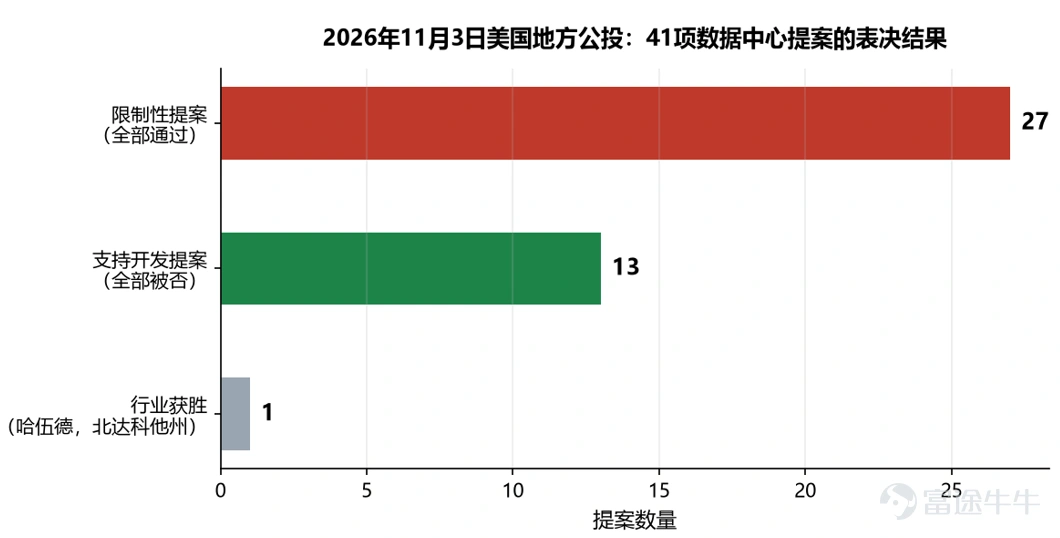
Voting results for data center-related proposals in US local referendums on November 3, 2026 (Source: Ballotpedia, CNBC; under another statistical methodology, 44 out of 45 items leaned towards restrictions).
The significance of this referendum result lies in its establishment ofthe precedent that community veto power can overturn capital budgets.Ohio was the focal point of this round, with 18 municipalities voting on 21 measures. The results overwhelmingly favored restrictions, with local media vote counts showing that most restrictive measures gained support from more than two-thirds of voters. A Gallup poll from March 2026 showed that 71% of Americans oppose building AI data centers near their residences, with 48% strongly opposed, a sentiment that crosses party lines. NBC exit polls on Election Day, November 3, put this figure at 76%. Voters are opposing data centers, not AI itself; residents do not reject the technology but are unwilling to bear its costs alone.
Institutional contraction is unfolding simultaneously. Since November, community resistance has escalated from scattered complaints to organized, institutionalized force. New York State has taken the lead by implementing a statewide moratorium on facilities exceeding 50 megawatts; as of early November, 46 states had introduced related restrictive measures.Goldman SachsEstimates suggest that states facing potential policy constraints account for approximately 45% of planned data center capacity nationwide, with Texas being the largest concentration, representing about one-fifth of the national planned capacity.The focus of the debate is shifting from whether to build to who pays and how compensation is handled.
Faced with grid interconnection queues, hyperscale cloud providers are turning to self-powered solutions, with nuclear energy being the most favored option. A report released by the International Energy Agency (IEA) in late October pointed out that major global computing markets are generally experiencing an 'queue inflation' in grid access applications, with the cumulative capacity of projects awaiting connection in multiple regions exceeding the local existing system's peak load. The IEA estimates that if data center electricity usage is restricted during periods of power tightness, an additional 750 to 900 gigawatts of grid carrying capacity could be released globally (IEA report 'Powering AI').
Microsoft signed a 20-year power purchase agreement with Constellation Energy to restart Unit 1 at Three Mile Island,with its 835-megawatt capacity expected to reconnect to the grid in 2027. Google has committed to purchasing up to 500 megawatts from Kairos Power's small modular reactors (SMRs). Meta has reached agreements totaling up to 6.6 gigawatts with Vistra, TerraPower, and Oklo, including a 20-year power purchase agreement with Vistra covering two operating nuclear plants. The total nuclear cooperation announced by various vendors amounts to approximately 10 gigawatts. The Palisades Nuclear Plant in Michigan has already reconnected to the grid, becoming the first restarted operating unit in the US, and together with Three Mile Island, which is scheduled to reconnect in 2027, constitutes the main force of this wave of nuclear restarts.
However, nuclear power faces a timing mismatch: Small Modular Reactors (SMRs) will not reach scale for power supply until the 2030s. Before the end of this decade, the only viable option to truly meet data center demand is restarting existing nuclear units. The task of filling the gap has fallen to natural gas. A July report by the environmental organization Environmental Integrity Project stated that at least 74 behind-the-meter natural gas power plants dedicated to data centers have been planned in the US, with a combined capacity of approximately 143 gigawatts. Once operational, these plants will emit 662 million tons of greenhouse gases annually, roughly equivalent to adding 140 million cars to the road.
Nuclear power is the long-term solution, while natural gas represents the transitional cost; the window for bridging the two is precisely 2027 to 2030. The risks during this window are equally evident: if nuclear deployment falls short of expectations and gas-fired units are slowed down by environmental pressures, the electricity shortfall will widen further. This would force data center construction cycles to synchronize with grid investment cycles, a scenario all cloud providers wish to avoid.
Constraints from power availability and public sentiment will ultimately transmit through to financial statements.

The Q3 earnings reports have already sent signals:Alphabet's quarterly capital expenditure surged 114% year-over-year to $51.4 billion, turning its free cash flow negative to -$9.1 billion; Meta's free cash flow also turned negative, and it announced a stock issuance of up to $95 billion;AmazonThe trailing 12-month free cash flow deficit widened to $42.4 billion. Among the five major tech giants, only Microsoft maintained positive cash flow.
The market is also re-pricing risk: Microsoft announced pre-market that it is lowering its 2026 capital expenditure guidance by $5 billion to approximately $170 billion and is reviewing and exiting several third-party computing projects. The primary market is tightening simultaneously; OpenAI reduced its latest fundraising target from $30 billion to $20 billion, with its target valuation dropping from $1.4 trillion to $1.25 trillion. Rating agencies are also shifting stance, with S&P downgrading Meta's rating outlook to negative. The phase of funding infrastructure through operating cash flow has ended, and the era of financing-supported growth has begun. According toMorgan Stanleyestimates, AI-related companies issued approximately $466 billion in bonds this year, far exceeding the ~$101 billion issued during the same period in 2025.
As financing structures such as bond issuances, secondary offerings, SPVs, and lease commitments are rolled out one by one, the market is beginning to ask the same question: Where exactly are the payback periods for these investments?
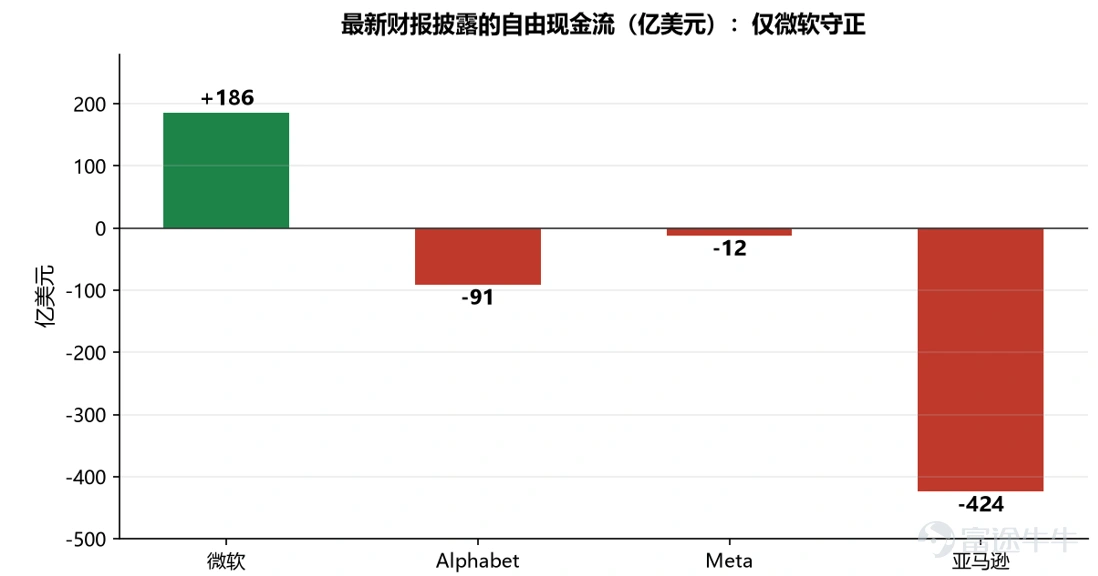
Free cash flow of hyperscale cloud providers disclosed in the latest financial reports (in USD hundreds of millions). Note: Amazon’s figures are based on a rolling 12-month period (Source: Company financial reports, Nomura Securities).
At this rate of cash burn, a slowdown in construction may not necessarily be a bad thing.
Capital expenditure plans for hyperscale cloud providers in 2026 have been raised to approximately $800 billion (Goldman Sachs estimate), nearly doubling from the roughly $410 billion projected for 2025. On a global basis, the International Energy Agency’s statistics show spending surpassing $700 billion for the first time. If expansion continues at this trajectory, the financing cliff and inflationary pressures will only intensify. Constraints have effectively acted as a speed governor: the triple restrictions of politics, power supply, and financing are spreading investments over more years, turning what could have been a stall-and-turn scenario into a controlled descent, thereby buying time for the monetization of AI applications.
Data centers are inherently capital-intensive assets requiring long payback periods; building them more slowly does not alter their economic model. More importantly, slowing down mitigates two risks previously masked by high growth: first, it avoids oversupply of computing power before demand matures; second, it allows time for supporting infrastructure such as power grids and nuclear energy to catch up, enabling a smoother intersection of supply and demand curves.
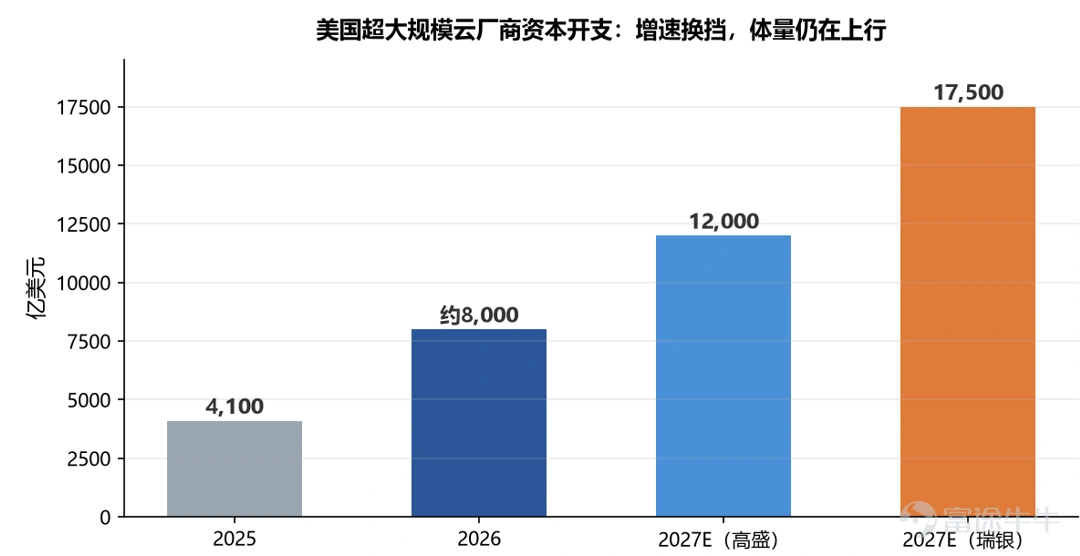
Capital expenditure scale of US hyperscale cloud providers and institutional forecasts for 2027 (Sources: Company disclosures, Goldman Sachs, UBS Group; 2026 figures are approximate estimates based on Goldman Sachs methodology).
Zooming out, China and the US are answering the same question in two different ways.
The US relies on voting and market dynamics, where costs are priced through the repeated tug-of-war between capital and public sentiment. China follows an administrative planning route: four departments, including the National Development and Reform Commission, require that new data centers at national hub nodes derive over 80% of their power from green energy. The China Electricity Council expects national computing power electricity consumption to reach approximately 800 billion kWh by 2030, accounting for about 6% of total societal electricity usage. CGN Power has already secured green energy cooperation agreements exceeding 3 billion kWh with companies like Huawei and Tencent. The efficiency and costs of these two approaches will determine the future direction of the global computing power landscape in the coming years.
Considering both constraints and funding as key threads, there are roughly three possible scenarios for the trend in 2027.
The base case scenario is an orderly slowdown.Goldman Sachs forecasts that the growth rate of capital expenditure will decline from nearly 100% in 2026 to 54% in 2027 and 12% in 2028. While total investment volume continues to climb (reaching approximately $1.2 trillion in 2027), the slope is clearly flattening. In the upside scenario, monetization catches up, with AI revenue growth outpacing the contraction in capital expenditure, creating a positive feedback loop. In the downside scenario, key pillars collapse. Since AI infrastructure currently represents the largest single incremental contributor to fixed investment by US corporations, a sharp deceleration rather than a gradual slowdown in capital expenditure would cause the economy to lose its most critical source of new demand.
Policy signals are also emerging: The US Senate has held a procedural vote on a bill requiring new data centers to bear the cost of additional grid capacity. Once enacted, the internalization of these costs will further raise the barrier to expansion. To determine which scenario plays out, it suffices to monitor two key metrics:If the annualized growth rate of power demand for US data centers falls below 5%, the 'constraint thesis' is disproven; if the growth rate of AI capital expenditure slips below 25%, the probability of the downside scenario rises significantly.
In 2027, hard indicators that can be verified on a quarterly basis include whether the electricity shortfall for US data centers narrows or widens, and whether the growth rate of AI capital expenditure stands at 54% or 12%.There is no pause button in the AI race; only the scoring method has changed. The decisive factors in the second half lie in power plants, communities, and balance sheets, not in GPUs. (First published on TMTPost APP, Author | Silicon Valley Tech-news, Editor | Jiao Yan)
Risk Disclaimer: The above content only represents the author's view. It does not represent any position or investment advice of Futu. Futu makes no representation or warranty.Read more
Comments
to post a comment